Cloud Mining vs Buying Your Own ASIC Miner — Detailed Cost Breakdown
Full 24-month P&L comparing owning an Antminer S21 Pro vs renting cloud hashrate — hardware depreciation, resale value, and real numbers for April 2026.

Buying an Antminer S21 Pro in April 2026 costs about $3,500 up front — but over 24 months the real bill is closer to $6,000 once you add hosting, electricity, maintenance, and the resale loss when the S23 generation lands. A 24-month NoxHash Pro Miner rental, by contrast, lists at $1,920 with a 20% long-term discount. This article walks the ASIC ownership P&L end-to-end and shows exactly when owning the box still beats renting the hashrate.
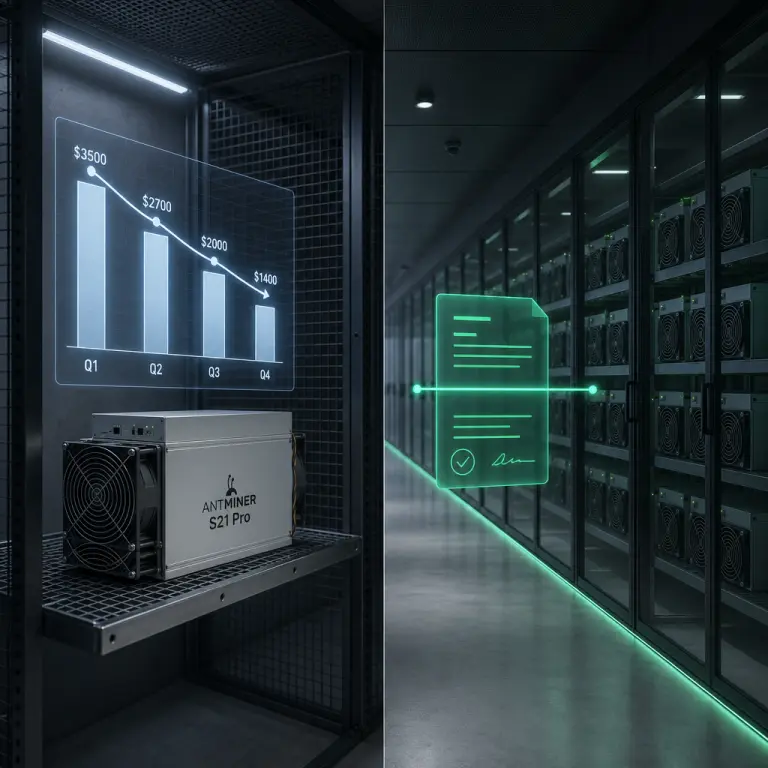
ASIC Ownership Is Four Bills, Not One
Most people planning to buy an ASIC budget only the sticker price. The truth is that an owned miner generates four parallel cost streams every month you run it — and ignoring any one of them will make the P&L lie to you. Here's the anatomy of what you're actually signing up for when you swipe the card on a $3,500 Antminer S21 Pro.
1. The hardware itself
A new S21 Pro 234 TH/s runs about $3,500 street price in April 2026, plus $80–150 shipping and often a 240 V PSU rail upgrade if you don't already have one. Used S21 Pro units sit around $1,500 on marketplaces like Compass Mining — a 57% drop from new in roughly 12 months.
2. Power — the obvious one
A 3,510 W S21 Pro running 24/7 consumes roughly 2,527 kWh per month. Even at a good hosted rate of $0.07/kWh you're paying $177/month; at $0.05/kWh industrial you're at $126/month. Power is the single largest variable in the ownership math.
3. Hosting or housing
If you don't have a soundproofed outbuilding, you're using a third-party host. Hosting in the US runs $10–15 per month per kW, so a 3.5 kW S21 Pro adds $35–52/month in racking, cooling, and remote-hands fees. In-home "closet" setups avoid this but add other problems (heat, noise, insurance).
4. Depreciation — the invisible one
The bill nobody writes a check for — but the biggest over 24 months. A new-gen Antminer typically loses about 50% of its resale value per 12 months as successor models ship. On a $3,500 unit that's a silent ~$145/month of wealth evaporating while the fans still spin normally.
Add the four streams honestly and an owned S21 Pro costs the owner roughly $450–600 per month of real economic spend (power + hosting + amortized hardware + depreciation). The mining revenue has to clear that bar before it touches a single dollar of profit. That's the math most "free calculator" sites skip.
The S21 Depreciation Curve — 2024 to 2026
ASIC miners depreciate on a fairly predictable curve. Each generation holds premium value for about 6 months after launch, then slides roughly 40–55% over the following 12 months as successors arrive and network difficulty rises. Here's what a new-in-box Antminer S21 Pro has actually done in the secondary market since launch, based on Hashrate Index ASIC Price Index tracking and current retailer listings.
| Quarter | Market condition | S21 Pro street price | % of launch MSRP |
|---|---|---|---|
| Q2 2024 (launch) | Pre-halving euphoria, stock limited | ~$6,500 new | 100% |
| Q4 2024 | Post-halving difficulty adjustment | ~$5,000 new | ~77% |
| Q2 2025 | S21 XP wide availability | ~$4,000 new / $2,800 used | ~62% / 43% |
| Q4 2025 | S23 pre-announcement rumors | ~$3,800 new / $2,000 used | ~58% / 31% |
| Q2 2026 (today) | S23 shipping to hyperscalers | ~$3,500 new / $1,500 used | ~54% / 23% |
| Q2 2027 (projected) | S23 retail availability, sub-10 J/TH on horizon | ~$1,800 used | ~28% |
Two things to notice. First, a used S21 Pro today sells for roughly $1,500 — less than half of the $3,500 new-unit cost. If you buy today and resell in 12 months, you should budget a further 40–50% loss on top of that. Second, the depreciation is not linear — it accelerates around the 18-month mark as the successor generation (S23) starts shipping to industrial buyers and siphons resale demand away from the older tier.
24-Month P&L — Owning an S21 Pro vs Renting Cloud Hashrate
Here's the side-by-side spreadsheet everybody should see before clicking "Buy Now" on a mining retailer. Both columns produce a similar ~234 TH/s of SHA-256 hashrate over 24 months. The only difference is who owns the depreciating asset — you, or the operator.
| Line item (24 months) | Own: S21 Pro + third-party hosting | Rent: NoxHash Pro Miner (24-mo term) |
|---|---|---|
| Hardware purchase | $3,500 (S21 Pro new) | $0 |
| Shipping + PSU/PDU setup | ~$200 | $0 |
| Electricity (2,527 kWh/mo × $0.07/kWh hosted × 24) | ~$4,245 | Included in rental |
| Hosting / racking fee ($45/mo × 24) | ~$1,080 | Included |
| Maintenance / failure allowance (~7% annual) | ~$500 | Included — 4–8h replacement SLA |
| Rental fee ($100 × 0.80 discount × 24) | — | $1,920 |
| Residual resale value at month 24 | +$800 (used S21 Pro, projected) | $0 — no asset to sell |
| Total net 24-month cost | ~$8,725 | ~$1,920 |
The ownership column ends up roughly 4.5× more expensive in raw cost over the same 24 months — before any mining revenue arrives. The argument for owning has to be that the owned S21 Pro's BTC output exceeds the rental by at least that gap, because both options earn BTC from the same network at the same difficulty. Industrial operators close the gap through cheaper power ($0.035/kWh vs your $0.07) and bulk hardware pricing. For a single household rig, the gap rarely closes.
One honest caveat: the mining revenue is identical per TH/s on either side. So if you mine the same 234 TH/s and earn, say, $140/month in BTC under April 2026 conditions, you collect $3,360 across 24 months either way. The question is purely which cost structure is cheaper — and at $0.07/kWh hosted power, it's cloud by a wide margin.
Skip the $3,500 hardware gamble — lock the 24-month rate instead
If the P&L above made ownership look like a capital-heavy way to arrive at the same BTC output, NoxHash's Pro Miner tier on a 24-month term is the direct alternative: $100/month list × 20% long-term discount = $80/month, everything included, same S21-class fleet referenced in this article.
The Resale Market Is Thinner Than You Think
The ownership case rests heavily on that residual resale value at month 24. Spreadsheet optimists pencil in "$800 resale" and move on. In practice, the used-ASIC market has three uncomfortable features the spreadsheet doesn't show you.
First, time on market is long. Used S21-class rigs typically sit 4–10 weeks before clearing at asking price. If you need liquidity quickly you'll knock another 15–25% off just to find a buyer this week. The "$1,500 used" number on Compass Mining or eBay listings is the ask — actual clearing prices run lower, and buyers expect negotiation room.
Second, the buyer pool is shrinking. Industrial operators almost never buy used single-digit quantities — they buy pallets directly from manufacturers at 15–25% below retail. That leaves the used market to hobbyists, small farms, and overseas buyers. When the S23 generation expands availability through 2026 into 2027, that hobbyist pool is the first to evaporate, because they'd rather borrow or wait for the next generation's used prices.
Third, sold-as-is risk is real. ASIC hashboards are the most common failure point, and a dead hashboard drops a unit's effective value by roughly one-third (an S21 Pro with 2 of 3 boards still alive is worth about two-thirds of a fully working unit). Buyers test aggressively. If your rig has even one weak board, that's a 15–30% haircut on clearing price on top of everything else.
Net effect: the "$800 residual" line in our P&L table is already optimistic. A more conservative figure in a soft market is $400–600, which pushes the real 24-month ownership cost closer to $9,000 rather than $8,700. That's a meaningful difference when you're trying to justify the extra $7,000 premium over cloud.
If You Do Buy — Hosting Options and Their Hidden Costs
This article assumes you're not running the ASIC in your living room, because nobody survives a 75 dB appliance there for long. That leaves four realistic places to put it, each with a different cost profile. Here's how they actually shake out in 2026 pricing.
| Option | All-in $/kWh equivalent | Monthly total (3.5 kW S21 Pro) | Hassle level |
|---|---|---|---|
| Home garage / shed | $0.08–0.18 (residential) | ~$200–455 in power alone | High — DIY everything |
| Small hosting provider (US) | ~$0.075 all-in | ~$190/month | Medium — ship + deposit |
| Marketplace hosting (Compass etc.) | ~$0.065 all-in | ~$165/month | Medium — waitlists common |
| Overseas industrial (Paraguay, Kazakhstan) | ~$0.05 all-in | ~$126/month | High — shipping, customs, trust |
Even the cheapest realistic hosted option for a single-unit retail buyer — roughly $0.065/kWh all-in on a marketplace — puts you at $165/month in operating cost before depreciation. Over 24 months that's $3,960. Add the $3,500 purchase and $200 setup, subtract a $600 realistic resale, and the all-in comes to about $7,060 — still more than 3.5× the $1,920 NoxHash 24-month rental.
There's also a softer cost nobody lists: your time. Coordinating shipping, setting up a hosting contract, handling a failed PSU swap, signing for a replacement PDU — realistically 8–15 hours of personal logistics per year per rig. If you value your time at any meaningful rate, add another $200–500 to the ownership column.
Obsolescence Risk — What the S23 Does to Your S21
Bitmain's roadmap, as tracked by ASIC Miner Value and mining-industry reporting through 2026, points toward the S23 generation reaching hyperscaler-only allocations in 2026 and wider availability in 2027. The S23 is expected to hit the sub-11 J/TH efficiency range (vs the S21 Pro's 15 J/TH), which is a roughly 25–30% step-change in energy efficiency.
Here's what that means for someone holding an S21 Pro through 2026 into 2027:
Difficulty climbs as S23 fleets come online
Every large S23 deployment adds hashrate to the network. As total hashrate rises, every existing S21 earns proportionally less BTC per day, even with no change in the machine itself. This is the "silent headwind" that compounds with resale depreciation.
Resale demand evaporates for the previous generation
Buyers who would have taken a used S21 Pro in 2025 start waiting for used S23s in 2027. This is exactly what happened to the S19 generation when the S21 launched — S19 Pro resale prices dropped below $400 inside 18 months from a $10,000 launch MSRP.
Shutdown price creeps upward
An ASIC's "shutdown price" is the BTC price below which its electricity cost exceeds its mining revenue. As difficulty rises, the shutdown price for older-generation machines creeps up. A 17.5 J/TH rig at $0.10/kWh may have a shutdown price near current BTC levels by late 2026 — meaning any sharp BTC drawdown flips it to loss-making.
Cloud operators rotate hardware for you
This is the operational advantage a rental has that ownership structurally can't match. A cloud operator running a fleet replaces S21s with S23s on its own capex schedule. The renter keeps getting fresh hashrate at the same contract price; the owner keeps the ageing box until they eat the resale loss.
Summed up: owning an S21 Pro in April 2026 means betting that BTC price appreciation outpaces a 50%+ hardware depreciation curve plus rising difficulty. That's a defensible bet, but it's a directional bet on BTC and a bet against the hardware cycle. Renting separates the two — you still carry BTC price risk, but not the hardware risk.
Test the rental side before committing $3,500 to a depreciating box
If the depreciation curve and S23 obsolescence timing are making you hesitate, NoxHash's 2-day free Basic Miner trial lets you confirm the infrastructure is real — same Kazakhstan fleet referenced throughout this article, no deposit required. If the math still favours owning after that, at least you'll have tested both sides.
Frequently Asked Questions
How much does an Antminer S21 Pro actually cost in April 2026?
New S21 Pro units (234 TH/s, 3,510 W) sell for about $3,500 in April 2026 through major retailers like Compass Mining and CryptoMinerBros, plus $80–150 shipping. Used units run roughly $1,500 on the secondary market — a ~57% drop from new in roughly 12 months. Prices drift lower as the S23 generation expands availability.
How much does an ASIC miner lose in value per year?
A new-generation Bitcoin ASIC typically loses 40–55% of resale value in the 12 months after launch, and another 30–45% in the following year as the successor ships. An S21 Pro that retailed near $6,500 at Q2 2024 launch sells used for about $1,500 today — a ~77% nominal decline over 24 months.
At what electricity rate does owning an S21 Pro beat cloud mining?
Roughly $0.06/kWh all-in. Below that — hydro regions, industrial tariffs, solar with net metering — owning an S21 Pro can outperform a 24-month rental on pure cost per TH/s. Above $0.06/kWh the rental wins once depreciation and hardware risk are counted honestly. Most residential power globally sits at $0.10/kWh or higher.
Can I recover my investment by reselling the ASIC at month 24?
Expect to recover 15–25% of the purchase price in realistic clearing terms — roughly $500–800 on a $3,500 S21 Pro bought today. Used-ASIC sales take 4–10 weeks, buyers discount any hashboard concerns sharply, and the pool of retail buyers shrinks as the successor generation ships. Plan conservatively.
What's the hardware failure rate on a home-hosted ASIC?
Roughly 5–10% of units experience a hashboard, fan, or PSU failure in a given year under decent conditions. In harsher conditions — poor airflow, high ambient temperature, dusty environments — that rate can climb past 15%. A failed hashboard alone cuts the unit's effective hashrate by one-third and its resale value proportionally.
When is the S23 expected, and will it kill S21 resale value?
Industry reporting points to S23-tier hardware shipping to hyperscalers through 2026 and reaching wider retail availability in 2027, at a 25–30% efficiency improvement over the S21 Pro. Based on the S19 → S21 pattern, S21 Pro resale will likely lose another 40–50% once S23 retail volume ramps up. Position accordingly.
Is cloud mining always cheaper than owning the hardware?
Not always. Owners with sub-$0.06/kWh electricity, dedicated infrastructure, technical skill, and willingness to operate as a small business still beat rentals on pure cost per TH/s. For everyone else — hosted or apartment-bound, paying retail power, lacking time to manage hardware — cloud rental usually wins on risk-adjusted return across 24 months.
Educational content — not financial advice
This article is for education. Hardware prices, hosting rates, resale projections, depreciation curves, and efficiency figures reflect public market data as of April 2026 and will change as the S23 generation ships and network difficulty evolves. Bitcoin mining profitability depends on BTC price, difficulty, electricity cost, and hardware lifecycle — all of which move independently and outside any operator's control. Past results do not guarantee future performance. Verify local legal, tax, and import-duty treatment before purchasing mining hardware, and only commit funds you can afford to lose.