Common Crypto Scams Targeting Miners — How to Stay Safe
The 6 scam patterns specifically aimed at Bitcoin miners — fake upgrades, pool hijacks, fake support, SIM swaps, giveaway traps, and how to spot each one.
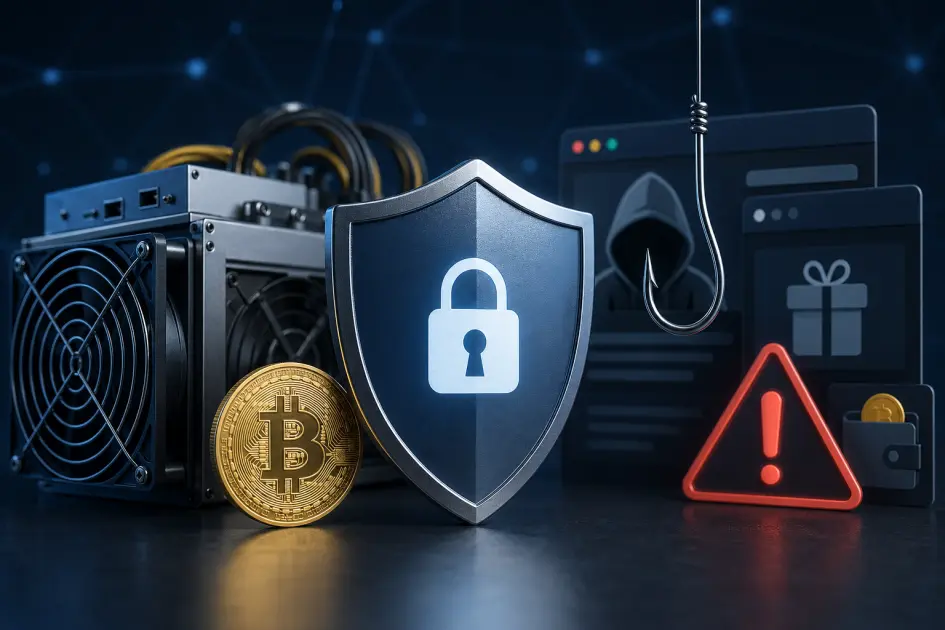
Crypto scams targeting miners are fraud attempts aimed at people who already hold Bitcoin mining accounts and recurring BTC payouts. Unlike scams that trick newcomers into fake platforms, these six patterns — fake firmware, pool hijacks, impersonated support, SIM swaps, payout-doubling traps, and recovery-service fraud — go after miners because they are identifiable crypto holders.

Why miners are targeted specifically
Once you are identifiable as a miner, you become a high-value target. Scammers know you have a platform account, a recurring stream of BTC payouts, and — usually — a public footprint somewhere. You post a hashrate screenshot on Twitter/X. You ask a question on Reddit r/BitcoinMining. Your wallet clusters are visible on the public chain. A KYC data leak at an unrelated exchange exposes your email. Any one of these is enough.
What makes miners different from regular crypto holders is predictability. A random HODLer might move coins once a year. A miner has a monthly BTC inflow, checks the dashboard weekly, and tends to have 2FA, a hardware wallet, and a familiar set of tools — all of which scammers learn to mimic. The six patterns below are not hypothetical. They are reported routinely on IC3.gov (the FBI Internet Crime Complaint Center), in mining subreddits, and in hardware-wallet community threads.
1. Fake miner firmware
"Free firmware boosts your S21 hashrate 20%" — actually malware that steals wallet files or redirects hashrate.
2. Pool redirect / stratum hijack
Attacker alters your miner config to point at their pool, quietly siphoning hashrate for days.
3. Fake support contact
Impersonated "NoxHash support" via Telegram, email or phone asks for your seed, password, or 2FA code.
4. SIM swap
Carrier ports your number to the attacker's SIM so they can receive your SMS 2FA codes.
5. "Double your payout" traps
"Send BTC to this address for a mining boost and we'll double it" — classic advance-fee fraud.
6. Recovery / tax scams
"We can recover your stolen crypto" or "settle your mining tax amnesty" — second-wave fraud after any loss.
Scam pattern #1 — Fake miner firmware and upgrade packages
The pitch is irresistible: "Flash this firmware and your Antminer S21 will run 20% faster." The download lives on a site that looks almost like Bitmain's, maybe bitmain-firmware.net instead of the real bitmain.com. Sometimes it is posted in a Telegram mining group by a user who joined yesterday. The package installs, the screen shows a progress bar, and it appears to work.
In reality, the firmware does one of two things. It scans the miner and any attached drive for wallet files (wallet.dat, Electrum seeds, browser-stored exchange sessions) and exfiltrates them. Or it silently rewrites the miner's stratum URL so the hashrate you paid for is now going to the attacker's pool. You still see fans spinning. The dashboard just gets quieter.
Defense. Firmware for Antminer, WhatsMiner, and every other major ASIC only from the manufacturer's official site — typed into the address bar, not clicked from a message. Verify the SHA-256 checksum published on the vendor site against the file you downloaded. Never flash firmware recommended in a DM or forum post, regardless of how many upvotes the comment has. If you run hosted hardware through a platform like NoxHash, you do not flash firmware at all — the operator handles it, which removes this entire attack surface.
Scam pattern #2 — Pool redirect and stratum hijacking
Every ASIC miner points at a stratum URL that tells it where to submit shares. Change that one line in the config, and every joule of electricity you pay for mines for somebody else. Attackers get there two ways. Technical: they compromise the miner's web UI (default credentials are still shockingly common) or breach a home network and rewrite the config. Social: they email you as "pool support" claiming you need to migrate to a new endpoint "for better payouts", and you paste their URL yourself.
The sneaky part is the detection lag. Your miner is still hashing, still warm, still showing work being done. But the rewards are going to the attacker's address. Depending on how often you check payouts, you can lose days — sometimes weeks — before noticing the dashboard drift.
Defense. Write down your real pool address and check the miner's config against it monthly. Set alerts for unexplained hashrate drops or missed payout windows. Change the miner's admin password from default immediately. For NoxHash tenants this is again abstracted away — your stratum targets are managed inside our infrastructure and not exposed as a line you can be tricked into editing. But the general principle applies everywhere: payout consistency is your tripwire, so monitor it.
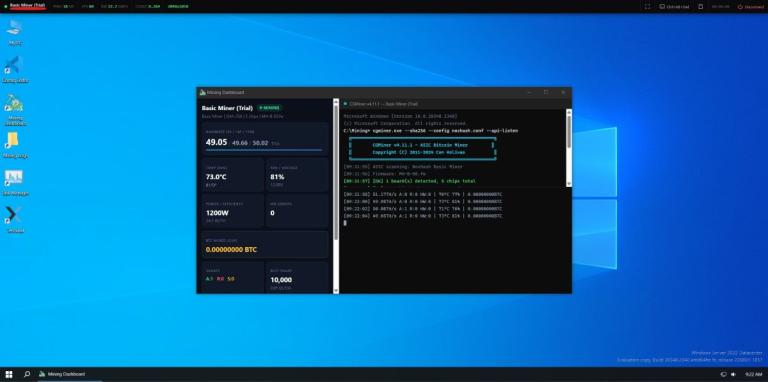
Scam pattern #3 — Fake NoxHash support contact
This is the most common scam by volume, and it is devastating because it weaponizes the one instinct you have been trained to follow: when there is a problem, talk to support. You get a message — email, Telegram DM, Discord ping, sometimes an actual phone call — from someone using the NoxHash name, logo, and a plausible ticket number. "We've flagged unusual activity on your miner. Please verify your account by confirming your 2FA code / seed phrase / password."
Real platforms do not ask for those things. Ever. NoxHash's policy is specific and worth memorizing: we contact you only from our official domain, we never ask for your seed phrase, password, recovery codes, or 2FA code, and we do not initiate contact via Telegram DM or social-media private messages. Community chat rooms have impostors; the official support channel is the logged-in help panel on the platform itself.
Defense. If you receive any inbound message that appears to be from NoxHash support, assume it is fake until you verify it by opening the platform yourself and checking the in-app inbox. Report impersonation. Never give a seed phrase or password to anyone, including someone wearing the right uniform.
Scam pattern #4 — SIM swap attacks
A SIM swap is when an attacker convinces your mobile carrier to port your phone number to a SIM card they control. With your number, they receive any SMS 2FA codes. With your codes, they drain exchange accounts, reset email passwords, and eventually cascade into crypto wallets. Miners are targeted because the attacker knows there is monthly BTC flow worth stealing.
The warning signs are brutal in how quickly they happen. Your phone suddenly shows "No Service" — not a dead zone, permanently. A few minutes later, password-reset emails start landing. By the time you figure out what happened, the attacker has cycled through your accounts.
Defense. Never use SMS 2FA for anything that touches crypto. NoxHash uses TOTP (Google Authenticator, Authy) — not SMS — for exactly this reason. Add a port-freeze PIN with your mobile carrier; most will offer this if you ask. Consider separating a crypto-only phone number from your primary one, never posted publicly. Treat your recovery email like a vault — its compromise is worse than losing any single wallet.
Scam pattern #5 — "Double your mining payout" giveaway traps
The pitch reads like: "Send 0.05 BTC to this address within the next hour and you will receive 0.10 BTC back. Limited-time mining pool boost. Verified users only." Sometimes it is framed as an Elon-Musk-style giveaway, sometimes as a "pool promotion", sometimes as a "Bitmain loyalty reward". The mechanics are identical: you send first, you receive nothing.
This is advance-fee fraud, one of the oldest categories on the internet, dressed in a mining jacket. No legitimate actor — not Bitmain, not Binance, not any mining pool, certainly not NoxHash — doubles BTC you send them. There is no mining physics that produces double output from an incoming deposit. The BTC goes to the attacker's wallet and is usually laundered through a mixer within hours.
Defense. If it sounds too good to be true, it is. Full stop. Block the account and report the address at chainabuse.com so other people can be warned off before they send. The "verified" blue check and the polished website are free to make; your BTC is not free to lose.
NoxHash support never asks for your seed phrase or password
If anyone claiming to be us asks for those — or for a 2FA code, or for a remote-access session — it is a scam. Report impersonation immediately through the in-app support panel on the logged-in dashboard.
Scam pattern #6 — Recovery services and fake tax settlements
Losing crypto to a scam creates a second, smaller wound that is easy to miss: you are now on a list. Scammers sell lists of victims to other scammers, and the second wave arrives with tailored pitches. "We specialize in recovering stolen cryptocurrency. Pay $500 upfront and we will trace your funds." Or: "IRS mining income amnesty — settle your unreported 2024 BTC earnings for a one-time fee."
Both are fake. Real crypto recovery is genuinely rare; most stolen BTC is unrecoverable once it moves through a mixer. A handful of specialized firms and blockchain forensics teams exist, but they do not DM victims unsolicited, and they do not require payment before beginning work. Real tax agencies — the IRS in the United States, HMRC in the UK, similar bodies elsewhere — contact you first through postal mail, not a Telegram message.
Defense. Treat any unsolicited "recovery" or "tax settlement" offer as a continuation of the original scam. Never pay upfront for recovery services. For real tax questions about mining income, consult a licensed CPA or tax attorney in your jurisdiction — they will have a verifiable license number and a real office.
What to do if you have been scammed
Speed matters less than you think — the BTC is usually gone within minutes — but documentation matters a lot. Work through these steps in order, not all at once.
Stop further loss immediately
Disconnect the compromised device from the network. Revoke active sessions from every exchange and platform account. Rotate every password starting with email. If a hardware wallet's seed was exposed, move remaining funds to a freshly-generated wallet before doing anything else.
Document everything
Screenshot messages, save transaction hashes, note timestamps, keep email headers. Write a chronology while it is fresh. This becomes evidence for law enforcement and is sometimes required by cyber-insurance or tax-loss claims later.
File with law enforcement
US residents: file at IC3.gov and your local FBI field office. Elsewhere: the equivalent cybercrime reporting unit (Action Fraud in the UK, BKA in Germany, ACCC Scamwatch in Australia). Even if recovery is unlikely, filings feed pattern databases that help catch rings.
Report impersonation to the platform
If the scam impersonated NoxHash, forward the message and sender details through our in-app support panel. We use those reports to chase down fake Telegram channels and spoofed domains. If a hardware wallet firm was impersonated, do the same with their official contact.
Handle the tax side
In many jurisdictions, scam losses on crypto assets can be claimed as theft or capital losses against mining income. Do not guess — talk to a licensed tax professional in your country. Do not pay anyone who contacts you unsolicited about this.
Defense mindset — four rules that cover most cases
Inbound = suspicious
If someone reaches you about your mining account, default to skeptical. Initiate support through the logged-in platform, not from the message.
Seed phrases live nowhere online
Not on your computer, not in a password manager cloud sync, not in a photo. And never given to anyone — there is no legitimate scenario where a seed phrase needs to be shared.
Urgency is a tell
"Verify in the next 15 minutes or your account will be locked." Real platforms do not operate on panic timers. If you feel rushed, that is the attack.
If it doubles money, it does not
No mechanism exists — inside Bitcoin, inside mining, inside any legitimate platform — that returns more than you send. Promises otherwise are theft with a press release.
Frequently asked questions
How do scammers find miners in the first place?
Public footprint, mostly. Hashrate screenshots on Twitter or X, posts in r/BitcoinMining, forum usernames, wallet clusters visible on-chain, and — most commonly — email addresses from unrelated data breaches. Once your email lands on a "crypto user" list, targeted phishing follows within weeks.
Are fake Ledger or Bitmain support scams real?
Yes — both are heavily impersonated. Ledger's 2020 customer-email leak created a long tail of targeted phishing that continues to this day. Bitmain and WhatsMiner customers face fake "firmware update" and "warranty" pitches constantly. Always initiate contact through the vendor's verified official channel.
Is the "mining pool boost" service actually real anywhere?
No. No mining pool multiplies BTC that you send to it. Pools pay out for hashrate submitted, not deposits received. Any pitch using the phrase "pool boost", "mining accelerator", or "hashrate multiplier" in exchange for upfront BTC is fraud — there is no legitimate exception.
What is the most common miner-targeted scam today?
Fake support impersonation by volume, SIM swap by dollar loss per incident. Impersonation is cheap and scales; SIM swap requires targeting but can clear six figures from a single victim. Both rely on urgency and social trust rather than technical exploits.
Can I get my stolen BTC back?
Rarely. Recovery happens when funds sit on an identifiable exchange and law enforcement moves fast, or when a blockchain forensics firm traces a rare technical mistake. Most stolen BTC is mixed within hours and becomes practically unrecoverable. Be deeply skeptical of anyone promising guaranteed recovery.
Does using a cloud-mining platform reduce my scam exposure?
Partially. Firmware flashes, stratum configs, and physical hardware theft are all handled by the operator — those attack surfaces go away. You still need to defend your account credentials, 2FA, email, and phone number. The scams shift rather than disappear, and the shift is usually toward impersonation and SIM swap.
Informational only — not legal, security, or investment advice
This article describes common scam patterns observed across public reporting and our own incident-response experience. It is not legal advice, security consulting, or investment guidance. Scam tactics evolve constantly — treat every inbound contact with skepticism, and consult licensed professionals (law enforcement, tax advisors, security firms) for matters specific to your situation.