Bitcoin Mining and Stranded Energy — Turning Waste Into Value
Flared gas, orphaned hydro, curtailed wind — how Bitcoin mining monetizes energy that physically can't reach other customers. Use cases and real 2026 operators.
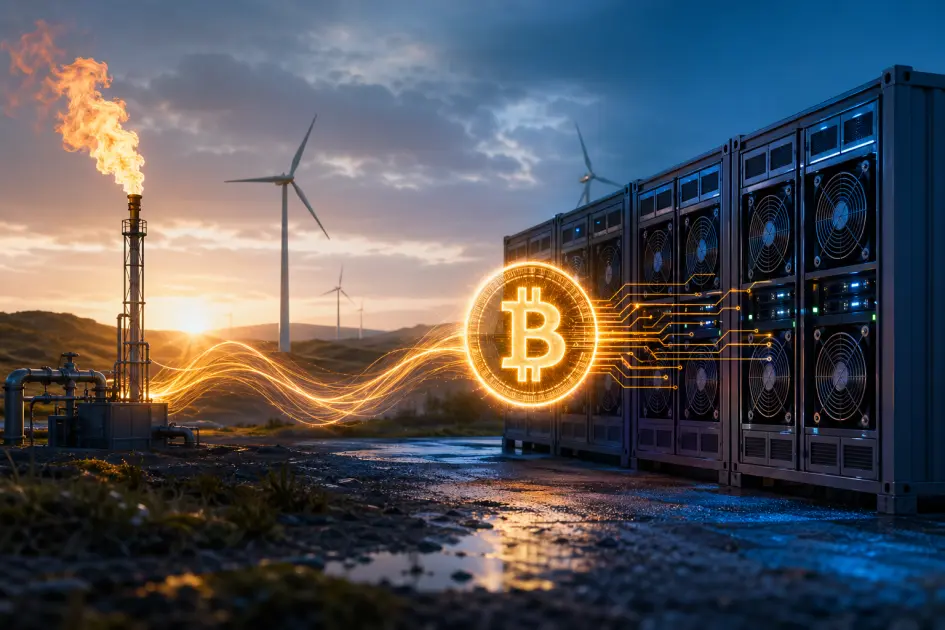
Stranded energy is electricity or fuel that gets generated but physically cannot reach paying customers — because no transmission line exists, the timing doesn't match demand, or the economics of delivery don't work. Historically, that energy is wasted: gas gets flared at oil wells, wind farms curtail at peak output, remote hydro dams run with no buyer. Bitcoin miners are unusually well-suited to absorb this waste because they are mobile, run 24/7, and don't need a grid connection to the outside world.
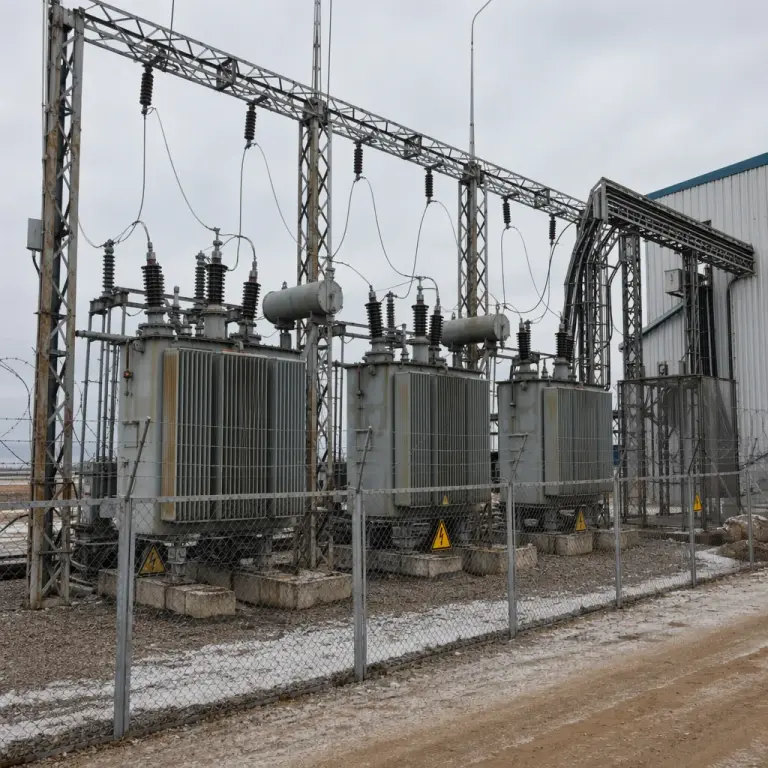
What "Stranded Energy" Actually Means
Stranded energy is energy that is generated — or could be generated cheaply — but physically cannot reach paying customers at the moment it exists. The strand, in other words, is a mismatch between a generation source and the grid of buyers that could use it. There are three typical reasons that mismatch occurs.
Reason one: no transmission infrastructure. A remote oil well, a small hydro dam in a rural valley, a geothermal vent on an isolated island. Each can produce electricity or combustible fuel right now, but there is no wire and no pipeline to carry that output to a city. Building transmission lines from a single small source is rarely economic, so the energy sits stranded at the generator.
Reason two: timing mismatch. Wind generation peaks at night when demand is low; solar peaks at midday when industrial demand may already be satisfied. If local demand doesn't exist at the moment of generation and the grid can't move the surplus elsewhere fast enough, the operator curtails — meaning they shut the turbines or inverters down and waste the output. The energy was available; nobody could use it in time.
Reason three: economic unviability. Even when transmission is theoretically possible, the cost of building lines from a remote source may exceed the revenue that source could ever generate. The energy exists and the wire could be built, but the math doesn't close. Historically, the outcome of all three cases is the same: energy is wasted or sold at a loss — if anyone pays at all.
Bitcoin miners have three structural properties that make them well-suited to absorb stranded energy. They are mobile — a containerized mining rig can be trucked to a well pad or a dam site in days. They run 24/7 at a nearly constant load, so they can absorb baseload output that no intermittent consumer would match. And they are location-agnostic — they sell their output (hashes) into a global network over a modest internet link, not into a local power grid. For stranded-energy operators, that combination is close to ideal.
Category #1 — Flared Natural Gas at Oil Wells
When an oil well is drilled, it often produces natural gas as a byproduct alongside the oil. In regions with dense pipeline networks, that gas is captured and sold. But in remote basins — West Texas's Permian, North Dakota's Bakken, parts of Alberta, and large producing areas in Nigeria — the closest pipeline may be tens or hundreds of miles away, and the volume of associated gas may not justify building one. The default industry practice in that case is to flare: burn the gas on-site in a controlled flame, venting CO2 and some unburned methane to atmosphere, with zero economic output.
The mining innovation is straightforward: put a natural-gas-fueled generator and a shipping container of ASIC miners next to the flare stack. Instead of burning the gas to nothing, burn it in a generator that produces electricity, and use that electricity to run miners. Two things happen. The gas still combusts, but more completely than open flaring — which typically reduces methane slip (unburned CH4 released into atmosphere) because gensets run hotter and more consistently than a flare tip. And the operator now earns mining revenue on energy that previously produced only emissions.
Notable operators in this space include Crusoe Energy Systems, which built its early business (2019–2023) deploying flare-gas mining across the Bakken and Permian before pivoting much of its compute capacity to AI inference workloads; JAI Energy and Upstream Data (Canadian) working well pads in Alberta and the US northern plains; and a long tail of smaller private operators serving individual well pads under contract to oil producers. The flared-gas model is the most studied and most deployed category of stranded-energy mining.
The Four Categories at a Glance
1. Flared natural gas
Associated gas at remote oil wells that would otherwise be burned to atmosphere. Operators: Crusoe (legacy mining ops), JAI Energy, Upstream Data. Largest and most mature category.
2. Orphaned hydro
Small rural dams without grid links. Operators: Gridless (East Africa mini-grids), several Paraguay projects. Clean power + community benefit, but modest scale.
3. Curtailed wind & solar
Renewables generating more than transmission can carry. Operators: Lancium (Texas, co-located with wind), similar projects in western China. Miners act as a flexible "dump load".
4. Geothermal
Baseload clean power in low-demand regions. Operators: El Salvador state miner (~1.5 MW on volcano geothermal), Kenya greenfield projects, some Iceland spillover. Smallest category by scale.
Category #2 — Orphaned Hydro in Remote Valleys
Small-scale hydroelectric dams — typically under 10 megawatts — exist all over the world in rural river valleys. Some were built to serve a nearby village; others were built decades ago and have since been partially abandoned. What they share is a lack of high-voltage transmission out. A 2 MW dam a hundred kilometers from the nearest substation simply cannot sell power into the wider grid without an uneconomic transmission build-out.
The mining fit is natural. A container of miners co-located at the dam site turns clean kilowatt-hours into hashes, with minimal infrastructure beyond a fiber or satellite link for pool communication. The energy profile is about as green as mining gets: zero direct emissions from the generation, and the alternative was curtailment or total under-utilization of an already-built asset.
Gridless is the most-cited example, operating small mini-grid projects in Kenya, Malawi, and Zambia where micro-hydro sites power both local villages and co-located mining load. Paraguay, which exports hydroelectric power from the massive Itaipu dam but has a surprising number of smaller orphaned sites in its interior, has also attracted a handful of mining operators. The unit of scale here is small — a few MW per site — so it will never dominate global hashrate, but the human-development angle (electrified rural villages funded by mining revenue) makes it one of the most defensible stranded-energy stories.

Category #3 — Curtailed Wind and Solar
Texas has built so much wind capacity in the west of the state that, at peak generation, the grid's east-to-west transmission lines physically cannot carry all of it to where demand lives. When that happens, ERCOT (the Texas grid operator) instructs wind operators to curtail — to shut down turbines that could be spinning. The energy is wasted. China's grid has similar problems in Inner Mongolia, Xinjiang, and Qinghai, where solar and wind capacity has outstripped inter-regional transmission.
Mining plays a specific role here that is different from demand-response. Demand-response is about pausing mining load during grid stress so other customers can keep power — miners act as a flexible consumer that can turn off in seconds. Curtailment absorption is the opposite: mining load turns on precisely when the grid has surplus it can't export, consuming energy that would otherwise be zero-valued. The miner acts as a local "dump load" that converts physically-unusable megawatt-hours into revenue.
Lancium is the most-cited US operator in this category, co-locating mining capacity with wind farms in west Texas specifically to soak up generation that cannot clear. The economic structure typically involves negotiated power purchase agreements at curtailment-price (very cheap or free kWh during excess periods, in exchange for a commitment to shed load during grid emergencies). This category is genuinely additive on the grid: miners are not competing with other buyers for scarce electrons, they are consuming electrons that had no other buyer.
Category #4 — Geothermal in Low-Demand Regions
Geothermal is the quirkiest category. In Iceland, roughly 70% of national electricity comes from a combination of geothermal and hydro; the island's small population means excess baseload capacity is common and has historically been absorbed by aluminum smelters and, more recently, some data-center load. Kenya's Rift Valley hosts Africa's largest geothermal fleet, with capacity occasionally running ahead of local demand growth. El Salvador's state-run mining operation, announced publicly in 2021 and operating at a modest scale (reported around 1.5 MW) draws from the Tecapa volcano's geothermal plant.
Geothermal is unusual because it is genuinely baseload and genuinely clean — unlike wind or solar, it doesn't curtail on timing — but it is stranded in the sense that the resource exists in places (small island nations, rural East Africa, central America) where local industrial demand is limited. Adding mining load turns otherwise under-utilized clean generation into revenue without displacing any other consumer. It will never be the largest category globally because the total installed geothermal base is modest, but per-kilowatt-hour it is arguably the cleanest form of mining that exists today.
Comparing the Four Categories
| Category | Carbon impact | Scale today | Named operators | Main challenge |
|---|---|---|---|---|
| Flared natural gas | Reduces methane vs open flaring; net CO2 falls | Largest — multi-hundred-MW globally | Crusoe (legacy), JAI Energy, Upstream Data | Site moves when pipeline arrives |
| Orphaned hydro | Near-zero direct emissions | Small — tens of MW globally | Gridless (East Africa), Paraguay operators | Dry-season generation variability |
| Curtailed wind / solar | Zero marginal emissions from absorbed MWh | Medium — growing with renewables buildout | Lancium (Texas), various China west projects | Intermittent load — duty cycle below 100% |
| Geothermal | Near-zero direct emissions, true baseload | Smallest — single-digit MW per deployment | El Salvador state, Kenya greenfield | Limited geographic footprint |
Total stranded-energy hashrate is hard to measure precisely — operators rarely publish audited numbers — but credible estimates from Cambridge Centre for Alternative Finance and industry surveys put the stranded-energy share of global hashrate in the range of 5–15% as of 2026. The Cambridge Bitcoin Electricity Consumption Index (CBECI) is the most-cited source for ongoing measurement of the global mining energy mix.
The Honest Caveats — Where Stranded-Energy Claims Break Down
Stranded-energy mining is one of the more defensible environmental stories the industry has. The flared-gas case in particular — where burning methane in a genset rather than a flare tip reduces net greenhouse impact while generating revenue — is genuinely additive and genuinely carbon-reducing. But the story has three important limits worth stating plainly.
First, scale is modest. Stranded-energy operations are perhaps 5–15% of global hashrate, not the majority. Most Bitcoin mining runs on ordinary grid electricity in ordinary electricity markets — Kazakhstan, Texas, mainland China, Russia — where the grid mix is whatever the grid mix is. Claims that "Bitcoin mining is carbon-negative" typically cite flared-gas case studies and extrapolate inappropriately.
Second, the economics are brittle. Flared-gas mining makes sense only while the flare exists. Once a pipeline is built to a producing well, the oil operator will always prefer selling gas to a market buyer over running it through a mining genset. Miners at that site have to relocate. The same applies to curtailment-based projects: if transmission is expanded, curtailment disappears and the miner loses its cheap power source. Stranded-energy mining is structurally migratory.
Third, the greenwashing risk is real. An operator with 10 MW on flared gas and 200 MW on coal grid power can truthfully describe themselves as "doing flared-gas mining" while the vast majority of their hashrate is conventional. Readers evaluating green-mining claims should ask for percentage of total hashrate from the stranded source, not just whether the operator has any stranded-energy deployments. Named projects with published MW figures are easier to verify than vague corporate sustainability language.
Where NoxHash Sits — Honest Disclosure
To be direct: NoxHash does not operate on stranded energy. Our data center is in Kazakhstan, connected to the integrated national grid — which sources most of its electricity from coal and natural gas with a smaller share of hydro. We pay $0.03–0.04/kWh on a standard industrial contract, not because the electricity has no other buyer, but because Kazakhstan's grid prices are low and our scale justifies a favorable rate.
Our value proposition to renters is different from the stranded-energy model. It rests on three things: low-cost grid power (the industrial tariff), fleet efficiency (a 2024–2025 generation ASIC mix averaging 12–18.5 J/TH, roughly twice as efficient as 2021 hardware), and natural cooling (Kazakhstan winters average -15°C to -30°C, cutting HVAC spend). That combination produces competitive mining economics on a conventional grid, and it is what we actually offer. We do not and would not market ourselves as green in the stranded-energy sense.
If stranded-energy exposure is specifically what you want — because you value the additionality argument, or because you want a carbon story that holds up to scrutiny — you should look at operators that specialize in it. The flared-gas companies named earlier (Crusoe's legacy mining business, JAI Energy, Upstream Data) publish more detailed site-by-site breakdowns. Lancium for curtailment absorption. Gridless for rural hydro. None of those operators offers retail cloud-mining contracts in the way NoxHash does — they mostly serve institutional clients — but if your criterion is the energy story rather than the user experience, they are worth researching directly.
If operational efficiency on grid power is your priority, look at NoxHash
NoxHash is not a stranded-energy operator, and this article has said so plainly. What we do run is an industrial-scale Kazakhstan data center with $0.03–0.04/kWh power, a 12–18.5 J/TH fleet, and natural winter cooling. If that profile fits what you're looking for, open a free account and see the hardware and pricing before you commit anything.
Frequently Asked Questions
Is flared-gas mining really carbon-negative?
Not strictly negative, but net-lower. Flaring vents CO2 plus unburned methane; methane is a far more potent greenhouse gas short-term. Burning the same gas in a hotter, more complete genset combustion reduces methane slip meaningfully. The result is lower net CO2-equivalent emissions than open flaring — genuine improvement, though not zero.
Why isn't all Bitcoin mining on stranded energy?
Because stranded energy is finite and geographically scattered. Flared gas, orphaned hydro and curtailed renewables total perhaps 5–15% of global mining capacity. Grid-power mining can scale to any size in any jurisdiction with cheap electricity; stranded-energy mining can only scale where the strand exists, which limits how large it ever gets.
What percent of global mining actually uses stranded energy?
Estimates cluster in the 5–15% range as of 2026, drawing on Cambridge CBECI surveys and industry reporting. The upper bound includes generous definitions (counting any co-located renewable). Rigorous definitions — flared gas, curtailment absorption, genuinely orphaned hydro — land closer to the lower end. The number has grown slowly, not exponentially, over recent years.
Can I verify an operator's stranded-energy claim?
Partially. Ask for named sites with MW figures, site photos, and the percentage of total hashrate from each stranded source. Public SEC filings (for listed miners), published sustainability reports with third-party audits, and on-chain block attribution help. Vague "we work with flared gas" claims without site-level numbers should be treated skeptically.
Is Kazakhstan stranded energy?
No. Kazakhstan operates a fully integrated national grid connecting coal, gas, hydro and some renewable generation to domestic and export customers. Low industrial tariffs reflect the country's energy abundance and subsidized pricing, not stranding. NoxHash and other Kazakhstan-based miners buy conventional grid power at industrial rates — a different, simpler story than flared gas.
How is stranded-energy mining different from demand-response mining?
Demand-response is about miners turning off during grid stress, freeing power for households and industry. Stranded-energy mining is the opposite — consuming energy that literally cannot reach other customers because of transmission or timing limits. Different mechanism, different grid role, often different sites. Some operators do both at the same facility.
Will stranded-energy mining keep growing as a share of the network?
Modestly. Renewable buildout creates more curtailment opportunities, and flaring regulations in the US and Canada are pushing oil producers toward beneficial-use alternatives like mining. But grid-power mining is also growing, so stranded-energy's share may stay flat even as absolute megawatts rise. Don't expect a dramatic shift in the overall mix.
Informational content, not investment advice
This article describes the stranded-energy mining landscape and names operators for educational purposes. It is not an endorsement, a recommendation, or investment advice. Operator profiles change rapidly and any company named here may evolve or exit the space. Mining returns depend on BTC price, network difficulty, and market conditions — all of which can move sharply. Research any operator carefully before committing capital, and only commit amounts you can afford to lose.