How US-China Relations Shape Bitcoin Mining Distribution
How US hashrate dominance and Chinese ASIC manufacturing pull Bitcoin mining in opposite directions — and where the hashrate actually goes in 2026.
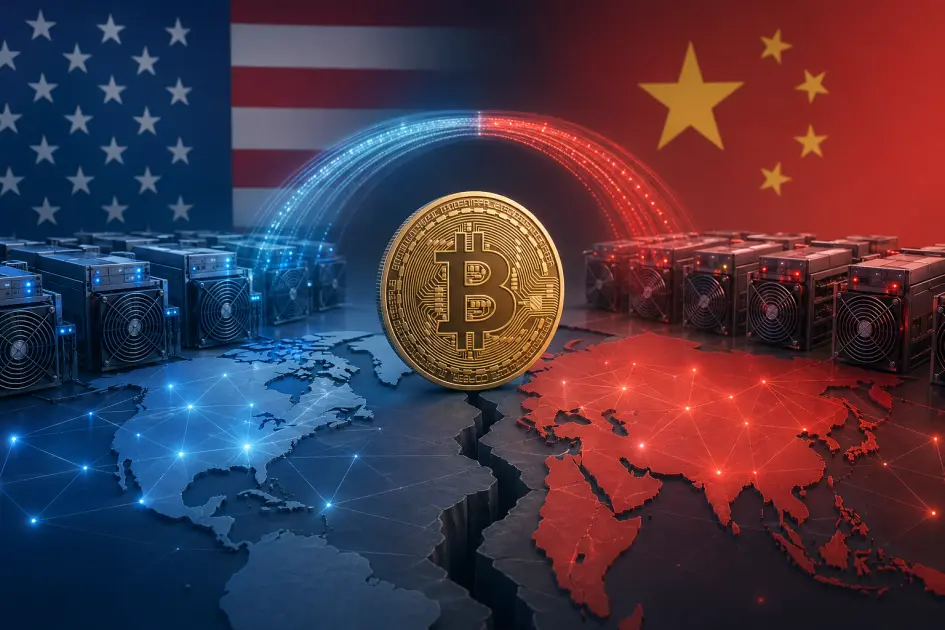
Nearly every Bitcoin ASIC running in the world is manufactured by a Chinese company. Most of those machines run inside the United States. The state of that relationship — tariffs, export controls, customs holds, reshoring pressure — shapes Bitcoin mining distribution more than any halving. Here is the two-sided dependency and where the hashrate actually goes in 2026.

The Two-Sided Dependency Nobody Unwinds in a Year
Bitcoin mining is often framed as a decentralized network, and at the protocol level it is. But at the industrial layer that runs it, two countries hold almost all the structural leverage. The United States is the largest single jurisdiction by operational hashrate. China — or more precisely, Chinese companies — is the largest source of the machines that produce that hashrate.
According to the Cambridge CBECI mining map, the US moved from roughly 37% of global share in early 2022 to the clear #1 position, while reported-pool data through 2024–2025 suggests the gap has widened further. On the hardware side, Bitmain and MicroBT together account for roughly 90% of new ASIC shipments — both headquartered in China, both reliant on Chinese chip design and Southeast Asian assembly.
The result is a lock-in that neither side can unwind quickly. A hard decoupling would damage the US mining industry (no machines to replace) and the Chinese ASIC industry (no largest buyer). That mutual exposure is the backdrop for every tariff announcement, customs hold, and export-control headline below.
Where Mining Actually Lives Today
The Cambridge Centre for Alternative Finance tracks mining distribution by country via geolocated pool data. The numbers below approximate reported shares through 2024–2025 — methodology is pool-sample-based, so the exact figures move month to month and treat VPN-routed hashrate imperfectly. Treat them as directional, not exact.
| Country | Reported hashrate share | Driver |
|---|---|---|
| United States | ~35–40% and growing | Public miners, cheap Texas gas, post-2021 capital |
| Russia | ~10–15% | Siberian hydro and gas, sanctions-driven demand for BTC revenue |
| China (underground) | ~10–20% (estimates vary) | Residual miners routing via VPNs despite 2021 ban |
| Kazakhstan | ~4–6% | Industrial grid, neutral geography, post-China absorption |
| Canada | ~5–7% | Québec hydro, favourable tariff regime vs. US |
One pattern stands out: the top five absorb almost the entire map, and three of them — the US, China, and Russia — are geopolitical heavyweights. Kazakhstan, Canada, Paraguay, and the UAE fill in as neutral-ish middle ground. Every tariff round from 2024 onward has been a referendum on which bucket ends up with marginal hashrate.
Tariffs, Customs Holds, and Export Controls
Four flashpoints define US–China mining friction right now. None is catastrophic on its own, but together they reshape where hashrate goes to be cost-effective.
Section 301 on Chinese-origin ASICs
ASICs shipped directly from China have been hit with the baseline 2.6% duty plus a 25% Section 301 ad-valorem rate — roughly 27.6% combined — with 2025 rounds pushing the total notably higher on some tranches. The cost falls on US buyers.
Southeast Asia reroute
Bitmain and MicroBT moved assembly into Malaysia, Thailand, and Indonesia during Trump's first term. Those lanes now face reciprocal tariffs of their own, putting total import duty in the ~20% range rather than 2.6%.
Customs holds and chip scrutiny
US Customs and Border Protection has held Antminer S21 and T21 shipments for weeks to months, reportedly tied to investigations around chips supplied by certain Chinese fabs. Seizures have extended to MicroBT and Canaan units as well.
Bitmain's US assembly push
Bitmain opened its first US assembly line in early 2025 to sidestep the tariff wall. Final assembly inside US borders changes the country-of-origin calculation, though upstream chips still ship through the same Chinese supply chain.
Put together, these four forces have one predictable effect: US miners pay meaningfully more per terahash than miners in jurisdictions with no tariff surcharge. The premium is absorbed by public miners with equity to spend, but it depresses marginal expansion and accelerates fleet turnover abroad.
Scenario: What a Harder Decoupling Would Look Like
Industry conversations in 2026 routinely entertain a harder scenario — not full embargo, but a meaningful escalation of tariffs, expanded export controls on mining-adjacent chips, or formal sanctions listings for specific Chinese manufacturers. In that world, four things happen reasonably fast:
ASIC price spike of 25–50%
With Chinese supply constrained and no substitute manufacturer at scale, spot ASIC prices climb. Used-gear markets in neutral jurisdictions become strategically valuable almost overnight.
US fleet replacement slows
US public miners keep running existing fleets longer, pushing up the average J/TH of the American share of the network. Older machines mean higher electricity per BTC, which squeezes margins during down markets.
Russia, Paraguay, and Central Asia pick up share
Jurisdictions outside the US–China trade axis don't pay the Section 301 premium. Several industry analysts see Russia in particular as the largest beneficiary of a tariff escalation, thanks to cheap Siberian power and easier ASIC access.
Cloud mining demand rises on the user side
Retail buyers priced out of direct ASIC purchase look for hosted or cloud-mining routes that aggregate industrial-scale procurement. The pricing is determined by the operator's landed hardware cost — which is why operator geography matters so much.
The Neutral Middle Ground
Outside the two poles sits a smaller, growing set of jurisdictions that don't fit cleanly into the US or China camp. They share a few features: non-aligned trade posture, access to cheap industrial electricity, and willingness to host hashrate without political friction.

Kazakhstan is the clearest post-2021 example. After China's ban, roughly a third of displaced hashrate initially rerouted through its grid before later regulatory caps tempered the boom. Industrial power at $0.03–0.04/kWh, a continental winter that does most of the cooling for free, and no exposure to Section 301 make it structurally competitive.
Paraguay offers Itaipú hydro surplus at comparable rates; the UAE offers capital and stable regulation; parts of Ethiopia, Oman, and Bhutan have added smaller-scale sovereign-backed hashrate since 2023. None of these individually rivals US share, but collectively they are the pressure valve that keeps the network from becoming a pure two-country story.
Where NoxHash Sits in the Map
We think it's useful to be explicit about the geography, because it's the load-bearing answer to most policy-risk questions we get from users.
Kazakhstan data center
Our operational hashrate lives on industrial Kazakh grid power at $0.03–0.04/kWh, with natural winter cooling. Outside the Section 301 tariff zone on the buyer side.
Bitmain + MicroBT fleet
Antminer S21 XP Hyd, S21 Pro, S21, and WhatsMiner M66S/M60S — sourced from the same Chinese ASIC industry everyone else uses, but imported into a non-tariff jurisdiction.
USDT in, BTC out
Users pay in USDT on TRC-20 or BEP-20 and withdraw BTC. The billing layer is protocol-native, not dollar-settled, which removes a whole category of cross-border friction.
This isn't a political claim — it's a structural one. A Kazakhstan-based operator running Chinese-manufactured ASICs sits in the middle of the map rather than at one pole of it. That's what users get when they rent hashrate from us.
Rent from the neutral middle of the mining map
The geography you just read about is where our data center runs. Open a free account, claim the 2-day Basic Miner trial, and see the Kazakh side of the distribution firsthand before committing USDT.
Frequently Asked Questions
Does China still mine Bitcoin after the 2021 ban?
Yes, though quietly. The 2021 ban displaced most large public farms, but Cambridge data has consistently suggested that a meaningful share of hashrate still originates from Chinese territory routed through VPNs. Estimates vary — 10–20% is a commonly cited range — and enforcement is uneven rather than total.
Why don't US-made ASICs dominate the market?
ASIC design is a decade-deep industry that Bitmain and MicroBT have dominated on efficiency and volume. US-based alternatives exist but have not matched the J/TH performance or shipping volume of Chinese incumbents. Bitmain's early-2025 US assembly line is an assembly move, not a full domestic supply chain.
Can a Kazakhstan-based cloud miner operate under expanding sanctions regimes?
Kazakhstan maintains trade relationships with both China and the West and is not a direct sanctions target. Mining hardware imports face normal commercial duty rather than Section 301 surcharges, and USDT-denominated billing sits outside the US banking rails where most sanctions friction shows up.
Which country is safest for hashrate over the long term?
No single jurisdiction is risk-free — the US faces tariffs, Russia faces sanctions, China faces enforcement. Operators mitigate by locating in neutral hubs with deep industrial power markets. Kazakhstan, Paraguay, and the UAE are the most frequently cited non-aligned homes for hashrate in 2026 analysis.
What happens to my rented hashrate if tariffs double tomorrow?
Nothing immediate for active NoxHash plans — the machines you rent are already installed in Kazakhstan, and the monthly price is locked by the rental term. Future fleet expansion costs could rise if global ASIC prices spike, but that risk sits with us, not with already-running plans.
Will Bitcoin itself be hurt by deeper US-China decoupling?
At the protocol level, no — Bitcoin re-distributes hashrate to wherever mining is profitable, and difficulty adjusts accordingly. Short-term disruptions like the 2021 China ban caused a temporary drop, but the network recovered within months. The industrial layer reshuffles; the blockchain keeps producing blocks.
Not financial or political advice
This article is an industry-structure overview, not investment advice or a political position. Hashrate share, tariff rates, and customs enforcement all change month to month — the figures cited reflect reported data through 2024–2025 and will shift. Mining revenue depends on Bitcoin price, network difficulty, and market conditions, all outside our control. Only commit funds you can afford to lose.