How Mempool Congestion Creates Bonus Revenue for Miners
Transaction fees make up a growing share of miner revenue — how congestion creates 20-50% fee spikes, historical bonus periods, and why post-halving this matters more.
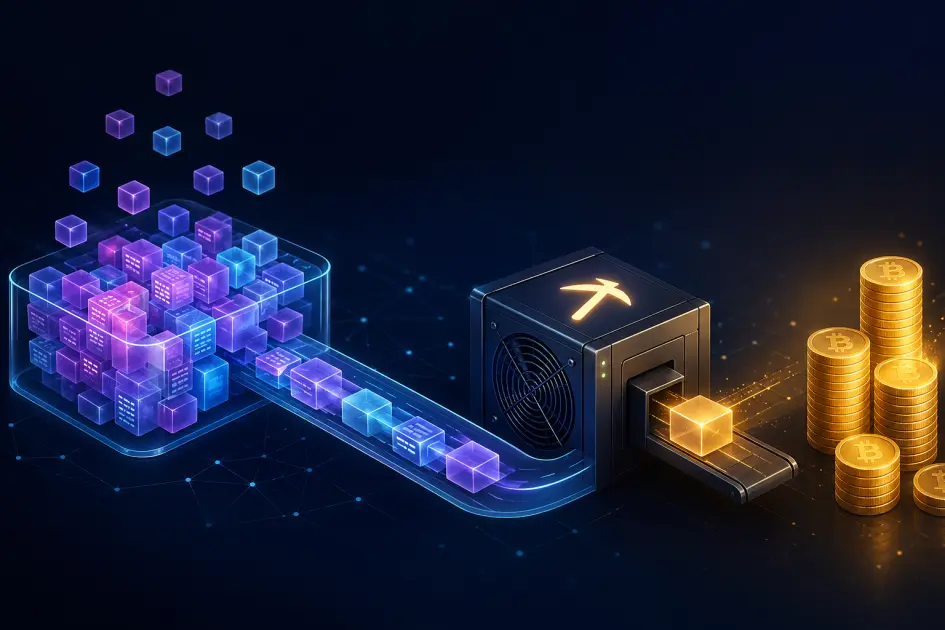
Every Bitcoin block pays miners two things: the base subsidy (3.125 BTC after the April 2024 halving) plus the transaction fees of the ~3,000-7,000 transactions it contains. In quiet months, fees are just 1-5% of that total. When the mempool floods — Ordinals in 2023, Runes in 2024, any sharp BTC rally — fees have briefly pushed past 50% of block revenue. That bonus flows proportionally to every TH/s of hashrate on the network, including rented cloud mining capacity.

Why Mempool Congestion Matters to Miners
A Bitcoin block has a hard size ceiling — roughly 1 MB of base data plus witness data, which translates to between 3,000 and 7,000 transactions depending on what those transactions look like. Miners choose what to include, and they choose by fee rate, measured in satoshis per virtual byte (sat/vB). Whatever does not fit in this block waits in the mempool for the next one.
When inflow equals outflow, the mempool stays shallow and fee rates hover around 1-10 sat/vB. Block revenue in those stretches is almost entirely subsidy: fees are often just 1-5% of what a miner pulls in per block. That is the baseline. It is the world you are running hashrate in for most of a given year.
Congestion is when the inflow of new transactions outruns block space for hours, days, or weeks. Fee rates climb, sometimes to 100-400 sat/vB or higher, and the fee portion of block revenue balloons. In April 2024 — halving week plus the Runes launch — several blocks saw fees exceed the subsidy itself, the first time this happened persistently since the late-2017 bull run. For cloud mining users, this is where the math changes: the same rented TH/s that paid out a quiet amount in March was suddenly earning materially more per day in late April.
How the Mempool Works — One Paragraph
Users broadcast transactions with a fee-per-byte offer. Full nodes validate and hold those transactions in memory — the mempool, a sorted queue indexed by fee rate. Miners, including the pools that cloud platforms like NoxHash send hashrate to, pull transactions from the top of the queue and pack them into each ~1 MB block. When transaction submission rate outstrips the 1 MB every ~10 minutes throughput, users start outbidding each other for the limited block space. That bidding war is the congestion mechanism, and it is the single lever that converts network demand into fee revenue.

Historical Bonus Periods — What the Spikes Looked Like
Fees have never been a smooth line. They spike around specific events and then settle back toward baseline. The table below shows the major bonus periods since 2017, expressed as the fee share of miner revenue during the peak window of each event. These are public on-chain numbers — you can reproduce them from any block explorer or from the long-range fee history at Blockchain.com.
| Period | Trigger | Peak fee share of revenue | Duration |
|---|---|---|---|
| Dec 2017 | BTC bull run top, $20k price | ~45-55% | ~3 weeks |
| Apr-May 2021 | DeFi and NFT mania, BTC at ATH | ~20-30% | ~4 weeks intermittent |
| Spring 2023 | Ordinals launch (Jan), BRC-20 (Mar), inscription boom (May) | ~40-50% | ~6-8 weeks of sustained pressure |
| Apr 2024 halving week | Halving at block 840,000 + Runes launch the same block | >100% of subsidy on several blocks | ~4-5 days peak, tail for 2 weeks |
| Late 2024 - 2025 | Intermittent Runes etchings, BTC rallies, occasional NFT drops | ~10-25% during bursts | Days at a time, monthly |
Two things stand out. First, the 2017 and 2024 peaks were both brief — a few days to a few weeks. Most of the calendar was baseline. Second, the 2023 Ordinals window was unusually long, because inscriptions produced a durable new source of block-space demand rather than a one-off event. When a bonus period lasts weeks instead of days, it shows up as a clearly elevated payout month on any FPPS cloud mining dashboard. You can always cross-check the current state of the queue visually at mempool.space before reading too much into any single daily payout.
Who Captures the Bonus — FPPS and Cloud Mining
Almost no cloud mining user mines solo. The hashrate you rent is pointed at a large mining pool, and the pool distributes earnings according to one of a few standard models. The one that matters here is FPPS (Full Pay Per Share), which is the model NoxHash uses.
Share-based payout
FPPS pays every miner for the shares they contribute, not for the blocks the pool happens to find. That smooths revenue — there are no "unlucky weeks" where the pool missed blocks.
Fees included, pro-rata
The "full" in FPPS means fees are part of the payout calculation, not held back. Your share of each day's network-wide fee pool is proportional to your share of network hashrate during that window.
Congestion = higher payouts
When mempool fees spike, the entire per-TH payout scale climbs. You do not see "fees" broken out as a line item — you see higher daily BTC credits across the same rented hashrate.
The practical takeaway: on an FPPS pool, the fee bonus is not optional and not withheld. It is mechanically baked into every payout cycle. When you compare one month of rented hashrate against the next, a fat month usually maps back to something that happened in the mempool — a rally, a Runes drop, a market-wide unwind that pushed everyone to move BTC at once. Reading that relationship over a year or two is one of the most useful instincts a cloud mining user can build.
Put your hashrate on the same FPPS rail that captures fee spikes
Every TH/s you rent on NoxHash points at FPPS pools, so the next congestion event — whatever triggers it — shows up directly in your daily BTC credits. No manual claiming, no separate fee line item.
The Post-Halving Importance Shift
The subsidy halves roughly every four years. That schedule is hard-coded into Bitcoin and has played out four times so far.
| Halving | Year | Subsidy per block | Fees as share of revenue (implicit) |
|---|---|---|---|
| 3rd | May 2020 | 6.25 BTC | Smaller — subsidy dominated |
| 4th | Apr 2024 | 3.125 BTC | Doubled in relative weight vs 2020 |
| 5th (projected) | ~2028 | 1.5625 BTC | Fee weight doubles again at the same fee level |
| 6th (projected) | ~2032 | 0.78125 BTC | Plausible fee parity in congested weeks |
The same fee environment — say, an average of 20 sat/vB — produces a steadily larger share of total revenue every time the subsidy halves. That is arithmetic, not speculation. You can see a clean long-run visualisation of the subsidy-versus-fees balance on Hashrate Index, which tracks the "fees as percent of miner revenue" series directly.
The strategic implication: as block rewards fall, the gap between a congested month and a quiet month widens in relative terms. Today, a 30% fee share feels like a meaningful bonus. In 2032, at the same absolute fee level, it would feel like a transformative payout. Cloud mining users who hold positions across multiple halvings will watch the fee component of their statements grow structurally over time — even without any single event behaving dramatically.

Can You Time Congestion? Honest Answer
In theory, renting hashrate right before a major fee event would be the move. In practice, you cannot time congestion with any reliability, and pretending otherwise is how cloud mining users end up overpaying for short contracts.
Triggers you can see coming
Halvings are scheduled years in advance. Announced Runes etchings, scheduled Ordinals drops, and large inscribed-art mints leak in advance. BTC rallies beyond prior ATHs tend to produce fee spikes within days.
Triggers that hit unannounced
Exchange batch processing, custodian rebalances, ETF flows, liquidation cascades, viral inscription campaigns, and random meme-coin launches all drive congestion without advance warning. Most monthly bursts fall into this bucket.
Short contracts are a bad hedge
Buying a 1-month contract right before a predicted congestion event costs more per TH/s than a 12-month contract that runs at 15% off. Missing the event by even a week eats the entire bonus you were chasing.
Treat bonuses as windfall
The healthier mental model: underwrite your contract assuming baseline fees (roughly 1-5% of revenue) and treat any fee spike as upside. This keeps your math conservative and your plan intact when the mempool stays quiet for a long stretch.
The rule of thumb most long-time miners live by: duration beats timing. A longer contract at a lower monthly rate is almost always a better bet than a shorter contract timed around a prediction. Congestion events happen on their own schedule; the only way to be guaranteed exposure to them is to already be running hashrate when they arrive. That is why the sibling piece on how to DCA into cloud mining contracts exists — dollar-cost averaging into duration is the closest thing to a free seat at the fee table.
Be running when the next fee spike hits
You cannot predict the next Runes drop or rally, but you can make sure your hashrate is already live when it arrives. Longer NoxHash terms cut the monthly rate and keep you exposed to every bonus window along the way.
Frequently Asked Questions
Do cloud mining users get a share of fee revenue?
Yes. Under FPPS — the model NoxHash uses — every unit of hashrate is paid pro-rata on the combined pool of subsidy plus fees. You do not see "fees" as a separate line, but a high-fee period shows up as a larger daily BTC credit on the same rented contract.
When was the biggest fee bonus period ever?
The April 2024 halving week was the most extreme: several blocks had fees larger than the 3.125 BTC subsidy itself, driven by the simultaneous Runes launch at block 840,000. December 2017 and spring 2023 were the other standouts, each with fees near 45-55% of revenue during peak windows.
Does NoxHash's target payout range already include fee bonuses?
The indicative ~115-125% monthly range is based on baseline fee conditions. Congestion windows lift payouts above that range for the days they last, while quiet periods may sit at the lower end. Actual results depend on BTC price and network difficulty at the time.
Are Ordinals and Runes still generating meaningful fees?
Yes, but intermittently. Both protocols produce bursts rather than a constant stream — a popular Runes etching or inscribed-art drop can lift fees for days, then activity fades. You can watch current contribution in real time on mempool.space, which labels Taproot-heavy inscription traffic visibly.
Will fees eventually replace the block subsidy?
By design, yes. The subsidy halves every four years and will approach zero around 2140. Long before then, fees are expected to carry the bulk of miner security budgeting. Each halving already pushes fees' relative weight higher at the same absolute fee level.
Can I time a short rental contract to catch a congestion event?
Not reliably. Even experienced on-chain analysts miss the start and end of fee windows by days. Short contracts also cost more per TH/s, so a mistimed bet usually erases the bonus. Longer contracts at discounted monthly rates guarantee you are already live when events arrive.
This is information, not investment advice
Fee revenue examples and historical percentages are drawn from public on-chain data and are illustrative only. Real payouts depend on Bitcoin price, network difficulty, and the fee environment during your contract window — all of which vary. Cryptocurrency mining carries market, regulatory, and technical risk. Only commit capital you can afford to lose, and research thoroughly before renting hashrate.