Bitcoin Mining Migration Trends — Where Are Miners Moving in 2026?
Where Bitcoin miners are relocating in 2026: the US plateau, AI-grid competition, and the rise of Ethiopia, Paraguay, Oman and Kazakhstan as frontier hubs.
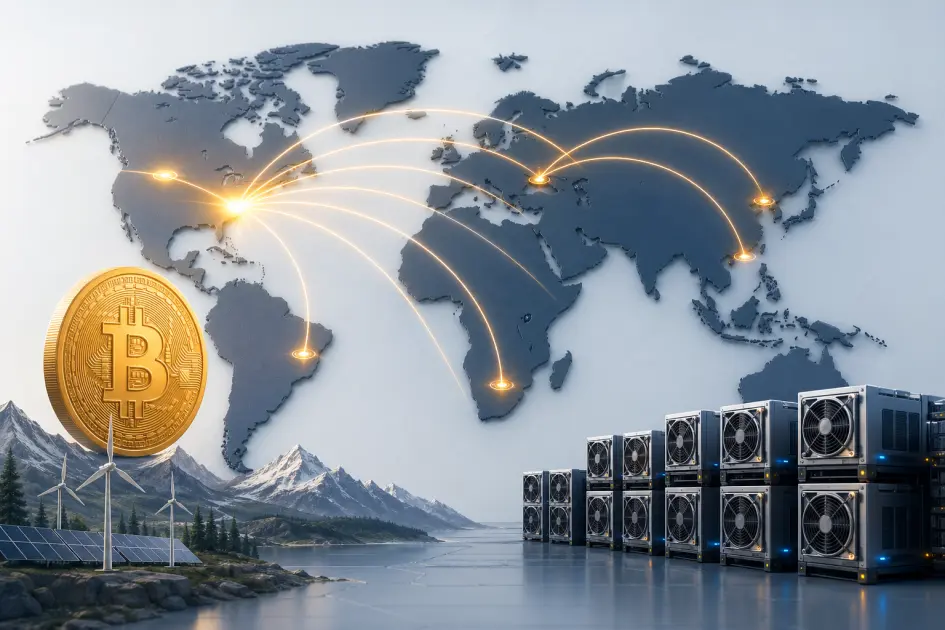
Bitcoin mining's geography is shifting faster than at any point since the 2021 China exodus. In 2026, the United States still leads with roughly 35–38% of global hashrate, but marginal operators are leaving for cheaper grids in Ethiopia, Paraguay, Oman and Kazakhstan, while AI data centers outbid miners for US gigawatt capacity. Frontier economics now define the new cost floor.

The Three Forces Reshaping the Mining Map
Miners do not pick countries because they are charming. They pick them because three numbers work: the power price, the regulatory risk, and the availability of megawatts that nobody else is fighting over. In 2026, all three inputs have moved sharply at once — which is why the map is moving with them.
Electricity price divergence
US industrial rates have crept from around $0.04/kWh in 2022 toward $0.06–0.08 in major mining states. Ethiopia, Paraguay and Kazakhstan sit at $0.03–0.05. A $0.02 gap on 3,500 W per machine is roughly $50 per miner per month — the difference between surviving the halving and shutting down.
Regulation and tax regime
Texas has tightened grid-curtailment rules, parts of the EU restrict proof-of-work outright, and Iran rations mining during power crunches. Meanwhile Paraguay, the UAE and Oman offer explicit crypto-mining frameworks with low corporate tax — stable enough for capex planning over a 3–5 year machine lifespan.
AI bidding up US grid
Hyperscalers signed more than $70 billion in AI and HPC power contracts in 2025–2026. Some US Bitcoin miners have flipped their own sites to AI training tenants because it pays better than mining — which removes hashrate from the network and pushes newcomers to non-US grids where AI has not yet crowded in.
The net effect: the US remains the largest single jurisdiction, but it is no longer the obvious answer to "where should I build my next 50 MW?" For an independent operator starting in 2026, the frontier grids now offer the lower all-in cost.
Who's Leaving, and Why
Migration is never uniform. In 2026 the outflows cluster around four very specific operator profiles — and understanding who is moving helps explain which countries will absorb the machines.
US marginal operators
Small publicly-listed miners running older S19 fleets (21–30 J/TH) on $0.06–0.08 grid power. Post-halving, their block subsidy halved while costs rose — many have sold older rigs abroad, and 2026 earnings calls increasingly describe fleet sales to Ethiopian and Paraguayan counterparties.
EU high-cost regions
Germany, Italy and parts of the Nordics price grid power at $0.10–0.20/kWh and face proof-of-work restrictions. The remaining European hashrate now concentrates in Iceland and Sweden — and even those operators are scouting North African or Gulf backups.
Iran's shrinking fleet
Iran still hosts a grey-market mining base, but rolling blackouts and seasonal bans during power crunches make it unreliable for serious capex. Machines there increasingly rotate out to the Gulf and Central Asia, where the grid is not rationed by presidential decree.
AI-flip conversions
Not a migration out of the country — a migration out of the workload. Several US operators have converted Bitcoin halls into AI training sites, selling off ASICs abroad. Same megawatts, different customer, and an extra chunk of hashrate relocated by proxy.
Where the Hashrate Is Going
Frontier markets are the story of 2026. Using CBECI-style monthly country data, here is how the receiving end of the migration looks — with honest notes on what each destination gives up in exchange for cheap power.
| Country | Est. hashrate share | Why attractive | Key risk |
|---|---|---|---|
| United States | ~35–38% | Capital, liquidity, public-company access | Rising power prices, AI outbids for grid |
| Russia (Siberia) | ~10–12% | Cheap hydro & gas, cold climate | Sanctions, payment rail risk |
| Kazakhstan | ~5–8% | $0.03–0.04/kWh, licensed framework, cold winter | Licensing caps post-2022 reforms |
| Paraguay | ~3–4% | Surplus Itaipú hydro, crypto-friendly tax | Periodic public debate over miner tariffs |
| UAE & Oman | ~3–5% combined | State-backed gas, free-zone licensing | Cooling intensive (desert heat) |
| Ethiopia | ~1.5–3% | Grand Renaissance Dam hydro, very cheap power | Political stability, grid reliability |
| Canada | ~4–6% | Québec hydro, stable rule-of-law | Provincial moratoria on new miner hookups |
Country shares are approximations sourced from the Cambridge CBECI mining map, which publishes a rolling monthly estimate based on geolocated mining-pool data. The dataset captures roughly a third of total hashrate, so exact ranks can wiggle month to month — but the directional picture is stable.
The Frontier Market Thesis
The frontier-market thesis is simple: countries with stranded cheap energy plus a workable legal framework will structurally out-earn miners in high-cost, high-competition grids over a machine's 3–5 year lifespan. The thesis is not that these countries are safer than Texas — they are not — but that the cost gap is wide enough to compensate risk-adjusted investors.
Ethiopia is the clearest example. Chinese operators, pushed out of their home country in 2021 and squeezed in the US post-halving, have routed hardware to the surplus output of the Grand Ethiopian Renaissance Dam. Coverage of the trend from CoinDesk on Ethiopian mining economics notes that even older ASICs turn profitable again at Ethiopian power prices. Paraguay is the Latin American parallel — Itaipú hydro, crypto-friendly tax treatment, and publicly listed miners now building hundreds of megawatts locally.
Oman represents the Gulf angle: state-backed natural gas, free-zone licensing, sovereign capital co-investing in crypto infrastructure. Bhutan — still the outlier — runs state-owned mining on Himalayan hydro as a sovereign treasury play. Each story is different, but the pattern repeats: stranded energy looking for a dollar-earning workload, and Bitcoin mining is the only portable 24/7 customer willing to go anywhere there is a substation.
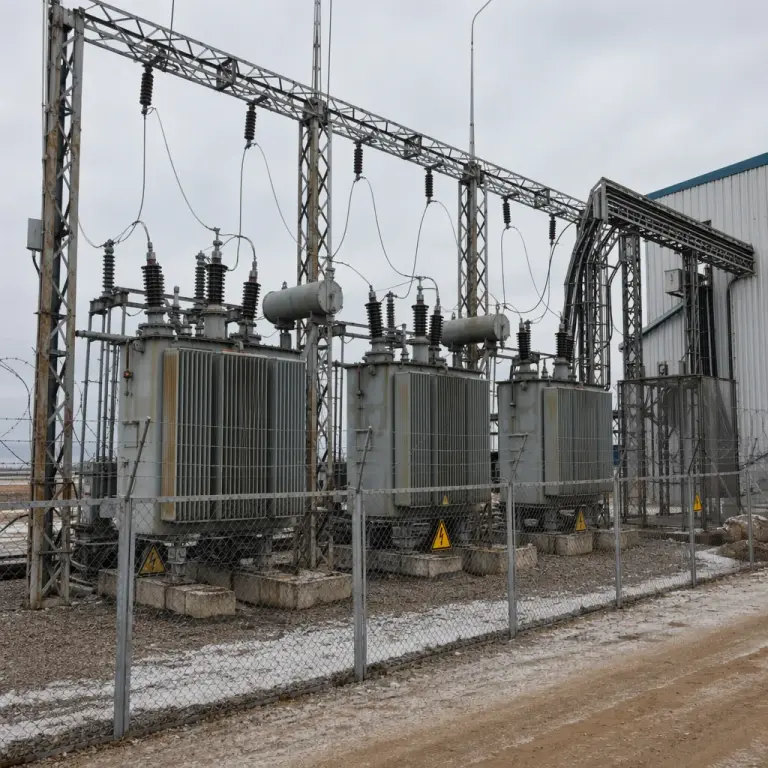
Risks are real, though. Frontier grids can be interrupted by drought (hydro), political transitions, or currency controls that trap fiat earnings. The operators who win here are the ones who hedge — diversified sites, strong local partners, and hardware written down fast enough that one stranded facility does not kill the book.
Where NoxHash Sits on the New Map
NoxHash's single data center in Kazakhstan lands on the favourable side of every one of these forces. It is a frontier-adjacent hub — lower cost than the US, more mature than Ethiopia, less sanctioned than Russia, and far enough from the AI land-grab that grid capacity is not contested.
$0.03–0.04/kWh industrial grid
A contracted industrial rate that tracks the lower end of the global table — half of Texas, a third of EU retail. The same power that breaks a marginal US operator keeps a Kazakh site comfortably profitable through a down cycle.
12–18.5 J/TH fleet
Antminer S21 XP Hyd, S21 Pro, S21, WhatsMiner M66S and M60S — current-gen ASICs, not the ex-US S19s being dumped on frontier markets. The efficiency edge compounds on top of the power advantage.
Natural cold-weather cooling
Continental Kazakh winters at −15 to −30°C remove the HVAC bill that drags on Oman, UAE and Paraguay sites. Free cooling is a structural advantage that does not show up on a rate card but shows up in margin.
Licensed, post-2022 framework
Kazakhstan tightened mining rules after the 2022 grid incident, and the industry that survived is the formal, licensed one. Predictable — not cheap-at-any-cost. That matters for anyone planning a rental contract a year or two out.
Rent the cost curve the frontier miners are chasing
You just saw why operators are moving. Instead of building your own frontier facility, rent SHA-256 hashrate from an already-running Kazakhstan data center on a monthly plan — no capex, no freight, no licensing file.
Frequently Asked Questions
Will the United States stop being the #1 mining country?
Not in 2026. The US still sits around 35–38% of global hashrate by CBECI estimates and has a deep capital base. But its share is plateauing while frontier markets grow off a small base — the trajectory, not the ranking, is what is shifting this year.
Is Iran still mining Bitcoin?
Yes, but less than before. A grey-market Iranian fleet persists, but seasonal blackouts and legal raids have pushed serious operators to rotate machines into the Gulf or Central Asia. CBECI captures only part of Iranian activity since much of it runs outside pool geolocation data.
Is it safe to rent hashrate from a frontier jurisdiction?
It depends on which frontier. Ethiopia and Paraguay carry real grid and political risk for operators. Kazakhstan — where NoxHash runs — has a post-2022 licensed framework and is counted as a top-three global hub rather than an experimental site. Always check whether your provider can show a live operational view.
Why didn't Kazakhstan's hashrate migrate away after 2022?
Some did. After the 2022 grid incident the government imposed licensing, electricity caps and formal taxation. Informal operators left; licensed industrial sites stayed because their economics still worked. The survivors run under clearer rules, which is why 2026 Kazakh hashrate is smaller but more stable than 2021.
What are the main risks of Ethiopian mining?
Power price is excellent, but the grid is still maturing, the regulatory regime is young, and currency controls can complicate fiat repatriation. For large operators with diversified sites, the cost edge is worth the risk. For a retail cloud user, it is usually better to access that economic layer through a more mature hub.
How does AI competition actually remove Bitcoin hashrate?
AI training customers pay more per megawatt-hour than a Bitcoin miner can earn at current prices, so some US miners convert halls to AI tenants and sell their ASICs overseas. The megawatts stay in the US, but the hashrate moves to wherever those machines end up plugged in — typically Africa, Central Asia or Latin America.
Not financial advice
This article covers industry geography and is not investment advice. Mining economics depend on Bitcoin price, network difficulty, power markets and regulation — all of which can move sharply. Country hashrate shares are estimates from third-party data and shift monthly. Past performance does not guarantee future results; only commit funds you can afford to lose, and consider consulting a local tax advisor about crypto earnings in your jurisdiction.