ASIC Mining vs GPU Mining — Which Is More Profitable?
ASIC vs GPU mining compared with real April 2026 numbers: S21 Pro earns ~$8/day, RTX 4090 ~$3/day on Kaspa. See which wins per dollar spent.
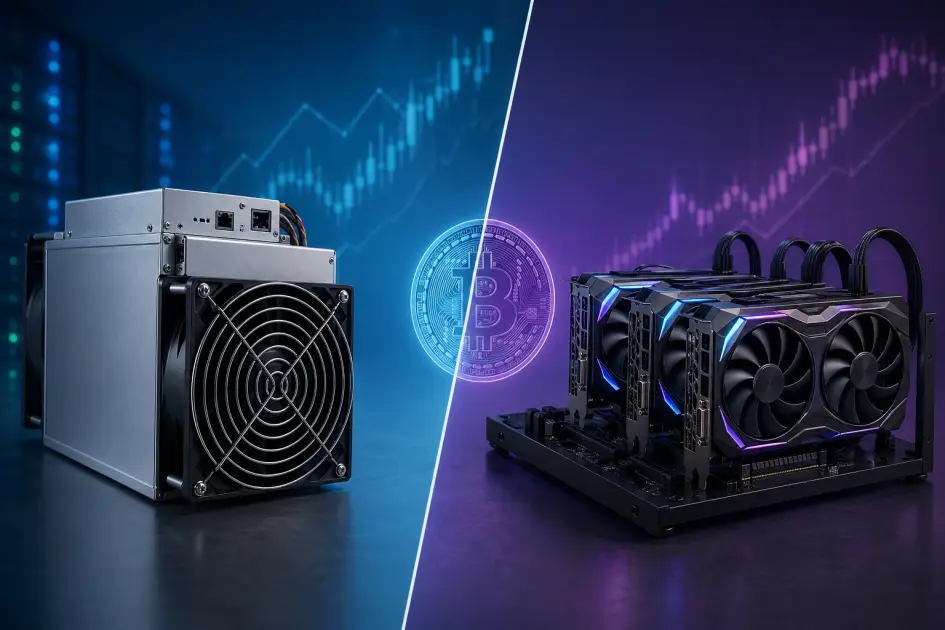
ASIC mining is purpose-built Bitcoin mining on a chip that does nothing else, while GPU mining is flexible altcoin mining on hardware you can repurpose for gaming or AI. In April 2026, one Antminer S21 Pro grosses roughly $8/day mining BTC; one RTX 4090 grosses around $3/day mining Kaspa. ASIC wins on raw output. GPU wins on flexibility and resale. The right choice depends on your capital, electricity price, and whether you want pure Bitcoin exposure or a multi-purpose machine.

Two Very Different Paradigms
ASIC and GPU mining look similar from 30,000 feet — both turn electricity into cryptocurrency — but economically they are almost opposite machines. An ASIC is a single-purpose industrial tool optimized for Bitcoin's SHA-256. A GPU is a general-purpose compute card that happens to run mining algorithms between gaming and AI workloads.
This changes almost every downstream decision: what coin you mine, how much you spend, how noisy your setup is, and what your hardware is worth three years from now. Before we get into the numbers, here's the paradigm gap in plain terms.
ASIC — one algorithm, massive output
A modern Bitcoin ASIC pushes 200–500 TH/s at 12–17.5 J/TH. It can only hash SHA-256 — no other coin, no gaming, no AI. When Bitcoin is profitable, nothing beats it per watt.
GPU — many algorithms, modest output
A gaming GPU draws 150–450 W and can switch between kHeavyHash (Kaspa), Autolykos (Ergo), KawPow (Ravencoin), and BLAKE3 (Alephium) — whichever pays best that week.
Different afterlife
An obsolete ASIC is a doorstop — no alternative use. A "retired" GPU still games, renders, and runs local LLMs. Resale value stays strong because the AI boom eats every used RTX card.
What Each Hardware Class Actually Mines
The coins split cleanly along a hardware line. Bitcoin is ASIC-only since 2013 — GPUs were knocked out of profitability within 18 months of the first commercial ASIC shipping. After Ethereum moved to Proof-of-Stake in 2022, GPU miners migrated to a handful of altcoins with ASIC-resistant algorithms that deliberately favor general-purpose compute.
| Hardware | Main coin | Algorithm | Why |
|---|---|---|---|
| ASIC (S21, M66) | Bitcoin (BTC) | SHA-256 | Hardwired, cannot mine anything else |
| GPU (RTX 4090) | Kaspa (KAS) | kHeavyHash | Currently the highest $/day for GPU |
| GPU (RTX 4070+) | Ergo (ERG) | Autolykos v2 | Memory-hard, ASIC-resistant by design |
| GPU (any) | Ravencoin, Alephium, Flux | KawPow, BLAKE3, ZelHash | Switching targets based on daily rates |
Notice the asymmetry: the ASIC column has exactly one entry (Bitcoin), while the GPU column has a half-dozen options. That is the core trade-off. If you are bullish on Bitcoin specifically, you want an ASIC — it produces satoshis, period. If you want optionality — the ability to chase whichever altcoin pays most that month — you want a GPU.
Profitability at April 2026 Rates — The Numbers
Here is the head-to-head comparison using publicly available data as of mid-April 2026: BTC price around $76,000, network hashrate ~1,018 EH/s, difficulty ~135.59T, Bitcoin hashprice ~$35.40 per PH/day. GPU figures come from WhatToMine's RTX 4090 calculator and recent Kaspa/Ergo payout rates; ASIC figures reference Hashrate Index's S21 profitability tracker.
| Metric | 1× Antminer S21 Pro (ASIC) | 1× RTX 4090 (GPU, Kaspa) |
|---|---|---|
| Hashrate | 234 TH/s SHA-256 | ~2 GH/s kHeavyHash |
| Power draw | 3,510 W | ~240 W (undervolted for mining) |
| Daily gross revenue | ~$8.16 BTC | ~$2.90–3.10 KAS |
| Electricity @ $0.05/kWh | ~$4.21/day | ~$0.29/day |
| Net profit @ $0.05/kWh | ~$3.95/day · $118/month | ~$2.71/day · $81/month |
| Electricity @ $0.12/kWh (home) | ~$10.11/day | ~$0.69/day |
| Net profit @ $0.12/kWh | ~−$1.95/day (loss) | ~$2.31/day · $69/month |
| Hardware cost (new) | ~$4,500 | ~$1,600 |
Two surprising takeaways jump out. First, at industrial electricity ($0.05/kWh) the ASIC nets roughly $118/month against the GPU's $81/month — the ASIC wins, but by less than the headline "234 TH/s vs 2 GH/s" gap suggests, because electricity eats most of the extra output. Second, at residential electricity ($0.12/kWh) the ASIC flips to a loss while the GPU stays profitable. A 3,500 W machine is simply punishing at home-utility rates.
The ASIC is a high-revenue, high-cost business. The GPU is a low-revenue, low-cost side hustle. Which one "wins" depends entirely on the denominator you care about: per dollar of hardware, per kWh of power, or per square foot of quiet living space.
Get the ASIC numbers without the ASIC
The table above assumes you buy a $4,500 S21 Pro and pay $0.05–0.12/kWh. NoxHash runs the same S21 and S21 Pro models in its Kazakhstan data center at an industrial rate of $0.035/kWh — and rents the hashrate starting at $20/month. You capture the ASIC-side revenue without the capital outlay or the 75 dB living-room vacuum cleaner.
Total Cost of Ownership — The 2-Year View
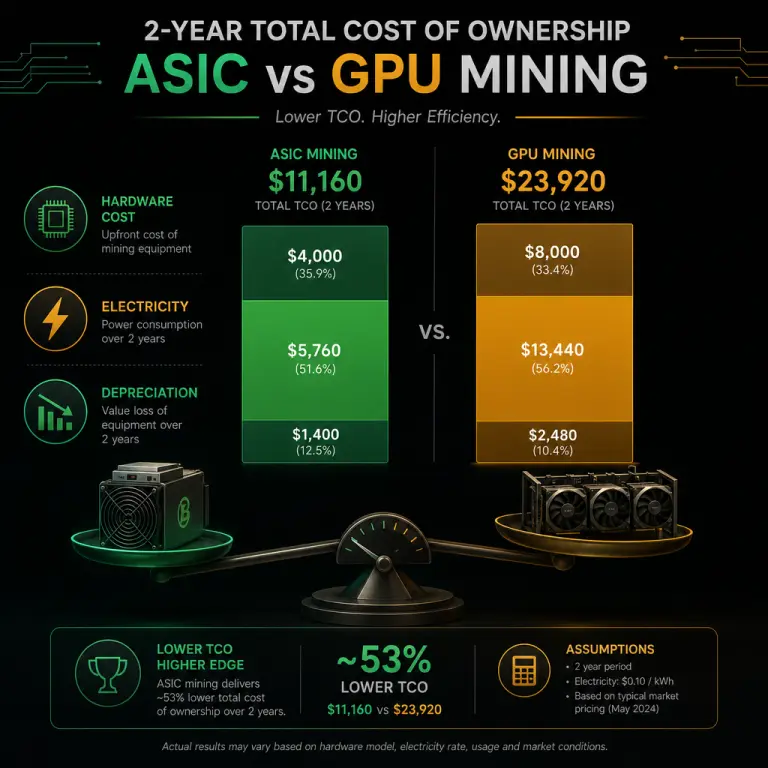
Daily revenue is only half the story. ASICs and GPUs depreciate at very different rates, and that gap shows up in the 24-month bottom line. Here is a rough TCO comparison for one S21 Pro and one RTX 4090 mining rig over two years of continuous operation at $0.05/kWh industrial power.
| Line item (24 months) | Antminer S21 Pro | RTX 4090 rig |
|---|---|---|
| Hardware purchase | −$4,500 | −$1,600 (GPU) + ~$500 (rig) |
| Electricity (24 mo) | ~−$3,073 | ~−$210 |
| Gross revenue (if rates hold) | ~+$5,957 | ~+$2,190 |
| Residual value at year 2 | ~$800–1,500 (next-gen pressure) | ~$900–1,200 (AI demand) |
| Net position | ~−$200 to +$900 | ~+$680 to +$1,180 |
The GPU often ends the two years further ahead in net position — not because it out-earned the ASIC, but because it held more resale value. An RTX 4090 from 2026 still commands strong prices in 2028's AI market. The 2024 S21 Pro, by contrast, gets squeezed between next-generation 10 J/TH replacements and falling post-halving rewards.
This is the hidden cost most "mining calculator" tools ignore. Your ASIC is not just running electricity — it's racing against its own replacement. A generation shift every 18–24 months has pushed roughly 20–30% better J/TH each cycle since 2021, and used-ASIC prices collapse accordingly. GPUs depreciate too, but the floor under them is the gaming and AI-compute markets, not a single collapsing mining economy.
Flexibility and Resale — The Silent Advantages of a GPU
Beyond spreadsheets, the day-to-day experience of owning each machine is radically different. An ASIC is a loud, hot, monomaniacal appliance — it hashes SHA-256 or it does nothing. A GPU sits in a normal gaming case, runs quietly with a good cooler, and pivots between tasks on demand.
Algorithm switching
GPU software like NiceHash, Kryptex, or manual pool-hopping can auto-pick the most profitable coin every few minutes. An ASIC cannot switch, full stop.
Dual use: games, AI, work
When mining is unprofitable, the GPU still runs Stable Diffusion, trains local LLMs, renders video, or plays AAA titles. The ASIC does nothing — literally a metal box.
Livability
A good GPU rig runs at 35–45 dB — quieter than a dishwasher. An Antminer S21 sustains 75 dB at one meter, equivalent to a running vacuum cleaner. Same room? Impossible.
Resale market
Used GPUs clear on Facebook Marketplace, eBay, and AI-compute resellers within days. Used ASICs trade on a thin specialist market and frequently sell for under 15% of their original price.
For a home user who values optionality, these four items often outweigh the raw earnings gap. For an investor who just wants concentrated Bitcoin exposure and has cheap industrial power, they don't matter — the ASIC's higher gross wins on every axis.
How to Decide — A Simple Framework
Skip the "which is best overall" question — it doesn't have a universal answer. Instead, walk through these four filters in order. The first one that triggers usually gives you the right answer for your situation.
What's your electricity cost?
Above $0.10/kWh, home ASIC ownership is close to impossible — the machine loses money daily. GPU mining still clears a small profit at that rate. Below $0.06/kWh, the ASIC is clearly stronger per dollar of hardware.
Do you want Bitcoin specifically, or "some crypto"?
If your thesis is BTC accumulation and nothing else, an ASIC (or cloud-rented ASIC hashrate) is the only hardware that produces BTC directly. GPU mining earns altcoins you'd then need to convert — adding friction, tax events, and exchange risk.
Where will the hardware live?
Apartment, shared house, or any residential space — GPU only. The ASIC's 75 dB acoustics and 3.5 kW heat output need a detached outbuilding. If you don't have one, cloud-rented ASIC hashrate is the only way to access ASIC economics from home.
How important is resale value to you?
If you might exit in 12–24 months, GPUs hold value dramatically better thanks to gaming and AI demand. If you're committed to running the hardware until end-of-life, this matters less — both will be worth a fraction of their purchase price.
Try ASIC-side economics before committing $4,500
If the framework above pointed you toward ASIC but your electricity, space, or noise situation rules out home ownership, cloud rental is the middle path. NoxHash's 2-day free trial puts you on a live S21 at $0.035/kWh industrial power — you'll see exactly what a BTC-denominated 200 TH/s produces in your account before deciding whether to rent monthly.
Frequently Asked Questions
Is ASIC mining always more profitable than GPU mining?
Not always. At industrial electricity rates an ASIC wins on gross revenue, but at residential rates above $0.10/kWh the ASIC often loses money while a GPU still clears a small profit. The answer depends on your power cost, capital, and whether resale value matters.
Can I mine Bitcoin with a GPU in 2026?
Technically yes, economically no. A modern ASIC hashes SHA-256 roughly 1,000 times faster per watt than a top GPU. A GPU would earn fractions of a cent per day on BTC while burning electricity. For GPUs, altcoins like Kaspa, Ergo, and Ravencoin are the only profitable targets.
What's the best GPU for mining in 2026?
RTX 4090 gives the highest raw output on Kaspa (~2 GH/s at 240 W). RTX 4070 and RX 7900 XTX offer better efficiency per dollar for budget builds. AMD cards typically win on Ergo's Autolykos algorithm, while NVIDIA dominates Kaspa's kHeavyHash.
How loud is an ASIC compared to a GPU mining rig?
A modern ASIC runs at ~75 dB sustained — loud as a vacuum cleaner one meter away. A well-built GPU rig with undervolted cards runs at 35–45 dB, quieter than a dishwasher. This alone rules out ASICs for most apartments and shared living spaces.
Why do ASICs depreciate faster than GPUs?
ASICs only serve the mining market, and each new generation is 20–30% more efficient. A 2-year-old ASIC gets pushed below break-even quickly. GPUs have a wider market — gaming, AI, rendering, creative work — so demand stays strong even when mining profitability drops.
Should I buy an ASIC or rent cloud hashrate instead?
Buy only if you have sub-$0.06/kWh electricity and a soundproofed outbuilding. Otherwise cloud rental gives you the same ASIC economics without the $4,500 upfront, the noise, the heat, or the depreciation risk — in exchange for a monthly fee and counterparty trust in the operator.
Educational content — not financial advice
This article is for education only. Hashrate, hashprice, difficulty, electricity costs, and coin prices reflect public data as of April 2026 and will change. Profitability depends on BTC and altcoin prices, network difficulty, electricity rates, and hardware efficiency — all of which move independently. Past results do not guarantee future performance. Only commit funds you can afford to lose, and verify local legal and tax treatment before purchasing hardware or renting hashrate.