Antminer S21 Pro Review — 234 TH/s at 15 J/TH, The Sweet Spot for Miners
The Antminer S21 Pro review — 234 TH/s at 15 J/TH air-cooled, the sweet spot between the base S21 and the hydro flagship. Specs, ROI math, home-mining verdict.
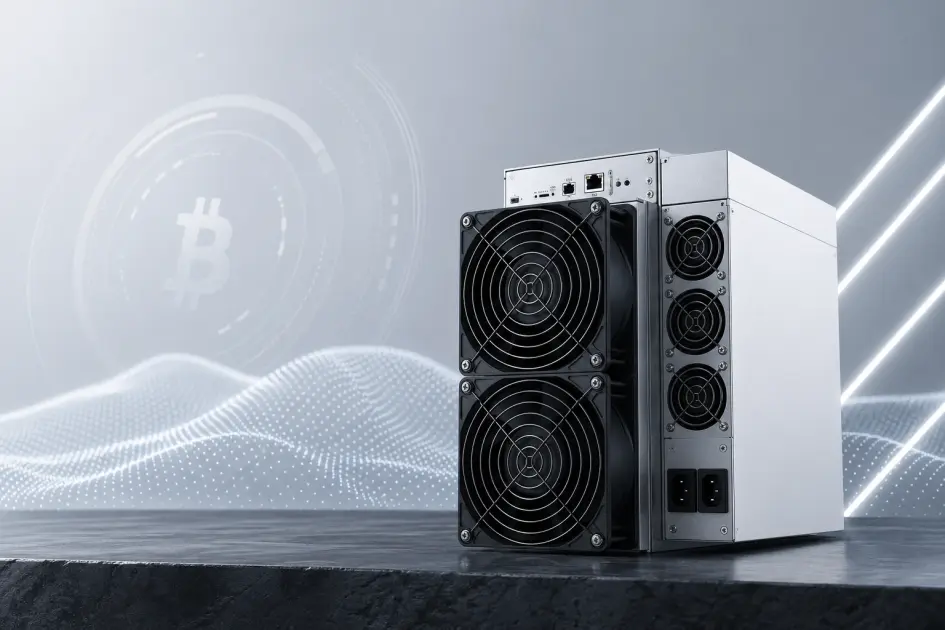
The Antminer S21 Pro is Bitmain's mid-tier SHA-256 miner delivering 234 TH/s at 15 J/TH — roughly 15% more efficient than the base S21 (17.5 J/TH) while staying air-cooled, unlike the 12 J/TH hydro flagship that needs plumbing. For professional miners in 2026, this is the sweet spot between mass-market simplicity and flagship-level efficiency.

Why the S21 Pro Is Called the "Sweet Spot"
Bitmain's 2024 Antminer lineup splits into three tiers and each makes a different trade-off. The base S21 (200 TH/s, 17.5 J/TH, air-cooled) is the mass-market workhorse — good efficiency, cheap per unit, but nothing exceptional. The S21 XP Hyd (473 TH/s, 12 J/TH, hydro-cooled) is the efficiency flagship — incredible J/TH, but it needs a liquid-cooling loop, a coolant distribution unit, and facility plumbing that solo miners simply cannot install.
The S21 Pro lands in the middle with 234 TH/s at 15 J/TH. You get a roughly 15% efficiency improvement over the base S21 with zero cooling-infrastructure premium — the same standard hashboard fans, the same two-bolt rack mounting, the same power cable. For most professional miners in 2026, this is the best single-unit purchase on the market: you capture the lion's share of the efficiency jump without signing up for the hydro complexity tax.
Full Spec Breakdown
Here are the published specs for the Antminer S21 Pro, based on Bitmain's official product sheet. Figures shown are the standard-mode numbers at an ambient temperature of 25 degrees Celsius.
Hashrate
234 TH/s on the SHA-256 algorithm, the protocol used by Bitcoin and Bitcoin Cash.
Power Draw
3,510W at the wall, which works out to 15.0 J/TH — one of the best air-cooled efficiency numbers in production.
Cooling
Air-cooled with dual high-static-pressure fans — standard 3-hashboard Antminer chassis, no liquid loop required.
Noise Level
Around 75 dB at 1 meter — typical ASIC loudness. Unsuitable for living spaces without a soundproofed enclosure.
Chip Technology
5nm process node (Samsung or TSMC, per Bitmain). The die shrink from 2023's 7nm is what unlocks the efficiency gain.
Launch
Announced late 2023, shipping in volume from 2024. Firmware and reliability are now mature going into 2026.
Input voltage runs 200–240V AC (standard for industrial deployments and most residential 240V outlets in North America). Network connection is RJ45 Ethernet — no Wi-Fi option. The unit ships with a PSU integrated into the chassis, so there's no separate power supply to source.
S21 vs S21 Pro vs S21 XP Hyd — The Three-Way Comparison
The single clearest way to understand where the S21 Pro sits is to line up all three 2024-generation siblings side by side. Monthly power figures below assume 24/7 operation at $0.035/kWh — the industrial rate NoxHash pays in Kazakhstan. Monthly gross revenue uses a hash price of $0.057/TH/day, a mid-range 2026 figure from Hashrate Index.
| Metric | Antminer S21 (base) | Antminer S21 Pro | S21 XP Hyd (flagship) |
|---|---|---|---|
| Hashrate | 200 TH/s | 234 TH/s | 473 TH/s |
| Power draw | 3,500W | 3,510W | 5,676W |
| Efficiency | 17.5 J/TH | 15.0 J/TH | 12.0 J/TH |
| Cooling | Air (fans) | Air (fans) | Hydro (liquid loop) |
| Infrastructure needed | Rack + airflow | Rack + airflow | Rack + CDU + plumbing |
| Monthly kWh | ~2,520 kWh | ~2,527 kWh | ~4,087 kWh |
| Power cost @ $0.035/kWh | ~$88 | ~$88 | ~$143 |
| Gross revenue @ mid hash price | ~$342 | ~$400 | ~$809 |
| Net (gross − power) | ~$254 | ~$312 | ~$666 |
On a raw net-dollars basis, the XP Hyd wins — it's the flagship, after all. But on net dollars per dollar of hardware deployed, the S21 Pro pulls ahead. Street prices in Q1 2026 put the S21 at roughly $3,200, the S21 Pro at around $4,800, and the S21 XP Hyd at around $10,500 (plus the hydro infrastructure surcharge). Divide net monthly by unit cost and the Pro gives you the strongest payback per dollar risked, which is why it has quietly become the workhorse choice for operators who don't already have hydro plumbed in.
ROI Math at Different Electricity Rates
Efficiency only matters once you multiply it by your local electricity rate. Here's what one S21 Pro looks like on your monthly P&L across three common rates — assuming the same mid-range hash price as the comparison table above.
| Scenario | Rate | Power cost / mo | Gross / mo | Net / mo |
|---|---|---|---|---|
| Industrial (NoxHash, Kazakhstan) | $0.035 / kWh | ~$88 | ~$400 | ~$312 |
| Texas hobby / small-commercial | $0.05 / kWh | ~$126 | ~$400 | ~$274 |
| US average home mining | $0.12 / kWh | ~$304 | ~$400 | ~$96 |
| European home mining | $0.20 / kWh | ~$505 | ~$400 | −$105 (loss) |
The pattern is the same every time: the S21 Pro's efficiency buys you a bigger profitable-rate window, but the window still has a hard ceiling. At the $0.035/kWh industrial rate that NoxHash pays in Kazakhstan, one unit clears roughly $312 per month net at a mid-range hash price. Move that same unit to a Texas hobby garage at $0.05/kWh and net drops to about $274. Plug it into a typical US home outlet at $0.12/kWh and you're scraping by at roughly $96 a month at a mid hash price — and a single drawdown in BTC price or a difficulty spike pushes you into the red. Above $0.15/kWh, the math simply doesn't work. The rate at which break-even lives is entirely local to you, which is why the "is this miner profitable?" question has no universal answer.

Why NoxHash Uses the S21 Pro as Our Pro/Enterprise Workhorse
Inside our Kazakhstan facility, the Antminer S21 Pro is the backbone of the Pro and Enterprise tiers. Three reasons:
First, density without plumbing. The XP Hyd is theoretically better at 12 J/TH, but hydro deployments require a coolant distribution unit, a manifold run, and quarterly coolant maintenance. Keeping a majority of the fleet on air-cooled Pros means we can fill standard racks with standard airflow design and add capacity in weeks, not months.
Second, maintenance profile. A technician can hot-swap an S21 Pro in under 10 minutes with two people. A hydro unit needs a shutdown of the loop segment, a coolant drain on the dripping mount, and a purge before the swap-in — 30 to 60 minutes minimum. Air-cooled wins on uptime arithmetic.
Third, it maps cleanly to customer-side rental tiers. Our Pro Miner rental at $100 per month delivers 350 TH/s to the customer — roughly the output of 1.5 S21 Pro units. That pairing means your rental is backed by real, current-generation hardware running in a real facility, not a paper contract. The 15 J/TH efficiency is what lets us offer that hashrate at that price while still covering power at $0.035/kWh, facility overhead, and the 125% annual return target on the tier.
Rent the S21 Pro's hashrate — skip the $4,800 unit cost
Our Pro Miner tier delivers 350 TH/s — roughly 1.5 S21 Pro units' worth of hashrate — at $100 per month, running in our Kazakhstan data center at $0.035/kWh. No unit to buy, no 75 dB of noise in your garage, no 3,500W on your meter.
Is the S21 Pro Right for Home Mining?
More than any hydro unit, yes — you can actually plug this in and run it without building a liquid-cooling room. But "can" and "should" are different questions, and the answer still hinges on three things you need to be honest with yourself about.
Green lights
Electricity at $0.08/kWh or below, a detached garage or outbuilding with cross-ventilation, tolerance for 75 dB (or a DIY enclosure), 240V circuit on its own breaker, and enough capital to ride out a 6-month BTC drawdown.
Red flags
Electricity at $0.12/kWh or above, apartment or HOA that flags noise, no 240V service, or a single unit being more than 30% of your monthly mining budget. Cloud mining is the hassle-free alternative in any of these cases.
Install reality
3,510W sustained is a real 240V / 20A load. A dedicated breaker is non-negotiable — sharing a branch with anything else will trip. Budget for the electrical work alongside the unit cost.
Firmware lock-in
Stock Bitmain firmware ships pool-locked to BTC.com. Most home miners install Braiins OS or LuxOS within a week to unlock autotuning and pool flexibility — factor that learning curve in.
The honest summary: below $0.08/kWh with decent ventilation and a 240V circuit, a single S21 Pro can be a profitable home-mining unit. Between $0.08 and $0.12/kWh it's marginal and depends heavily on BTC price. At $0.12 or above, the math rarely clears, and the sensible move is to rent the equivalent hashrate through a cloud-mining provider that runs the unit at $0.035/kWh instead. The hardware doesn't change; the electricity does.
Frequently Asked Questions
Is the S21 Pro quieter than the S21 XP Hyd?
No — the S21 Pro is louder. Hydro units run near-silent because they lack the high-RPM fans the Pro relies on. Expect about 75 dB from the S21 Pro versus 50 dB or less from a properly plumbed XP Hyd. If silence matters to you, hydro wins on noise even though it loses on infrastructure simplicity.
What's the S21 Pro retail price in 2026?
New units from Bitmain-authorized resellers run around $4,500 to $5,200 in Q1 2026, down from about $5,800 at 2024 launch. Prices move with BTC price and next-generation release rumors — expect another 10–15% drop once 10 J/TH air-cooled units reach volume production in late 2026.
How does a NoxHash rental translate into S21 Pro units?
Our Pro Miner tier delivers 350 TH/s for $100 per month, which matches roughly 1.5 S21 Pro units. The Enterprise tier at 1,000 TH/s for $250 per month maps to about 4.3 S21 Pros. Fleet mix actually blends several 2024-generation models, but S21 Pros back the bulk of these two tiers.
What's the expected useful life of an S21 Pro?
Physical hardware life is 4–6 years of 24/7 operation with routine fan and thermal-paste maintenance. Economic life is shorter — typically 2–3 years before a next-generation unit at 10–12 J/TH makes the Pro uneconomic at most electricity rates. Plan your payback window accordingly.
Can I buy a used S21 Pro?
Yes, the secondary market is active at roughly $3,400–$3,900 per unit in Q1 2026. Insist on a benchmark video showing stable hashrate and chip temperatures, verify serial numbers with Bitmain, and expect firmware to already be reflashed. Used units carry higher fan-failure risk in their first 90 days under new ownership.
Does the S21 Pro support autotuning?
Not on stock Bitmain firmware — you're locked to the factory profile. Third-party firmware like Braiins OS or LuxOS enables per-chip autotuning, low-power modes that push efficiency to about 13 J/TH at reduced hashrate, and pool flexibility. Most professional operators reflash within the first week of deployment.
Sources & references (as of April 2026): specs cross-checked against Bitmain's official Antminer S21 Pro product page at bitmain.com/products/antminer/s21pro; hash-price figures from Hashrate Index historical data at hashrateindex.com/hashrate.
Not investment advice
The revenue, cost, and ROI figures in this review are illustrative — actual mining income depends on Bitcoin price, network difficulty, transaction-fee levels, your electricity rate, and hardware uptime, all of which can change rapidly. Past performance does not guarantee future results. Cryptocurrency mining carries market, regulatory, and technical risk. Only deploy capital you can afford to lose and do your own research before purchasing hardware or entering a mining contract.