The NoxHash 1.5% Withdrawal Fee vs Industry Standards
Understand NoxHash's flat 1.5% BTC withdrawal fee with worked examples at 0.001, 0.1 and 1 BTC — plus how it compares to exchange withdrawal pricing in 2026.

NoxHash charges a flat 1.5% fee on every Bitcoin withdrawal, with a 0.00001 BTC minimum and a short admin review before broadcast. Unlike exchanges that pass through dynamic network fees — often $2–20 per send — the percentage model stays fair at small amounts and includes the cost of human safety checks that protect your balance.
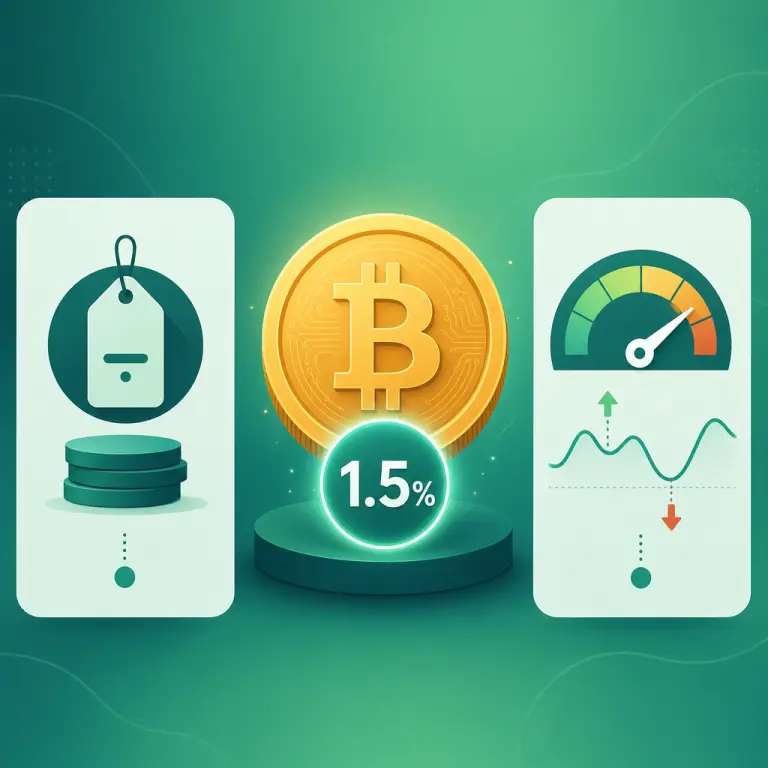
What the NoxHash 1.5% Withdrawal Fee Covers
A withdrawal from a custodial platform is never just an on-chain transaction. It bundles several real costs into one line item. Understanding what lives inside those 150 basis points makes the fee easier to judge on its own terms, before comparing it to anyone else.
The 1.5% NoxHash charges covers three things at once: the Bitcoin network (miner) fee we pay to broadcast your transaction, the operational cost of reviewing every request by hand, and the platform overhead — wallet custody infrastructure, fraud monitoring, and support. There is no separate "network fee" surcharge and no withdrawal-tier pricing that penalises power users.
On-chain network fee
NoxHash pays Bitcoin miners for block inclusion. No separate dynamic surcharge lands on your statement — it is already inside the 1.5%.
Admin review
A human verifies every request before broadcast — catching stolen-account drains and typo'd addresses while BTC is still recoverable.
Platform overhead
Wallet custody, hot/cold key management, 24/7 fraud monitoring, and customer support — the cost of keeping your balance safe on-platform.
How Exchanges Structure BTC Withdrawal Fees
Before we can compare, we need to understand what we're comparing against. Centralised exchanges typically use one of two pricing models — and both look different from a percentage-based platform fee.
Dynamic network-fee pass-through is the dominant model on most large exchanges. The platform estimates the current Bitcoin network fee at the moment of your request and passes that estimate to you as the "withdrawal fee". When the mempool is quiet, it is cheap; when a new NFT or inscription wave clogs blocks, it can spike to $10–20 per transaction or more. You pay exactly what the network charges — no more, no less on paper — but you cannot predict the number in advance.
Flat per-transaction fees charge a fixed BTC or USD amount regardless of withdrawal size. Published figures in 2026 range from roughly 0.00003 BTC on Binance's Bitcoin network withdrawals to around $1–3 on Kraken, and typical dynamic fees of $1.50–3.00 on Coinbase under normal conditions (higher during congestion). If you are curious about current on-chain conditions, you can watch the live mempool at mempool.space for Bitcoin network fee context — the same data exchanges use to set their pass-through prices.
Cloud mining platforms tend to sit closer to NoxHash's structure: most published rates we have seen in the industry land between 1% and 3% flat, or a network pass-through plus a smaller percentage overhead. The reason is simple — cloud mining operators, like NoxHash, typically review withdrawals manually, and a percentage covers that labour in a way that a flat $2 does not.
NoxHash vs Exchange Fee Structures — The Comparison
This is the centrepiece of the article: a side-by-side of how the different fee models behave. Figures for third parties are drawn from their published 2026 schedules — always verify on their official fee page before you send, because dynamic models change hour-to-hour.
| Platform | NoxHash (reference) | Large exchanges (typical) | Other cloud mining peers |
|---|---|---|---|
| Model | Flat 1.5% of amount | Dynamic network fee or flat per-transaction | Flat 1–3% or pass-through + surcharge |
| Predictable before you send | Yes — always 1.5% | Partially — moves with congestion | Usually yes |
| Cheap for small withdrawals | Yes — fee scales down with amount | No — flat fee can eat most of a tiny send | Yes — percentage scales |
| Cheap for large withdrawals | Moderate — 1.5% of a large amount is meaningful | Yes — flat fee is a tiny percent of a big send | Similar to NoxHash |
| Human review included | Yes — on every request | Rarely — mostly automated | Often yes |
| Network-fee surprise risk | None — absorbed in the 1.5% | Real — spikes during congestion | None to low |
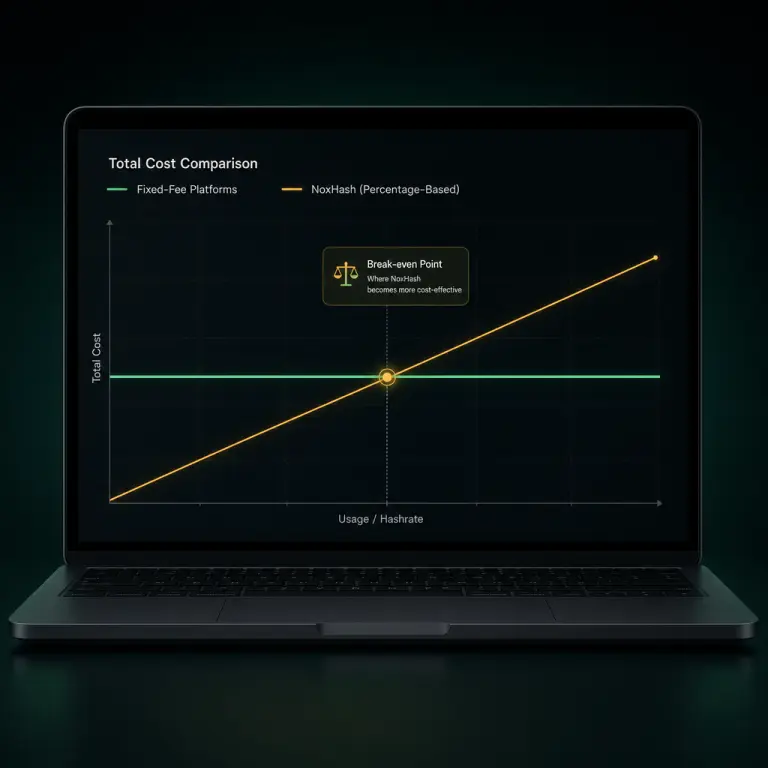
The takeaway is not "NoxHash is cheapest everywhere" — it is not. The takeaway is that each model has a different shape. Percentage-based pricing wins at small amounts and absorbs network volatility; flat per-transaction pricing wins at very large single sends. The next section shows exactly where those lines cross.
Worked Examples — 0.001 BTC, 0.1 BTC and 1 BTC
Pricing theory is easy; arithmetic is clearer. Below are three worked examples at amounts that cover most real NoxHash withdrawals, from first-payout scale to long-term accumulator scale. Exchange figures are illustrative mid-range values from their 2026 public fee pages — network-fee-pass-through platforms will move above or below these on any given day.
Percentage wins here
- NoxHash (1.5%)
- 0.000015 BTC
- Flat 0.00003 BTC
- 0.000030 BTC
- Flat 0.0002 BTC
- 0.000200 BTC
Effective rate: 1.5% on NoxHash vs 3% at 0.00003 flat, or 20% at 0.0002 flat. Tiny sends suffer most under flat fees.
Roughly comparable
- NoxHash (1.5%)
- 0.001500 BTC
- Flat 0.00003 BTC
- 0.000030 BTC
- Flat 0.0002 BTC
- 0.000200 BTC
Effective rate: 1.5% on NoxHash vs 0.03% at 0.00003 flat, or 0.2% at 0.0002 flat. Flat pulls ahead at this scale — but remember, NoxHash bundles in admin review.
Flat fee wins here
- NoxHash (1.5%)
- 0.015000 BTC
- Flat 0.00003 BTC
- 0.000030 BTC
- Flat 0.0002 BTC
- 0.000200 BTC
Effective rate: 1.5% on NoxHash vs 0.003% at 0.00003 flat. Large single-send users save meaningfully on flat-fee platforms — a valid reason to time withdrawals carefully.
The pattern is consistent: the percentage model protects small users (who would be crushed by a $2 flat fee on a $5 withdrawal) at the cost of charging proportionally more on very large sends. NoxHash chose the small-user-friendly side of that trade-off deliberately, because most cloud miners reach 0.001–0.01 BTC in a wallet long before they see 1 BTC. Reference BTC-to-USD values for any of these amounts can be checked on CoinGecko's live Bitcoin price page when you are budgeting a withdrawal.
See the 1.5% maths on your own wallet
You've seen the side-by-side with exchange fees and the break-even points at 0.001, 0.1 and 1 BTC. Start earning BTC on NoxHash today — the free 2-day Basic Miner trial unlocks the moment you verify your email, no deposit needed.
Why NoxHash Chose a Percentage, Not a Flat Fee
The choice was intentional. After looking at how cloud mining users actually withdraw, three reasons pointed the same way.
Fair to small and large users
A flat $2 fee is 20% of a $10 withdrawal but 0.002% of a $100,000 one. A percentage keeps the relative cost identical across every user — same share of their earnings, whatever the size.
Funds human review
Every withdrawal is manually approved by an admin. That labour has a real cost, and it scales with payout size because the risk being reviewed scales too. A percentage funds it proportionally.
No network-fee surprises
You see the fee before you submit, and it does not move if the Bitcoin mempool spikes overnight. NoxHash absorbs that volatility into the 1.5% — users never chase an on-chain fee they did not choose.
Simple to explain
"1.5% of the amount you request" is something you can verify with a calculator in five seconds. No tier tables, no BTC-denominated flat fees to convert, no network-fee estimator to squint at.
Frequently Asked Questions
Is the NoxHash 1.5% fee on top of a separate network fee?
No. The 1.5% is all-in. NoxHash covers the Bitcoin miner fee out of that rate, which means you see exactly one number on your statement and it will not surprise you by jumping during mempool congestion. What you submit is what you pay.
Does it cost less if I batch several payouts into one withdrawal?
Not in relative terms. Because the fee is a flat 1.5% of the amount, the effective rate is identical whether you withdraw 0.001 BTC ten times or 0.01 BTC once. Batching still saves time and the single admin review cycle feels cleaner, but the percentage cost does not change.
When does a flat-fee exchange become cheaper than 1.5%?
Break-even depends on the flat amount. Against a 0.0002 BTC flat fee, you start saving above roughly 0.0133 BTC per withdrawal; against a 0.00003 BTC flat fee, above 0.002 BTC. Below those points, the percentage is cheaper — and that is where most cloud mining payouts live.
What is the minimum withdrawal on NoxHash?
The minimum is 0.00001 BTC per request, roughly a thousand satoshis. The 1.5% fee still applies, so a request just above the minimum receives approximately 0.00000985 BTC net. In practice most users accumulate further before withdrawing so the on-chain fee is worth paying.
Do exchange withdrawal fees ever beat NoxHash in a crisis?
The opposite. When the Bitcoin network congests, exchanges using dynamic pass-through models have historically raised BTC withdrawal fees sharply — occasionally suspending withdrawals entirely. NoxHash absorbs that volatility because the 1.5% is fixed contractually, so the user price stays steady.
Why does human review matter if the fee is already low?
Bitcoin is irreversible. A few hours of admin review on each request catches stolen-account drains, address typos, and unusual behaviour before BTC leaves custody. Instant-withdrawal platforms routinely lose user funds to attackers because they skip this layer entirely.
Not financial advice
This guide compares withdrawal fee structures for information only and does not constitute investment advice. Third-party exchange fees cited are drawn from their public 2026 schedules and can change without notice — always check the source directly before relying on them. Bitcoin is a volatile asset and on-chain transactions are irreversible, so double-check every destination address. Tax treatment of crypto withdrawals varies by country; consult a local tax advisor about how earnings apply to you.