Why Kazakhstan? The Advantages of Mining in Central Asia
Discover why Kazakhstan became a top-3 Bitcoin mining hub: $0.03-0.04/kWh electricity, subzero winters, and a mature post-2021 mining infrastructure.

Kazakhstan is one of the world's top-3 Bitcoin mining hubs thanks to industrial electricity at $0.03–0.04/kWh, a cold continental climate that cools ASIC rigs for free, and a mature post-2021 infrastructure built when miners fled China. NoxHash runs its entire fleet from a Kazakh data center for exactly these reasons.
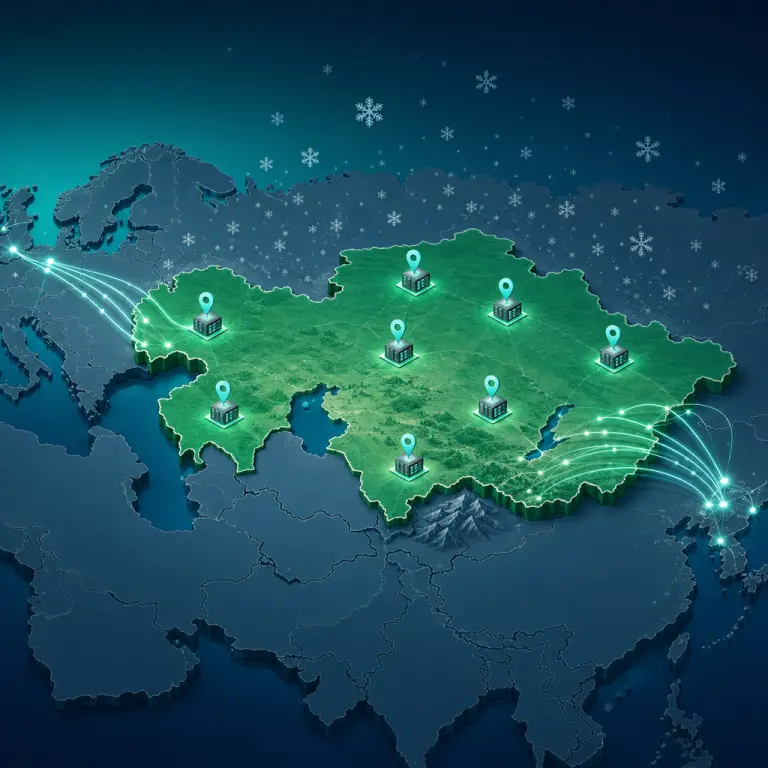
From the 2021 China Ban to a New Mining Capital
For most of the 2010s, China hosted roughly 65–75% of global Bitcoin hashrate. That ended in June 2021, when Beijing ordered a nationwide shutdown of crypto mining. Within months, hundreds of farms packed their ASICs into shipping containers and looked for the next place that combined cheap electricity, cold weather, and a friendly enough regulatory posture.
Kazakhstan was the closest geographic match. A 1,700 km land border with China meant miners could truck their rigs across in days rather than shipping them by sea. The country already had surplus coal and natural-gas power, a modernising grid, and industrial tariffs roughly a third of the global average. By late 2021 Kazakhstan briefly became the second-largest Bitcoin mining country on Earth, behind only the United States, according to Cambridge CBECI country hashrate data.
Top-3 hashrate hub
Cambridge CBECI has consistently placed Kazakhstan inside the global top 3 since 2022, alongside the US and Russia.
Dedicated legal framework
Mining is registered, taxed, and regulated under a 2023 digital-assets law — not a grey-market activity tolerated by default.
Winters that cool rigs for free
An average annual temperature of 2–7 C and -15 to -30 C winters let modern ASIC fleets run on ambient airflow alone.
4 Reasons Kazakhstan Beats Almost Every Other Mining Region
You can frame Kazakhstan's advantage around four stackable factors. Any single one of them would help a mining operation; together they produce a rare combination that directly compresses the cost per terahash.
Some of the cheapest industrial electricity on the planet
Large-volume contracts land at $0.03–0.04 per kWh, versus $0.10–0.20 for ordinary household power and roughly $0.05 for industrial US rates. On a single Antminer S21 (3,500W, 24/7) that's the difference between a ~$88 monthly power bill in Kazakhstan and ~$302 on $0.12/kWh home electricity — a 243% gap that decides whether a rig runs in the black.
Free natural cooling almost year-round
Kazakhstan has a sharp continental climate: winters of -15 C to -30 C, summers usually under 30 C, and an annual average of just 2–7 C. Cold ambient air means data centers can rely on industrial fans instead of energy-hungry HVAC — typically saving 20–30% on cooling costs compared with farms in hot regions like Texas or Paraguay.
Mature post-2021 mining infrastructure
Nearly five years after the China exodus, Kazakhstan has something most emerging hubs don't: experienced site operators, licensed power contracts, ASIC repair shops, and customs paths for Bitmain and MicroBT hardware. A 2023 digital-assets law formalised miner registration, taxation, and reporting — turning the industry from grey-market into a defined sector.
Strategic geography between Asia and Europe
Kazakhstan sits at a natural network crossroads: fiber routes east to China, west to Russia and Europe, and south to the Middle East. That translates into low-latency connectivity to every major Bitcoin mining pool and redundant upstream paths — the kind of dual-ISP redundancy a serious 24/7 data center needs.
Kazakhstan vs Other Mining Regions — Side by Side
Mining economics come down to three levers: power price, cooling cost, and regulatory stability. Here's how Kazakhstan stacks up against the most-discussed alternatives, based on the figures NoxHash uses when modelling fleet economics.
| Region | Industrial power | Climate for cooling | Mining infrastructure |
|---|---|---|---|
| Kazakhstan (NoxHash) | $0.03–0.04/kWh | Cold continental, free cooling | Mature, licensed framework |
| Paraguay (Itaipú hydro) | $0.03–0.05/kWh | Hot subtropical, needs HVAC | Growing, limited operators |
| Russia (Siberia) | $0.03–0.05/kWh | Very cold, good for cooling | Sanctions + payment friction |
| Canada (Québec) | $0.04–0.06/kWh | Cold, hydro-powered | Mature, but power moratoriums |
| Texas, USA | $0.04–0.06/kWh | Hot summers, grid curtailment | Largest Western hub |
| Norway / Sweden | $0.04–0.07/kWh | Very cold, hydro-powered | Strict, rising electricity taxes |
The pattern is clear: a handful of regions match one or two of Kazakhstan's advantages, but very few combine low power, cold climate, and a dedicated legal framework in one place. Paraguay has cheap hydro but tropical heat. Québec has cold hydro but sporadic moratoriums on new miners. Norway and Sweden are cold and clean but increasingly expensive and tax-heavy.
Rent hashrate from the same Kazakh farms you just read about
NoxHash's entire fleet runs on $0.035/kWh industrial power under Kazakhstan's continental climate. Activate a free 2-day Basic Miner trial and watch real hashrate from the region before you commit a cent.

Why This Matters When You Rent Hashrate
If you rent a miner on NoxHash, you're not directly paying the electricity bill — but the location still decides how much hashrate your money buys. A provider running on $0.12/kWh home power simply cannot offer the same $/TH as one running on $0.035/kWh industrial contracts. The geography underneath a cloud-mining platform is the single biggest predictor of its long-term pricing.
Lower breakeven BTC price
Farms with cheap power stay profitable at lower BTC prices. That resilience flows into your rental — fleets are less likely to be switched off during bear markets.
Cheaper cooling, steadier uptime
When ambient air handles cooling, hot-summer throttling and HVAC failures disappear. That's a direct contribution to the 99.9% uptime NoxHash targets.
Scale advantages you can't replicate at home
Kazakh farms buy ASICs hundreds at a time and negotiate industrial power contracts — a combination a home miner on retail electricity simply cannot match.
Good pool latency, anywhere you live
Kazakhstan's central location keeps the ping to every major mining pool — and to your dashboard — low, whether you're logging in from Hanoi, Seoul, Berlin, or São Paulo.
Frequently Asked Questions
Is Bitcoin mining legal in Kazakhstan?
Yes. Since the 2023 digital-assets law, mining is a licensed, taxed activity with formal registration requirements for operators. Farms must comply with power usage caps, reporting obligations, and a dedicated mining tax, which professional platforms like NoxHash factor into their pricing.
Why is Kazakh electricity so cheap?
Kazakhstan has massive domestic reserves of coal and natural gas, combined with a Soviet-era grid overbuilt for heavy industry. That produces a structural surplus at industrial voltage — the economic root of the $0.03–0.04/kWh tariffs that mining operations negotiate on long-term contracts.
How does Kazakhstan compare with Texas or Paraguay?
Texas and Paraguay are the strongest alternatives. Texas offers ERCOT demand-response revenue but 30–50% higher power and summer curtailment. Paraguay has cheap Itaipú hydro but hot subtropical summers requiring active cooling. Kazakhstan combines both: cheap power and cold air.
Do I pay any Kazakh taxes when I rent a NoxHash miner?
No. NoxHash handles all Kazakh operational, energy, and mining taxes at the platform level — you only pay the monthly rental fee. Any personal tax obligation on your BTC earnings falls under your home country's rules, so it's worth checking with a local tax advisor if that applies to you.
What happens if Kazakh regulation changes?
Mining regulation can shift in any country. Kazakhstan's 2023 framework is relatively stable, but power caps, taxes, or registration rules may evolve. NoxHash's response plan is fleet diversification across regions over time — your rental contract and earnings model remain unchanged regardless of where specific machines physically sit.
Is Kazakh mining environmentally sustainable?
The grid still leans on coal and natural gas, which is a real trade-off. Offsetting factors include free ambient cooling (no HVAC load) and a fleet made of 2024–2025-generation ASICs at 12–18.5 J/TH — roughly twice as energy-efficient as 2021-era machines running in other regions.
Not financial or regulatory advice
This article is informational and reflects figures current as of April 2026. Mining regulation, energy pricing, and tax treatment can change in Kazakhstan and every other mining jurisdiction globally — a regulatory shift is a real and recurring risk across the industry. Cloud mining earnings also depend on BTC price, network difficulty, and market conditions, none of which are guaranteed. Past performance does not predict future results. Invest only what you can afford to lose, and consult a qualified local tax or legal advisor for your own situation.