Why I Chose Cloud Mining Over Buying My Own ASIC Miner
With $5,000 in hand, I compared one Antminer S21 at home against 24 months of NoxHash Pro cloud mining. Here is my full cost breakdown and why I chose cloud.

I had $5,000 set aside for Bitcoin mining and a choice in front of me: buy one Antminer S21 and run it in my basement, or rent equivalent hashrate through NoxHash cloud mining for 24 months. After a weekend spent in spreadsheets, I picked cloud. Here is the full breakdown — including where a home ASIC still wins.
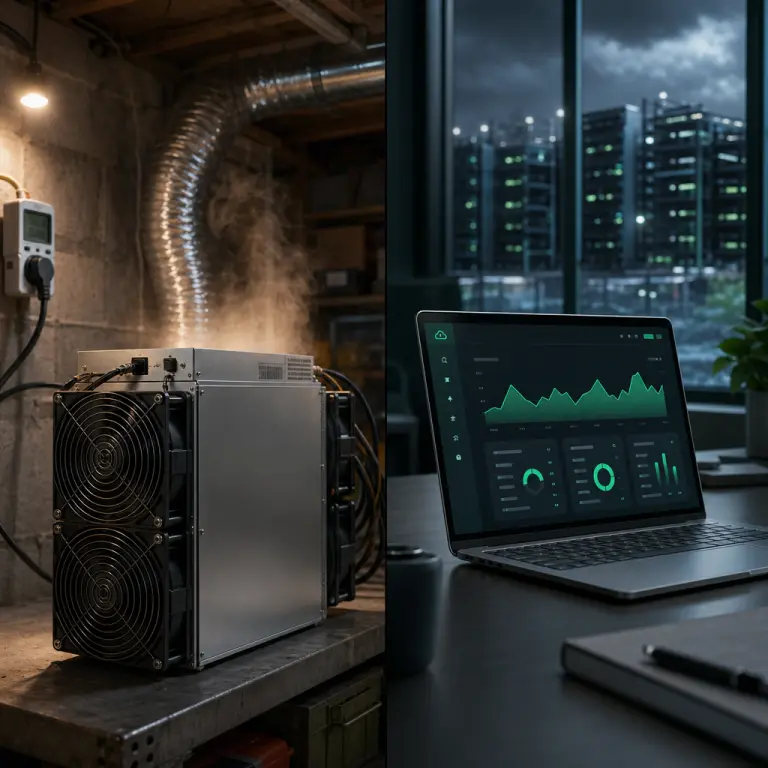
The $5,000 Question I Sat With for a Weekend
My savings earmarked for mining were exactly $5,000. The decision split cleanly into two paths:
Path A — Buy my own ASIC
One Bitmain Antminer S21 (200 TH/s, 3,500W), priced $4,500–6,000 on the official shop and resale market. Run it in my basement on US residential power.
Path B — NoxHash Pro tier, 24 months
One Pro Miner (350 TH/s) at $100/month, locked in for 24 months with the 20% long-term discount = $80/month × 24 = $1,920 total. All electricity, cooling, and maintenance included.
Same goal on both sides: accumulate Bitcoin over roughly two years. Radically different cost profiles, operational burdens, and risks. I refused to decide on vibes — so I listed every factor I could think of and priced each one honestly.
My Full Cost Comparison Table
This is the table I kept open on one monitor for the entire weekend. The Path A figures use my actual US utility rate of $0.12/kWh — roughly the US residential average according to US EIA Electric Power Monthly data. The Path B figures come from NoxHash's published infrastructure: data center in Kazakhstan, industrial electricity at $0.035/kWh, and the 20% discount applied for a 24-month rental.
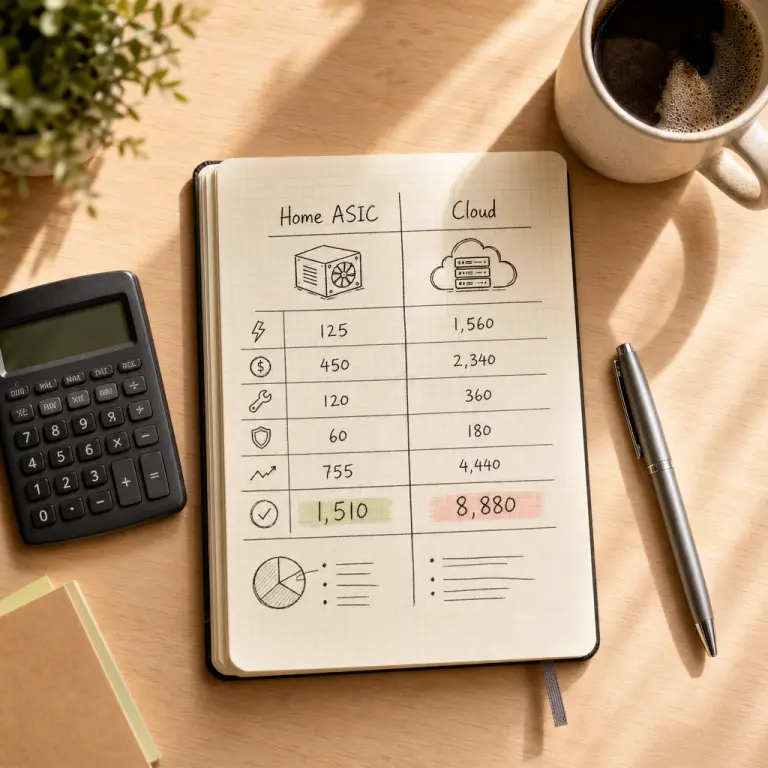
| Cost line item | Path A — Own Antminer S21 | Path B — NoxHash Pro cloud |
|---|---|---|
| Hardware | $4,500–6,000 upfront | $0 — included |
| Electricity (2,520 kWh/mo × 24) | ~$7,250 at $0.12/kWh | Included in rental |
| Cooling / HVAC | $30–100/mo extra AC | Natural cooling, $0 |
| Maintenance & repairs | My time + part costs | 24/7 technical team |
| Noise at my location | ~75 dB, basement-only | Zero — machine in data center |
| Hardware-failure risk | I absorb it 100% | NoxHash swaps in 4–8h |
| Depreciation / resale | ~30%+ loss in 2 years | N/A — not my asset |
| Setup time | Days–weeks (wiring, PDU, ducting) | Instant after payment |
| Total 2-year cash outlay | ~$11,750–13,250 | $1,920 fixed USD |
At my $0.12/kWh residential rate, the electricity line alone is larger than the entire cloud rental. That single row decided more than half my choice — but the other factors mattered too, and I want to walk through them one by one because residential rates and situations vary.
The Factors I Weighed, One by One
Money is the loudest number, but it is not the only one. These are the six factors I ranked in order of how much they shaped my final call.
Electricity — the 3x gap
My utility charges $0.12/kWh. NoxHash runs on a Kazakhstan industrial contract at $0.035/kWh. Same machine, same hashrate, but mine would burn roughly three dollars of power for every one of theirs. Over 24 months, that gap alone erases the entire cost of the cloud rental.
Cooling — nature does it for free there
An S21 dumps 3,500W of heat into whatever room it occupies. In my climate that means the AC fights the miner all summer — another line item on the power bill. Kazakhstan averages below 7°C year-round and drops to –30°C in winter, so NoxHash cools mostly with outside air.
Noise — 75 dB is basement-only
An S21 runs around 75 dB at one meter, roughly a vacuum cleaner that never turns off. My house has thin walls and a sleeping toddler. Even with sound-dampening foam, I would have spent weekends chasing rattles. Cloud mining pushes the noise to a facility built for it.
Maintenance — who do I call at 2 a.m.?
ASICs fail. Fans seize, hash boards die, PSUs pop. On my own, I'd ship units to a repair shop and lose weeks of hashrate. NoxHash's 24/7 techs swap a failed unit in 4–8 hours and my dashboard barely blinks. That "someone else's problem" value is genuine.
Depreciation — the S21 bleeds value
ASICs are terrible investment assets. A two-year-old miner typically resells for 60–70% of its original price, and the curve gets steeper near each halving. If I sold after 24 months, I'd probably recover $2,700–3,500 of the original $4,500–6,000 — a real $1,500–2,500 loss buried in the story.
Predictability — fixed USD vs moving target
With my own ASIC, cost depends on power pricing, cooling season, and failures. With cloud, my cost is $80/month, full stop. I personally value a budget I can plan around more than the small optimization edge of running my own machine in a perfect climate.
Run the same numbers against your own power bill
If your residential rate sits above $0.08/kWh, the electricity row alone usually tips the math toward cloud. Create a free account and activate the 2-day Basic Miner trial to watch real hashrate before you commit anything.
Where an Own ASIC Still Beats Cloud — Honestly
I want to be straight about this: cloud mining is not universally the right call. There are legitimate reasons to buy your own machine, and I considered each of these seriously before I pulled the trigger on Path B.
You own a real asset
A physical S21 is a thing you can see, touch, power off, and resell. If you value holding tangible hardware or want to move the machine to a different location later, only ownership gives you that. A cloud plan is a service contract, not an asset you can carry away.
Full control and tinkerability
You can undervolt, repaste, firmware-tune, switch pools, point hashrate at alt-SHA-256 networks, or shut down during a price crash. I cannot do any of that with a cloud plan. If deep technical control is part of the fun for you, that is a real argument for buying.
No platform counterparty risk
With your own miner the only party between you and your BTC is the pool. With any cloud platform (including NoxHash) you rely on the operator staying solvent and honest. That is a real risk to weigh, and it should push people with very low trust tolerance toward owning hardware.
Very cheap local power changes the math
If you happen to have rooftop solar, hydro access, or a commercial contract near $0.04/kWh, owning a miner can actually beat cloud on cost. My residential $0.12/kWh erased that possibility — but don't assume your situation mirrors mine.
How I Made the Final Call
When I laid everything out, two things pushed me into cloud:
- The electricity gap at my address was decisive. I am not in a cheap-power state, and the math doesn't survive a $0.12/kWh tariff.
- I prioritized simplicity over tinkering. My free time is scarce. A fixed $80/month with no maintenance calls is worth the loss of full control for me, even knowing I give up resale value and direct hardware ownership.
I locked in a 24-month Pro plan and pointed the savings I didn't spend on hardware toward a simple BTC-DCA strategy. Two months in, the decision still feels right — but if my power situation were different, or if I enjoyed the hardware side as a hobby, I could easily see someone reasonable picking the opposite path.
Frequently Asked Questions
Is cloud mining always cheaper than buying an ASIC?
Not always. The tipping point is usually your electricity rate. Below roughly $0.05/kWh with free cooling, a well-run home ASIC can beat cloud. Above $0.08/kWh on residential power, cloud almost always wins on pure cost — especially once you add HVAC, maintenance, and ASIC depreciation.
What happens to my earnings if the cloud platform has issues?
Counterparty risk is real with any cloud platform. That is why I withdraw BTC regularly instead of letting a large balance accumulate on the platform wallet, and why I started with a smaller plan before committing to 24 months. With an owned ASIC, that risk is replaced by hardware and local-utility risk.
Can I test cloud mining before committing 24 months?
Yes. NoxHash offers a free 2-day Basic Miner trial when you create an account — no deposit needed. Trial earnings are display-only, not withdrawable, but the hashrate and desktop view are real. I used it to confirm the dashboard worked as advertised before paying anything.
What about ASIC resale — doesn't it offset the upfront cost?
Partially, but less than people expect. A 2-year-old S21 typically resells at 60–70% of its new price, and the curve steepens near each halving. When I priced realistic resale, the net cost of ownership was still well above the 24-month cloud rental at my electricity rate — but your mileage will vary.
Do earnings actually cover the $80/month rental?
It depends entirely on BTC price and network difficulty. At favorable market conditions the Pro tier can produce BTC worth more than its rental cost; at unfavorable ones it can produce less. Nobody — cloud or owner — should assume guaranteed profit. I treat mining income as a variable stream, not a paycheck.
Not financial advice — a composite personal account
This article describes a composite decision assembled from real NoxHash user conversations and public data; the numbers are illustrative, not a personal investment record. Bitcoin mining returns depend on BTC price, network difficulty, halving cycles, hardware reliability, and local electricity prices — all of which can move sharply. Past performance does not guarantee future results. Only commit funds you can afford to lose, and consult a local tax advisor about crypto earnings in your jurisdiction.