WhatsMiner M60 vs M66 — Full Specification Breakdown
WhatsMiner M60 vs M66 specification breakdown — hashrate, J/TH efficiency, noise, reliability, and ROI math for MicroBT's two flagship Bitcoin miner series.
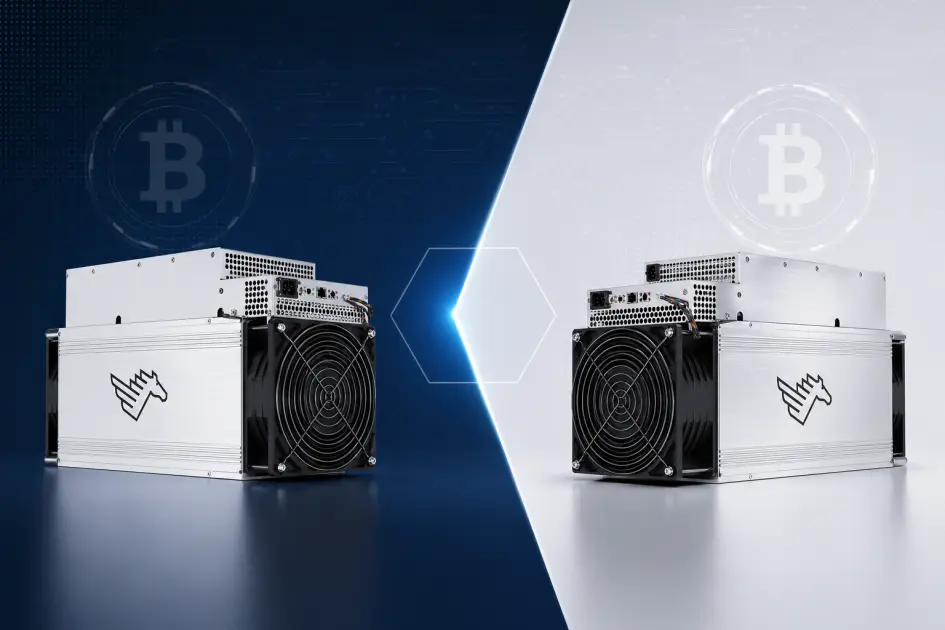
The WhatsMiner M60 vs M66 comparison is about MicroBT's own generational jump, not a Bitmain fight. The M60S delivers 186 TH/s at 18.5 J/TH for ~3,441W, while the newer M66S pushes 298 TH/s at 17.0 J/TH for ~5,066W. Both are air-cooled SHA-256 ASICs — but the choice depends on your capex budget and cost per deployed TH, not just raw hashrate.

WhatsMiner in 2026 — MicroBT's place in the ASIC market
MicroBT is the second-largest ASIC manufacturer in the world after Bitmain, commanding roughly 20–30% of the global SHA-256 hardware market as of early 2026. Its WhatsMiner brand has become the default "second source" for any serious Bitcoin miner who refuses to run a Bitmain-only fleet.
The M60 series (M60 and the higher-binned M60S) launched as MicroBT's 2024 flagship air-cooled line, built on a 5nm chip design and positioned as the company's answer to Bitmain's S21. The M66 series (M66 and M66S), released in late 2024 through 2025, is the direct next-generation replacement — same SHA-256 algorithm, same air cooling, but with refined silicon, a heavier power envelope, and noticeably better absolute hashrate per box.
Both series ship in standard 3U-ish form factors compatible with existing container and warehouse racks. The generational gap isn't about a new cooling paradigm — it's about denser silicon and smarter board layout. For operators already running M60S units, the M66S feels familiar to deploy but has meaningfully different economics once you do the math.
One useful mental model: think of the M60 series as MicroBT's "response to the S21" and the M66 series as its "response to the S21 Pro". Bitmain shipped first in each round, MicroBT countered with a tighter board revision a quarter or two later, and the market ends up with two viable options at each efficiency tier. That parallel is exactly why most serious farms stock both brands rather than picking sides — the competitive dynamic benefits buyers.
Full spec comparison — M60S vs M66S side by side
Here are the headline numbers both series are rated for at stock settings. The M66S wins on absolute hashrate and J/TH efficiency; the M60S wins on power draw and upfront cost if you only count watts and dollars.
| Specification | WhatsMiner M60S | WhatsMiner M66S (winner highlighted) |
|---|---|---|
| Hashrate (rated) | 186 TH/s | 298 TH/s |
| Power draw (wall) | ~3,441W | ~5,066W |
| Efficiency (J/TH) | 18.5 J/TH | 17.0 J/TH |
| Algorithm | SHA-256 | SHA-256 |
| Cooling | Air (dual-fan) | Air (dual-fan, higher CFM) |
| Noise level | ~75 dB | ~80 dB |
| Chip technology | 5nm (refined 2024 bin) | 5nm (next-gen 2024–2025) |
| Launch window | Early 2024 | Late 2024 – 2025 |
| Firmware | Proprietary, pool-configurable | Proprietary, pool-configurable |
| Warranty | ~1 year (standard) | ~1 year (standard) |
The M66S pulls 47% more watts from the wall but delivers 60% more hashrate — which is why its J/TH number is better. Noise is slightly higher, but both machines live in container-grade facilities where a 5 dB delta is a non-issue.
Efficiency and ROI math — capex-constrained vs footprint-constrained
Run the numbers at $0.035/kWh industrial power (close to what we pay in Kazakhstan) and a hashprice of $40 per PH/s per day, which is a reasonable mid-range assumption for 2026.
| Monthly economics (est.) | M60S | M66S |
|---|---|---|
| Power cost (730h, $0.035/kWh) | ~$87 | ~$128 |
| Gross mining revenue ($40/PH/day) | ~$223 | ~$358 |
| Net (before capex amortization) | ~$136 | ~$230 |
| Net per TH deployed | ~$0.73 / TH | ~$0.77 / TH |
The headline: M66S wins on absolute net profit per unit by roughly 70% because it crunches more hashes per box. But when you normalize for dollars per TH actually deployed, the gap narrows sharply. If you're capex-constrained (limited upfront cash for hardware), a used or late-stage new M60S can be the smarter pick because the purchase price per TH is usually lower, even if the J/TH number is a touch worse.
If you're footprint-constrained (fixed rack space, fixed power allocation per unit), the M66S is the obvious answer — denser hashrate per rack slot means fewer network cables, PDUs, and monitoring headaches per petahash of output.
A third consideration often missed: power delivery infrastructure. An M60S sits comfortably inside a 20A 240V circuit with headroom to spare. An M66S at 5,066W needs either a 30A circuit or careful balancing across two 20A circuits — the kind of thing that matters in a basement deployment but disappears in a facility with proper PDUs and transformer-grade wiring. Operators running at scale barely notice; home miners absolutely should.
Breakeven sensitivity also differs. The M60S stays profitable at a lower hashprice because its power bill is smaller in absolute dollars — if BTC price crashes and hashprice drops to $25/PH/day, the M60S still nets roughly $76/month while the M66S drops closer to $85/month. At $15/PH/day (a bear-market floor), both machines are marginal, but the M60S's smaller per-unit electricity exposure gives it a slight edge on survival during the downturn.
Numbers assume stable network difficulty and BTC price; real-world earnings vary with market conditions and difficulty adjustments. See Hashrate Index for live hashprice data.
Skip the M60S vs M66S decision — rent either (or both) per TH
NoxHash runs both M-series and S21-series units at a Kazakhstan facility with $0.035/kWh power. You rent hashrate by the TH, and we handle which specific box delivers it — so you get the M66S efficiency without the $5,000+ capex bill.
Reliability and firmware — why operators keep MicroBT in the fleet

Among farm operators, WhatsMiner has a quiet reputation for mechanical reliability that's slightly better than Bitmain's S-series, particularly around hashboard failure rates in long-duration deployments. The operator community doesn't treat this as a flame war — it's just a known bias that explains why many farms deliberately mix both brands even when one looks cheaper per-TH on paper.
The fleet-risk argument is straightforward: if a firmware bug, factory recall, or component supply issue hits Bitmain, your 100% Bitmain farm is exposed. A farm that's 60% Bitmain and 40% MicroBT keeps earning while the problem brand gets sorted. This is the same logic that made "dual-vendor" a standard phrase in enterprise IT procurement for 30 years, and it applies cleanly to ASIC mining.
Firmware-wise, both M60S and M66S run MicroBT's proprietary stack. You can configure mining pools, worker names, and basic tuning from a web UI, but you don't get the flashable openness of a third-party firmware scene like the S19 generation enjoyed. For most industrial operators this is fine — stock firmware is stable, and MicroBT pushes regular updates.
Warranty and repair networks are comparable to Bitmain: roughly 1 year of manufacturer coverage on new units, with regional repair hubs in Southeast Asia and Europe. Post-warranty, third-party hashboard repair shops service both M60 and M66 boards because the chip footprint is similar between the two series — so spare parts stocking is efficient if you run a mixed M-series fleet.
From an operations standpoint, one real-world difference emerges at the PSU (power supply unit) level. The M66S's larger power envelope stresses its PSU harder than the M60S does — and PSU failures are, industry-wide, one of the two most common hardware issues on ASICs (the other being hashboard chip degradation). Keeping a small stock of swap-in PSUs specific to each model cuts mean-time-to-recovery dramatically. At NoxHash we carry spare PSUs for both series, which is part of why per-customer downtime from hardware events stays low even when individual units misbehave.
Where each fits in NoxHash's fleet
NoxHash operates a deliberately mixed fleet — Bitmain Antminer S21-series units alongside MicroBT WhatsMiner M-series boxes — precisely to avoid single-manufacturer supply risk. We hold both M60S and M66S units in production, and customers don't see which specific box their rented hashrate resolves to. They see the TH/s they paid for, delivered on the SHA-256 network, and that's the contract.
Basic / Standard tiers
Backed by a pool of M60S and S21 units — workhorse density at moderate power budget per TH.
Pro tier
Leans on S21 Pro and M66S — the sweet-spot air-cooled machines for dense per-box hashrate at 15–17 J/TH.
Enterprise tier
1,000 TH/s at $250/month — served by a mix that can include S21 XP Hyd flagship units and M66S air-cooled boxes.
The practical effect: if MicroBT announces a recall on a specific M66 batch, we can shift customer hashrate allocation toward S21 and M60S units while the affected boxes cycle through repair. Single-manufacturer farms can't do that — they either eat the downtime or eat the supply-chain risk. For a customer renting hashrate rather than buying hardware, all of this complexity disappears into the per-TH price.
It also changes the upgrade cadence conversation. A home miner who bought one M60S in 2024 is stuck with that specific piece of hardware until they choose to sell and buy again — a capex cycle of thousands of dollars, complete with box shipping, warranty transfers, and resale value risk. NoxHash, by contrast, rotates aging units out and rolls new-generation units in continuously across the fleet. When the M70 series eventually ships and beats the M66S on J/TH by a meaningful margin, our customers see that efficiency gain in operational cost, not a new purchase decision. Cloud rental abstracts the hardware treadmill entirely.
WhatsMiner M60 vs M66 — frequently asked questions
Is the M66S better than Bitmain's S21 Pro?
S21 Pro hits 234 TH/s at 15.0 J/TH — better J/TH than M66S's 17.0 J/TH. But the M66S pushes more hashrate per box at 298 TH/s. S21 Pro wins efficiency; M66S wins density per rack slot. Most large farms run both deliberately.
Which WhatsMiner is quieter — M60S or M66S?
The M60S runs around 75 dB versus roughly 80 dB for the M66S — a noticeable but not transformative difference. Both are far too loud for a home environment. Either way, plan on a garage, shed, or dedicated mining facility with hearing protection required.
Does NoxHash prefer WhatsMiner over Bitmain?
No — NoxHash runs both deliberately to spread supply-chain and firmware risk across manufacturers. The fleet blends Antminer S21 series with WhatsMiner M60S and M66S boxes. Customers rent hashrate by the TH; the specific unit serving their rental is an operational detail.
What's the timeline for MicroBT's M70 series?
MicroBT has previewed an M70 series line targeting sub-15 J/TH for late 2026 or early 2027 availability, competing directly with Bitmain's next air-cooled flagship. Shipping dates for ASICs regularly slip by quarters, so treat any announced date as aspirational until production units appear.
Can I buy a used M60S cheaper than a new M66S?
Yes — used M60S units typically trade at 40–60% of new M66S pricing on secondary markets, making them attractive for capex-constrained operators. The catch is residual lifespan, warranty status, and hashboard health. Always insist on a diagnostic test report before wiring funds for used hardware.
Are M60 and M66 hydro-cooled like the S21 XP Hyd?
No — both the M60 and M66 series discussed here are air-cooled. MicroBT does sell hydro variants (the M63S Hyd, for example) in a separate product line, but the M60S and M66S stay squarely in the air-cooled category and ship with dual-fan assemblies rather than water-block interfaces.
How does a customer get exposure to M66S output without buying one?
Rent hashrate from a cloud mining operator like NoxHash that runs M66S units in its fleet. You pay a monthly fee for a specific TH/s allocation and receive BTC rewards proportional to your share — without the $5,000 capex, the warranty paperwork, or the 80 dB of fan noise at home.
Informational content, not investment advice
Hashrate, efficiency, and revenue figures are manufacturer specs and illustrative estimates. Real mining earnings depend on Bitcoin price, network difficulty, hashprice, pool fees, and power contract terms — all of which can move sharply. Past performance does not predict future results. Only deploy capital you can afford to lose, and verify current numbers on live sources before committing.