What Is a Satoshi? The Smallest Unit of Bitcoin Explained
A satoshi is 0.00000001 BTC — one hundred-millionth of a bitcoin. Learn conversions, why sats matter, and how they power Lightning, mining, and Ordinals.
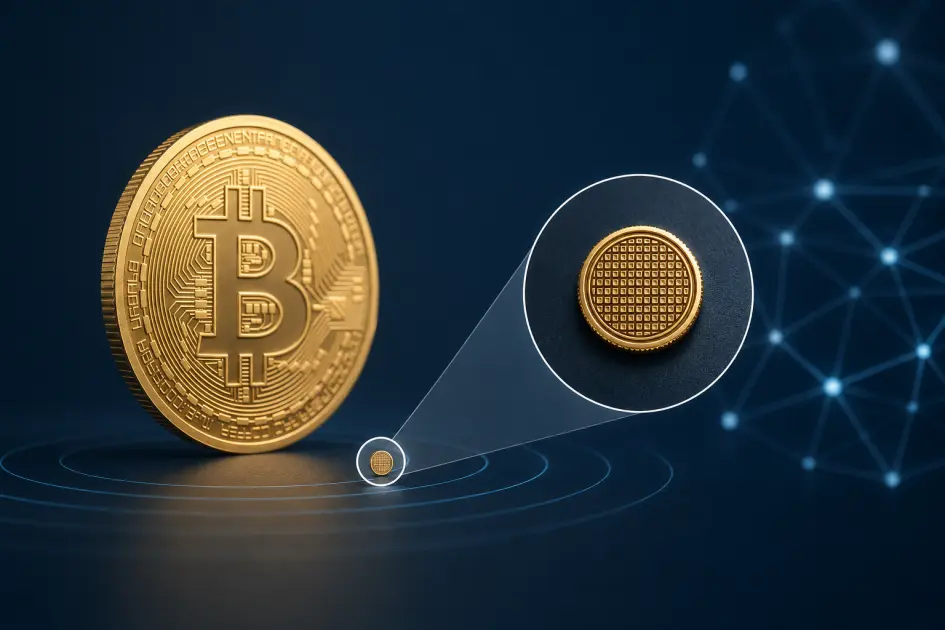
A satoshi (sat) is the smallest unit of Bitcoin, equal to 0.00000001 BTC — one hundred-millionth of a single bitcoin. One whole BTC contains exactly 100,000,000 sats, and the unit is named after Satoshi Nakamoto, Bitcoin's pseudonymous creator. Because each coin is this finely divisible, you do not need to own a whole bitcoin to participate — you can own, send, and earn sats.

The Plain Definition — and Where the Name Comes From
A satoshi is a single unit of the smallest amount that can exist on the Bitcoin blockchain. Bitcoin's codebase stores every balance as an integer number of satoshis — when your wallet shows "0.05 BTC", what the network actually sees is 5,000,000 sats. The decimal is a display convention; the ledger itself has always been sat-native.
The unit is a tribute to Satoshi Nakamoto, the pseudonymous creator who published the Bitcoin whitepaper in 2008 and mined the genesis block in January 2009. The shorthand "sat" first appeared on the BitcoinTalk forum in late 2010 and was formally adopted by the community in early 2011, after brief flirtations with alternative names like "austrians" and "shillings" — a debate documented on the Bitcoin Wiki satoshi unit page.
8 decimal places
Bitcoin was designed with 8 decimal divisibility from day one. The final digit — 0.00000001 BTC — is the atomic unit: a satoshi.
Integer-only on-chain
The Bitcoin protocol never stores fractional sats. Every UTXO, every fee, every block reward is an integer number of satoshis.
Capped at 2.1 quadrillion
21 million BTC ceiling translates to 2,100,000,000,000,000 sats — roughly 260,000 sats for every person alive today.
The Conversion Table — Sats, Bitcoin, and Everything Between
You will encounter a handful of Bitcoin denominations online, though most wallets in 2026 now default to a simple BTC/sats toggle. Knowing how they line up takes the guesswork out of reading block explorers, fee estimators, and mining dashboards.
| Unit | In satoshis | In BTC | Typical context |
|---|---|---|---|
| 1 millisatoshi (msat) | 0.001 sat | 0.00000000001 BTC | Lightning Network routing fees |
| 1 satoshi (sat) | 1 sat | 0.00000001 BTC | On-chain smallest unit, tips, Ordinals |
| 1 kilosat (ksat) | 1,000 sats | 0.00001 BTC | Minimum withdrawals, small mining payouts |
| 1 "bit" (legacy) | 100 sats | 0.000001 BTC | Rarely used today — legacy denomination |
| 1 milliBTC (mBTC) | 100,000 sats | 0.001 BTC | Legacy denomination, some exchanges |
| 1 bitcoin (BTC) | 100,000,000 sats | 1 BTC | Full coin — headlines and market quotes |
A concrete USD anchor: if BTC trades at $95,000, then 1 sat is worth roughly $0.00095 — less than a tenth of a US cent. Put another way, it takes about 1,053 sats to equal a single penny. The takeaway: sats are small enough that micropayments, streaming value, and dust-free tipping all become possible without ever touching a whole BTC.
Why "Stacking Sats" Matters — The Psychology of Small Units
"Stacking sats" is the phrase long-term Bitcoin holders and miners use for steadily accumulating Bitcoin in small amounts over time, rather than waiting to buy a whole coin. It shifts the mental frame from "I can't afford 1 BTC" to "I can afford 10,000 sats this week" — and over years, those stacks compound into meaningful positions.
There is also a hard-supply argument for thinking in sats. Bitcoin's 21 million coin ceiling sounds scarce in headlines, but 2.1 quadrillion satoshis is plenty of fine-grained units for global adoption. If every human alive received an equal share, that would be roughly 260,000 sats per person — more than enough for a unit of account to function at everyday price points.
Accessibility
Thinking in sats removes the psychological barrier of the BTC price tag. A $20 buy feels like "stacking 21,000 sats", not "buying 0.00021 BTC".
Precision for fees
Bitcoin network fees are quoted in sats per virtual byte (sats/vB). Working in sats is the only sensible way to read a fee market.
Abundance framing
21M BTC feels scarce, but 2.1 quadrillion sats feels plentiful. Both numbers describe the same supply — the frame changes how people behave.
Cultural shorthand
"Stacking sats" is the miner and HODLer ethos — accumulate quietly over time, let the cycles play out, verify on-chain rather than watch price.
Turn the stacking-sats idea into a real habit
You've seen why sats are the unit that matters for long-term accumulators. NoxHash's free 2-day Basic Miner trial lets you watch sats tick into a wallet in real time — no deposit, no card. It's the clearest way to feel what "stacking" looks like at a per-minute cadence.
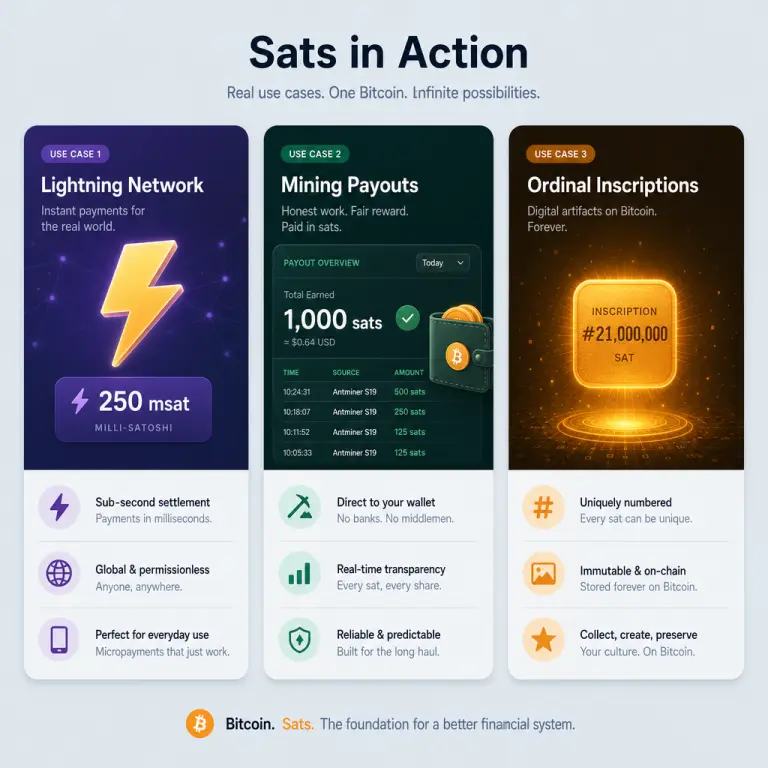
Sats in the Lightning Network — Where Millisats Come In
The Lightning Network is Bitcoin's high-speed payment layer, and it is sat-native — you cannot really transact on Lightning thinking in whole BTC. A routine Lightning tip is 100 sats (roughly $0.095 at BTC $95K). A streaming-video micropayment might be 1 sat per second.
Lightning also introduces a sub-satoshi unit: the millisatoshi (msat), where 1 sat = 1,000 msats. Millisats only exist inside Lightning channel accounting — they allow precise fee-splitting across multi-hop routes — and any Lightning payment has to round to an integer sat before it can ever settle on-chain. In practice, end users see sats; routing logic sees millisats.
Sats in Cloud Mining Payouts — How NoxHash Pays You
Mining payouts are a perfect reason to think in sats. A single Basic Miner (50 TH/s) earns on the order of a few hundred sats per day under typical 2026 network conditions — far too small to meaningfully express in BTC decimals, but intuitive as a daily sat count.
NoxHash credits your wallet every minute in real BTC, denominated internally in sats. The platform's minimum withdrawal is 0.00001 BTC — exactly 1,000 sats — which is the floor most modern ASIC services use: high enough to clear on-chain fees, low enough that a first-week miner can still cash out and verify self-custody. The table below grounds the math.
| Event | In sats | In BTC |
|---|---|---|
| NoxHash minimum withdrawal | 1,000 sats | 0.00001 BTC |
| Typical Lightning tip | 100 sats | 0.000001 BTC |
| Per-minute mining credit (illustrative) | ~1–5 sats (Basic Miner) | ~0.00000001–0.00000005 BTC |
| Current Bitcoin block reward | 312,500,000 sats | 3.125 BTC |
Per-minute mining figures are illustrative — actual output depends on BTC price, network difficulty, and real-time hashrate. The point is structural: when your revenue arrives as a constant trickle of sats, you naturally start thinking in sats, which is exactly how most of the mining industry has framed its balance sheets since 2020.
Sats in Ordinals — When Individual Sats Get Named
The Ordinals protocol, launched in 2023, introduced the idea that individual satoshis can be numbered, tracked, and inscribed with arbitrary data — turning a specific sat into a unique collectible. Ordinal theory assigns every sat a serial number based on the order it was mined, and "inscribing" a sat attaches text, an image, or other content to it that persists on-chain.
You do not need to care about Ordinals to use Bitcoin — most sats will live and die as plain value units. But the protocol is a useful reminder that every sat has its own identity in the ledger. Rare sats (the first sat of each block, sats from the genesis era, halving boundary sats) now trade at premiums in collector markets. It is one more reason the sat — not the BTC — is Bitcoin's fundamental unit.
Watch sats tick into a wallet you control
Reading about sats is one thing — seeing them accumulate minute by minute is another. NoxHash denominates every mining credit in real BTC, with a 1,000-sat minimum withdrawal to any Bitcoin address you choose. Test the flow with a small withdrawal before you size up.
Frequently Asked Questions
How many satoshis are in one Bitcoin?
There are exactly 100,000,000 satoshis in one bitcoin. A satoshi is the smallest on-chain unit — 0.00000001 BTC — and Bitcoin's ledger stores every balance as an integer number of sats. Because the supply cap is 21 million BTC, the total sat supply is 2.1 quadrillion.
How much is one satoshi worth in USD?
At a reference BTC price of $95,000, one satoshi is worth approximately $0.00095 — less than a tenth of a US cent. Roughly 1,053 sats equal one cent. The USD value of a sat moves in lockstep with the spot BTC price, so the figure updates constantly.
Can a satoshi be divided further?
Not on the Bitcoin blockchain — the satoshi is the smallest on-chain unit. The Lightning Network uses millisatoshis (1/1000 of a sat) for routing fee accounting, but any Lightning payment rounds to an integer sat before settling on-chain. Sub-sat amounts never appear in a block.
Why is it called a satoshi?
The unit honors Satoshi Nakamoto, Bitcoin's pseudonymous creator who authored the 2008 whitepaper and mined the genesis block. The community coined the name on the BitcoinTalk forum in late 2010 and adopted it broadly in 2011. Satoshi Nakamoto's real identity remains unknown.
What does "stacking sats" mean?
Stacking sats is the practice of accumulating Bitcoin gradually in small amounts — through recurring purchases, mining payouts, tips, or earned income — rather than buying a full BTC at once. The phrase captures a long-horizon mindset popular among miners and long-term holders.
How many sats do I need to withdraw from NoxHash?
The minimum withdrawal is 1,000 sats — equal to 0.00001 BTC. Withdrawals go to any Bitcoin address you control (Segwit, P2PKH, or P2SH) and carry a 1.5% network fee. Hitting 1,000 sats is deliberately low so new users can test self-custody early.
Educational content — not financial advice
This article explains Bitcoin units for reference and is not financial, tax, or investment advice. USD values of sats change every second with the BTC spot price; example per-minute mining credits are illustrative and depend on network difficulty, BTC price, and operator conditions. Only commit funds you can afford to lose, and consult a qualified professional before sizing up any crypto position.