What Is a Mining Pool and Why Do Miners Join One?
A mining pool combines hashrate so payouts stay frequent and predictable. Learn how pools work, PPS vs PPLNS vs FPPS, and the top Bitcoin pools in 2026.
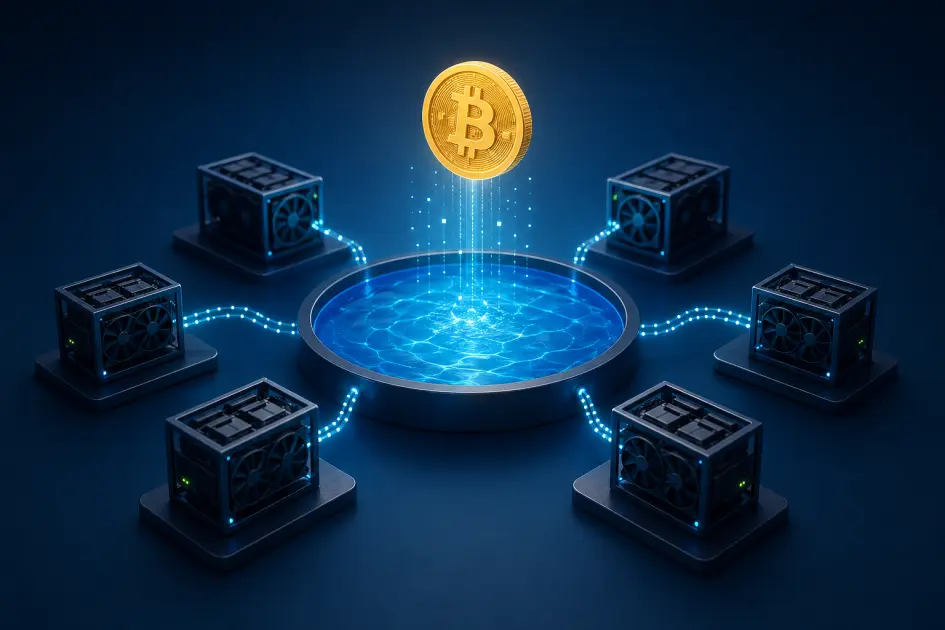
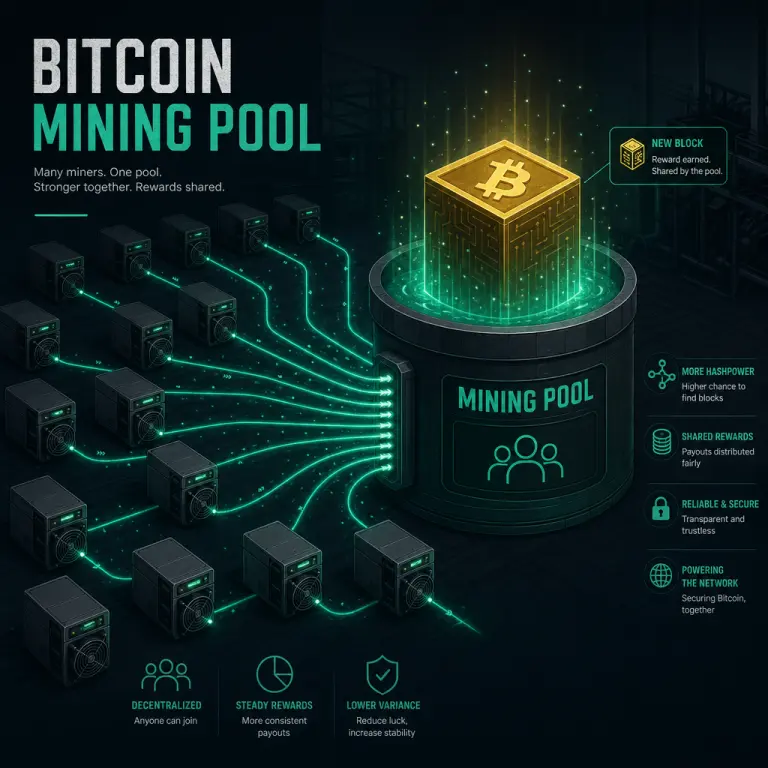
A mining pool is a group of Bitcoin miners who combine their hashrate and share the block rewards proportionally, so payouts become frequent and predictable instead of winning a full block once every several years. Think of it as a lottery-ticket syndicate: pooling thousands of tickets means the group wins far more often, and everyone collects a small cut of each win.
Why Solo Mining Looks Like a Lottery
Bitcoin's network hashrate sat above 1 ZH/s (1,000 EH/s) in early 2026 with difficulty near 135 T. At that scale, solo mining — running your own miner without joining a pool — becomes a statistical game with very long odds. The network produces a block roughly every 10 minutes, but it doesn't matter how many blocks are found if yours is never the winning ticket.
Here is the math the industry actually uses. A dedicated solo miner running 1 PH/s (1,000 TH/s) of hashrate — roughly five Antminer S21 Pro units — represents about one millionth of the global network at 1 ZH/s. At 144 blocks per day, that miner's expected block-finding rate is about one block every ~14 years. Find one and you earn the full 3.125 BTC block reward plus transaction fees. Find none and you earn zero for a decade and a half.
For anyone who isn't running a multi-megawatt fleet, that variance is simply unusable. You can't pay an electricity bill with a jackpot ticket you might not cash for 14 years. Joining a pool converts that single, massive, rare payout into thousands of small, frequent ones — the same expected value, minus a small fee, but with the cash flow shape a real miner needs.
Frequent payouts
Pools credit your share every few minutes or once a day instead of forcing you to wait for a direct block hit. Cash flow looks like a job, not a slot machine.
Predictable income
Under PPS-style payout schemes, you get paid per share regardless of whether the pool actually finds a block that day. Revenue becomes a calm line instead of a spiky chart.
Low variance
Variance scales down with pool size. Ten thousand miners sharing a block reward smooth out the randomness that would otherwise dominate any single participant's returns.
Payout Methods — PPS vs PPLNS vs FPPS
Not all pools pay the same way. The three dominant models each move a different risk from the pool onto the miner (or vice versa). Once you understand which, choosing a pool becomes much easier.
| Model | How it pays | Who bears the risk | Best for |
|---|---|---|---|
| PPS Pay Per Share |
Fixed payout per valid share based on expected block reward only. Transaction fees stay with the pool. | Pool absorbs all luck variance. | Miners who want a flat, boring salary and don't care about transaction-fee upside. |
| PPLNS Pay Per Last N Shares |
You only get paid when the pool finds a block — then shares from the last N rounds split the reward. | Miner absorbs all luck variance. | Loyal miners who stay on one pool long-term and don't mind streaky payouts. Lowest fees. |
| FPPS Full Pay Per Share |
Fixed share-based payout plus a share of average network transaction fees. | Pool absorbs variance; miner captures fee upside. | Most miners in 2026 — the industry default. Stable cash flow plus fee income. |
FPPS is the clear winner for the majority of operators, which is why it has become the default model across the largest pools in 2026. You get the predictability of PPS and your proportional share of the fee market, which currently adds a meaningful few percent on top of block-reward income — especially important post-halving when fees make up a bigger slice of total miner revenue. Pool fees on FPPS typically range from 1% to 4%, with most major pools clustered in the 2–2.5% band.
Want FPPS payouts without picking a pool?
NoxHash already routes rented hashrate to major FPPS pools on your behalf. You rent TH/s from $20/month, we handle the pool selection, share submission, and fee layer — BTC shows up in your wallet on a steady cadence.
The Top Bitcoin Mining Pools in 2026
Pool share shifts month to month, but the concentration at the top has been remarkably stable. According to the public Hashrate Index pool distribution chart, four names control the overwhelming majority of Bitcoin's global hashrate in early 2026:
| Pool | Approx. network share (Q1 2026) | Default payout | Notes |
|---|---|---|---|
| Foundry | ~30–37% | FPPS | US-based, institutional onboarding with KYC — dominant among North American public miners. |
| AntPool | ~14–20% | FPPS | Bitmain-aligned, default for many Antminer buyers globally. |
| ViaBTC | ~10–11% | PPS+ / FPPS | Strong presence in Russia and Central Asia; multi-coin pool. |
| F2Pool | ~7–9% | PPS+ / FPPS | One of the oldest active pools; technically sophisticated, offers merge-mining on several chains. |
Together, Foundry and AntPool alone command roughly half or more of global hashrate — a concentration that concerns some Bitcoiners from a decentralization standpoint. The counter-argument is that individual miners can switch pools at any time, so "pool share" is more fluid than "network power" suggests. Either way, if you are choosing a pool in 2026, the realistic shortlist is short.
How Pools Affect Cloud Mining Renters
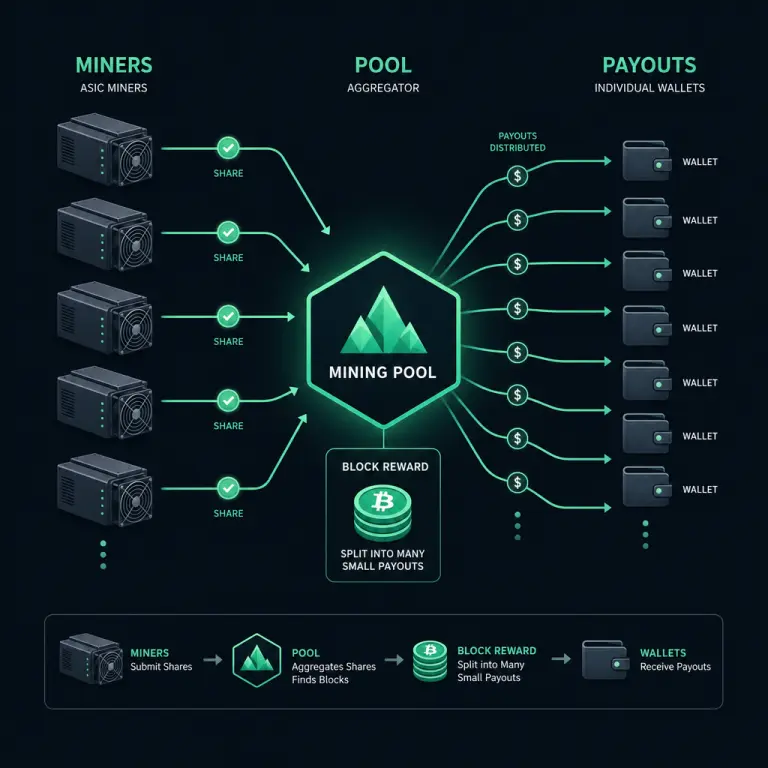
Here is a detail many beginners miss: when you rent hashrate from a cloud mining platform like NoxHash, you are not picking the pool yourself. The operator runs the physical ASICs at its Kazakhstan data center and connects them to mining pools on your behalf. You see the BTC land in your account; the pool selection happens invisibly behind the dashboard.
In our case, rented hashrate is routed to major FPPS pools by default. That choice is deliberate: FPPS gives renters the smoothest payout curve because it strips out the pool-luck variance and adds transaction-fee income on top. Pool fees (typically 1–2% at scale) are already absorbed into the monthly rental price, so renters see BTC credited to their wallet without a separate pool-fee line item.
The practical upshot: if you rent a Standard Miner (150 TH/s) for $50/month, you don't need to understand PPLNS round mechanics or negotiate pool fees. You just need to decide how much hashrate to rent and for how long. The pool layer is already handled — correctly — by the operator.
Skip the pool research — just rent hashrate
If the last 1,200 words were more than you bargained for, that's the point of cloud mining. NoxHash connects your rented TH/s to FPPS pools automatically, credits BTC every minute, and lets you test the full flow on a 2-day Basic Miner trial — no deposit required.
Frequently Asked Questions
Do I need to join a pool if I already have a large miner?
Practically, yes. Even a 1 PH/s rig — five top-tier Antminer S21 Pro units — faces roughly one block every 14 years solo at today's ~1 ZH/s network hashrate. Pools convert that variance into steady daily income. Only multi-EH/s operators realistically consider solo mining.
Which payout method is best for a beginner — PPS, PPLNS, or FPPS?
FPPS in almost every case. It pays a stable share-based amount plus your cut of network transaction fees, so income is smooth but still captures fee upside. PPLNS can beat FPPS during lucky streaks but adds too much variance for a newcomer learning the ropes.
How much do mining pools charge in fees?
Most major pools charge 1–4% of mined rewards. FPPS pools cluster around 2–2.5%, PPLNS pools sometimes offer 0–1% as an incentive for loyalty, and institutional tiers at Foundry can be negotiated toward 0% for very large miners. Lower fees do not always mean higher net income once variance is factored in.
If cloud mining uses pools, who receives the fees?
The pool fee is paid by the operator running the physical ASICs — in NoxHash's case, absorbed into the monthly rental price. As a renter, you don't see a separate pool fee line. What you pay is the advertised hashrate rental fee; what you earn is BTC net of the pool layer already being handled.
Does pool concentration threaten Bitcoin's security?
Pool share does not equal hashrate ownership. Individual miners point their machines at whichever pool they choose, and can switch providers within minutes. If a pool operator misbehaved, its hashrate would drain almost immediately. Concentration is worth monitoring but is not the same as centralized control of blocks.
Can I switch mining pools whenever I want?
If you run your own ASIC, yes — pointing a miner at a new pool takes a couple of minutes via its web interface. If you rent cloud hashrate, pool selection is handled by the operator and isn't a user setting. For most renters that is a feature, not a limitation.
Educational content — not financial advice
This guide is for education. Pool market-share figures, network hashrate, difficulty, and fee ranges reflect public data as of April 2026 and will change. Mining income depends on BTC price, network difficulty, pool luck, and operator reliability — all outside your direct control. Past performance does not guarantee future results. Only commit capital you can afford to lose and consult a qualified tax professional for your jurisdiction.