What Is Merge Mining? How Some Coins Are Mined Alongside Bitcoin
Merge mining lets one proof-of-work hash secure multiple chains at once — how AuxPoW works, which coins use it, and whether it adds meaningful income for miners.
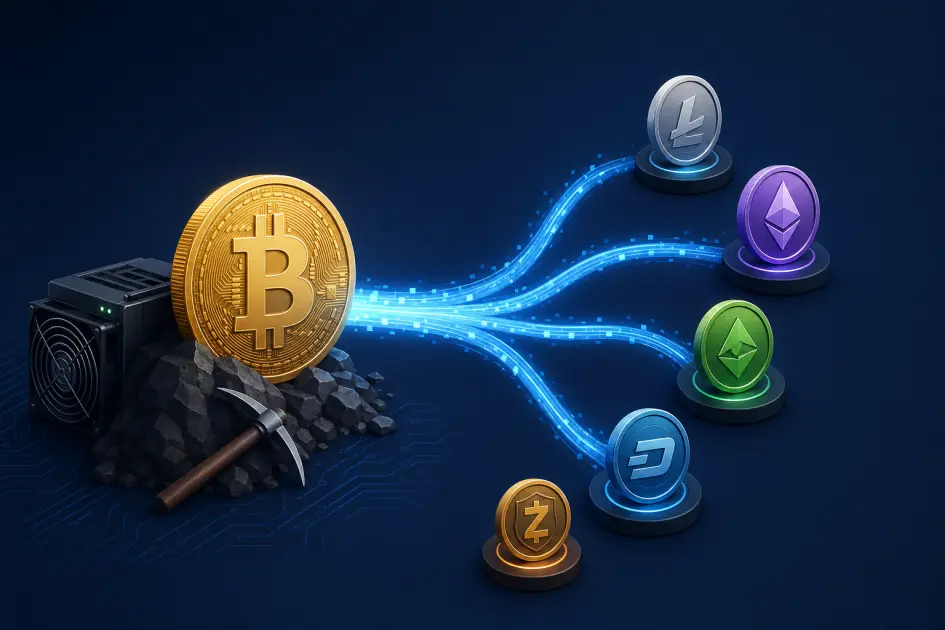
Merge mining is a technique that lets a single proof-of-work hash secure two or more blockchains at the same time, so miners can earn rewards on each chain without spending extra electricity. It relies on a standard called Auxiliary Proof-of-Work (AuxPoW), invented by Satoshi Nakamoto for Namecoin in 2011. Today it still powers coins like RSK, Syscoin, and the Litecoin-Dogecoin pair.

The simple idea behind merge mining
Mining a proof-of-work chain is expensive: you buy ASICs, pay for electricity, and run them 24/7 to search for a block hash that meets a difficulty target. Merge mining flips the economics: once you have done that work, the same hash can be submitted to other compatible chains for free. If one of those chains accepts it, you collect a second reward without spending a watt more.
The idea was proposed by Satoshi Nakamoto in December 2010 as a way to let small projects inherit Bitcoin's security. Namecoin became the first production merge-mined coin in October 2011, and the concept has been part of the Bitcoin ecosystem ever since. A chain that uses it is called a "child" or "auxiliary" chain; the chain whose hash it borrows is the "parent."
The mechanism only works when a child chain is designed to accept parent-chain headers as valid proof. Bitcoin itself does not care about the child — BTC miners do not need to change anything. The child chain does all the coordination work on its side.
How AuxPoW works, step by step
Auxiliary Proof-of-Work is the protocol rule that lets a child chain recognize a parent-chain block hash as its own proof of work. The mechanics are less magical than they sound.
Build a candidate block on the child chain
The miner (or, in practice, the mining pool) assembles a candidate block for the child chain — transactions, timestamp, and its own header — just as it would for any chain. Call the hash of this header H_child.
Commit to that header inside the Bitcoin coinbase
The pool inserts a commitment to H_child into the BTC block's coinbase transaction — typically as part of a Merkle root of multiple auxiliary chain headers. This is often placed in an OP_RETURN-style field so it never spends BTC, only records a few bytes.
Mine the Bitcoin block normally
SHA-256 hashing proceeds as usual. The ASIC does not know or care about the child chain — it is just searching for a hash under Bitcoin's difficulty target. When a valid hash is found, the BTC block is broadcast.
Submit the same hash to the child chain
The child chain's difficulty target is usually far lower than Bitcoin's. So the same hash that cleared BTC's bar also clears the child's, by a wide margin. The pool submits the BTC header plus a Merkle proof showing H_child was committed — the child accepts it as a valid block.
Collect rewards on both chains
BTC block reward plus fees go to the pool as normal. The child-chain reward (NMC, RBTC, SYS, or similar) goes to the address specified in the child block's coinbase. One hash, two payouts.
Two details matter. First, it is asymmetric: the parent chain does not need to know the child exists. Second, it is near-free for the miner — the only extra cost is a handful of bytes in the coinbase plus the software to track child blocks, which pool operators handle centrally.
Notable merge-mined coins in 2026
Not every altcoin supports merge mining — the chain has to be designed for it. These four are the most historically and practically relevant examples.
Namecoin (NMC) — with Bitcoin
The original. Launched April 2011, switched to AuxPoW on block 19,200 in October 2011. Namecoin is a decentralized naming system (think DNS with .bit domains) that piggybacks on Bitcoin's hashrate for security.
RSK / Rootstock — with Bitcoin
A Bitcoin sidechain that adds Ethereum-style smart contracts. Mainnet launched January 2018. BTC miners merge-mine RSK and earn RBTC (a 1:1 Bitcoin-pegged token) plus fees paid on the sidechain's contract traffic.
Syscoin (SYS) — with Bitcoin
A merge-mined chain that bundles a UTXO layer with an EVM-compatible rollup. Merge mining with Bitcoin gives Syscoin access to roughly the same hashrate security as BTC itself, at no extra cost to participating pools.
Dogecoin (DOGE) — with Litecoin
The famous non-BTC pairing. Dogecoin enabled AuxPoW in September 2014 at block 371,337, and has been merge-mined with Litecoin ever since. Both use Scrypt, so LTC miners get DOGE as a bonus on every LTC block. Not relevant to SHA-256 ASICs.
The first three sit on top of Bitcoin's SHA-256 hashrate. The DOGE+LTC pair sits on Scrypt hashrate — a reminder that merge mining is a generic idea, not Bitcoin-specific. Any two PoW chains sharing the same algorithm can do it, as long as the child is built to accept parent headers.
Does merge mining pay real money?
The honest answer: a little, not a lot — and it depends heavily on which pair you are looking at.
| Pair | Typical bonus on top of parent revenue | Notes |
|---|---|---|
| BTC + Namecoin | Well under 1% | NMC market cap tiny; liquidity thin |
| BTC + RSK | Usually under 1%, variable | Depends on RSK contract fee activity |
| BTC + Syscoin | Well under 1% | Small relative to BTC block reward |
| LTC + Dogecoin | Roughly 30–80% | Materially changes LTC mining economics |
For a Bitcoin miner, merge-mined altcoins combined are rarely more than a rounding error on the main BTC revenue line. The parent chain is where the serious money lives, and any auxiliary coins are a small kicker. Many pools sell the auxiliary coins on exchanges and fold the proceeds into the BTC payout, so miners never see a line item for NMC or RBTC.
The Litecoin-Dogecoin case is the exception that proves the rule. Because DOGE has a large market cap relative to LTC and an active culture, a Scrypt miner can earn meaningful extra income — often 30–80% of their LTC revenue, depending on DOGE price. That is why you almost never see a serious LTC pool that does not merge-mine DOGE.
Crucially, individual miners rarely configure merge mining themselves. The pool handles the AuxPoW work template, the commitments, and the reward splitting. From the miner's perspective, merge mining is a feature of the pool, not of the hardware.

Merge mining and cloud mining: what renters should expect
Cloud mining adds a layer on top: the renter pays for hashrate, and the operator runs the actual hardware. Whatever the pool pays out in auxiliary coins flows to the operator first, and how (or whether) it reaches the renter depends on the contract.
Most cloud mining platforms do not pass through merge-mined bonus coins to renters. The amounts are small, accounting them separately across thousands of users is operationally heavy, and users typically want to be paid in BTC anyway. So the auxiliary rewards either stay on the operator side or are silently converted into BTC and folded into normal payouts.
NoxHash falls in the same camp: payouts to users are made in Bitcoin, credited to your in-platform wallet. We do not itemize merge-mined bonuses in your earnings view, and we do not promise NMC, RBTC, or SYS rewards as part of a plan. If you rent a Pro Miner at 350 TH/s, the revenue you see is BTC revenue — the same SHA-256 output you would expect from a mainstream BTC-focused pool.
This is not unique to NoxHash. It is the default behavior across the industry, and for good reason: unbundling sub-1% auxiliary coins would add complexity without giving users a number they can plan around.
Skip the AuxPoW paperwork — rent hashrate and get paid in Bitcoin
The small merge-mining bonuses on BTC sidechains rarely move the needle for renters. NoxHash keeps the accounting simple: rent a plan, earn BTC, withdraw when you want. The pool handles the pool-side mechanics.
Risks and criticisms of merge mining
Merge mining looks like a free lunch for everyone — and it mostly is — but it comes with real downsides worth naming.
Borrowed security, not earned
A child chain's security depends entirely on parent-chain miners choosing to merge-mine it. If a majority of pools stopped supporting Namecoin tomorrow, NMC's hashrate — and its resistance to reorgs — would drop sharply overnight.
Pool concentration
Because the AuxPoW work is assembled at the pool level, a handful of large pools effectively decide whether a child chain lives or dies. Academic research has flagged this as a quiet centralization risk for merge-mined coins.
Bribery attack surface
Researchers have pointed out that merge-mined child chains can in theory be attacked cheaply if a rival pays parent-chain miners to include malicious child headers. The parent chain's security does not automatically transfer to honest behavior on the child.
Orphan risk for the child
If pools quietly drop a merge-mined chain — say, because the auxiliary coin's price dropped below the operational overhead — the child can go from well-secured to effectively abandoned, leaving users exposed to block reorganizations.
None of these criticisms break merge mining as a concept. They are reasons to treat small merge-mined chains with healthy skepticism as investments, and to remember that "secured by Bitcoin's hashrate" is a marketing claim with real caveats — the security is only as strong as pool operators' willingness to keep participating.
Frequently asked questions
Is merge mining the same as dual mining?
No. Merge mining reuses a single proof-of-work hash across multiple chains that share the same algorithm. Dual mining runs two different algorithms on the same hardware at the same time, like Ethash plus Kaspa on a GPU. Merge mining is algorithm-matched; dual mining is algorithm-split.
Does NoxHash merge-mine and pass bonuses to renters?
NoxHash pays users in Bitcoin. We do not promise or itemize merge-mined altcoin bonuses (Namecoin, RBTC, Syscoin) in plan earnings, and we do not base pricing on them. What you see in your wallet is BTC income from SHA-256 work, not a bundle of small auxiliary coins.
Can I merge-mine Bitcoin and Bitcoin Cash?
No. Both use SHA-256, but neither BTC nor BCH implements AuxPoW to accept the other's headers as valid proof. Miners can switch between them based on profitability, but they cannot mine both in a single act of hashing. That requires a chain explicitly designed as an auxiliary chain.
Is Dogecoin merge mining still profitable in 2026?
For Scrypt miners, yes — DOGE typically adds 30–80% on top of Litecoin mining revenue depending on DOGE price. It does not help Bitcoin ASIC miners, because SHA-256 hardware cannot mine Scrypt. The DOGE+LTC pair has been active since September 2014 and remains the most material merge-mining case.
What is the difference between merge mining and a sidechain?
A sidechain is any chain pegged to another for asset movement. Merge mining is a security mechanism. RSK is both — a Bitcoin sidechain that also merge-mines with Bitcoin. A chain can be a sidechain without merge mining (using a federation), and a merge-mined chain does not have to be pegged.
Do merge-mined coins hurt Bitcoin in any way?
In practice, no. The only BTC-side footprint is a small commitment inside the coinbase transaction, which costs the miner essentially nothing. Bitcoin's consensus, difficulty, and block propagation are unaffected. The child chains bear all the protocol complexity on their side.
Educational content, not investment advice
This article explains merge mining as a technical concept. It is not a recommendation to buy, hold, or mine any of the coins mentioned. Auxiliary coins can be thinly traded, can lose pool support with little notice, and can experience sudden drops in hashrate security. Cryptocurrency mining and investing involve market, regulatory, and technical risks — research carefully and only commit funds you can afford to lose.