What Is J/TH? Understanding Energy Efficiency in Mining
J/TH measures how much electricity an ASIC miner burns per trillion hashes. Learn the math, see 2021-2025 efficiency gains, and why the metric matters.
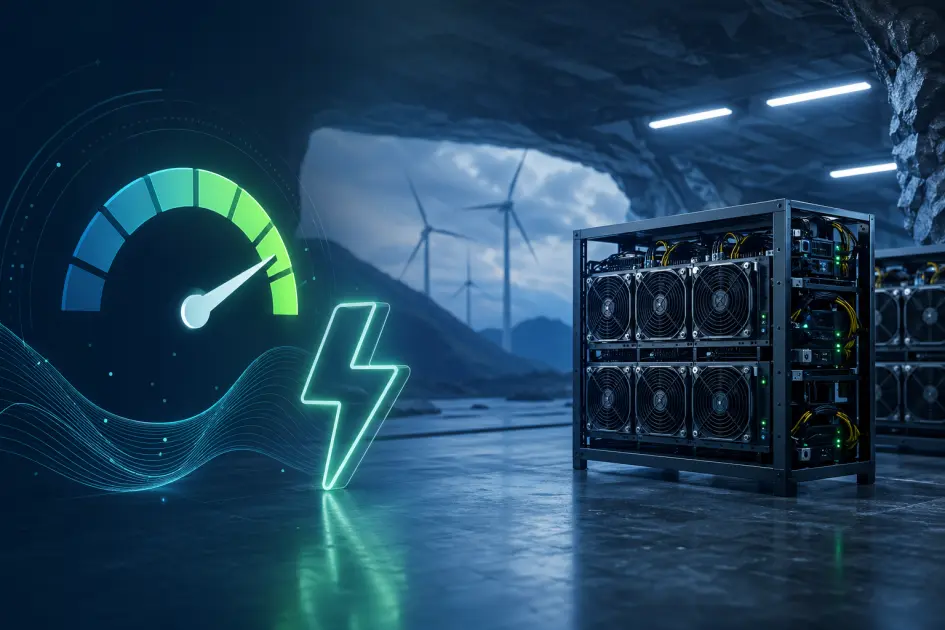
J/TH (Joules per Terahash) is a measure of ASIC miner energy efficiency — how many joules of electricity it takes to perform one trillion hashes. Lower is better. A 2021 Antminer S19 Pro consumed about 30 J/TH; a 2024 S21 Pro runs at 15 J/TH. Cut the J/TH in half and you cut the electricity cost per mined Bitcoin in half — which is why this single number quietly decides who stays profitable when the market turns.
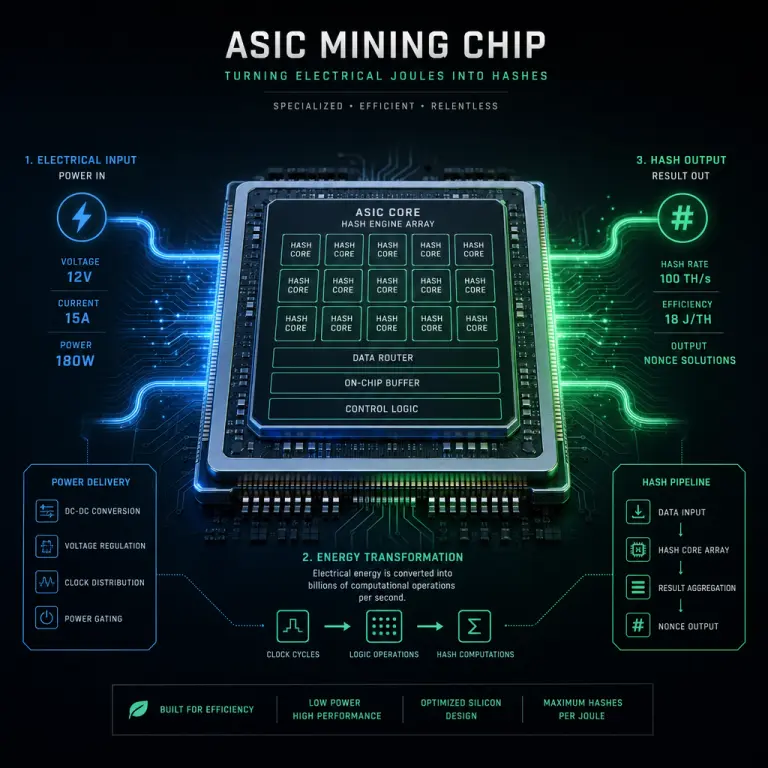
J/TH in Plain English — Plus the Quick Math
Every ASIC miner is, at heart, a machine that converts electricity into guesses at a cryptographic puzzle. J/TH tells you how efficiently it does that conversion. One joule is the energy a 1-watt device uses in one second. One terahash is one trillion hash attempts. Divide the watts a machine draws by the terahashes it produces per second, and you get its J/TH rating — the electricity bill attached to every trillion hashes.
The formula is simpler than it looks: J/TH = Watts ÷ TH/s. A Bitmain Antminer S21 Pro draws 3,510 W at 234 TH/s, so 3,510 ÷ 234 = 15.0 J/TH. That single number lets you compare any two miners apples-to-apples, regardless of size or vintage, and feeds straight into the one question miners actually care about: how much does it cost to find a Bitcoin on this hardware?
The formula
J/TH equals watts divided by terahashes per second. One watt running for one second is one joule — that's the foundation of the unit.
Worked example
Antminer S21 Pro: 3,510 W ÷ 234 TH/s = 15.0 J/TH. Antminer S21: 3,500 W ÷ 200 TH/s = 17.5 J/TH. Same math, every unit.
Why "lower is better"
Fewer joules per trillion hashes means less electricity for the same work. Halving J/TH halves your power cost per mined BTC — directly, one-to-one.
How ASIC Efficiency Has Evolved — Five Generations of J/TH
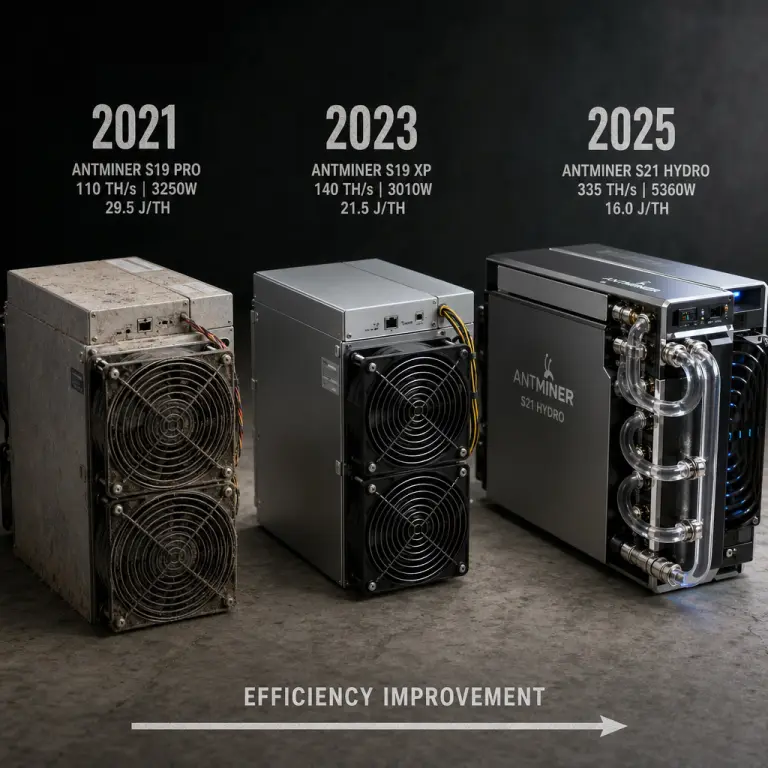
The progress over the last five years has been steep and steady. Each new chip node shaves J/TH by roughly 15–40% against its predecessor, thanks mainly to smaller lithography (5 nm → 3 nm) and better thermal design. Here's how the leading air-cooled and hydro-cooled machines line up, sourced from manufacturer specifications and independent benchmarks.
| Year | Model | Hashrate | Power | Efficiency |
|---|---|---|---|---|
| 2021 | Antminer S19 Pro | 110 TH/s | 3,250 W | ~29.5 J/TH |
| 2023 | Antminer S19 XP | 140 TH/s | 3,010 W | ~21.5 J/TH |
| 2024 | Antminer S21 | 200 TH/s | 3,500 W | 17.5 J/TH |
| 2024 | Antminer S21 Pro | 234 TH/s | 3,510 W | 15.0 J/TH |
| 2025 | Antminer S21 XP Hyd | 473 TH/s | 5,676 W | 12.0 J/TH |
Specifications verified against Bitmain's official product pages and the public ASIC Miner Value efficiency index. The trend is clear: efficiency has improved roughly 2.5× in four years. A 2021 flagship and a 2025 flagship produce the same terahash at dramatically different electricity bills.
Why J/TH Decides Operator Margin — The Cost-Per-BTC Math
On paper, mining is simple: the network pays you BTC, and you pay for electricity. Hardware cost and rack space matter, but electricity is the recurring bill that never stops. J/TH is the exchange rate between kilowatt-hours and hashes — and across a fleet of hundreds of machines, a 5 J/TH difference compounds into a very large number.
Consider two 1 EH/s fleets running for 30 days at the NoxHash industrial rate of $0.035/kWh. One fleet averages 30 J/TH (2021 vintage), the other 15 J/TH (2024 S21 Pro class). Power draw on 1 EH/s is the efficiency times the hashrate — so 30 MW versus 15 MW, continuous, 720 hours each.
| Metric | Fleet A — 30 J/TH (2021) | Fleet B — 15 J/TH (2024) |
|---|---|---|
| Hashrate | 1 EH/s | 1 EH/s (same) |
| Continuous power draw | 30 MW | 15 MW |
| Energy per 30 days | 21.6 GWh | 10.8 GWh |
| Power cost at $0.035/kWh | ~$756,000 | ~$378,000 |
| BTC mined (identical hashrate) | Same | Same |
| Electricity cost per mined BTC | 2× higher | Half as much |
Both fleets produce the same BTC because hashrate is identical — but Fleet B pays $378k less per month for electricity. That's not margin improvement. That's survival math. When BTC drops 40% or difficulty jumps 10%, Fleet A goes underwater first. Fleet B keeps mining. This is exactly why professional operators refresh hardware aggressively and why the NoxHash fleet sits in the 12–18.5 J/TH range rather than coasting on older gear.
See the hardware behind the efficiency
The J/TH numbers in the table above are the actual machines NoxHash runs — Antminer S21 Pro at 15 J/TH, S21 XP Hyd at 12 J/TH. Open a free account to inspect the live fleet, run the 2-day Basic Miner trial, and watch the watts-to-hashes math happen in real time.
Why J/TH Matters to Cloud Mining Renters — Indirectly, but Meaningfully
If you rent hashrate instead of owning it, you don't pay the electricity bill directly — the operator does. So does J/TH still matter to you? Yes, but one layer removed. The efficiency of the machines in the fleet you're renting from quietly determines whether your rental pricing stays stable over time.
Here's the mechanism. A cloud mining operator on 30 J/TH hardware has a thin margin between what users pay and what electricity costs. When BTC price drops or difficulty climbs, that margin evaporates first — and the operator is forced to either raise rental prices, cut terms short, or (worst case) stop paying out. Operators on 15 J/TH hardware have twice the margin cushion, which translates into more stable contracts, steadier BTC payouts, and lower pressure to hike prices during a downturn.
You also inherit the operator's obsolescence risk. A fleet stuck on older hardware will either raise rental prices or wind down those contracts as newer, more efficient machines outcompete the old ones on the open market. When you evaluate any cloud mining provider, ask what hardware they run and quote the J/TH. If they won't name the models, they probably don't want the comparison.
Air-Cooled vs Hydro-Cooled — Where the Efficiency Gains Come From
You'll often see two variants of the same generation — for instance, Antminer S21 (air-cooled, 17.5 J/TH) and S21 XP Hyd (hydro-cooled, 12.0 J/TH). The difference isn't magic chip tuning. It's thermodynamics.
| Aspect | Air-cooled ASIC | Hydro-cooled ASIC |
|---|---|---|
| Cooling medium | Forced air, four fans | Liquid coolant loop |
| Chip temperature | Higher — limits overclock headroom | Lower — chip runs at sweet spot |
| Typical efficiency gain | Baseline | 20–30% lower J/TH |
| Noise & infrastructure | ~75 dB, simple install | Quieter, needs coolant loop |
Colder silicon leaks fewer electrons and runs more reliably at target clock — so liquid-cooled chips simply do more hashes for the same watt. That's why the most efficient NoxHash machines are the hydro-cooled S21 XP Hyd units at 12 J/TH, deployed alongside air-cooled S21 and S21 Pro models for balance across the fleet.
Ask the J/TH question before you rent anywhere
You now know the metric and the math. Any reputable cloud mining operator should answer "which models, at what J/TH?" in a sentence. NoxHash publishes its fleet in full — S21 series at 12–17.5 J/TH, WhatsMiner M60S/M66S at 17–18.5 J/TH. Check the specs before committing a dollar.
Frequently Asked Questions
What does J/TH stand for, exactly?
J/TH means joules per terahash — the electrical energy in joules that an ASIC miner consumes to perform one trillion hash attempts. It is computed as watts divided by terahashes per second. Lower values indicate better efficiency and lower electricity cost per unit of hashing work.
What is a good J/TH number in 2026?
Anything at or below 18 J/TH is competitive production hardware as of 2026. Top air-cooled units sit around 15 J/TH (Antminer S21 Pro), while leading hydro-cooled models hit 12 J/TH (S21 XP Hyd). Above 25 J/TH is generally legacy gear surviving only on very cheap power.
How do I calculate J/TH myself?
Divide the miner's wall power draw in watts by its hashrate in TH/s. For example, 3,510 W divided by 234 TH/s equals 15.0 J/TH. Both numbers are on every manufacturer spec sheet. Remember that one watt sustained for one second equals one joule — that's why the unit works out.
Does a lower J/TH always mean a better miner?
For operating economics, yes — lower J/TH means lower power cost per terahash. But purchase price, reliability, firmware quality, and warranty also matter. A slightly higher J/TH unit that is cheaper up front and more reliable can still beat a flagship on total cost of ownership over a 3-year horizon.
If I rent hashrate, why should I care about J/TH?
Because it quietly determines your operator's margin cushion. A fleet at 15 J/TH has roughly twice the power-cost headroom of a fleet at 30 J/TH, which means more stable rental pricing and steadier payouts when BTC drops or difficulty rises. Ask any operator which models they run before committing.
Will J/TH keep improving, or are we near a limit?
Gains are slowing but continuing. The jump from 30 to 15 J/TH took four years. Pushing below 10 J/TH requires smaller process nodes (3 nm and beyond) and advanced cooling, both of which raise costs. Expect single-digit improvements per generation rather than the dramatic halving we saw in 2021–2024.
Educational content — not financial advice
This article is for education. Hardware specifications, efficiency ratings, and cost figures reflect public data available in April 2026 and will change as new chips ship. Mining profitability depends on BTC price, network difficulty, electricity rates, and operator reliability — all outside your direct control. Past performance does not guarantee future returns. Only commit funds you can afford to lose, and consult a qualified professional about tax and legal treatment in your jurisdiction.