What Is Hashrate? A Simple Explanation for Beginners
Hashrate explained in plain English: what TH/s means, the full unit ladder up to ZH/s, and why it matters for your Bitcoin cloud mining payout in 2026.

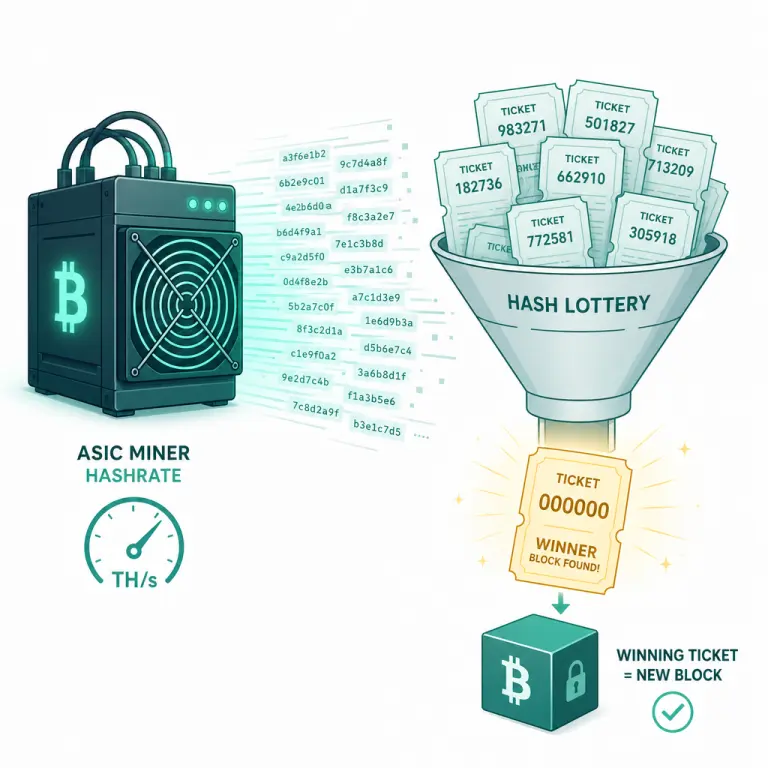
Hashrate is the speed at which a Bitcoin mining computer performs hash calculations, measured in TH/s (trillions of hashes per second). Think of each hash as one lottery ticket in the race to find the next block — the more hashes your machine (or rented share) produces every second, the higher your odds of winning a slice of the Bitcoin block reward.
What Hashrate Actually Means
Every Bitcoin miner on Earth is playing the same game: repeatedly guess a random number, run it through the SHA-256 algorithm, and hope the result comes out below a target set by the network. A single guess-and-check cycle is one hash. Hashrate is simply how many of those guesses a machine produces each second.
That's the entire technical definition. Everything else — TH/s, J/TH, difficulty — is just how we measure, compare, and optimize that one primitive action. If you remember nothing else, remember this: hashrate is guesses per second in a cryptographic lottery.
Speed, not size
Hashrate is a rate (per second), not a total. A miner rated at 200 TH/s produces 200 trillion hash attempts every second it is powered on — a lake of guesses, refilled continuously.
Lottery tickets per second
Each hash is one ticket. A winning ticket solves the block and earns the 3.125 BTC reward plus fees. More hashrate = more tickets per second = a bigger slice of the global lottery pool.
Share of the pool
Your hashrate as a percentage of global hashrate is roughly your share of total BTC issued each day. At ~1 ZH/s global, each 1 PH/s represents about 0.0001% of the daily reward.
The Hashrate Units Cheat Sheet
Miners love prefixes. Every thousand-fold jump in speed gets a new letter — from the tiny H/s a CPU produced in 2009 to the ZH/s the entire Bitcoin network now runs at. Here is the full ladder in one view.
| Unit | Hashes per second | Real-world reference |
|---|---|---|
| H/s | 1 | A hand calculator |
| KH/s | 1,000 (103) | Early 2009 CPU miners |
| MH/s | 1,000,000 (106) | GPU rigs circa 2011 |
| GH/s | 1,000,000,000 (109) | First-generation ASICs, 2013 |
| TH/s | 1 trillion (1012) | Today's unit for single ASICs and cloud plans |
| PH/s | 1015 | A full ASIC container (~5 units of Enterprise Miner) |
| EH/s | 1018 | A large public mining company |
| ZH/s | 1021 | The entire Bitcoin network in April 2026 |
Each row is 1,000× the row above it. So 1 TH/s = 1,000 GH/s = 1,000,000 MH/s. A single Antminer S21 running at 200 TH/s produces the same work in one second that a 2011-era GPU would have taken six years to produce — which is why home CPU/GPU mining Bitcoin stopped being viable a decade ago.
How Hashrate Translates Into BTC Earnings
The Bitcoin network pays out roughly 450 BTC per day (144 blocks × 3.125 BTC reward, ignoring fees). That reward is split among every miner on Earth in proportion to their hashrate. Your daily BTC is, to a first approximation:
Your daily BTC ≈ (your hashrate ÷ global hashrate) × 450 BTC
Plug in numbers. Rent 150 TH/s on a Standard Miner, with global hashrate at 1 ZH/s (= 1,000,000,000 TH/s). Your share is 150 ÷ 1,000,000,000 = 0.000000015, or 0.0000015%. Multiply by 450 BTC and you get about 0.00000675 BTC/day — roughly $0.70/day at a $100k BTC price, before pool fees and payout efficiency adjustments.
This is why operators obsess over two numbers: getting more TH/s for the same money (through newer-gen ASICs like the Antminer S21 at 17.5 J/TH) and keeping every one of those TH/s online 24/7 with 99.9% uptime. Each offline hour is hashrate that never produced a lottery ticket — and tickets are all you're paying for.
See your own hashrate ticking live
You've seen how TH/s converts to BTC. The fastest way to internalize it is to watch a real hashrate number move on a dashboard. NoxHash gives you a 2-day Basic Miner trial — 50 TH/s, no deposit — so you can see the lottery tickets land every minute.
Why Global Hashrate Matters (April 2026 Context)
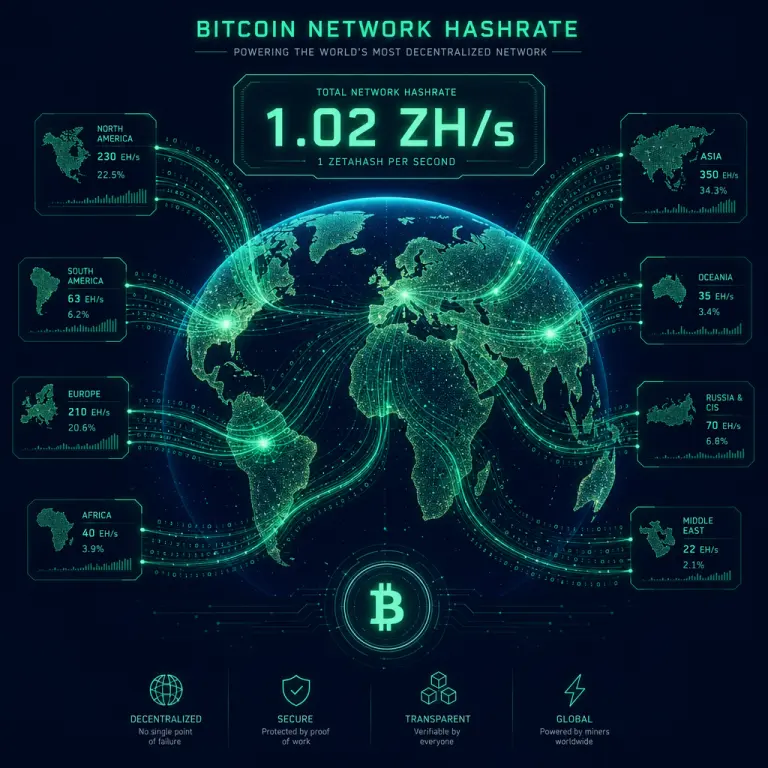
As of April 2026, the Bitcoin network is hashing at roughly 1 zettahash per second — that's 1,000 EH/s, or 1,000,000,000 TH/s. The milestone was first touched on March 28, 2026, then settled into the 950–1,000 EH/s band as revenue pressure pushed some operators to rebalance capacity toward AI workloads. You can watch the live figure on the CoinWarz Bitcoin hashrate chart.
Two numbers for perspective: in April 2021 the network was around 180 EH/s, and in April 2016 it was around 1 EH/s. In a decade, global hashrate has grown 1,000-fold. That's why difficulty — the self-adjusting knob that keeps a new block landing every ten minutes — has climbed in lockstep. More global hashrate means each individual TH/s earns proportionally less BTC than the year before.
The practical implication for a cloud mining renter is simple: the absolute hashrate you rent is less interesting than your share of the global pie. What matters is the efficiency of the hardware behind that rental and the electricity cost feeding it — because those two inputs decide whether the share you buy is profitable at today's difficulty.
Hashrate in Cloud Mining vs Home Mining
The same 200 TH/s looks very different depending on where it physically lives. In a home, those hashes cost you a $4,500 ASIC, a 3,500-watt breaker, and the willingness to run a vacuum-cleaner-loud appliance in your spare room. In a cloud rental, they cost a flat monthly fee and someone else handles the wall socket.
| What 200 TH/s means | Home mining | Cloud mining (NoxHash) |
|---|---|---|
| Upfront cost | $4,500–6,000 for one Antminer S21 | ~$65/month Pro tier share at 350 TH/s |
| Electricity per TH | 17.5 J/TH × residential $0.12/kWh | 17.5 J/TH × industrial $0.035/kWh |
| Uptime managing the hashes | Your problem: firmware, fans, internet | 99.9% SLA, technicians on-site 24/7 |
| Adjusting hashrate | Buy/sell physical units (slow, illiquid) | Add or drop a tier next billing cycle |
The hashes themselves are identical — a SHA-256 hash is the same operation whether it happens in your garage or in a Kazakhstan warehouse. What differs is the cost per hash. Industrial power at $0.035/kWh and newer-gen ASICs at 12–17.5 J/TH produce hashes for roughly a third of what the same ASIC would cost to run on typical residential power. That cost gap is why cloud mining exists as a product.
Hashrate you control
In a cloud plan you choose how many TH/s to rent and for how long — 50, 150, 350, or 1,000 TH/s tiers, on 1 to 24-month terms. The machine behind the number is the operator's headache.
24/7 hashes, no downtime
Every minute your TH/s is offline is a minute of lottery tickets you didn't buy. A managed facility with 99.9% uptime produces materially more BTC over a year than a home rig with monthly service interruptions.
Efficient hashes win
At 1 ZH/s global, raw TH/s is commoditized. What separates profitable from unprofitable hashrate is J/TH and $/kWh behind it — the Antminer S21 Pro at 15 J/TH on $0.035 power is a different product from an S19 at 30 J/TH on $0.12 power.
Hashrate is a share, not a product
The BTC your rented TH/s mines comes from a proportional share of a pool's daily block rewards. That's why payouts cadence (every minute on NoxHash) tracks the steady drip of share contributions, not the timing of individual blocks.
Pick the hashrate that matches your budget
Now that you know how TH/s maps to BTC share and why industrial efficiency matters, compare NoxHash tiers side by side. Each tier runs on Antminer S21 series hardware at 12–17.5 J/TH, out of a Kazakhstan facility on $0.035/kWh power.
Frequently Asked Questions
What is hashrate in simple terms?
Hashrate is the number of guesses per second a Bitcoin miner makes while trying to solve a block. Each guess is one SHA-256 hash, like a lottery ticket. The more hashes per second you produce, the higher your probability of winning a share of the block reward.
What does TH/s mean?
TH/s stands for terahashes per second — one trillion (10 to the 12th power) hash attempts every second. A modern Antminer S21 produces about 200 TH/s. It is the standard unit for measuring individual ASIC miners and most retail cloud mining plans in 2026.
How much hashrate do I need to mine 1 Bitcoin?
At April 2026 network conditions — around 1 ZH/s global hashrate and 3.125 BTC per block — mining one whole BTC solo would take roughly 2.2 million TH/s running for a full day. Pool mining removes the all-or-nothing outcome by splitting rewards by hashrate share.
Why does the global hashrate keep rising?
Better ASICs, cheaper industrial electricity, and new mining farms keep adding TH/s to the network. When BTC price rises, mining becomes more profitable and more hashrate comes online. Network difficulty then adjusts upward to keep block times near ten minutes.
Does more hashrate always mean more profit?
Not automatically. More TH/s means more gross BTC, but profit depends on cost per hash — the J/TH efficiency of the ASIC plus the electricity price feeding it. Adding inefficient hashrate during high difficulty or a low BTC price can widen losses instead of revenue.
What is a good hashrate for a beginner?
For a first-time renter, 50–150 TH/s is a sensible learning size. It produces a visible daily BTC figure on the dashboard without committing much capital. On NoxHash that maps to the $20 Basic Miner or $50 Standard Miner, both on Antminer S21 series hardware.
Educational content — not financial advice
This explainer is for education. The hashrate figures, difficulty, and BTC output examples reflect network conditions in April 2026 and will change. Actual mining returns depend on BTC price, network difficulty, operator uptime, and your tax jurisdiction — all outside your direct control. Past results do not guarantee future performance. Only commit funds you can afford to lose, and consult a qualified professional on local tax and legal rules before scaling any mining allocation.