What Is a Bitcoin Node and How Does It Relate to Mining?
A Bitcoin node validates transactions and blocks. Learn the difference between nodes and miners, node types, and why cloud mining users rarely need one.

A Bitcoin node is a computer running Bitcoin Core (or compatible software) that independently validates and relays transactions and blocks, maintaining a copy of the blockchain and enforcing consensus rules. A miner is a node that additionally attempts to find valid blocks. Every miner is a node — but most nodes never mine, and that distinction matters more than newcomers realise.

What a Bitcoin Node Actually Does
Think of a Bitcoin node as the network's auditor. Every ten minutes or so, a new block of transactions is broadcast across the internet. Thousands of nodes — each running software that speaks the Bitcoin protocol — receive that block, independently check every transaction against consensus rules, and either relay it onward or reject it. No central authority signs off; the network's truth is whatever a majority of well-connected nodes agree on.
The software most nodes run is Bitcoin Core, the reference implementation maintained by open-source contributors since 2009. Current releases sit around the 28–30 series, with minor updates rolling out every few months. Alternative compatible clients exist (Knots, btcd, Libbitcoin), but Core dominates the network because its rules are the ones virtually all nodes enforce in practice.
A node's job is continuous and boring by design: accept blocks from peers, verify signatures, check spending history, update its local view of the UTXO set, and gossip valid data onward. It is not trying to earn anything. It simply refuses to pass along anything that breaks the rules — which is exactly what makes Bitcoin resistant to tampering.
Nodes vs Miners — Same Family, Different Jobs
The words get used interchangeably in casual crypto coverage, which causes real confusion. Nodes and miners share the same software lineage but have fundamentally different roles. The table below makes the split explicit.
| Property | Bitcoin node | Bitcoin miner |
|---|---|---|
| Primary job | Validate and relay blocks | Produce new valid blocks |
| Hardware | Any PC, Raspberry Pi, or VPS | Purpose-built ASIC (e.g. Antminer S21) |
| Power draw | ~10–30 W | 3,000–6,000 W per unit |
| Earns block reward? | No | Yes — 3.125 BTC plus fees per block found |
| Runs Bitcoin Core? | Yes — or a compatible client | Usually yes, plus CGMiner / BFGMiner / Braiins |
| Enforces consensus rules? | Yes — this is the whole point | Yes, if running its own node |
| Count on the network | ~23,500 reachable (Apr 2026) | A few thousand industrial operators globally |
The simplest mental model: every miner is a node, but most nodes are not miners. A miner without its own node is blindly trusting someone else's validation — which is why serious operations always run their own Core instance alongside the ASICs. According to Bitnodes' live reachable-node crawler, the public network consistently hovers in the 20,000–25,000 range, with roughly 99% of those nodes doing nothing but validation.
The Three Types of Bitcoin Nodes
Not every node carries the same data. The Bitcoin Core software exposes three configuration modes that trade off storage for query power. Picking the right one depends on what you actually want to do with your node.
Full node
Downloads and validates every block since 2009. Keeps the complete blockchain on disk — roughly 700 GB in April 2026, growing ~10 GB per month. The default mode and the one that actually enforces consensus.
Pruned node
Still validates every block, but discards old block files once verified — keeping only the last few GB. Footprint drops to ~5–50 GB depending on the prune setting. Great for a Raspberry Pi or a small VPS.
Archive node
A full node with every historical index enabled — txindex, coinstatsindex, address lookups. Runs 1+ TB and powers block explorers, analytics platforms, and exchanges that need to query historical data by arbitrary fields.
For an individual user who wants to verify payments or contribute to decentralisation, a pruned full node on a cheap PC is the sweet spot. Archive nodes are overkill unless you're building a block explorer; a non-pruned full node is only worth the disk if you plan to share blocks with new peers joining the network.
Skip the node setup — rent validated hashrate instead
Running a full node plus an ASIC is a serious commitment in storage, power, and uptime. NoxHash's Kazakhstan data center already operates its own Bitcoin Core nodes alongside the mining fleet — you rent the hashrate and the validation comes bundled, from $20 per month.
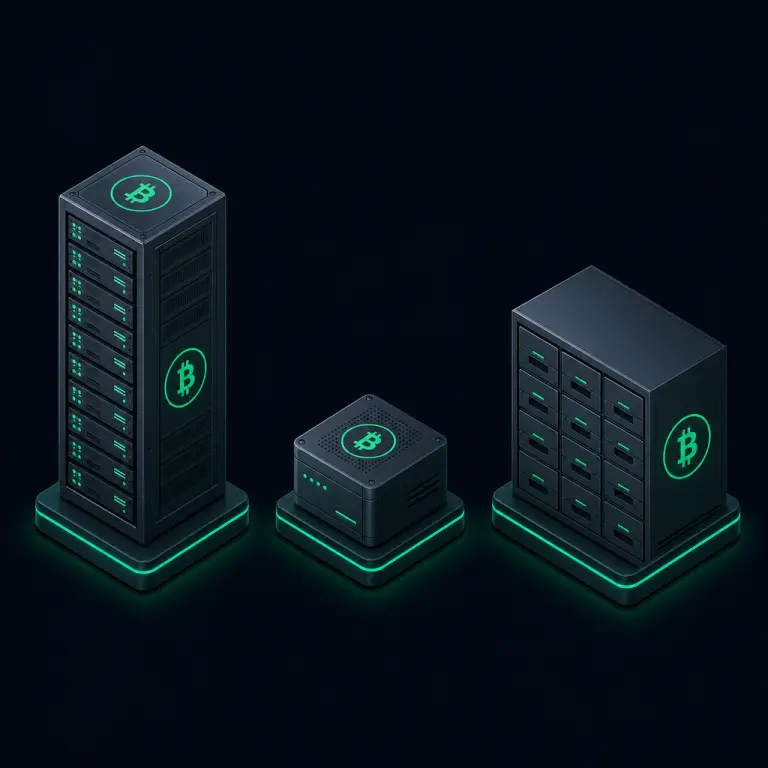
Why Run Your Own Node
Nodes don't pay you. So why do roughly 23,500 people keep them running around the clock? Three reasons show up again and again in the community, and all of them are about trust minimisation rather than profit.
Verify your own payments
When a merchant sends you BTC, a node you run confirms the transaction is real and the coins aren't fake. No need to trust a block explorer that could be down, lying, or phishing.
Stronger privacy
Wallets that connect to a public explorer leak every address you check to that server. Pointing your wallet at a node you run keeps your balance queries on your own machine.
Contribute to decentralisation
Every additional node makes censorship and protocol capture harder. You become one more voice enforcing the rules — a small, but real, piece of Bitcoin's resilience.
Power your own Lightning or miner
Running a Lightning Network node or a home ASIC both require a backing full node. The node is the foundation layer that those higher-level services validate against.
Why Most People Don't Bother
For all the philosophical benefits, node participation has grown slowly compared to Bitcoin's user base. That gap is explained by three pragmatic costs that anyone considering the leap should weigh up front.
Storage. A non-pruned full node now eats around 700 GB and climbs by roughly 10 GB per month. That means an SSD purchase today is a ~5-year commitment before you have to expand. Pruned mode softens this considerably (5–50 GB) at the cost of losing historical block data you could serve to peers.
Bandwidth and uptime. A well-behaved node relays blocks and transactions around the clock. Expect 200 GB to 1 TB of upload traffic per month depending on how many peers connect, and budget for 24/7 operation — capped residential connections and frequent sleeps blunt the usefulness.
Initial sync pain. Downloading and validating every block since 2009 takes a week or more on a typical home connection, longer on a Raspberry Pi. Once synced, the node stays current with small hourly updates — but the first-run experience is the biggest deterrent most newcomers hit.
Nodes, Miners, and Cloud Mining
Here's where the node concept hits practical cloud-mining ground. A miner without its own full node has to trust someone else's validation — typically the mining pool's operator. If that pool runs a buggy or tampered Core version, everyone hashing through it could end up mining on an invalid chain. Serious mining operations therefore run their own Core nodes alongside the ASICs.
NoxHash's Kazakhstan facility already operates full Bitcoin Core nodes as part of the infrastructure — that's what our ASICs hash against. When you rent a Basic, Standard, Pro, or Enterprise Miner from $20 per month, the node layer is included by default. You get the block validation without the 700 GB disk commitment.
That doesn't mean cloud mining users can't run their own node — it means you don't have to for the mining itself to work. Some renters do set one up anyway, purely to independently verify the BTC payouts hitting their withdrawal address. That's a legitimate and relatively cheap layer of self-verification (a Raspberry Pi 5 plus a 1 TB external SSD costs around $200 total) and it pairs well with a cloud mining workflow.
Let the node and the miner run together for you
You've seen what a node is, what a miner is, and why serious operations pair both. NoxHash handles both layers in-house — you rent the hashrate, and our Bitcoin Core nodes validate every block your ASIC works on. Start with a free trial or compare the four plan tiers.
Frequently Asked Questions
Is a Bitcoin node the same thing as a Bitcoin miner?
No. A node validates and relays transactions and blocks; a miner is a node that additionally tries to produce new blocks by computing SHA-256 hashes. Every miner is a node, but most nodes never mine — they simply enforce consensus rules on the data flowing through them.
How big is the Bitcoin blockchain in 2026?
As of April 2026, a full non-pruned Bitcoin node stores roughly 700 GB of block data and grows about 10 GB per month. A pruned node needs just 5–50 GB, while an archive node with every lookup index enabled typically runs past 1 TB.
How many Bitcoin nodes are there globally?
The Bitnodes crawler shows roughly 23,500 reachable Bitcoin nodes as of April 2026, with the total typically fluctuating between 20,000 and 25,000. Many additional nodes run behind firewalls or over Tor and are therefore not directly counted in the public figure.
Do I need to run a node to do cloud mining?
No. The cloud mining operator runs the full node alongside their ASIC fleet. On NoxHash, Bitcoin Core validation is bundled into the infrastructure — renters get the benefits without the 700 GB disk commitment. You can still run your own node to verify payouts, but it's optional.
Can a Raspberry Pi really run a Bitcoin node?
Yes — a Raspberry Pi 5 with a 1 TB external SSD is a popular, low-power node setup. Expect initial synchronisation to take a week or more, then steady hourly updates. For tighter storage, pruned mode on the same hardware runs comfortably in 50 GB.
Does a node earn me any Bitcoin?
No. Running a plain validating node pays zero BTC. Only miners — nodes with ASIC hardware attempting to find blocks — earn the block subsidy and transaction fees. If earnings matter, you need either your own ASIC setup or a cloud mining rental, not just a node.
Educational content — not financial advice
This article is for education only. Network statistics, Bitcoin Core versions, and storage figures reflect conditions in April 2026 and will change as the blockchain grows and client software evolves. Running a node does not generate income, and cloud mining returns depend on BTC price, network difficulty, and operator reliability — all outside your direct control. Past results do not guarantee future performance. Only commit funds you can afford to lose, and verify local legal and tax rules with a qualified professional before scaling up.