US Bitcoin Mining Regulations — State-by-State Overview
Federal rules, state-by-state differences, and what cloud mining users in the US need to know — from Texas incentives to New York's proof-of-work moratorium.
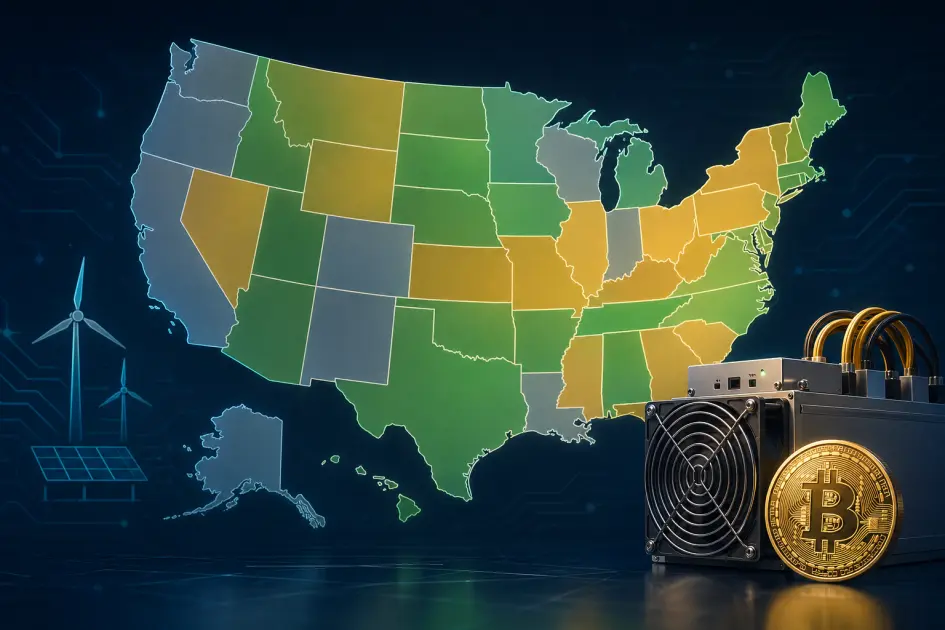
Bitcoin mining is federally legal in the United States, but the rules that shape real-world operations sit at the state level. Texas courts miners with grid incentives, Wyoming offers the clearest regulatory charter, and New York enforces a partial proof-of-work moratorium on fossil-fuel-powered farms. For cloud mining users, the state picture matters far less than the federal tax picture.

The United States hosts roughly 35-40% of global Bitcoin hashrate, according to the Cambridge Centre for Alternative Finance, making it the single largest mining jurisdiction on earth. That scale sits on top of a patchwork: four federal agencies set baseline rules, but the actual experience of operating miners depends heavily on which state you're in. This guide walks through the federal framework, then groups states by posture — mining-friendly, restrictive, and the quiet middle — before zeroing in on what cloud mining users specifically need to track.
The federal framework — why mining itself is legal
At the federal level, Bitcoin mining is a lawful commercial activity. No US agency currently requires a mining-specific license, and mining operations generally do not trigger securities registration with the SEC. Four agencies draw the relevant lines:
IRS — tax treatment
IRS Notice 2014-21 treats mined crypto as ordinary income at its fair market value on the day received. A later sale or exchange creates a separate capital gain or loss. This applies whether you run hardware yourself or receive payouts from a cloud contract.
FinCEN — money transmission
Under 2013 guidance and the 2014 administrative ruling on mining, a person who mines Bitcoin for their own account is generally not a money transmitter. That means no federal MSB registration for plain mining income. Pools and exchanges sit in a different bucket.
SEC — securities reach
The SEC has not treated Bitcoin itself as a security and has not pursued plain mining operations as unregistered offerings. The line gets drawn at investment schemes — packaged "mining contract" products sold with profit promises can be reclassified as securities.
CFTC — commodity framing
The CFTC views Bitcoin as a commodity, which puts derivatives and futures under its umbrella. Mining the underlying asset is not a CFTC-regulated activity, but hedging hashrate with derivatives might be.
Proposed federal changes surface regularly — energy disclosure rules, a previously-proposed Digital Asset Mining Energy (DAME) excise tax that did not advance, and periodic Treasury reports on mining's grid impact. As of early 2026, none of these have become binding federal mining regulations. Verify the latest before relying on this summary for tax or compliance work.
Mining-friendly states — where the hashrate concentrates
A handful of states compete actively for mining investment. They combine abundant power, favorable tax treatment, and — in some cases — laws that explicitly recognize digital asset businesses. Texas alone is estimated to host around 30-40% of US hashrate, per industry tracking and ERCOT load data.
| State | Why miners go there | State income tax |
|---|---|---|
| Texas | Deregulated ERCOT grid, demand-response programs that pay miners to curtail, cheap stranded gas | 0% personal |
| Wyoming | SPDI (Special Purpose Depository Institution) bank charter, clear digital asset statutes, mining exemption from money transmitter laws | 0% personal |
| Tennessee | Low industrial power rates via TVA, business-friendly posture, no state wage income tax | 0% on wages |
| Kentucky | Sales tax exemption on electricity for commercial crypto mining (per 2021 legislation), abundant coal and hydro | ~4-5% flat |
| North Dakota | Flared-gas mining pilots, low power costs, light regulatory touch | ~1-3% tiered |
| Montana | 2023 state law protecting "right to mine" digital assets, including prohibiting discriminatory utility rates | ~5-6% tiered |
Texas stands out because of ERCOT's demand-response market. Large miners sign up as controllable load resources, shutting down during grid stress in exchange for payments — Riot, Core Scientific, and others have disclosed meaningful revenue from curtailment alone. Wyoming is the outlier for legal clarity: its SPDI charter and 2018-2019 digital asset statutes give mining and custody businesses a predictable compliance path unavailable in most other states.
Restrictive states — where mining runs into friction
A smaller group of states has passed laws or utility policies that directly constrain mining operations. None of them ban mining outright, and the rules usually target operators of physical hashrate rather than individuals who buy BTC or use cloud services.
| State | Restriction | Who it hits |
|---|---|---|
| New York | 2022 two-year moratorium on new/expanded proof-of-work mining operations that run on fossil-fuel power plants (signed by Governor Hochul) | New fossil-powered farms only — not renewable mining, not personal use, not cloud users |
| Washington | Local utility moratoria and elevated rate classes for high-density crypto mining — notably in Chelan, Grant, and Douglas counties (PUDs) | Commercial farms drawing large loads from public utility districts |
| California | No direct mining ban, but high power rates, strict grid-reliability rules, and broader crypto legislation (e.g. DFPI licensing discussions) raise the operating bar | Any energy-intensive miner; cost structure makes large farms rare |
New York's moratorium is the most cited example, and it's narrower than headlines suggest. It blocks new air permits for proof-of-work mining that uses behind-the-meter fossil generation; existing farms and renewable-powered operations were not affected. As of early 2026, the underlying statute's fate has been subject to ongoing legislative and regulatory review — check current state guidance before relying on a specific status. Washington's restrictions come mostly from local public utility districts, not the state legislature, so the picture differs by county.
The quiet middle — most states have no mining-specific law
The majority of states simply do not have Bitcoin-mining-specific statutes. That means mining is treated like any other commercial or hobby activity:
Business registration follows the entity, not the activity
If you operate miners through an LLC or corporation, you register the entity with the Secretary of State and file state tax returns normally. Personal hobby mining at the kitchen-counter scale usually does not require registration.
State tax varies dramatically
Texas, Florida, Wyoming, Nevada, South Dakota, and Washington have no personal state income tax. California tops out at 13.3%, New York at 10.9% plus NYC surtax. Same mining income, very different after-tax result.
Zoning and utility rules often matter more than "crypto law"
Counties regulate noise from mining containers, utilities classify miners into commercial or industrial rate tiers, and building codes determine what power density you can install. These non-crypto rules often decide whether a site is viable.
Money transmitter laws almost never apply to miners
A handful of states theoretically could sweep crypto activity under money transmitter statutes, but the consensus and most AGs treat self-account mining the same way FinCEN does — outside the scope. Exchanges and custodial services are the focus.
What this means if you're a US cloud mining user
Here's the practical conclusion the rest of the regulatory map leads to: if you're buying a cloud mining contract while living in the US, and the actual hardware runs in a foreign facility, the state-level mining restrictions above mostly don't apply to you. The rules target the operator of the physical hashrate, not the customer who rents it.
That's not a loophole — it's just how regulation is scoped. New York's moratorium restricts new air permits for fossil-fuel-powered mining plants inside New York. A New York resident using NoxHash's Kazakhstan facility isn't operating a plant in New York; they're purchasing a service from a foreign operator. Same logic for Washington's PUD rate classes or California's industrial permitting.
What typically does NOT apply
State mining moratoria, utility rate classes for crypto miners, zoning/noise ordinances, air-quality permits — these all target in-state hashrate operators, not overseas cloud customers.
What still DOES apply
IRS Notice 2014-21 — mined BTC is ordinary income at fair market value on receipt, period. State income tax on that same income. Any capital gain/loss when you later sell or exchange. Foreign facility location does not change federal tax reporting.
The state tax angle that actually matters
Because federal income is the same wherever you live, the main state variation is the income tax rate applied on top. A Texas or Florida resident pays 0% state; a California resident can pay up to 13.3% on the same mining income.
Exchanges vs mining — different rules
Several states license crypto exchanges under money transmitter laws (e.g. New York BitLicense). That affects where you can trade or off-ramp your BTC, not whether your cloud mining income is legal. Keep the two categories separate.
Most state mining rules target in-state operators — not cloud users
NoxHash's Antminer S21 fleet runs in Kazakhstan at $0.03-0.04/kWh. Because the hashrate is physically abroad, state-level restrictions like the NY moratorium or WA utility rate classes don't reach you. Verify your state's current stance with a US CPA, then decide whether cloud mining fits your situation.
Frequently asked questions
Can I use cloud mining from New York despite the moratorium?
Generally yes. New York's 2022 moratorium restricts new fossil-fuel-powered proof-of-work mining operations physically located in New York. Purchasing a cloud mining contract from a foreign facility is a different activity and is not covered. Federal IRS rules still apply to your mined BTC, and New York state income tax applies to the same income.
Which state has the lowest total tax burden on mining income?
No-income-tax states — Texas, Florida, Wyoming, Nevada, South Dakota, Tennessee (wages) and Washington (wages) — leave only federal tax on your mined BTC. High-tax states like California can add up to 13.3% and New York up to 10.9% on top of federal. Residency rules and domicile tests matter; consult a CPA before relocating for tax reasons.
Do I need to register a business to use cloud mining?
Usually not. An individual buying a cloud mining contract can typically report the income on a Schedule 1 or Schedule C depending on scale and intent — hobby vs trade or business. LLCs and corporations are optional tools for larger operations or liability planning, not a precondition for cloud mining. A CPA can tell you which treatment fits your activity level.
What if my state restricts crypto exchanges — does that affect mining?
Exchange regulation and mining regulation are separate. A state that licenses exchanges strictly (like New York's BitLicense) can still allow mining and cloud mining. The practical impact is on where you off-ramp your BTC to dollars — your exchange choice may be narrower, but the mining income itself remains lawful.
Is there federal reporting like a Form 1099 for mining income?
Foreign cloud mining providers generally do not issue a US Form 1099. That does not relieve you of the reporting duty — IRS Notice 2014-21 requires you to self-report fair market value at receipt. Form 1040 digital asset question, Schedule 1 or Schedule C, and Form 8949 for later sales are typical. Keep transaction logs from the platform.
Does the federal government plan to ban or tax mining specifically?
A previously floated Digital Asset Mining Energy (DAME) excise tax proposal did not advance into law. Periodic Treasury and EIA reports examine mining's grid and emissions impact, and disclosure rules have been debated. As of early 2026, no mining-specific federal tax or ban exists — verify the current position before long-term planning.
Educational content — not legal or tax advice
This article summarizes US federal and state-level rules affecting Bitcoin mining as of early 2026 and is intended for education only. Regulations change, and how a rule applies to your specific situation depends on residency, entity structure, and activity level. Consult a US tax attorney or CPA before relying on any of the points above for filing, compliance, or investment decisions. Cryptocurrency mining and investment carry market, legal, and technical risk.