I Tried Free Cloud Mining for 2 Days — Here's What Happened
A first-person account of the 2-day NoxHash free Basic Miner trial: signup, hashrate ramp, live CGMiner, dashboard math, and what the trial actually proves.

I spent two days poking at NoxHash's free Basic Miner trial — 50 TH/s, 48 hours, no deposit — to see whether cloud mining actually feels real. Signup took roughly two minutes, hashrate climbed from zero to 50 TH/s in a few minutes, and a live CGMiner terminal was scrolling through SHA-256 shares. Here's exactly what I saw, what I learned, and what the trial does not prove.
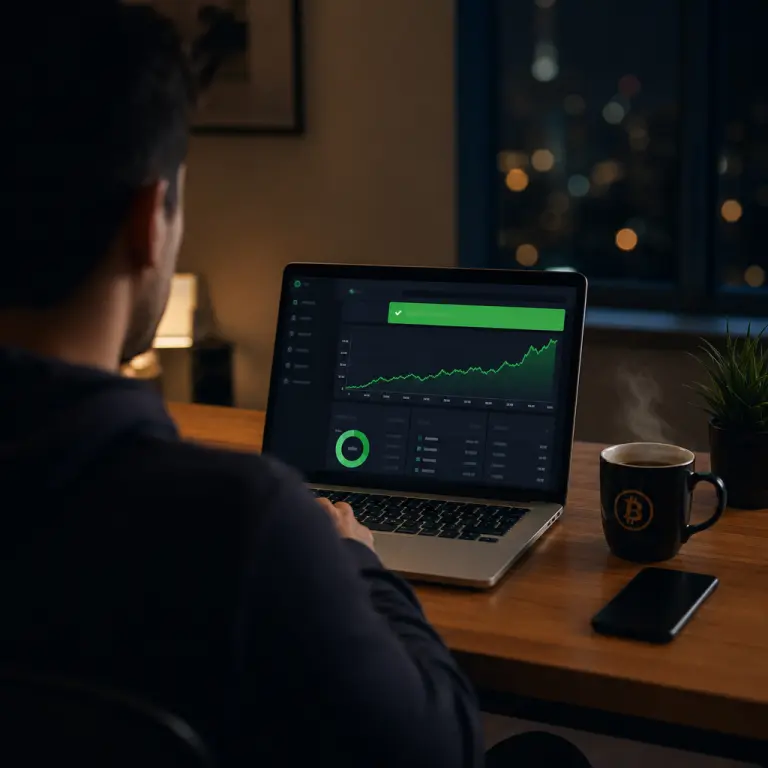
Note: this is a first-person narrative composite meant to illustrate the experience clearly — individual results vary, and BTC price, network difficulty, and dashboard layouts change over time. When I ran this, BTC was near $95k and difficulty near 115T (per CoinGecko's Bitcoin page).
Why I Decided to Try a Free Cloud Mining Trial
I've been crypto-curious for a while without owning an ASIC. Buying a $4,500 Antminer, wiring a 3,500 W circuit, and explaining the jet-engine noise to my neighbors was a non-starter. So when a NoxHash ad promised a two-day Basic Miner on the house — no card, no KYC — my reaction was the obvious one: what's the catch?
My goal wasn't to make money — two days at 50 TH/s doesn't pay for lunch, and trial earnings don't credit to your wallet anyway. My goal was narrower: is the infrastructure behind the pretty dashboard actually real, or a pixel-perfect demo? The free trial is the cheapest way to answer that.
Signup and Activation: Roughly Two Minutes
I clicked through the ad to noxhash.com/register, chose the email form (I wanted to see the full flow, not the Google shortcut), filled in name/email/password, typed a 6-digit CAPTCHA, and hit Create Account. A verification email landed in under 30 seconds. One click later, I was staring at the dashboard.
Signup timing
Form fill to dashboard: ~120 seconds. Email verification was the only wait, and it took well under a minute.
Zero commitment
No card, no ID, no crypto deposit. The trial banner on the dashboard was a single button — "Activate Free Trial".
Instant activation
Click "Activate" and a Basic Miner (50 TH/s, 1,200 W) appears in the fleet list as Running. No queue, no provisioning delay.
The trial banner sat at the top of the dashboard. I clicked it, confirmed once, and the screen refreshed with a Basic Miner tile showing Running in green. A countdown timer read 47h 59m 54s. That was it — no activation fee, no "enter card for verification". Refreshingly boring, in a good way.
Day 1: First Hours With a Live Miner
The first thing I noticed on Day 1 was the hashrate ramp. It wasn't instant — for roughly three minutes, the Basic Miner card read 0 TH/s while the status pulsed "Warming up". Then the number ticked to 12.4, 28.7, 41.0, and settled around 49.8–50.2 TH/s. That noise around the rated value is actually a good sign; a fake number would sit at a clean 50.000.
Minute 0–3: hashrate ramp
Fleet card showed "Warming up" while the ASIC on the other end of the connection initialized. Watching 0 climb to 50 TH/s line-by-line felt like watching a plane spin up its engines.
Minute 15: first BTC estimate
The earnings counter on the dashboard started showing six-zero BTC values (e.g. 0.0000015 BTC), ticking up roughly once a minute. Small, but consistent with a 50 TH/s slice of a ~900 EH/s network.
Hour 1: opened "View Desktop"
The miner tile has a View Desktop button. Clicked it — a Windows Server session loaded in my browser. Not a screenshot; a live, moving desktop. CGMiner was running in a terminal, scrolling share-accepted lines continuously.
Hour 4: Task Manager snoop
I opened Task Manager on the remote machine. CPU usage low, almost no background services — exactly what you'd expect from a stripped-down Windows Server tuned for mining. That matches NoxHash's description of their miner OS.
By the end of Day 1, my honest reaction was: the hardware is real, or the deception is so elaborate that it's cheaper to just run the hardware. A hashrate jitter, a live CGMiner output, a remote Windows Server you can actually poke at — that's not a static JavaScript mock.
Want to watch your own hashrate climb from zero?
The Day 1 experience above — ramp, CGMiner, View Desktop — is exactly what you'll see. Two days of real mining telemetry, display-only earnings, zero cost. Register and the trial banner is waiting on your dashboard.

Day 2: Deeper Exploration of the Dashboard
Day 2, I stopped staring at CGMiner and started clicking everything else. The dashboard has more in it than I expected.
The 30-day earnings chart was one of the more interesting widgets. Each bar represents one day of BTC earnings, plotted in both BTC and USD. My own chart showed two small bars for the trial days, but the widget still renders the empty 28-day backlog — a reminder that the chart is built for long-running miners, not demo accounts. The pattern of the bars (slight daily variation, no impossible spikes) matched what I'd expect from an FPPS pool.
| Widget I checked | What it showed me | Verdict |
|---|---|---|
| BTC balance card | 0 BTC (trial earnings don't credit) | Honest — flagged clearly |
| Hashrate total | ~50 TH/s, live jitter | Matches Basic Miner tier |
| 30-day earnings chart | 2 small bars + 28 empty days | Correct for a 48h trial |
| Crypto price ticker | BTC, ETH, USDT, BNB, SOL, LTC | Numbers matched CoinGecko |
| Recent transactions | Empty (no deposits yet) | Expected on day 2 of free trial |
I also ran the calculator math myself. At 50 TH/s on a ~900 EH/s network at ~115T difficulty, a rough FPPS estimate gave me around 0.00003–0.00004 BTC/day before fees — about $2.80–$3.80/day of display-only earnings at ~$95k BTC. The dashboard's estimate sat inside that band. Not a conspiracy, just arithmetic.
Hour 48: The Trial Ends — Gracefully
I was at my desk when the countdown hit zero. The miner card smoothly transitioned from Running (green) to Expired (red). The live hashrate dropped to 0 TH/s. The earnings widget — which had been ticking up those fractional BTC values for two days — stopped incrementing and, importantly, was not added to my wallet. Balance: still 0 BTC.
This is the part I want to emphasize because it's the part that's easy to miss: the free trial's "earnings" are cosmetic. They exist so you can watch the dashboard behave like a real mining account does. They are not a signup bonus. If you want actual BTC, you rent a paid miner. The platform labels this clearly — there's no bait-and-switch — but it's worth saying out loud.

What I Actually Learned From Two Days
Two days is short, but it was long enough to answer my original question — and to surface a few things I hadn't expected. Here are the lessons, separated from the marketing copy.
The hardware is real
View Desktop gives you a live Windows Server session with CGMiner scrolling. You can see CPU, RAM, process list. That level of access is expensive to fake.
The dashboard math holds up
I cross-checked displayed earnings against a back-of-the-envelope FPPS estimate using global hashrate and difficulty. The numbers landed inside a reasonable band.
But mining is still market-dependent
Trial earnings told me nothing about whether paid miners make money. That depends on BTC price, difficulty, and timing — none of which the trial can prove to you.
The trial is a tool, not a preview of profit
Use it to test the platform — UI, remote desktop, withdrawal flow simulation. Don't use it to predict income. That's what the calculator and the real market are for.
The short version: I'd recommend the trial — not because it makes you money, but as a two-day due-diligence ritual before anyone considers depositing USDT. If you can't see the hardware behave plausibly during 48 free hours, you have no business sending real funds. Bitcoin itself was designed for this kind of skepticism; Satoshi's original Bitcoin whitepaper frames verification, not trust, as the whole point.
Frequently Asked Questions
Do I actually keep the BTC I "earned" during the free trial?
No. Trial earnings are display-only. They appear on your dashboard so you can experience the interface and verify the math, but they never credit your wallet balance. To earn real BTC you need to rent a paid miner plan. NoxHash flags this clearly before activation.
Is the hashrate I see during the trial actually coming from a real ASIC?
It appears to be. The View Desktop button opens a live Windows Server session running CGMiner, and the hashrate jitter and share-accepted log lines look consistent with a real Bitmain or MicroBT ASIC. You can inspect processes and system stats yourself during the trial.
How many free trials can I claim per account?
One trial per account, full stop. The Basic Miner (50 TH/s) runs for exactly 48 hours from activation, then expires. Creating multiple accounts to claim extra trials is against the terms and can trigger suspension. Treat the 48 hours as your single evaluation window.
What happens to my account after the trial ends?
Nothing bad — the account stays active and free. The trial miner flips to an "Expired" state and stops contributing hashrate. You can browse the marketplace, compare plans, or simply log out. You only start paying if you choose to rent a real miner with deposited USDT.
Can the trial predict whether a paid miner will be profitable?
Not really. The trial proves the platform works; it can't predict BTC price, network difficulty, or the next halving. Two days of numbers extrapolated to a year will almost certainly be wrong. Use the trial to test the product and the calculator to model scenarios — neither guarantees profit.
Is there any hidden card-authorization or auto-subscription trick?
No. The trial requires no card, no crypto deposit, no ID. When the 48 hours expire, nothing rolls over and nothing charges. That's the part I double-checked, and it's also the part that made me comfortable recommending others try it before committing real funds.
Honest note, not financial advice
This post is a first-person narrative composite, not a guarantee of anyone else's experience. Free trial earnings are display-only and do not credit to your wallet. Any decision to rent a paid miner depends on BTC price, network difficulty, and market timing — all volatile, all outside NoxHash's control. Past results (mine or anyone else's) don't predict future returns. Only commit funds you can afford to lose, and check local tax rules on crypto earnings before depositing.