Transaction Fees as the Future of Mining Revenue — Will It Be Enough?
Fees are only 1-2% of miner revenue in 2025-26. With the 2028 halving cutting subsidy to 1.5625 BTC, can fees grow fast enough to secure Bitcoin? Data inside.

Transaction fees are the revenue stream meant to replace Bitcoin's shrinking block subsidy, but in 2025 and early 2026 they have averaged just 1–2% of miner revenue — far short of the 20%+ share most analysts say the network needs by the 2030s. With the 2028 halving set to cut the subsidy to 1.5625 BTC per block, the question is no longer theoretical: will fees grow fast enough to keep miners — and the network's security — profitable?
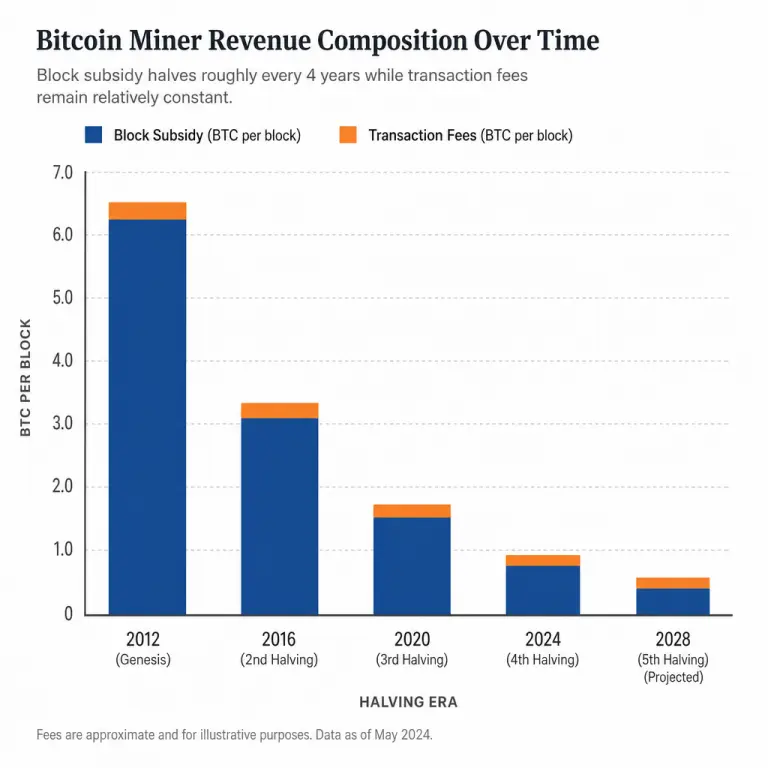
The halving math: why fees matter more each cycle
Every 210,000 blocks — roughly every four years — Bitcoin cuts its block subsidy in half. That's protocol, not policy. The subsidy is designed to approach zero around 2140, which means transaction fees are the only revenue source built to last forever. Each halving doubles the relative importance of fees, even if fees themselves stay flat.
The table below shows what that looks like in numbers. We use a simplified 450-block day and assume a constant fee income of 0.5 BTC per block (close to the 2025 trend) — a flat fee market, not a growing one.
| Era | Subsidy / block | Flat fee assumption | Fees as % of revenue |
|---|---|---|---|
| Post-2020 halving | 6.25 BTC | 0.5 BTC | ~7.4% |
| Post-2024 halving (current) | 3.125 BTC | 0.5 BTC | ~13.8% |
| Post-2028 halving (projected) | 1.5625 BTC | 0.5 BTC | ~24.2% |
| Post-2032 halving (projected) | 0.78125 BTC | 0.5 BTC | ~39.0% |
The math is unforgiving. Even if fees stay exactly where they are today, the subsidy cut alone will push fees toward a quarter of miner revenue by 2028 and a third by the early 2030s. That arithmetic assumes no growth in fee demand — pure halving arithmetic. If fees do grow, the share gets larger faster. If fees shrink, miner revenue falls off a cliff.
Reality check: what fees have actually done since 2020
The flat-fee assumption in the table above is generous for recent history. According to data aggregated by Bitbo's fee-percent-of-reward chart and reporting from The Block, the fee share has been highly volatile and trending down through 2025.
2020–2023: fees averaged 1–3% of revenue
After the 2020 halving, subsidy dominated. Fee share rarely broke above 3% outside of short bull-market congestion spikes. Miners leaned almost entirely on the 6.25 BTC subsidy and BTC price appreciation for margin.
Late 2023–early 2024: Ordinals and BRC-20 push fees above 20%
Inscriptions (Ordinals) and BRC-20 tokens filled blocks with non-monetary data. On some peak days fees briefly exceeded 40% of block rewards. For the first time since 2017, miners could see a plausible fee-driven future.
April 20, 2024: the Runes launch and the halving block
Casey Rodarmor's Runes protocol went live at the halving. The halving block carried $2.4 million in fees versus $40–60k for a typical block. Average daily fees hit $127.97. Over April 19–20 miners earned ~$89.8 million in fees — more than all of March combined.
May 2024–2025: the collapse
Runes hype faded within weeks. Fees fell 97% from the $128 peak to ~$3.60. By mid-2025, fees were back to ~1.05% of block rewards — a 12-month low. The "fee market thesis" looked more fragile than ever.
Late 2025–2026: partial recovery
Fee share climbed back into the mid-single digits as on-chain activity normalized. Industry analysts now estimate fees need to reliably clear 20% of revenue for the network to be economically self-sustaining without subsidy growth.

Why fees spike — and why they crash back down
The 2024 Ordinals/Runes surge proved something important: Bitcoin's fee market can absolutely reach sustainability levels — when there is demand. The problem is the "when." Fee episodes have been driven by a handful of recurring catalysts, and each one has its own expiration date.
Congestion spikes
Bull-market mempools fill up and drive fee bidding wars. Correlated with BTC price rallies — and collapses with them.
Meta-protocols
Ordinals, BRC-20, Runes, inscriptions — experiments that use block space non-monetarily. Novelty drives fees; saturation kills them.
Settlement demand
Layer-2 channel openings, exchange batches, institutional rebalancing. Less spiky, more durable — and the real long-term bet for a sustainable fee market.
Look at the chronology and the pattern is brutal: every sustained fee episode has come from a new use case, not organic payment growth. Ordinals in 2023. Runes in April 2024. Before that, the 2017 ICO boom. Each episode lasted months, not years. In the gaps, fee share reverted to 1–3%.
You can't control fee spikes. You can control your cost per TH.
When fees collapse to 1% of revenue, only miners with the lowest J/TH hardware and cheapest power stay profitable. NoxHash runs Antminer S21 series at 12–17.5 J/TH on $0.035/kWh power in Kazakhstan — built to survive thin-margin stretches.
Post-2028 projection: how big does the fee market need to be?
Rough numbers, tied to 2026 reference points. Global hashrate sits around 800–900 EH/s with average mining costs roughly $0.04–0.06 per TH/s per day. That works out to a total network security budget of roughly $15–18 billion per year — the amount miners collectively earn (and spend on power, hardware, and operations) to keep Bitcoin secure.
| Scenario (at $100k BTC) | Annual subsidy | Annual fees needed | Multiple of 2025 fees |
|---|---|---|---|
| 2026 (3.125 BTC) | ~$16.4B | ~$0.2B (actual, ~1%) | 1× (baseline) |
| 2028 — hold security flat | ~$8.2B | ~$8B | ~40× |
| 2032 — hold security flat | ~$4.1B | ~$12B | ~60× |
| 2140 — zero subsidy | $0 | ~$16B+ | ~80× |
These numbers assume BTC stays near $100k and hashrate doesn't retreat. Fee revenue would need to grow 40× between now and 2028 just to offset the subsidy cut — without any expansion of network security. A rising BTC price does most of the lifting here: if BTC doubles, the fee market can stay the same BTC-denominated size and still double in USD terms. Much of the "will fees be enough" debate is really a "will BTC keep appreciating" debate in disguise.
What this means for miners right now
Efficiency is the real hedge
Low-J/TH hardware plus cheap power is what keeps miners alive through 1%-fee stretches. A 2021-era S19 Pro at 30 J/TH won't survive the 2028 halving on fees alone.
Fee spikes are bonuses, not budgets
Never build a break-even model around fee episodes. Plan with 1–3% fee share as the baseline; treat Ordinals/Runes-style spikes as upside, not the expected case.
BTC price is the meta-variable
A 2× BTC price keeps USD-denominated revenue flat across a halving even if BTC-denominated revenue halves. Fee math and price math are entangled — don't analyze one without the other.
L2 and settlement are the long bet
Lightning channel opens, batch settlements, institutional rebalancing — these grow linearly with adoption, not with hype cycles. They are Bitcoin's most durable path to a sustainable fee market.
Frequently asked questions
What percentage of miner revenue currently comes from transaction fees?
As of early 2026, transaction fees account for roughly 1–2% of total miner revenue on most days, recovering from a 2025 low of ~1.05%. The block subsidy of 3.125 BTC provides the remaining 98%+. Short-term spikes during Ordinals or Runes surges can briefly push fees above 20%.
Will fees be enough to replace the block subsidy after 2140?
It depends on block space demand and BTC price. To hold today's USD-denominated security budget of ~$16B with zero subsidy, fees would need to grow roughly 80× from current BTC-denominated levels. That's plausible if Bitcoin becomes a global settlement layer, uncertain if it stays a niche asset.
What is Bitcoin's "security budget"?
The security budget is the total revenue miners earn per year — subsidy plus fees — that funds the hashrate protecting Bitcoin. At ~$16B/year in 2026, it is what makes 51% attacks economically prohibitive. If the budget shrinks faster than the cost of attack, security weakens.
How did Ordinals and Runes change the fee picture?
They proved fees can reach sustainability levels briefly. The April 20, 2024 halving block carried $2.4M in fees — 40× the typical block. But the effect lasted weeks, not years. Ordinals showed what is possible; they did not solve the long-run problem of inconsistent demand.
Does low fee share mean Bitcoin is in danger?
Not immediately. Bitcoin's difficulty adjustment lets miners stay profitable even as rewards shrink, by naturally reducing hashrate until it matches available revenue. The deeper concern is long-term: a persistently low fee share means a lower hashrate ceiling, which reduces the cost of a 51% attack.
Want exposure to fees without buying hardware?
When fees spike, NoxHash miners capture that upside automatically — no pool switching, no mempool monitoring. When fees collapse, low J/TH hardware and $0.035/kWh power keep the plan profitable where home miners lose money.
Not financial advice
This article is informational. Projections about fee markets, hashrate, and BTC price are estimates based on current data and may not reflect future conditions. Bitcoin mining carries market, regulatory, and technical risks. Do not invest money you cannot afford to lose, and do your own research before making decisions. Past fee episodes and halving outcomes do not guarantee future results.