A Standard Miner User's Journey — What to Expect Month-by-Month
An honest 6-month diary of a NoxHash Standard Miner user — $50/mo start, scaling decisions, surviving a BTC dip, and what each month actually looks like.

This is my honest 6-month diary as a NoxHash Standard Miner user — $50/month, 150 TH/s, zero hardware of my own. I started with one miner, scaled to two, survived a rough BTC dip, and renewed for 12 months to lock a 15% discount. Spoiler: this is slow-stack Bitcoin, not get-rich-quick.
Why I Call It "Side Income," Not a Salary
Before I walk you through my six months, let me set expectations. Side income is supplemental — it rides on top of my day job, not under it. Bitcoin is volatile, network difficulty shifts, and nothing about cloud mining is guaranteed. According to the U.S. Bureau of Labor Statistics analysis of multiple jobholders, most people who take on a second income stream do it for stability, not to replace a primary paycheck. That framing kept me sane.
I picked the Standard Miner tier ($50/month, 150 TH/s, 3,000W) because it felt like a realistic commitment. Basic Miner ($20) felt too small to learn anything meaningful, and Pro ($100) felt premature for month one. Standard was my Goldilocks.
The 6-Month Timeline, One Month at a Time
Here's the chronological version. Every number is composite and illustrative — actual payouts depend on live BTC price and network difficulty — but the shape of the journey is real.
Month 1 — Curiosity phase
I deposited $60 USDT via BEP-20 (fee under $0.30), rented one Standard Miner for a single month, and watched the dashboard like a new parent. I refreshed it four or five times a day. Satoshis ticked in every minute. By day 30 I'd accumulated BTC worth roughly the plan cost plus a modest margin — enough to confirm the plumbing actually works.
Month 2 — Familiarized, added a second miner
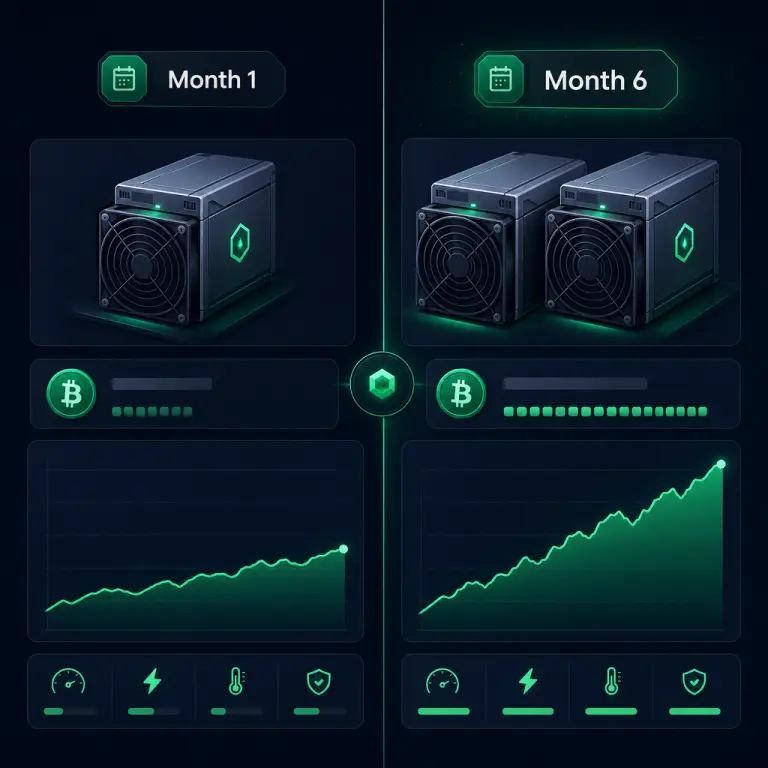
By now the dashboard was background music. I stopped checking daily and started checking weekly. I added a second Standard Miner, bringing my monthly commitment to $100 and my hashrate to 300 TH/s. I deliberately kept both on 1-month plans so I could bail if anything felt off.
Month 3 — BTC dropped, I got nervous
This is the honest part. BTC dropped noticeably mid-month — you can browse any CoinGecko Bitcoin historical price chart to see how often 15–25% swings happen. My daily BTC payout was roughly the same in satoshis, but the USD value shrank. I almost stopped the second miner. I didn't. I'd already paid the rental, and stopping wouldn't refund it. Lesson learned: decide the budget before you deposit, not after the market moves.
Month 4 — Locked a 12-month renewal at 15% off
Price stabilized. I felt confident enough to renew one miner on a 12-month term, which unlocks a 15% discount: $50 × 0.85 = $42.50/month, saving $90 across the year. I kept the second miner on a flexible 1-month rolling plan — that way, if conditions worsened, I could pause the variable one without losing the discounted one.
Month 5 — Tallying the BTC stack
I stopped obsessing over USD value and started tracking BTC accumulated. That mental shift changed everything. Instead of "did I beat my rental cost in dollars this month?" the question became "how many more sats am I stacking per month vs. month one?" The answer was a steady climb, because I'd doubled my hashrate and locked a discount.
Month 6 — Reflection
Half a year in, the dashboard is ambient. I check it maybe once a week out of habit. The honest takeaway: this isn't a side hustle that replaces a job. It's a slow, automated BTC accumulation layer that happens while I sleep and work. Some months the USD math looks great. Some months it doesn't. The BTC keeps stacking either way.
Milestones I Actually Celebrated
Numbers alone didn't keep me going. These small wins did:
First payout tick
Watching the satoshi counter increment for the first time — proof the miner was real and alive in Kazakhstan.
Hashrate doubled
150 TH/s to 300 TH/s in month 2. Seeing both miners on the dashboard made the plan feel tangible.
15% annual discount locked
$42.50/month on the 12-month miner — a $90/year saving and a psychological commitment to stay the course.
Start your own slow-stack diary
Before committing $50/month to a Standard Miner, try the free 2-day Basic Miner trial to see the dashboard work end-to-end — exactly how I started month 1.
Lessons From Six Months I Wish I'd Known on Day One
Set the budget before the market does
Decide your monthly limit in advance and stick to it. Don't let a BTC rally tempt you into over-committing, or a dip scare you into stopping prematurely.
Track BTC, not just USD
USD-denominated returns swing daily. Satoshi accumulation is steadier. Both numbers matter — but the sats story kept me focused long-term.
Expect at least one nervous month
BTC has dropped 15–25% inside a single month many times in its history. If that ruins you, your position is too big. Right-size it.
Longer terms reward conviction
A 12-month renewal unlocks 15% off, 24 months unlock 20%. Only commit to longer terms after you've completed at least one shorter rental and know what you're signing up for.
Frequently Asked Questions
Is $50/month enough to see meaningful results?
It's enough to learn the mechanics, feel the volatility, and accumulate some BTC as a side position. It is not enough to replace a salary. Treat the Standard Miner as a $50 experiment that teaches you whether this model fits your risk tolerance before you ever scale up.
What happens if BTC price crashes mid-rental?
Your rental fee is already paid and doesn't refund if you stop. You keep earning BTC at the same rate in satoshis, but the USD value of those satoshis falls with the market. This is the market risk you're taking on — NoxHash handles hardware risk, you handle price risk.
Should I lock a 12-month term right away?
I wouldn't. I started on a 1-month plan for the first three months, then upgraded one miner to 12 months for the 15% discount once I was confident. Starting short lets you validate the platform, your risk tolerance, and the rhythm of the dashboard before committing a year of rental.
Why a Standard Miner instead of Basic or Pro?
Basic Miner ($20, 50 TH/s) is ideal to test the mechanics cheaply. Pro ($100, 350 TH/s) is a bigger commitment. Standard ($50, 150 TH/s) sat in the middle: serious enough to matter, small enough that a bad month wasn't catastrophic. Pick the tier that matches your comfort, not mine.
How often did I actually check the dashboard?
Month 1: several times a day. Month 2: once a day. Month 3 (the dip): multiple times a day again, nervously. By month 6: roughly once a week. The less I checked, the healthier my relationship with the investment became. Set it and loosely forget it.
Honest disclosure: this is a composite narrative, not financial advice
The 6-month journey above is a composite drawn from typical Standard Miner user patterns — not a guaranteed outcome or a verified case study of a single person. Bitcoin is volatile. Cloud mining earnings depend on BTC price, network difficulty, halving cycles, and market conditions that no one can predict. Past performance never guarantees future results. Renting hashrate during a prolonged BTC downtrend can produce BTC earnings worth less in USD than the rental cost. Only commit funds you can afford to lose, size the position to your personal risk tolerance, and consult a local tax advisor about crypto earnings in your country. Nothing here is investment advice.