Solo Mining vs Pool Mining vs Cloud Mining — Full Comparison
Solo, pool, or cloud mining in 2026? Compare variance, hardware cost, payout cadence, and real 1 ZH/s network math to see which model actually fits you.

Solo mining means running your own ASIC and keeping the full block reward if you're lucky, pool mining means combining hashrate with thousands of miners to share rewards proportionally, and cloud mining means renting someone else's hashrate for a fixed monthly fee. Each model trades a different balance of reward, variance, and hardware burden — and in 2026 only one of them is realistically accessible to a first-time miner.
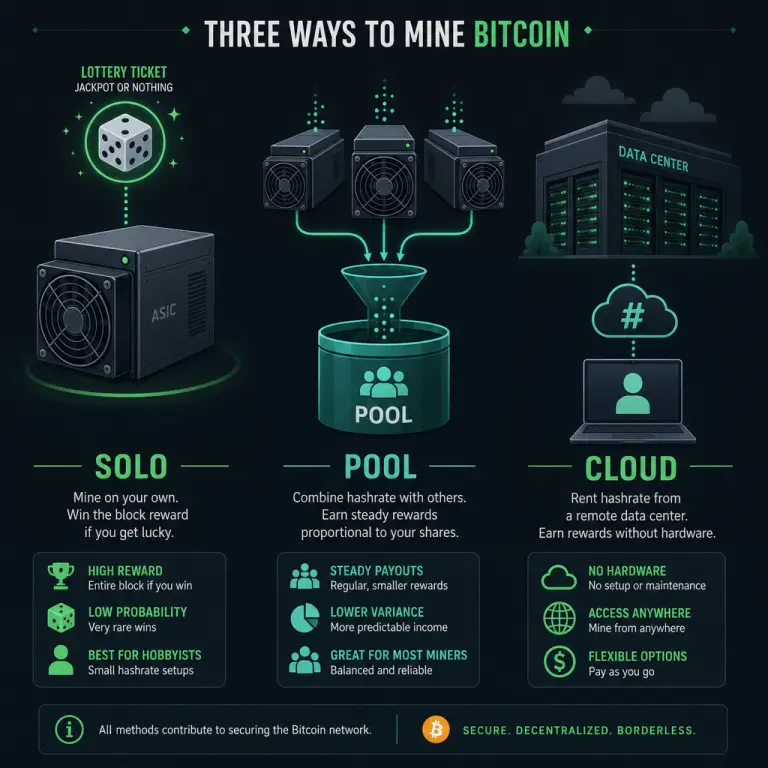
The Three Mining Models in Plain English
All three models produce the same output — BTC credited to a wallet — but the path from electricity to Bitcoin is radically different. The easiest way to understand the trade-offs is to look at who owns the hardware, who takes the risk, and what the cash flow actually looks like week to week.
Solo mining
You buy the ASIC, run a full Bitcoin node, point the miner at yourself. If your hash beats the target, you keep the whole 3.125 BTC reward. If not, you earn nothing for months or years.
Pool mining
You still own the ASIC, but point it at a pool (Foundry, AntPool, F2Pool). Thousands of miners share block rewards in proportion to submitted shares. Pool fee is 1–4%; payouts arrive daily.
Cloud mining
You own no hardware at all. An operator runs ASICs at an industrial data center and rents you hashrate by the month. Fixed USD cost, proportional BTC output, pool layer handled behind the scenes.
Solo Mining: The Math of a Lottery at 1 ZH/s
Bitcoin's global hashrate crossed the 1 ZH/s mark (1,000 EH/s) in early 2026, with difficulty sitting above 125 T. Those numbers are abstract until you translate them into the odds a single miner actually faces. That's when solo mining starts to look like what it really is — a lottery with astronomically long but non-zero odds.
Consider a dedicated hobbyist with one Antminer S21 Pro (234 TH/s). That miner represents about 234 / 1,000,000,000 = 0.0000234% of total network hashrate. With 144 blocks mined per day, the expected block-finding rate works out to roughly one block every ~120 years. Find one and you collect 3.125 BTC plus fees — but the expected wait is longer than a human lifetime.
Scale up to 1 PH/s (1,000 TH/s, about five S21 Pros) and the expected wait drops to around 14 years per block. Even a small farm of 10 PH/s still faces roughly a 1.4-year wait between blocks on average — and "average" hides enormous variance. You could win twice in a month or go five years in a row without a single hit.
Solo mining does still happen. According to Solo CKPool data, roughly 22 solo blocks were found in the twelve months ending April 2026 — including a 70 TH/s hobbyist who hit block 944,306 against 1-in-100,000 daily odds. Life-changing when it happens, but not a business model — a lottery ticket you pay an electricity bill to keep buying.
Pool Mining: How Payouts Smooth Out
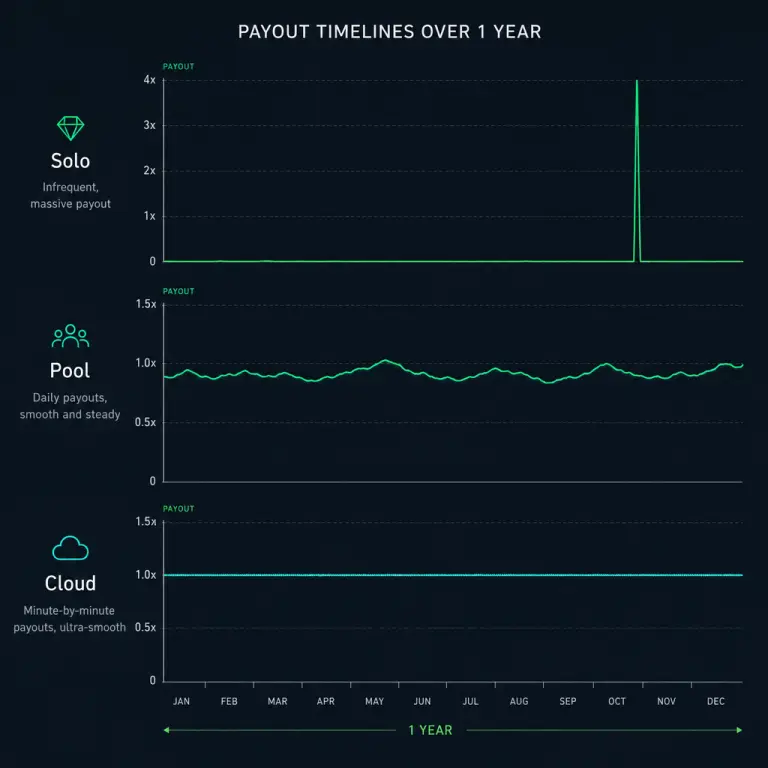
Joining a pool keeps the same underlying economics — you still earn proportional to your hashrate — but converts one massive rare payout into thousands of tiny frequent ones. The expected value is almost identical (minus a small pool fee), yet the shape of the cash flow becomes something a real operator can work with.
Here's the intuition. That same Antminer S21 Pro contributing 234 TH/s to a pool with 100 EH/s total gets credited for 0.000234% of every block the pool finds. The pool wins dozens of blocks a day, so the miner sees a small BTC credit show up like clockwork — typically every few minutes under FPPS schemes or once a day under PPS. No more waiting 120 years.
The four pools that dominate 2026 — Foundry, AntPool, ViaBTC, F2Pool — together control the majority of global hashrate, all defaulting to FPPS (Full Pay Per Share) payouts. Typical pool fees land in the 1–4% band, most clustering around 2–2.5%. That fee buys you predictability: revenue becomes a calm line on a chart instead of a spiky, mostly-zero waveform.
You still carry every non-pool risk, though. The ASIC is yours. So is the $4,500–$6,000 up-front hardware cost, the electricity bill, the cooling, the noise, the repairs, and the obsolescence cycle when next year's more efficient generation arrives. Pool mining solves variance; it does not solve the hardware burden.
Cloud Mining: Zero-Hardware Entry
Cloud mining takes the final step: you don't own the ASIC at all. The operator buys the hardware, installs it at an industrial data center, negotiates the electricity contract, handles cooling, connects to mining pools — and rents you the resulting hashrate at a fixed monthly price denominated in USD.
At NoxHash, the ASICs live in a Kazakhstan data center running on a $0.035/kWh industrial power contract, cooled by the -15°C to -30°C continental winters. The fleet is Antminer S21 and WhatsMiner M60/M66 units at 12–18.5 J/TH efficiency. Rented hashrate is routed to major FPPS pools and BTC drips into your wallet every minute. Plans start at $20/month for a Basic Miner (50 TH/s) and scale to $250/month for 1,000 TH/s Enterprise hashrate.
The trade-off is transparent. You're not buying a machine with resale value — you're paying for access to hashrate for a defined period. When the month ends, the hashrate stops unless you renew. You don't capture ASIC resale upside, but you also don't carry the downside of a $5,000 brick if difficulty spikes. Cloud mining shifts hardware risk off your balance sheet entirely.
Comparison Matrix — Variance, Capital, Risk
Here is the entire decision laid out in one table. Read across each row and the right answer for your situation usually becomes obvious.
| Criteria | Solo | Pool | Cloud |
|---|---|---|---|
| Up-front capital | $4,500+ per ASIC + infrastructure | $4,500+ per ASIC + infrastructure | From $20/month, no hardware |
| Payout variance | Extreme — lottery shape, years between wins | Low — daily BTC credits | Lowest — BTC every minute |
| Max reward per block | Full 3.125 BTC + fees | Proportional share minus 1–4% fee | Proportional share, pool fee absorbed |
| Technical knowledge | High — run full node, firmware, networking | Medium — pool config + hardware ops | Low — create an account, pick a plan |
| Hardware risk | You own 100% (repair, obsolescence, resale) | You own 100% | Operator absorbs hardware risk |
| Electricity exposure | Full — $0.10–0.20/kWh at home | Full — $0.10–0.20/kWh at home | Bundled — $0.035/kWh industrial |
| Setup time | Days to weeks | Days to weeks | Minutes after payment |
| Market risk (BTC price) | You carry it | You carry it | You carry it |
One row deserves a second look: market risk sits with you in all three models. Whether the BTC earned comes from solo luck, a pool credit, or rented hashrate, its USD value rises and falls with Bitcoin's price. Nothing about any of these models hedges that. It only ever shifts hardware risk, variance risk, and operational risk around.
Want the right-most column without the research?
If the matrix above made the cloud row look like the obvious fit, you can test it without spending anything. NoxHash ships a 2-day Basic Miner free trial so you can see the payout cadence, dashboard, and BTC drip before committing to a plan.
When Each Model Actually Makes Sense
The comparison matrix gives the abstract answer. The practical answer depends on your capital, your goals, and what you want to learn from the experience. Here is the honest break-down by user profile.
Solo makes sense when…
You're a hobbyist who wants to "play the lottery" with a small space-heater-sized ASIC, you value the philosophical purity of finding your own block, or you run a multi-EH/s farm where variance becomes statistically tolerable.
Pool makes sense when…
You already own ASICs (or plan to), you have access to sub-$0.08/kWh electricity, you can absorb the noise and heat footprint, and you want the smooth payout shape without outsourcing operations to a third party.
Cloud makes sense when…
You don't own a property suitable for a loud 3,500W heater, your home electricity costs more than $0.08/kWh, you want exposure measured in tens of dollars per month rather than thousands up front, or you're testing mining as an idea before going deeper.
None of them make sense when…
You need guaranteed returns, you'd be investing money you can't afford to lose, or BTC price is in a deep drawdown and the USD-denominated cost base would outrun what the BTC income is worth. Timing matters in every model.
The Hybrid Path: Cloud First, Rig Later
For a lot of newcomers the honest answer is not "pick one" but "sequence them". Cloud mining is the cheapest way to learn how payouts behave, what a pool fee looks like on a balance sheet, and how difficulty adjustments feel month to month. A $20 Basic Miner rental for three months costs less than a single Antminer PSU — and leaves you with real operating experience rather than theory.
Once you've lived through a difficulty jump and a BTC drawdown, the decision about whether to go deeper becomes informed. Some scale up on the same cloud platform; others take that understanding and buy a home ASIC. Either path is reasonable — the mistake is skipping the learning step and committing $5,000 to hardware before watching a single payout cycle.
Test the cloud column before you commit to a rig
The hybrid path works because cloud mining is cheap to start and easy to leave. Create a NoxHash account, activate the 2-day Basic Miner trial with no deposit, and watch how BTC actually drips in before you decide whether to rent more hashrate — or eventually buy your own.
Frequently Asked Questions
Is solo mining still possible in 2026?
Technically yes — anyone can run a full node and point an ASIC at themselves. Statistically, with network hashrate near 1 ZH/s, a single S21 Pro expects one block every ~120 years. About 22 solo blocks were found globally in the twelve months to April 2026, so wins happen, but it is a lottery, not income.
What is the difference between pool mining and cloud mining?
In pool mining you own the ASIC, pay the electricity, and submit shares to a shared pool. In cloud mining you own no hardware — you rent hashrate from an operator who handles the machines, electricity, cooling, and pool connection. Pool mining keeps hardware upside; cloud mining trades it for zero operational burden.
Can I combine cloud mining with owning a home rig?
Yes, and many miners do. Cloud rentals cover variable demand or teach the payout cycle; a home rig gives you hardware upside and direct control. The combination lets you scale hashrate quickly without waiting for ASIC deliveries and absorb seasonal electricity spikes more flexibly than a pure-hardware setup allows.
Which model earns the most money per dollar invested?
There is no universal answer. Pool mining at $0.04/kWh can beat cloud mining; cloud mining beats pool mining at home $0.15/kWh electricity. Solo mining has the highest expected value only if you own very large hashrate. Compare your own electricity rate and capital horizon against the operator's rental price to decide.
Do I need technical knowledge to start cloud mining?
No. Cloud mining was designed to remove the firmware, pool configuration, cooling, and networking layers. You create an account, pick a plan, fund it with USDT, and watch BTC credit into your wallet. Solo and pool mining both require hands-on familiarity with ASIC firmware, pool stratum URLs, and basic networking.
What is the smallest amount I can start mining with?
Solo and pool mining both require an ASIC, which starts around $4,500 plus setup costs. Cloud mining with NoxHash starts at $20/month for a Basic Miner (50 TH/s), and a 2-day Basic Miner free trial requires no deposit at all — the minimum realistic entry point across all three models.
Does cloud mining use pools internally?
Yes. The operator's ASICs are connected to major FPPS pools such as Foundry and AntPool so they benefit from the same variance-smoothing that every other commercial miner uses. The pool fee is absorbed into the monthly rental price — renters see a clean USD cost and a steady BTC credit, without a separate pool-fee line.
Educational content — not financial advice
This guide is for education, not investment advice. Network hashrate, difficulty, pool fees, ASIC prices, and electricity rates cited reflect public data as of April 2026 and will change. Mining income depends on BTC price, network difficulty, and operator reliability — all outside your direct control. Past performance does not guarantee future results. Only commit capital you can afford to lose and consult a qualified tax professional for your jurisdiction.