SHA-256 Mining Explained — What Coins Use Bitcoin's Algorithm?
SHA-256 secures Bitcoin and coins like BCH, BSV, Namecoin, DigiByte. How the shared algorithm shapes ASIC compatibility and mining profitability in 2026.
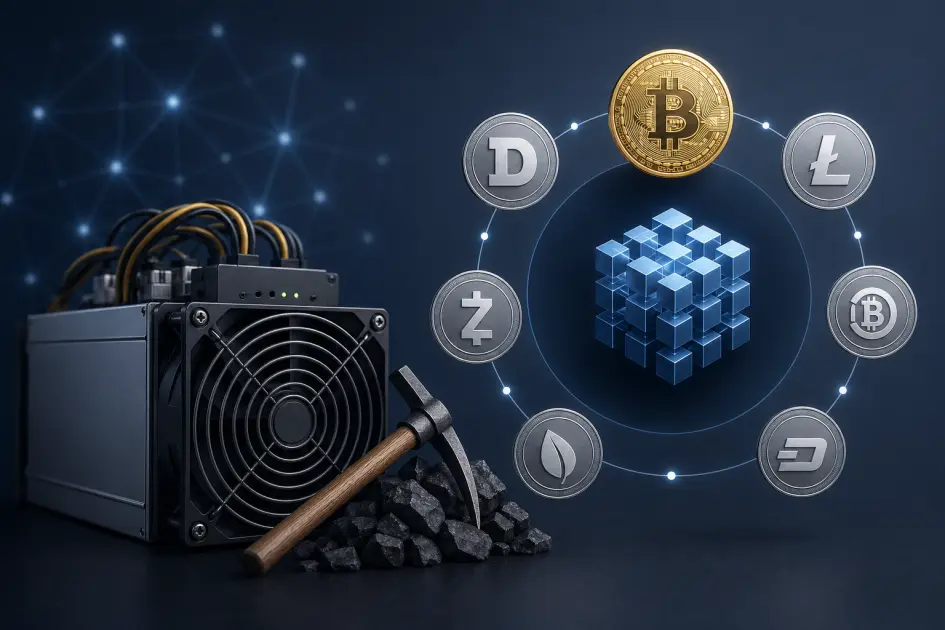
SHA-256 is the cryptographic hash function that powers Bitcoin's proof-of-work — and a small family of related coins share the exact same algorithm. That means any SHA-256 ASIC miner can point its hashrate at Bitcoin, Bitcoin Cash, Bitcoin SV, Namecoin, or DigiByte's SHA-256 layer. In practice, nearly all industrial SHA-256 hashrate targets BTC because that's where the revenue is.

Why "which coins use SHA-256" matters to miners
If you own or rent SHA-256 ASIC hashrate, the hardware doesn't know or care whether it's hashing Bitcoin or Bitcoin Cash headers — the math is identical. That gives miners theoretical optionality: point the same machine at whichever SHA-256 coin is paying most per TH/s right now.
In practice, that optionality is mostly on paper. Bitcoin's market cap, transaction fees, and liquidity dwarf every other SHA-256 coin combined. For almost any miner running modern gear — S21, M66S, S21 Pro — BTC prints more revenue per petahash than the alternatives for weeks or months at a time. Alternative SHA-256 coins become profitable only during brief pricing anomalies, and when they do, enough hashrate migrates to close the gap within hours.
Understanding which coins share Bitcoin's algorithm matters for three reasons. First, it explains why alt SHA-256 coin prices react to BTC difficulty changes. Second, it explains why these coins live under a security shadow — any large Bitcoin miner could redirect hashrate and overwhelm them. Third, if you're evaluating cloud mining, it's useful to know what the operator could theoretically mine, even if they only offer BTC.
SHA-256 in two paragraphs
SHA-256 is a cryptographic hash function that takes any input and produces a fixed 256-bit (32-byte) output. It's deterministic — the same input always produces the same hash — and practically collision-resistant, meaning nobody has ever found two different inputs that produce the same output. The function is one-way: given a hash, you can't compute the input short of brute force. It was published by the U.S. NSA in 2001 as part of the SHA-2 family.
Bitcoin's proof-of-work uses SHA-256 in a specific way. To mine a block, you search for a nonce (a 32-bit number) such that SHA-256(SHA-256(block header)) produces a hash below the network difficulty target — a very small number that requires leading zeros. The double-hash design was Satoshi's choice in 2008-2009, intended to defend against length-extension attacks. Miners are essentially running trillions of SHA-256 operations per second per machine, looking for that rare nonce that satisfies the target. Find one, and you win the block reward.

The SHA-256 coin family
Below is the current roster of notable SHA-256 proof-of-work coins, with network hashrate and economic scale. Figures are approximate and reflect conditions in early 2026 — hashrate and market cap move daily.
| Coin | Network hashrate | Market cap tier | Block reward | Profitability vs BTC |
|---|---|---|---|---|
| Bitcoin (BTC) | ~800-900 EH/s | $1T+ (dominant) | 3.125 BTC | Baseline (100%) |
| Bitcoin Cash (BCH) | ~3-5 EH/s | Mid-cap | 3.125 BCH | ~85-95% typical |
| Bitcoin SV (BSV) | ~0.5-1 EH/s | Small-cap | 3.125 BSV | ~40-70% typical |
| Namecoin (NMC) | Merge-mined with BTC | Micro-cap | 25 NMC (variable) | Free bonus via merge mining |
| DigiByte (DGB) — SHA-256 layer | Fraction of multi-algo | Small-cap | ~528 DGB | Highly variable |
| Peercoin (PPC) | Negligible (hybrid PoS) | Micro-cap | Variable | Not meaningful |
| Niche / legacy (eMark, etc.) | Trace | Dust | Varies | Not worth targeting |
A few quick notes on the roster. Bitcoin Cash forked from Bitcoin in August 2017 over a block-size dispute and kept the same SHA-256 algorithm and 21 million supply cap. Bitcoin SV forked from BCH in November 2018 during the "hash war," again keeping SHA-256. Namecoin launched in April 2011 — it's often called the first altcoin, and because it can be merge-mined with Bitcoin, miners earn NMC as a bonus without extra energy cost. DigiByte runs five algorithms simultaneously and only a slice of its blocks are mined with SHA-256. Peercoin is a hybrid PoW/PoS that's economically marginal for SHA-256 miners today.
The "switch your ASIC" math — why BTC wins anyway
Here's the central dynamic. Bitcoin's network hashrate is roughly 1 zettahash per second (1 ZH/s = 1,000 EH/s). Bitcoin Cash's network runs at roughly 0.5-1% of that. Bitcoin SV is around 0.05-0.15%. Because ASIC hashrate is fungible across SHA-256 coins, miners constantly compare expected revenue per TH/s across the family and route hashrate toward whatever pays best.
The result is a self-correcting equilibrium. When BCH or BSV briefly becomes more profitable — usually because of a price spike, a difficulty adjustment lag, or both — some Bitcoin hashrate migrates over. The alt coin's difficulty then rises to absorb the new hashrate, profitability falls back in line with BTC, and the hashrate drifts home. These cycles play out over hours to days, and a handful of pools automate the routing.
For a retail user or a large industrial operator, the conclusion is the same: over 99% of the time, pointing SHA-256 hashrate at Bitcoin is the correct call. The few percent of the time an alt coin is more profitable, the edge is small (often 2-5%) and short-lived, and only sophisticated pools with automated switching capture it reliably. For a solo operator or cloud mining user, chasing the spread is rarely worth the operational complexity.
Rent SHA-256 hashrate the same ASICs mine with
NoxHash runs Antminer S21 and WhatsMiner M66 machines — the same hardware that secures Bitcoin, Bitcoin Cash, and the rest of the SHA-256 family — pointed at BTC because that's where the revenue is.

The security shadow — 51% attack risk for alt SHA-256 coins
One uncomfortable consequence of shared-algorithm mining is that alt SHA-256 coins live in Bitcoin's security shadow. The math is blunt: BCH's network is ~100-200x smaller than Bitcoin's, and BSV's is ~1,000x smaller. A large BTC mining operation could, in principle, redirect a fraction of its hashrate and control more than 50% of an alt network for long enough to perform a double-spend or deep reorg.
This isn't theoretical. Bitcoin SV suffered a serious chain reorganization attack in August 2021, with reorgs reported at depths of dozens of blocks. Bitcoin Cash has had multiple scares and at least one coordinated hash reallocation event in 2020 when miners briefly redirected capacity. Testnet demonstrations have shown that a modest fraction of BTC hashrate is enough to temporarily overwhelm these smaller networks.
Security asymmetry
Alt SHA-256 coins can be attacked with hashrate that already exists for BTC. Small networks are cheap to rent or redirect.
Why BTC is safe
Bitcoin is the largest SHA-256 network. No other actor commands enough spare hashrate to threaten it, so it sets the security ceiling for the family.
History matters
BSV's August 2021 reorgs and past BCH incidents show this is not a hypothetical concern. Exchanges often require 50+ confirmations on alt SHA-256 deposits.
Mitigations exist
Checkpointing, deeper confirmation requirements, and changing the PoW algorithm entirely (as Monero has done) are the standard defenses, but each carries tradeoffs.
This dynamic is why some alt SHA-256 projects have considered or implemented rolling checkpoints (BCH did in 2018) and why exchanges often require far more confirmations on BCH or BSV deposits than on Bitcoin deposits. It's also why pure cryptographic security of SHA-256 is largely irrelevant to these smaller coins — economic security is what matters, and it's borrowed from BTC's hashrate surplus.
What this means for cloud mining users
When you rent SHA-256 hashrate on NoxHash or any credible cloud mining platform, you're mining BTC — the operator picks the target. In principle the exact same hashrate could be pointed at BCH, BSV, or merge-mined Namecoin. In practice, operators target BTC for four simple reasons.
Revenue stability
BTC's deeper order books and higher transaction fees make daily revenue more predictable. Alt coin revenue can swing wildly on thin liquidity and depend on a handful of exchanges.
Liquidity for payouts
Mining BSV and paying users in BSV assumes they want BSV. Most users want BTC or stablecoins — so mining BTC avoids forced conversions and the slippage they entail.
Regulatory and reputational risk
Smaller SHA-256 coins carry more exchange-listing and reorg risk. Operators prefer the most battle-tested target to protect their business and customers.
Demand signal from users
Virtually no cloud mining customer asks to mine BSV or Namecoin. Offering alt-SHA-256 contracts as a user option is demand-constrained, not supply-constrained.
The practical takeaway: if you want exposure to BCH, BSV, or DGB, buy the coins directly on an exchange. Trying to cloud-mine them means paying the same hardware lease rate while earning less, and accepting reorg and liquidity risk on top. The economics only make sense for niche operators running their own machines who want to hold the alt coin regardless.
Skip the alt-SHA-256 detour — mine where the revenue is
Over 99% of the time, pointing SHA-256 hashrate at Bitcoin outperforms any alt coin in the family. NoxHash targets BTC, pays in BTC, and lets you try the platform for two days on a Basic Miner before you deposit.
Frequently asked questions
Can I choose to mine BCH instead of BTC on a cloud platform?
Most mainstream cloud mining operators, including NoxHash, only offer BTC-targeted contracts because BTC yields the most revenue per TH/s almost all the time. A handful of niche services let users pick the target, but the alt coin payout is usually worse than the BTC equivalent after accounting for conversion slippage.
Why is Bitcoin Cash less profitable to mine than Bitcoin?
BCH and BTC both pay 3.125 coins per block, but BCH's coin price is a small fraction of BTC's and its transaction fees are much lower. A miner hashing BCH earns the same number of coins per unit of work, but each coin is worth far less. That price gap drives the profitability differential.
What coin uses a modified version of SHA-256?
Some coins use SHA-256 variants to deliberately break ASIC compatibility. Examples include Terracoin's past SHA-256d adjustments and various experimental projects. Modified SHA-256 means standard Bitcoin ASICs can't mine them, which was the whole point — to keep mining accessible to CPU or GPU hardware.
Is SHA-256 still secure in 2026?
Yes. After 25 years of intensive public cryptanalysis, SHA-256 has no known practical attacks. Collision and preimage resistance remain intact. Quantum computing is a longer-term concern for some crypto primitives, but current and near-future quantum hardware does not threaten SHA-256 at scale.
What is double-SHA256?
Double-SHA256 (also written SHA-256d) means applying SHA-256 twice in sequence: the output of the first hash becomes the input of the second. Bitcoin uses this for its block header hashing. Satoshi's rationale was defense against length-extension attacks that affect single-application Merkle-Damgard constructions.
Can a big Bitcoin miner really 51%-attack BCH or BSV?
Technically yes — a large BTC miner redirecting even a small fraction of hashrate could dominate BCH or BSV temporarily. BSV experienced real deep reorgs in August 2021. The economic incentive is usually absent because attacking trashes the coin you'd need to profit from, but the capability is real.
Is merge mining Namecoin still profitable?
Merge mining means you get NMC essentially for free alongside your BTC work, but Namecoin's market cap is so small that the extra revenue is typically well under 1% of your BTC earnings. A few pools still merge-mine it; most don't bother. It's a bonus, not a reason to change your mining strategy.
Sources referenced: Bitcoin whitepaper (bitcoin.org) for the original SHA-256 PoW construction, and CoinGecko for current market cap and network hashrate figures on each coin. Approximate values reflect conditions as of early 2026.
Informational content, not investment advice
This article explains the SHA-256 mining ecosystem. Network hashrate, market cap, and relative profitability figures change constantly and were approximate at the time of writing. Crypto mining and crypto holdings carry market, regulatory, and technical risk — only allocate capital you can afford to lose, and verify current figures from primary sources before making financial decisions.