How to Recognize Social Engineering Attacks in Crypto Communities
The 6 psychological levers attackers pull in crypto Telegram, Discord, and Twitter — authority, urgency, reciprocity — and the scripts that defeat each one.
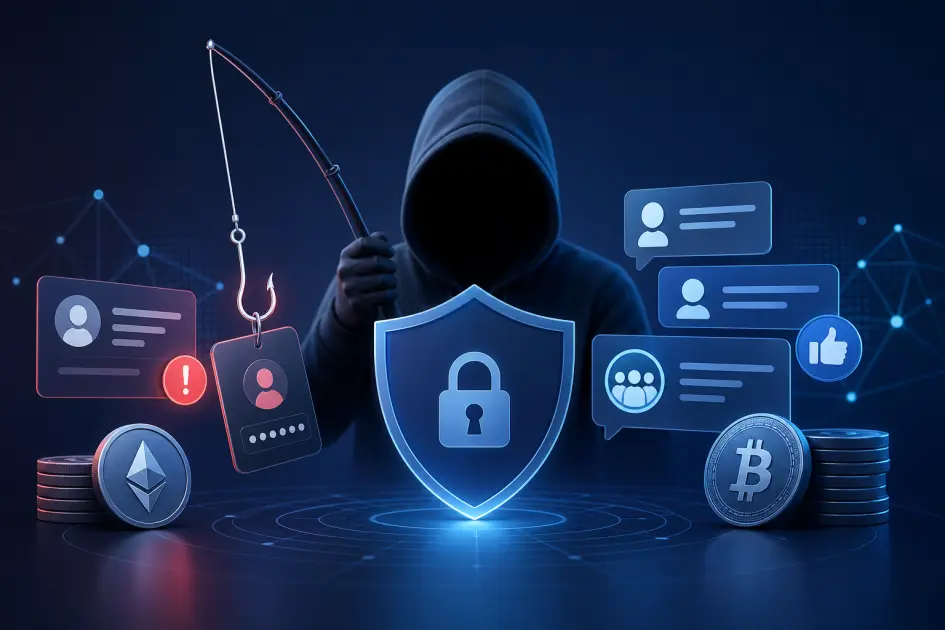
Social engineering is the practice of manipulating humans — through authority signals, cognitive biases, and social pressure — into actions they would refuse under reflection. In crypto, these attacks are overwhelmingly more successful than technical exploits because cryptography is (mostly) unbreakable, but humans are forever patchable. The attacker never needs your seed phrase if you will type it in yourself.

What Social Engineering Actually Is
Social engineering is the practice of exploiting predictable human responses — deference to authority, fear of missing out, reciprocity for small favors, comfort in crowds — to make someone act against their own interest. The attacker does not break any code. They get you to do the breaking for them: paste your recovery phrase, approve a malicious transaction, send a "test" deposit, click a link that drains your wallet.
In crypto, social engineering is the dominant attack class. A 2023 FBI IC3 report attributed billions in losses to what it labels "investment fraud" and "tech-support impersonation" — categories that are, operationally, social engineering wearing a crypto costume. The cryptography protecting a Bitcoin transaction is effectively unbreakable; the cryptography protecting the human holding the keys is not.
That is why understanding the psychology matters more than memorizing a list of scam URLs. New scam sites appear daily. The underlying levers — authority, urgency, reciprocity, social proof, liking, scarcity — have not changed since Robert Cialdini catalogued them in 1984. If you learn to spot the levers, you can defeat scams you have never seen before.
The Six Psychological Levers Attackers Use
Every crypto social engineering script in the wild is built from one or more of these six levers. The names come from classic influence research; the scripts are adapted for Telegram, Discord, Twitter/X, and Reddit.
1. Authority
Impersonation of someone you trust to obey: "Ledger Support", "Binance Security Team", a project's CEO, a Discord moderator, even law enforcement. Profile photos, badges, and title tags do almost all the work. The message arrives with a tone of calm authority and an instruction.
2. Urgency
Hard deadlines designed to short-circuit reflection. "Claim your airdrop in 10 minutes or it expires." "Verify your wallet in 1 hour or your funds will be frozen." "Only 3 hours left to migrate before the old contract is deprecated." Panic is the point — a panicking user does not double-check.
3. Reciprocity
"Free" gifts create a debt. An attacker DMs you an NFT, sends you testnet tokens, helps you debug a wallet issue, then asks a "small favor" — connect your wallet here, sign this message, send 0.01 ETH to confirm the gift address. The favor always costs more than the gift.
4. Social Proof
Manufactured consensus. Twenty accounts all posting "thanks bro just got my 2 ETH!", pump-and-dump Telegram groups with 50,000 bot members, fake Trustpilot testimonials. If "everyone" is getting rich, the risk of being the one skeptic feels higher than the risk of the scam.
5. Liking / Rapport
The long play. A "helpful stranger" answers your Discord question patiently for weeks. You start chatting about hobbies, life, the market. Eventually they mention an opportunity, or ask you to test a tool, or need help with something. People defraud people they like — that is why the grooming phase exists.
6. Scarcity
"Only 10 whitelist spots left." "Private alpha, invite-only." "First 100 wallets get 10x allocation." Scarcity converts hesitation into fear of loss. Any legitimate service that actually has limited spots does not pressure you into them — the pressure itself is the signal.
Where These Attacks Actually Live
Social engineering in crypto does not happen in a vacuum — it happens on the platforms where crypto users already spend their time. Each platform shapes the script.
Telegram. The single highest-volume vector. You join a project's official channel to ask a question; within minutes you get a DM from "Admin Support" offering to help. That DM is always an impersonator. Real Telegram admins of legitimate crypto projects do not DM users first — it is a universal convention precisely because impersonation is so rampant. Every support request is handled inside the public channel or via a bot, never via unsolicited DM.
Discord. The mid-volume grooming ground. Attackers use verification bots ("click this link to verify your wallet and keep your role"), fake support tickets, and long-con rapport building in voice channels. Pay special attention to DMs from accounts with the server's name or logo — Discord allows any user to set any display name, and scammers routinely spoof "Moderator", "Support", or the bot's own name.
Twitter / X. The reply-guy ecosystem. You tweet about a stuck transaction, and within minutes a dozen "support" accounts reply offering help via DM. Every single one is a scam. Projects do not provide support via Twitter replies from nameless accounts — they direct you to a help center or ticketing system.
Reddit. Mining subreddits (r/BitcoinMining, r/gpumining, r/CryptoCurrency) are prime targets. The common script: you post about hardware, electricity costs, or payout issues, and a "friendly user" sends a DM with a "tip" — a link to a fake dashboard, a Telegram group, or a "cloud mining calculator" that asks for your credentials.
LinkedIn. The surprising one. "Crypto recruiter" DMs offering remote jobs at made-up exchanges, asking you to complete a "skills test" by running a script or connecting a wallet. The interview is the attack.
The Counter-Scripts That Defeat Each Lever
For each lever, there is a short internal script you can rehearse and deploy. These are deliberately simple and a little blunt — that is the point. Social engineering works on politeness and flow; the counter works by breaking flow.
Against Authority
"I will verify this through the official channel and get back to you." Then close the DM and open the project's website in a new tab yourself. Do not click links in the message. Do not reply "sure" — the conversation does not resume.
Against Urgency
"If it is real, it will still be real in 24 hours. I need time to verify." Any legitimate offer survives a one-day delay. Deadlines that do not survive are fabricated to defeat reflection — the deadline is the evidence of fraud.
Against Reciprocity
"Thanks, but I would rather not owe anyone." Refuse the gift. If the gift already arrived, ignore it — airdropped NFTs and tokens are bait for wallet-drainer approvals; never interact with unsolicited assets in your wallet.
Against Social Proof
"Testimonials from strangers on the internet are not evidence." Bot accounts are cheap; 10,000 "happy users" in a Telegram group cost the attacker roughly nothing. Only verifiable on-chain behavior over long time windows counts.
Against Liking
Keep crypto conversations with strangers transactional. A helpful stranger in a Discord server is not your friend — they are a stranger in a Discord server. Do not take financial suggestions, wallet tools, or "opportunities" from people you met online, no matter how long the friendship feels.
Against Scarcity
"Any legitimate service will not pressure me. The pressure is the signal." Walk away. If you return later and the "opportunity" is gone, you have lost nothing a scammer had to give you in the first place.
NoxHash support does not DM users on Telegram or Discord
All communication happens via official email or in-platform support tickets. If someone claiming to be NoxHash DMs you on a community platform asking for your password, 2FA code, seed phrase, or a "verification" transfer — they are an impersonator. Close the message, block, and report.

Community-Specific Rules to Hard-Code
These are not guidelines — they are hard rules. Internalize them now and apply them without exception. Each one eliminates an entire class of attack.
Never click DMs from anyone in a group
Even if they seem helpful. Even if they have the server's logo. Even if another user vouches for them. The rule has no exceptions because the cost of exceptions is catastrophic.
Admins don't DM first
On legitimate crypto servers, admins respond in public channels or through bots — never via unsolicited private messages. An "Admin" initiating contact is by definition an impersonator.
No one legitimate asks for secrets
No real support agent — from any exchange, wallet, or platform — will ever ask for your seed phrase, password, 2FA code, or private key. Ever. The request itself is the evidence of fraud.
"Send first to receive" is always a scam
Any giveaway that requires you to send crypto first — "send 0.1 ETH to the event address and receive 1 ETH back" — is a theft. Legitimate giveaways never require outbound transfers. The math alone should stop you.
Projects announce in official channels
Real projects do not announce airdrops, migrations, or urgent actions via DM. If the first time you heard about an "urgent" event is a private message, it is not real. Check the project's website or verified social account.
Urgency is a red flag, not a real signal
Real support, real airdrops, and real opportunities do not pressure you into hasty action. Artificial deadlines are a social engineering tool — the pressure itself is diagnostic of a scam.
What to Do When You're Targeted
Assume you will be targeted — everyone in crypto is, eventually. The question is not whether but how you respond. The correct response is disappointingly boring.
Do not engage. Do not reply "not interested". Do not argue. Do not "waste their time" to "protect others" — you are talking to a bot or a professional who will simply mark you as a live target and pass your handle to other operators. Every reply, even a hostile one, is a signal that the account is active and worth working on.
Do not confront. The sender is almost always a bot account, a data-harvesting script, or a paid worker in a scam operation. There is no individual to shame. Confrontation burns your time and teaches the script what your objections sound like so the next version can pre-empt them.
Screenshot, report, block, move on. Take a screenshot of the message and the profile. Report to the platform: Telegram has in-app report; Discord has a report button; Twitter/X has "Report Tweet". If you lost funds, file with IC3.gov (the FBI's Internet Crime Complaint Center) — recovery is rare but aggregated reports drive takedowns. Then block the sender and close the tab.
Do not assume you can play along safely. Social engineers are trained to extract value incrementally — a confirmation of your email address, a hint about your wallet type, a photo of your setup. Each data point fuels the next attack, on you or someone you know. When in doubt, exit. That is the whole strategy. It is not clever or satisfying. It works.
Frequently Asked Questions
Can social engineering bypass two-factor authentication?
Yes — easily, if you cooperate. An attacker calls pretending to be support, says they need your "temporary login code" to verify your account, and you read out the 2FA code yourself. The cryptography is fine; you handed over the second factor voluntarily. Never read any code to anyone who contacted you.
How do scammers find crypto users in the first place?
Public member lists of Telegram/Discord crypto groups, Twitter users who reply to wallet or exchange accounts, Reddit posters in mining subreddits, and leaked databases from hacked crypto sites. If you have ever interacted publicly with crypto, you are on several target lists. Assume targeting by default.
What is a "pig butchering" scam?
A long-con hybrid of romance and investment fraud (Chinese: shā zhū pán, "fattening the pig before slaughter"). The attacker spends weeks or months building emotional rapport, then introduces a fake crypto trading platform showing fabricated profits. Victims deposit escalating amounts before the platform vanishes. Losses often reach six figures.
Are Telegram group admins safe to talk to?
Real admins do not initiate DMs. Anyone in your inbox calling themselves "Admin" or "Support" after you post a question in a group is an impersonator — they scrape questions from the channel and race to DM victims first. Real admins answer in the public channel, never privately.
Can you social engineer a hardware wallet?
You cannot social engineer the device — the secrets never leave it. You can, however, social engineer the human into typing their 24-word recovery phrase into a fake "Ledger Support" form or signing a malicious transaction on a spoofed site. The wallet is safe; the owner is the attack surface.
What's the difference between social engineering and phishing?
Phishing is a subset of social engineering that relies on technical spoofing — fake websites, cloned emails, Unicode lookalike domains. Social engineering is broader and includes purely human-to-human manipulation: impersonation calls, rapport grooming, authority exploitation. All phishing is social engineering; not all social engineering is phishing.
If I already replied to a scammer, am I compromised?
Replying alone does not compromise your funds — but it flags you as a live, engaged target for future attempts. Stop responding immediately, block the account, and stay alert for an increase in impersonation DMs over the coming weeks. If you clicked links or shared codes, rotate passwords and reset 2FA now.
Security notice
This article is educational and not legal, financial, or professional security advice. Scam tactics evolve constantly — treat the principles here as a foundation, not a complete defense. Crypto transactions are irreversible, and losses from social engineering are almost never recoverable. If you suspect an attack in progress, stop, do not engage, and verify through an independent official channel.