Proof of Mining — How to Verify a Cloud Mining Platform Is Real
Concrete verification methods for cloud mining platforms — on-chain payout proofs, facility and hardware transparency, NOC signals, and the small-withdrawal test.

Proof of mining is not one check — it is a stack of independent signals that together make fraud expensive to fake. Four signals matter: on-chain payout traces you can verify in a block explorer, specific hardware and facility disclosures (ASIC model, J/TH, jurisdiction, remote desktop access), an operational fingerprint that only real 24/7 technical teams leave, and the small-withdrawal test you run yourself in week one. None of these is enough alone; together they are how a real platform separates itself from a polished-looking Ponzi.
What "Proof of Mining" Actually Means
Proof of mining is the act of establishing, through independent evidence, that the hashrate you are paying for is attached to real ASIC hardware producing real Bitcoin. It borrows the name from proof-of-reserves (an exchange practice) and proof-of-work (Bitcoin's consensus mechanism), but it is a cloud mining-specific discipline: a forensic stack of checks you run before — and during — a rental to convert the question "is this real?" into a set of verifiable answers.
The key word is stack. No single proof is decisive on its own. A block explorer trace can be cherry-picked. A facility photo can be stolen from another operator. A glossy NOC video can be staged. A small withdrawal can be paid while the big ones are quietly frozen. Fraud becomes expensive — and eventually not worth faking — only when a platform has to sustain all four signals simultaneously, over months, to every user who asks. That is the bar.
This article assumes you already know cloud mining as a category is legitimate (real operators, real BTC) but individual platforms can be fraudulent. Our sibling piece answers the broader "is cloud mining a scam?" question. Here we focus only on the forensic layer — how do I actually verify this specific platform today.
On-Chain Proof — Tracing Payouts to the Bitcoin Ledger
Bitcoin's public ledger is the single most powerful verification tool in this entire article. Every real payout leaves a fingerprint nobody can fake: a transaction hash, an input address, an output address, a block height, a confirmation count. If a platform genuinely mines and pays users in BTC, that activity is on-chain and readable by anyone with a block explorer.
The first on-chain signal is your own payout. After your first real withdrawal, the platform issues you a transaction ID (TXID). Paste it into mempool.space or Blockchain.com Explorer. You should see: a real transaction, confirmed in a recent block, sending BTC from the platform's hot wallet to the address you provided. The fee paid by the sender should be consistent with the mempool rate at broadcast time. The input transactions feeding the hot wallet should themselves be traceable backwards — and some of those upstream transactions should originate in coinbase outputs, the protocol-level rewards that only mining pools receive.
| What you trace | Legitimate operator | Ponzi-shaped operator |
|---|---|---|
| Withdrawal TXID | Real on-chain tx with market-rate fee | "Pending" screen that never resolves to a TXID |
| Hot wallet funding | Inputs trace back to pool payout addresses over many months | Inputs trace back to user deposit addresses (circular money) |
| Payout cadence | Steady outflow over weeks, many unique destination addresses | Bursty outflows tied to specific marketing pushes |
| Pool address lineage | Recognisable FPPS pool payout patterns (Foundry, AntPool, F2Pool) | No traceable pool lineage — just user-to-user shuffling |
FPPS (Full Pay Per Share) pools — the model NoxHash uses and the most common in industrial mining — produce a recognisable payout pattern: predictable daily settlements from a known pool hot wallet, fanned out to many operator wallets, each of which then fans out to end-user withdrawal addresses. You can sample any of those hops on an explorer. A platform that refuses to disclose a single example operator address — not just a user's own — is denying you the easiest free verification check in the industry. On NoxHash, withdrawal TXIDs are published on the transaction history page for exactly this reason.
One caveat: on-chain proof confirms that BTC is flowing; it does not by itself prove the BTC was freshly mined versus purchased on an exchange and recycled. That is why it is one of four signals, not one of one. Combine it with the hardware and facility proof below and the gap narrows quickly.
Hardware & Facility Proof — Specificity Is the Signal
The strongest signal of a real operator is specificity. Scam sites hide behind vague language — "latest-generation miners," "global data centers," "industrial-grade cooling" — because vagueness scales across dozens of clone sites. Real operators name things, because they have to: their hardware is invoiced, their power contract is signed, their technicians are employed.
Named ASIC models
"Antminer S21 XP Hyd at 12 J/TH" beats "latest generation." Real operators list specific models, hashrates, and efficiency figures because they can be cross-referenced against Bitmain and MicroBT spec sheets.
Named jurisdiction
"Kazakhstan, $0.035/kWh industrial contract" is verifiable against the country's known mining landscape. "Global data centers" with no country is the Ponzi dialect.
Remote desktop access
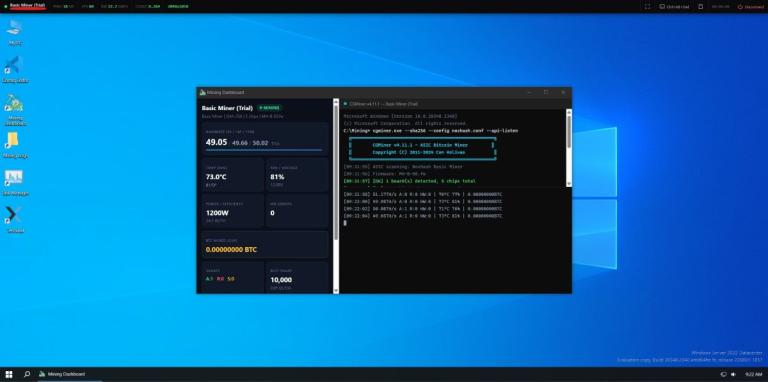
The strongest hardware proof in the industry: clicking "View Desktop" on your rented miner and watching the live CGMiner console. You cannot fake that at scale.
The remote desktop angle deserves its own paragraph because it is the cheapest single verification check a user can run. On NoxHash, every rented miner exposes a "View Desktop" button that opens the underlying Windows Server instance in your browser. You see: the exact hardware specs the OS has enumerated, the live CGMiner log scrolling share-accepted events, the pool endpoint being dialed, and the temperature/hashrate telemetry. A Ponzi cannot synthesize this at scale — keeping thousands of simulated CGMiner consoles in sync with fabricated on-chain payouts is more engineering effort than actually running the mine. Platforms that offer read-only screenshots are not in the same category; a static image proves nothing. Live, interactive desktop access is the proof.
Facility photography plays a supporting role. Drone shots of buildings, closeups of hot-aisle racks, shots of the power substation — all are forgeable if taken in isolation, but a consistent set across multiple angles, cross-referenced to the named jurisdiction, cross-referenced to the named power rate, cross-referenced to the named ASIC models, is much harder to fake than each piece individually. The Cambridge Bitcoin Electricity Consumption Index publishes the country-by-country hashrate distribution you can sanity-check any claim against: Kazakhstan, the US, Russia, and Canada host the bulk of global hashrate, and any operator claiming a location far outside that map deserves extra scrutiny.

Operational Proof — The Fingerprint of a Real 24/7 Team
The third signal is the hardest to forge and the hardest to describe, because it is not one feature — it is a pattern of behavior over time. Real operators leave an operational fingerprint that Ponzi sites cannot cheaply replicate, because the fingerprint requires a real NOC (network operations center), real technicians, and real years of uptime data.
What the fingerprint looks like: a publicly advertised uptime SLA with specific numbers (NoxHash: 99.9%), a stated hardware-replacement window (NoxHash: 4–8 hours by on-site technicians), a support response pattern that does not evaporate between 9pm and 6am, a public operating history you can crawl with the Wayback Machine, and status updates during infrastructure events (power maintenance, pool failover, ISP incidents). Ponzi sites tend to have no uptime number — because publishing one commits them to a measurement they cannot survive — or they publish an absurdly high one like "100% uptime since inception," which is not what any honest infrastructure operator would claim.
Check the domain's operating history
Plug the domain into the Wayback Machine. A real operator has a content trail — blog posts, support pages, changelog entries — stretching back months or years. A six-week-old domain with a dashboard demo is the single most predictive red flag in cloud mining history.
Test support response at odd hours
Send a substantive technical question (not "is this a scam?") at 2am UTC on a Sunday. A real NOC has coverage. A solo operator larping as a team has a sleeping schedule you can detect inside of one weekend of observation.
Look for specific SLA commitments
"99.9% uptime" is a specific, auditable number. "24/7 support" with a 4–8 hour hardware-replacement window is a specific, auditable commitment. "Best-in-class reliability" is a marketing phrase you cannot hold anyone to. Insist on numbers.
Watch how they handle the boring incidents
Scheduled power maintenance, pool failovers, difficulty adjustments — a real operator communicates these proactively because users will notice them anyway. Platforms that go silent during routine operational events are usually silent for a reason.
One especially strong operational signal is uninteresting failures handled well. A miner fails at 3am; the dashboard shows it offline for 4 hours; support proactively credits or restores; a replacement is logged in the next day's event list. That sequence is dull, specific, and almost impossible to fake, because it requires a live facility with live technicians. Ponzi sites never have this problem — their hashrate numbers are software-generated and never need physical intervention.

Run all four proofs on NoxHash inside the 2-day trial
You just read the first three signals (on-chain, hardware, operational). The fourth — the small-withdrawal test — is covered next. The fastest way to exercise all four at once is the 2-day Basic Miner trial: register, activate the real 50 TH/s unit at the Kazakhstan facility, open "View Desktop" to watch live CGMiner output, and check the transaction history page for historical TXIDs you can drop into mempool.space. No USDT required to observe.
The Small-Withdrawal Test — The Single Most Important Check
If you take one thing from this article, take this: withdraw a tiny amount in your first week on any cloud mining platform, and do not scale up until that withdrawal has completed on-chain. This single check eliminates the majority of historical Ponzi losses. A platform that cannot pay out 0.00001 BTC today will not pay out 0.1 BTC in six months — and the small test costs almost nothing to run.
Here is what the test looks like on NoxHash specifically, so you know what to expect on a working flow and what deviations should raise alarm:
| Step | Expected on a legitimate platform | Red-flag variant |
|---|---|---|
| Minimum amount | 0.00001 BTC, published on the withdrawal page | Surprise "minimum" revealed only after you try |
| Withdrawal fee | 1.5% flat, disclosed up front | "Processing fee," "network fee," "VIP upgrade fee" stacked after submission |
| Admin review window | Hours to a day, then broadcast to mempool | "Pending" for 2+ weeks with no TXID |
| On-chain evidence | Real TXID visible on mempool.space, confirmed in the next few blocks | "Confirmed" status on the platform with no TXID you can verify yourself |
| Address format support | Accepts bc1 (Segwit), 1 (P2PKH), 3 (P2SH) | "Address format not supported, please upgrade account" |
The red-flag column deserves particular attention. The fake "pending withdrawal" screen is the signature Ponzi tell. It looks identical to a real pending state on any crypto platform — a progress bar, a status label, sometimes an animated checkmark. The difference is that no TXID is ever issued. If you cannot paste a real transaction hash into a public block explorer within 24–48 hours of submitting a small withdrawal, escalate immediately: open a support ticket, post publicly asking for the TXID, and do not fund any additional capital. In every historical cloud mining Ponzi collapse, the "pending withdrawal with no TXID" pattern preceded the final shutdown by weeks.
On the legitimate side, the expected path is almost boring: submit the withdrawal, see it move from "pending" to "processing" within hours, receive a TXID, watch it confirm on mempool.space over the next 30–60 minutes, verify the amount (mined BTC minus the 1.5% fee) lands in your wallet. That boring sequence — run once in week one, for 0.00001 BTC — is a better signal than any number of facility photos.
A 10-Minute Verification Checklist
Every proof described above condenses down to six actions you can run on any cloud mining platform in roughly ten minutes — before you register, before you deposit, before you rent. This is the quick-check version; keep it as a bookmarked sanity test.
1. Named ASIC on the pricing page
Ctrl-F the pricing page for "S21", "M66", "M60", or another specific model plus a J/TH figure. If the answer is "latest miners" and nothing else, close the tab.
2. Named jurisdiction and power rate
One country, one price, ideally one power source category. Cross-reference against the CBECI country map. "Global" with no country name is a fail.
3. Remote desktop or live console access
Check whether the platform lets you see the actual mining rig. Static screenshots do not count. Live, interactive access (like NoxHash's "View Desktop") is the strongest hardware proof that exists.
4. Wayback Machine on the domain
Paste the domain into web.archive.org. Look for content trail > 6 months, evolving pricing pages, and blog posts reacting to real market events (halving, difficulty adjustments, price crashes).
5. Published fee and minimum
A clear withdrawal fee (NoxHash: 1.5%) and minimum (NoxHash: 0.00001 BTC) on the public page before registration. "Contact support for fee schedule" is a fail.
6. Plan the week-1 withdrawal
Before you rent, commit to the small test. Put it on your calendar for day 7. A platform that passes the first five checks but freezes on step six is still not safe.
The whole checklist takes roughly ten minutes. It will not give you a guarantee — nothing will — but it converts a fuzzy "does this feel legit?" into a falsifiable set of six specific observations. Platforms that pass all six are not automatically safe; platforms that fail any one of them are almost always not worth the risk.
Walk the 6-item checklist through NoxHash
You now have the ten-minute checklist. Run it against NoxHash: the pricing page lists S21 and M66 models with J/TH figures, the facility is Kazakhstan at $0.035/kWh, the dashboard exposes live remote desktop on every rented miner, the withdrawal page publishes the 1.5% fee and 0.00001 BTC minimum, and transaction history pages show real TXIDs you can drop into mempool.space. The 2-day trial lets you see five of the six signals before any deposit; the sixth — your own small withdrawal — unlocks on a paid plan.
Frequently Asked Questions
Can I verify a cloud mining platform without registering?
Partly. You can verify five of the six checklist items — named ASIC models, named jurisdiction and power rate, Wayback Machine history, published fee and minimum, and the existence of remote desktop access — without registering. The sixth, your own small withdrawal, requires a paid plan. Start with the free trial to unlock the middle layer.
What counts as "enough" proof to trust a platform?
All four signals present — on-chain traceability, specific hardware and facility disclosures, operational fingerprint, and a successful small withdrawal from your own account. Any single check is forgeable; the whole stack is expensive to fake consistently. That expense is the actual definition of "enough" in proof-of-mining terms.
How long does on-chain proof take to verify?
Minutes once you have a transaction hash. Paste the TXID into mempool.space or Blockchain.com, wait for one or two confirmations (10–20 minutes on average), and check the inputs trace backwards to recognisable pool payout patterns. A light trace takes five minutes; a deeper one looking at hot-wallet history takes thirty.
What if a platform has great facility photos but no remote access?
Treat it as a partial signal and lean harder on the other three. Photos can be real but recycled from another operator, which is why live remote desktop access is stronger. If facility photography is the only hardware proof, demand more — specific ASIC models with J/TH numbers, named power rate, published SLA — before funding anything.
Can proof-of-reserves apply to cloud mining?
Only loosely. Proof-of-reserves was designed for exchanges, where the custodial balance is the core concern. Cloud mining has a smaller custodial footprint (mined BTC sitting on the platform between payouts) and a bigger production-side concern (is the hashrate real?). The four-signal stack in this article is the closer analogue.
Is a free trial proof of legitimacy on its own?
No, but it is strong supporting evidence. A trial on a real miner (NoxHash: 2-day Basic, 50 TH/s) lets you verify the dashboard, hashrate curve, and remote desktop without depositing. It does not prove payouts — the trial does not credit to your withdrawal balance — but combined with the other signals, it is a very cheap way to filter out most fakes.
What is the single most predictive red flag?
A "pending withdrawal" that never resolves to a real on-chain TXID within 48 hours. This single pattern has preceded virtually every cloud mining Ponzi collapse in the last decade. If it happens to you on a small test withdrawal, escalate immediately and do not fund more capital under any circumstances.
Educational content — not financial advice
This article is educational and does not constitute investment, tax, or legal advice. Verification methods described here reduce operator fraud risk but cannot eliminate it; they also do not protect against market risk (BTC price and network difficulty), regulatory risk, or custody risk post-withdrawal. All facility, hardware, fee, and SLA figures reflect April 2026 NoxHash conditions and may change. Past performance does not predict future results. Only commit funds you can afford to lose, and consult a qualified crypto-aware accountant about tax treatment in your jurisdiction.