NiceHash vs NoxHash — Cloud Mining Marketplace Comparison (2026)
An honest 2026 comparison of NiceHash's hashrate marketplace versus NoxHash's cloud-mining operator model — pricing, fees, trade-offs, and who each fits.

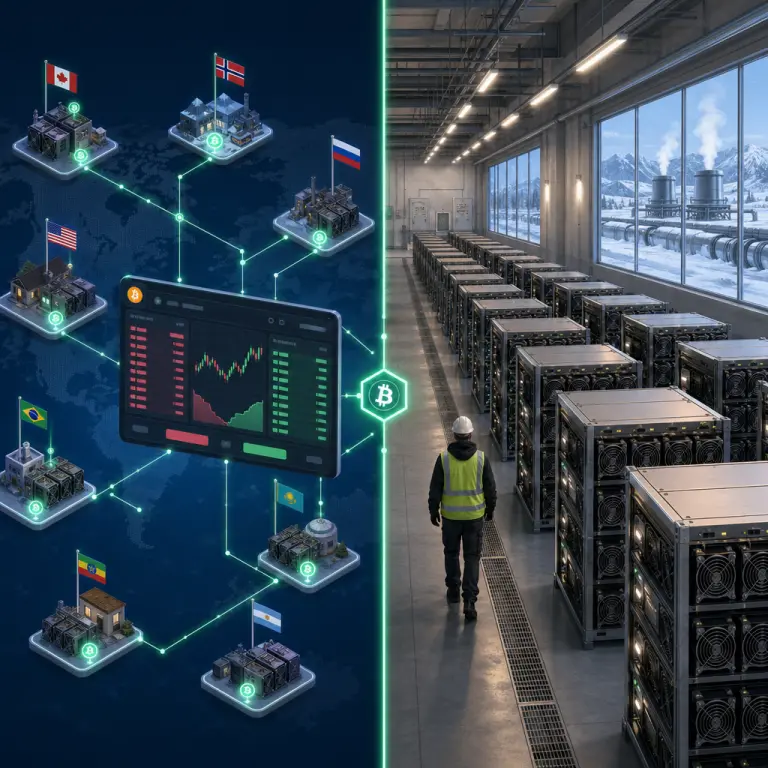
NiceHash and NoxHash both let you earn Bitcoin without owning an ASIC, but they run fundamentally different models. NiceHash is a hashrate marketplace — buyers rent computing power directly from independent sellers at variable prices. NoxHash is a cloud-mining operator — it owns and runs an Antminer fleet in a Kazakhstan data center and rents fixed monthly plans. This 2026 comparison walks through the real trade-offs so you can decide which structure fits your situation.
Two Different Models, One Shared Goal
The most important thing to understand up front: these platforms are not the same product with different branding. They solve the "I want BTC without running hardware at home" problem in structurally different ways. Comparing them fairly means comparing the models first, before any feature checklist makes sense.
NiceHash, founded in Slovenia in 2014, runs a peer-to-peer marketplace where independent miners sell their spare hashrate and buyers rent it on short, user-specified contracts. NoxHash, by contrast, is a vertically integrated operator — it buys the ASICs, pays the Kazakhstan industrial electricity bill, employs the technicians, and sells you fixed monthly plans on top of that infrastructure.
NiceHash — Hashrate Marketplace
A two-sided exchange. Sellers point mining software at NiceHash and earn BTC; buyers post orders specifying algorithm, hashrate, duration and price. Spot-style pricing, short contracts, multi-algorithm support. Founded 2014, based in Slovenia.
NoxHash — Cloud-Mining Operator
A single operator running its own Antminer S21 fleet (12–17.5 J/TH) at a Kazakhstan data center on $0.035/kWh industrial power. Fixed monthly plans from $20 to $250, 1–24 month terms with 5–20% discounts, SHA-256 BTC only.
Each side implies a different buyer psychology. A NiceHash user is, at heart, a trader — they see hashrate as a commodity whose spot price should be timed. A NoxHash user is, at heart, an accumulator — they want a predictable BTC-per-month subscription they can set and check monthly. Both are valid. They're just not the same person.
Side-by-Side Comparison Matrix
Fifteen factors that actually decide which platform suits you. Figures reflect publicly available information as of April 2026 — always verify current terms on each platform's site before committing funds. Columns are clearly labeled so you can see exactly which platform does what.
| Factor | NiceHash (marketplace) | NoxHash (operator) |
|---|---|---|
| Business model | P2P hashrate marketplace | Owned-and-operated data center |
| Founded | 2014 (Slovenia) | Current-generation operator, Kazakhstan |
| Hardware ownership | None — matches independent sellers to buyers | Owns Antminer S21 / S21 Pro / S21 XP Hyd, WhatsMiner M60S / M66S |
| Power cost | Not disclosed — depends on each seller's grid | $0.035/kWh industrial contract |
| Pricing structure | Variable — spot-style bid/ask in BTC per TH/s per day | Fixed — $20 / $50 / $100 / $250 monthly tiers |
| Minimum entry | Small order fee (~0.00001 BTC) + BTC to fund the order | $10 USDT deposit minimum, $20/month Basic plan |
| Contract duration | As short as the buyer chooses — hours to days | 1, 3, 6, 12, 24 months (5–20% longer-term discount) |
| Buyer fees | ~3% service fee + small fixed order fee on each contract (Apr 2026 public pricing) | Plan price all-in; 1.5% on BTC withdrawals |
| Coins supported | Multi-algorithm — buyers can target many coins | BTC only (SHA-256) |
| Payout predictability | Variable — depends on order fill rate and market price | Accrues every minute at fleet's real hashrate |
| Free trial | No trial — you fund an order to test | 2 days on Basic Miner, no deposit required |
| Deposit method | BTC-centric; NiceWallet / on-chain | USDT on TRC-20 or BEP-20 |
| Learning curve | Steeper — requires understanding spot pricing, fill probability, algorithm selection | Flatter — pick a plan tier and term, deposit, earn |
| Languages | Primarily English | 6 languages (EN, VI, ZH, RU, KO, JA) |
| Track record note | Operating since 2014; suffered a ~4,640 BTC hack in Dec 2017 and fully repaid affected users by Dec 2020 (per CoinDesk) | Current-generation operator with disclosed hardware, location, and electricity terms |
Notice that neither column is strictly "better" — they're trade-offs. Multi-coin flexibility and short contracts cost you price volatility and a steeper learning curve. Fixed monthly pricing and a free trial cost you flexibility and coin choice. Your profile determines which trade you want to make.
If the operator column fits your profile, you can test before you spend
The fixed-plan, BTC-accumulator side of the matrix is exactly where NoxHash lives. You can verify the infrastructure with a 2-day Basic Miner trial — no USDT, no card, same Kazakhstan fleet and $0.035/kWh contract the table references.

When NiceHash Suits You
NiceHash's marketplace model has clear advantages for a specific kind of buyer. These are the situations where the extra complexity genuinely pays off — the trade-off becomes a feature rather than friction.
You want short-term, tactical hashrate
New coin launch, solo-block lottery attempt, testnet stress test, or a profitability spike you want to ride for a day. Fixed monthly operators can't match hour-to-day granularity; a marketplace can.
You want multi-algorithm flexibility
Interested in mining non-SHA-256 coins? Marketplaces typically support many algorithms, so you can point rented hashrate at the most profitable coin of the moment. Pure BTC operators are SHA-256 only.
You're experienced with spot markets
You already understand order books, fill probability, maker-taker fees, and you'd rather price-discover than subscribe. The marketplace structure reinforces habits you already have.
You're also a seller
Own your own ASICs or high-end GPUs and want to monetize them without running a solo operation? A marketplace lets you plug in as a supplier. Operators don't offer that path — they already have hardware.
When NoxHash Suits You
The operator model's advantages are symmetrical — they kick in exactly where marketplace friction becomes a cost. If you see your situation here, the fixed-plan structure is doing work for you, not against you.
You want predictable BTC accumulation
A fixed $50/month plan on a 150 TH/s Standard Miner gives you a stable subscription-style commitment. Budget-friendly, easy to reason about, no need to watch an order book or retime rentals.
You want transparency about hardware
The fleet is disclosed: Antminer S21, S21 Pro, S21 XP Hyd, plus WhatsMiner M60S / M66S — all 12–17.5 J/TH, current-generation ASICs. Industrial $0.035/kWh power, Kazakhstan data center, 99.9% uptime target, 24/7 technicians.
You want to test with zero capital
The 2-day Basic Miner trial runs on the real fleet with no deposit required. You can confirm the infrastructure exists and works before sending any USDT — something a marketplace can't easily offer because its sellers aren't the platform.
You prefer native-language support
NoxHash ships with six full locales (English, Vietnamese, Chinese, Russian, Korean, Japanese) across dashboard, blog, and support. If you're reading this in Hanoi, Seoul, or Tokyo, that's a tangible usability advantage.
The shared thread is friction. NoxHash is optimized to remove as many decisions as possible between a curious first-time user and their first satoshi. That simplicity is the product.
How to Choose — A Quick Framework
Three questions will usually resolve the decision faster than any feature list. Answer them honestly — the "right" platform falls out at the end.
Do I want variable pricing or fixed pricing?
Variable gives you upside when hashrate is cheap and downside when it's expensive — marketplace territory. Fixed gives you a predictable monthly line item regardless of market — operator territory. If "predictable monthly bill" sounds calming, go fixed.
Am I mining BTC, or hopping between coins?
If you're a pure BTC accumulator, multi-algorithm flexibility is noise — you'd be paying for complexity you won't use. If you genuinely plan to chase altcoin profitability, a marketplace earns its keep.
How much time am I willing to spend managing this?
Marketplace activity rewards attention — watching prices, retiming contracts, optimizing pool choice. Operator plans reward patience — subscribe, check monthly, withdraw when it's worth the 1.5% fee. Pick the one that fits your calendar, not just your portfolio.
A final honest note: these two platforms are not mutually exclusive. An experienced miner can use a NoxHash plan as a stable BTC baseline and a marketplace for tactical plays on top — a barbell approach. "Which one is better?" is almost always the wrong question. "Which one is better for this part of my strategy?" is the right one.
If the framework points you to fixed-plan, BTC-first simplicity — try before you commit
The three-question filter above lands many readers on the operator side: predictable pricing, BTC-only, low management overhead. If that's you, the Basic Miner trial confirms the infrastructure in 48 hours without spending a cent.
Frequently Asked Questions
Is NiceHash legit in 2026?
Yes. NiceHash has operated publicly from Slovenia since 2014 and remains one of the most recognized hashrate marketplaces. It was hacked in December 2017 for roughly 4,640 BTC and, per CoinDesk reporting, completed full reimbursement to affected users by December 2020.
Is NoxHash legit?
NoxHash is a current-generation cloud-mining operator running an Antminer S21 and WhatsMiner fleet in Kazakhstan on $0.035/kWh industrial power. Hardware models, efficiency (12–17.5 J/TH), location, uptime target (99.9%) and fee schedule are publicly disclosed. A 2-day free trial lets users verify the infrastructure with zero deposit.
What's the core difference between NiceHash and NoxHash?
NiceHash is a peer-to-peer marketplace — buyers rent hashrate from independent sellers at spot prices on very short contracts. NoxHash owns the hardware and sells fixed monthly plans on its own fleet. Marketplace equals flexibility and variable pricing; operator equals predictability and a direct counterparty.
Which platform is cheaper?
It depends on timing. NiceHash can be cheaper per TH/s during low-demand periods and more expensive during spikes — you are exposed to spot volatility. NoxHash's fixed plans are predictable: you know the monthly cost on day one. Neither is universally cheaper. Match the pricing structure to your risk appetite.
Can I mine altcoins on NoxHash?
Not directly. NoxHash runs SHA-256 hardware, so mined rewards are Bitcoin. If you want multi-algorithm exposure to coins like Kaspa, Litecoin, or new launches, a hashrate marketplace like NiceHash is a better fit. If you want to accumulate BTC specifically, a SHA-256 operator is the cleaner tool.
Can I use both platforms at once?
Yes, and many experienced miners do. A NoxHash plan can serve as a predictable BTC baseline while occasional marketplace rentals handle tactical plays — new coin launches, short-term profitability spikes. Treat them as complementary tools, not rival products. The one thing to avoid is double-sizing and ending up over-exposed.
How should I verify current fees and terms?
Always check each platform's official pricing page for the live fee schedule — figures in this guide reflect April 2026 public information and can change. For neutral industry reporting on cloud mining and marketplace news, Decrypt and CoinDesk are useful references before committing funds.
Educational content — not financial advice
This comparison is for education. Platform fees, pricing, and terms reflect publicly available information as of April 2026 and can change without notice — always verify current terms on each platform's official site before committing funds. Cloud mining and hashrate rental both carry real risks: BTC price volatility, network difficulty growth, operator or counterparty risk, and regulatory changes in your jurisdiction. Past performance does not guarantee future results. Only deploy capital you can afford to lose.