What Is a Mining Pool's Luck Rate and Why Does It Matter?
Pool luck compares expected shares to actual shares needed to find a block. Learn how the formula works, why luck averages to 100%, and how it affects payouts.

A mining pool's luck rate is the ratio of expected shares to actual shares it took to find a block, shown as a percentage. A luck rate below 100% means the pool found the block faster than statistically expected (good luck); above 100% means it took longer (bad luck). Over time, every honest pool trends toward exactly 100%.
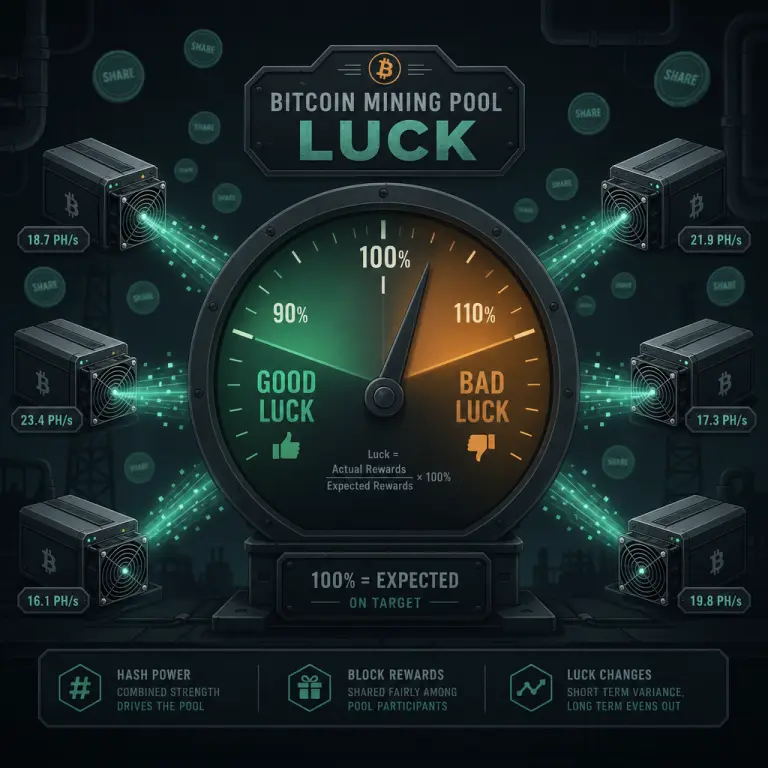
The Luck Formula, Written Out
Every share your miner submits is a "near-miss" — a hash that met the pool's share difficulty but not the full network difficulty required for a valid Bitcoin block. The pool knows roughly how many shares the network should produce, on average, before a block is found. That statistical expectation is the baseline. Compare the real number to the expected number and you have luck.
The industry-standard formula, used by Braiins, Foundry, F2Pool, AntPool and virtually every major operator, is:
Luck = (Expected Shares / Actual Shares) × 100%
Expected shares come from network difficulty. Actual shares are what miners really submitted before the block was found.
Two quick worked examples make the direction of the number obvious. The pool needed roughly 600,000 expected shares at current difficulty to have an even chance of sealing a block:
Block found in 300,000 shares
600k / 300k × 100% = 200% luck
Good luck. The pool sealed a block using half the expected work. Round payouts go further than average.
Block found in 1,200,000 shares
600k / 1,200k × 100% = 50% luck
Bad luck. The pool needed double the expected work. For PPLNS miners, round payouts shrink accordingly.
Note the counterintuitive part: a smaller luck percentage is worse, not better. That confuses newcomers every time. The number represents how efficient the pool's reality was versus its theoretical baseline, and "efficient" here means fewer shares burned per block. Braiins phrases it cleanly in its guide to pool luck and shares: "a value over 100% is bad luck; a value under 100% is good luck."
Why Luck Exists at All (It's Not a Flaw)
Bitcoin mining is not a puzzle miners solve — it is a coin-flip contest they repeat trillions of times per second. Each SHA-256 hash has the same tiny, independent probability of landing below the network target. The math calls this a Poisson process. It has a well-known expected value but wide short-term variance, which is exactly what luck measures.
At our Kazakhstan data center we operate Antminer S21 Pro units pulling 234 TH/s each at 15 J/TH (see full hardware details on the NoxHash infrastructure page). Even at fleet scale, a block round can end in 10 minutes or 50 minutes purely by chance. The hashrate is identical either way; only the coin flips differed. That variance doesn't disappear — it just becomes a smaller share of the long-term picture as blocks pile up.

Why Pool Size Changes How Luck Feels
A pool with 30% of global network hashrate will find roughly 43 of the 144 daily blocks on average. A pool with 0.5% will find less than one per day. Both experience the same underlying randomness per hash, but the small pool sees far fuller swings between great days and empty days, because each unlucky stretch represents a much larger portion of its short-term history.
| Pool size | Expected blocks/day | Typical luck swing (weekly) | What miners feel |
|---|---|---|---|
| Tiny (0.1% of network) | ~0.14 | 50% – 250% | Huge week-to-week jumps |
| Mid (2% of network) | ~2.9 | 75% – 140% | Noticeable but manageable |
| Large (15% of network) | ~21.6 | 90% – 115% | Mostly flat, boring |
| Dominant (30% of network) | ~43 | 95% – 108% | Smooth, looks boring |
Swing ranges are illustrative — representative of typical weekly ranges we've observed across public pool luck dashboards; your mileage will vary. Averages reference Bitcoin's ~144 blocks/day.
The key insight: luck is the same coin, but pool size decides how many times it gets flipped before the stats smooth out. A 30% pool flips the "did we win this block" coin 43 times per day; a 0.1% pool flips it once every week. Both sit at 100% over a year. Over seven days they look very different.
Does Pool Luck Actually Hit Your Wallet?
This is where most miners get tripped up. The honest answer: it depends entirely on your payout model. The same 70% unlucky week can either wreck your earnings or leave them untouched, based on a single menu choice the pool made.
| Payout model | Who absorbs luck variance | Effect on your payout |
|---|---|---|
| PPS / FPPS | The pool operator — paid from its treasury reserve | Flat. You get paid per share regardless of luck. |
| PPLNS | You, the miner — directly | Volatile. Unlucky weeks pay less; lucky weeks pay more. |
| Solo-via-pool | You, maximally — all-or-nothing | Extreme. Entire block or zero. |
FPPS, the dominant model among serious Bitcoin pools in 2026, is specifically designed to quarantine luck inside the operator. The pool charges a slightly higher fee (commonly 2–4%) and uses that premium to guarantee every valid share gets paid, even if the pool goes three days without a block. PPLNS pays less in fees — often 0–2% — but passes the full luck rollercoaster straight through to your daily statement.
This is also why cloud mining platforms like NoxHash connect to FPPS pools. When a user rents a Pro Miner (350 TH/s) and expects consistent daily BTC credited to their wallet, exposing that income to raw pool luck variance would be unacceptable. FPPS converts pool luck into the operator's problem, which is exactly how it should be from the renter's perspective.
Skip the luck rollercoaster — let the pool eat the variance
NoxHash connects all rented hashrate to FPPS pools, so pool luck swings never land on your payout. Start with a Basic Miner from $20/month and get per-minute BTC credits regardless of what the luck meter reads this week.
Luck Is Not a Quality Signal — Don't Chase It
A common beginner mistake is to pool-shop based on the "recent luck" widget on a pool's dashboard. A pool showing 78% luck this week looks great; 140% looks terrible. Both numbers tell you almost nothing about which pool to join next month. Why? Because luck has zero autocorrelation — next week's result is completely independent of this week's.
Hashrate Index's research team has written extensively on this point in their analysis of mining luck and probability. The only two things that actually matter for your long-term take-home: (1) the pool's fee, and (2) its payout model's variance profile. Luck will always revert to 100% — what you keep from that mean depends on fee structure, not on which pool had a hot streak last Tuesday.
Do: compare fees and payout model
Permanent edges. A 1% vs 3% fee difference compounds over every block the pool ever finds; luck does not.
Don't: switch pools chasing recent luck
Past luck predicts nothing. You'll likely join right as the hot pool reverts to mean and the cold one catches up.
Do: watch luck over months, not days
A pool consistently stuck below 80% for six months is suspicious (possible share manipulation). A single 60% week is noise.
Do: pick FPPS if cash flow matters
The 2–4% fee buys you a flat earnings curve. For most miners, that's worth the premium over chasing PPLNS's slightly higher long-run expected value.
Frequently Asked Questions
What does 100% luck actually mean?
100% luck means the pool found its block using exactly the expected number of shares for current network difficulty. It is the statistical baseline — the break-even line. Every honest pool's luck converges to 100% over a large enough sample of blocks, regardless of hashrate or geography.
Is 50% luck good or bad for me?
50% luck is bad, counterintuitively. It means the pool needed twice the expected shares to find a block. If you're on PPLNS, your round payout is roughly halved. On FPPS, you feel nothing — the pool absorbs the shortfall from its treasury reserve.
Can a pool manipulate its displayed luck?
The share count is verifiable on the pool's transparent side, but some operators selectively hide unlucky rounds or reset windows to make dashboards flatter. A pool whose reported luck is persistently below 90% for many months is a red flag — reality doesn't work that way.
Does cloud mining expose me to pool luck?
Generally no, if the provider uses FPPS pools. Your contract pays per effective hashrate delivered, and pool luck variance lives on the operator's balance sheet. That's by design — renters want predictable BTC credits, not a share of random block timing.
How long until luck "evens out"?
It depends on pool size. A dominant pool finding 40+ blocks/day typically stabilizes within a month. A small pool finding less than one block daily may take six months to a year before its cumulative luck sits comfortably near 100%. Variance shrinks with the square root of the number of blocks observed.
Educational content — not investment advice
This article explains how mining pool luck is calculated and reported. Numerical examples are illustrative — actual mining revenue depends on Bitcoin price, network difficulty, pool fees, payout model and uptime. Cryptocurrency mining carries market, regulatory and technical risk. Research thoroughly and only commit funds you can afford to lose.