How Does Bitcoin Mining Work? Everything You Need to Know
Bitcoin mining explained end-to-end: mempool, SHA-256 proof-of-work, block rewards, difficulty, and energy. A clear, practical 2026 guide for beginners.
Bitcoin mining is the process by which specialized computers compete to package new transactions into a block and add it to the Bitcoin blockchain, in exchange for newly issued BTC and transaction fees. Miners race to find a SHA-256 hash below a network-set target — a puzzle that is extremely hard to solve but trivial to verify. The winner of each roughly 10-minute round earns 3.125 BTC plus fees, and the clock resets.
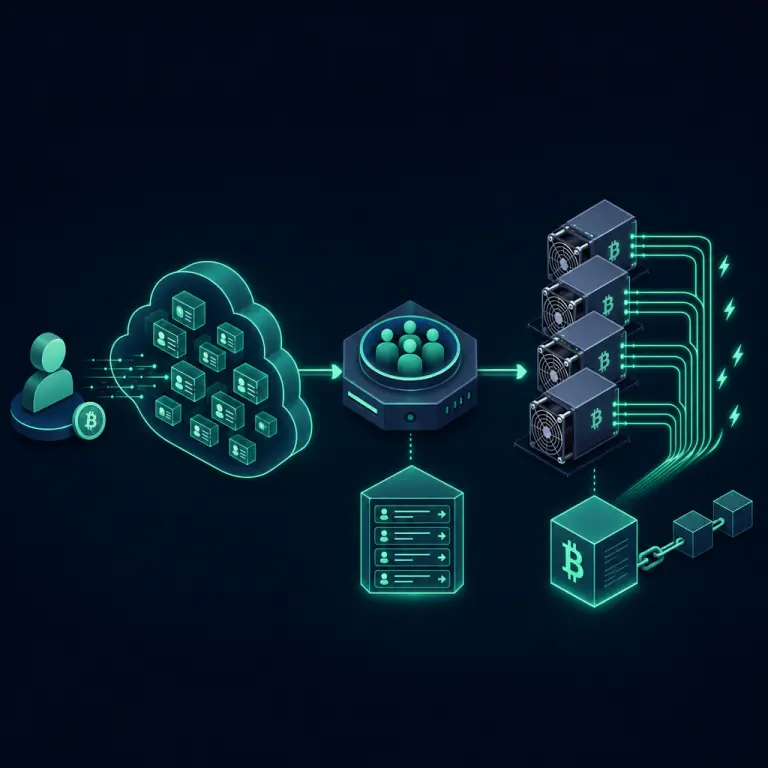
What Bitcoin Mining Actually Does
Bitcoin mining does two jobs at once. The first is issuance — it's how new BTC enters circulation, currently at 3.125 BTC per block after the April 2024 halving. The second is security — by forcing anyone who wants to add transactions to the ledger to spend real energy, mining makes rewriting history prohibitively expensive.
Those two roles are linked by design. Satoshi Nakamoto's 2008 Bitcoin whitepaper bundles them into one mechanism — proof-of-work — so that the act of paying miners is also the act of defending the network. Every block mined is both a paycheck and a fortification.
Nodes & mempool
Full nodes validate transactions and broadcast them to a shared waiting room called the mempool — the pool of unconfirmed transactions miners pick from.
Hashrate
The number of SHA-256 guesses per second. Think of each hash as one lottery ticket — more tickets, more chances to be the miner that finds the winning number first.
Difficulty
A self-adjusting governor that retargets every 2,016 blocks (~14 days) to keep average block time near 10 minutes regardless of how much hashrate comes on- or off-line.
How a Block Gets Mined — The Full Pipeline
Zooming out, a single Bitcoin block passes through seven distinct stages between "I want to send Alice some BTC" and "this transaction is permanent." Here's the pipeline in order.
Transaction is created and signed
A wallet builds a transaction — inputs, outputs, and an optional fee in satoshis per virtual byte — and signs it with the sender's private key. Without that signature, nothing moves.
Nodes broadcast it into the mempool
The wallet sends the transaction to a Bitcoin node, which validates syntax and signatures and then gossips it to peers. Every full node keeps its own mempool — a waiting room of unconfirmed transactions sorted by fee rate.
A mining pool assembles a candidate block
Pools like Foundry, AntPool, or F2Pool pick up to ~3,000–4,000 transactions from their mempool — usually highest fee rate first — and pack them into a candidate block of roughly 1.5–4 MB (weight-limited to 4 MWU).
ASIC miners hash the block header
The pool distributes the block header to connected ASICs — machines like the Antminer S21 Pro doing 234 TH/s — which try quadrillions of nonce values per second, double-SHA-256-hashing each one, searching for a hash below the network target.
A valid hash is found — the block is broadcast
When any miner stumbles onto a hash that meets the target (lots of leading zeros), the pool instantly broadcasts the completed block to every node on the network. This is the "eureka" moment — and it happens roughly every 10 minutes worldwide.
Nodes independently verify and extend
Every other node re-hashes the header in milliseconds, verifies each transaction, and — if everything checks out — appends the block to its own copy of the chain. Verification is cheap; finding the hash was the hard part. This asymmetry is the core of proof-of-work.
Reward is paid — the cycle repeats
The block's first transaction (the coinbase) pays the miner 3.125 newly issued BTC plus every fee included in the block. The pool distributes that reward pro-rata to contributors, usually on an FPPS model, and the race for the next block begins immediately.
The SHA-256 Puzzle, in Plain English
Every block has a header: the previous block's hash, a Merkle root summarizing every transaction inside, a timestamp, the difficulty target, and a field called the nonce. Miners can freely change the nonce (and a handful of other fields) and then ask: is the SHA-256 hash of this header less than the current target?
SHA-256 is a cryptographic one-way function — deterministic but unpredictable. You cannot reverse-engineer an input from a desired output. The only strategy is brute force: try a nonce, hash, check, repeat. Bitcoin uses double SHA-256 (the hash is hashed twice) for extra collision resistance.
At April 2026 difficulty levels, the network as a whole guesses roughly 1 ZH/s — one sextillion (1021) hashes per second — and still takes about ten minutes to find one that works. That's the scale of energy expenditure baked into every Bitcoin block.
Proof-of-Work vs Proof-of-Stake — Quick Contrast
Bitcoin uses proof-of-work. Ethereum and most newer chains use proof-of-stake. It helps to see the trade-offs side by side.
| Property | Proof-of-Work (Bitcoin) | Proof-of-Stake (Ethereum, etc.) |
|---|---|---|
| Who secures the chain | Miners spending energy | Validators locking coins |
| Cost of attack | Buy/build 51% of global hashrate + pay the power | Acquire 33–66% of staked supply |
| Energy use | High — the security budget is electricity | Very low by comparison |
| Entry for earners | ASIC hardware or cloud mining rental | Lock coins, run a validator |
| Issuance link | New BTC minted with every block | Usually disinflationary or burn-offset |
Neither is strictly "better." Proof-of-work trades energy for a tangible, physical cost-to-attack that doesn't rely on any coin holder's good behavior. Proof-of-stake trades that physical anchor for efficiency. Bitcoin deliberately keeps the older, energy-backed model — and the difficulty adjustment is how it keeps that model honest.
Why Difficulty Adjusts — The Network's Thermostat
If hashrate doubled overnight and nothing else changed, blocks would start arriving every five minutes instead of ten. Bitcoin prevents that with an automatic retarget every 2,016 blocks — roughly two weeks — that raises or lowers the target so the average block time drifts back to ten minutes.
Think of difficulty as the network's thermostat. If the "room" (global hashrate) heats up, the thermostat makes finding a valid hash harder. If hashrate cools (miners unplug), difficulty eases. In mid-April 2026, difficulty slid about 2.43% to roughly 135.6 T, according to the CoinWarz Bitcoin difficulty chart — a mild breather after months of all-time highs.
This mechanism is what makes Bitcoin self-regulating. Block time stays near 10 minutes whether there are a dozen hobbyists or a million industrial machines mining. New issuance is predictable by calendar, not by how many miners show up.
Watch SHA-256 hashing on a live ASIC — no deposit
You've seen the pipeline on paper. NoxHash's 2-day Basic Miner trial (50 TH/s) lets you open the CGMiner terminal on a real Antminer in our Kazakhstan data center and watch actual hashes stream by — the exact process described above, running in production.

Why Mining Uses So Much Energy (and What That Energy Buys)
Critics often describe Bitcoin's energy use as "wasted." Supporters counter that the energy is the security. Both framings miss half the story. Mining consumes real electricity — measured continuously by the Cambridge Centre for Alternative Finance CBECI — and that electricity is what makes double-spending the ledger economically impossible.
In practice, industrial miners chase the cheapest reliable power on Earth. That's why you see mining clusters in Texas (stranded gas, flexible grid demand), Paraguay (hydro), Iceland and Norway (geothermal and hydro), and Kazakhstan (low-cost industrial contracts plus natural cold-climate cooling). NoxHash runs its fleet in Kazakhstan at roughly $0.035/kWh — three to five times cheaper than the average household rate.
Efficiency matters as much as price. Today's flagship ASICs — the Antminer S21 XP Hyd and S21 Pro — hit 12–15 J/TH, roughly half the energy per terahash of 2021-era rigs. Every generation of hardware nudges the network toward doing more hashing per kWh, which partly offsets rising difficulty.
Reality: energy = security budget
Unlike a vault door, Bitcoin's security is recreated block by block. The electricity consumed this week is the cost an attacker would need to match to rewrite this week's history.
Reality: the grid often benefits
Miners are interruptible load — they throttle down when grids are stressed and monetize surplus or stranded generation that would otherwise be curtailed, especially for wind and hydro.
Nuance: fuel mix matters
A miner running on coal-fired power has a very different footprint than one on hydro or flared gas. Aggregate figures hide large regional differences — always look at the mix, not just the megawatts.
Nuance: efficiency keeps improving
ASICs went from ~30 J/TH in 2021 to 12–15 J/TH in 2025. The network does more useful hashing per unit of energy each cycle, even as absolute consumption grows with hashrate.
Who Actually Mines Bitcoin in 2026?
Mining in 2026 is not what it was in 2013. The days of a laptop quietly minting BTC are long gone — network hashrate sits near 1 ZH/s, roughly one trillion times higher than Bitcoin's first year. Three groups now do almost all the work.
Industrial mining farms dominate. Companies like Marathon, Riot, Core Scientific, and Cipher operate warehouses of 10,000–100,000 ASICs on dedicated substations. They negotiate direct power contracts, run their own dev teams, and publicly report fleet metrics. Combined, listed public miners account for a material double-digit share of global hashrate.
Home and small-scale miners still exist but typically run one to ten machines in a garage, basement, or purpose-built shed. They only make sense with sub-$0.06/kWh electricity, adequate cooling, and tolerance for 75-dB appliance noise. It's a hobby for many, a niche business for a few, and a losing proposition almost everywhere with normal residential power.
Cloud mining users form the third group — people who want BTC-denominated exposure to mining without ever touching hardware. Rent a slice of an industrial operator's fleet, pay a fixed monthly fee in USDT, and the BTC earned by "your" hashrate is credited to your account. It's how most individuals now access mining economics without a $5,000 ASIC purchase.
Skip the $5,000 ASIC — rent hashrate instead
Now that you understand the pipeline, the puzzle, and who actually mines, the accessible way in is renting. NoxHash Basic Miner is 50 TH/s for $20/month on the same Antminer S21 fleet industrial operators use — and the 2-day free trial lets you test before depositing a cent.
Frequently Asked Questions
Why does Bitcoin mining take exactly 10 minutes per block?
It doesn't — individual blocks arrive anywhere from seconds to an hour apart. But the protocol retargets difficulty every 2,016 blocks so the long-run average stays close to 10 minutes. That figure was chosen by Satoshi as a balance between fast confirmation and enough time for blocks to propagate worldwide before the next one is found.
What happens if two miners find a block at the same time?
The chain briefly forks — different nodes see different valid blocks first. Mining continues on whichever branch each node received earliest. Whichever branch finds the next block first becomes the canonical chain; the other block becomes "stale," and its transactions (except the coinbase) return to the mempool.
Can I still mine Bitcoin on a laptop or gaming PC?
Technically yes, practically no. Your laptop competes against a network hashing at roughly 1 ZH/s — you'd expect to find a block roughly once per the age of the universe. Profitable Bitcoin mining in 2026 requires ASIC miners, or renting hashrate from operators who run them.
What is a mining pool and why do miners join one?
A mining pool lets many miners combine hashrate and split rewards proportionally to contribution. Solo mining a single ASIC would only find a block every several years on average, with highly volatile payouts. Pools smooth earnings into a steady trickle, usually on an FPPS (Full Pay Per Share) payout model with a 1–2% fee.
What happens when all 21 million BTC are mined?
The final BTC is projected to be mined around 2140. After that, miners earn only transaction fees — no new issuance. Whether fees alone can sustain network security is an open design question. For now, with 3.125 BTC per block, fees are a minority of miner revenue, but their share is slowly rising over time.
How is Bitcoin mining different from buying BTC on an exchange?
Buying gives you instant BTC at today's price. Mining earns BTC gradually over months as reward for securing the network, with costs denominated in USD and revenue in BTC. Mining tends to outperform buying when BTC price trends upward over a multi-month horizon, and underperform in sharp drawdowns.
Is Bitcoin mining still profitable in 2026?
It depends entirely on electricity cost and hardware efficiency. At industrial rates under $0.05/kWh on modern ASICs (~15 J/TH), mining is generally profitable. At residential rates of $0.10–0.20/kWh, most ASICs are unprofitable in April 2026 — which is why cloud mining has become the practical path for most individuals.
Educational content — not financial advice
This article explains how Bitcoin mining works technically. Network statistics, difficulty values, block rewards, and ASIC efficiency figures reflect conditions in April 2026 and change continuously. Mining and cloud-mining returns depend on BTC price, network difficulty, energy costs, and operator reliability — none of which are guaranteed. Past performance does not predict future results. Only commit capital you can afford to lose, and consult a qualified tax professional about your local treatment of mining income before scaling up.