How NoxHash Keeps Electricity at $0.035/kWh
See how NoxHash secures $0.035/kWh industrial power in Kazakhstan — saving renters $200-400/month per miner versus home electricity rates.

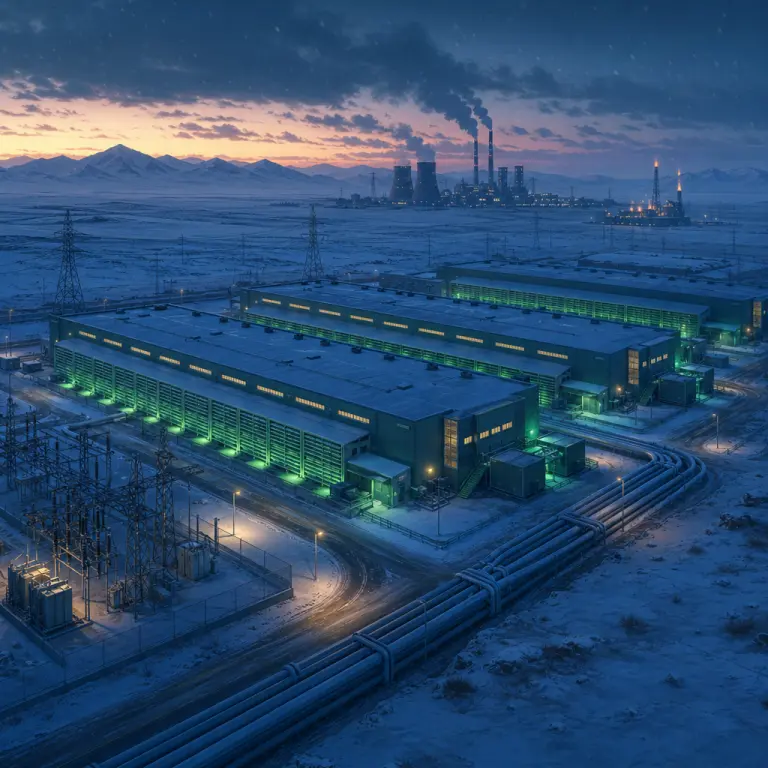
Electricity is the single biggest cost in Bitcoin mining — and NoxHash keeps it at roughly $0.035/kWh through a long-term industrial power contract in Kazakhstan, backed by coal and natural-gas generation plus year-round natural cooling. That's three to five times cheaper than typical home electricity, and it's the reason hashrate rentals on NoxHash can stay profitable where home miners would lose money.
Why $0.035/kWh Is the Number That Decides Profitability
In Bitcoin mining, hardware cost is a one-time expense you can amortize over years. Electricity, on the other hand, bills you every single hour the machine runs. A modern Antminer S21 draws 3,500 watts non-stop — about 2,520 kWh per month. Multiply that by the local power rate and you get the difference between a profitable rig and a space heater that loses money.
At our Kazakhstan facility, the blended industrial rate sits at $0.03-0.04/kWh, averaging close to $0.035. That rate is not a marketing claim — it is the price we actually sign in long-term power purchase agreements with regional generators. The number matters because every $0.01/kWh saved equals roughly $25/month per S21-class miner. Stretch that across a full fleet and it reshapes what a cloud-mining renter can earn.
Industrial power contract
Multi-megawatt offtake directly from regional coal and natural-gas generators — not the retail grid homeowners pay.
Natural free cooling
Winter temperatures of -15 °C to -30 °C cut cooling overhead by 20-30% versus hot-climate farms that need HVAC.
Long-term PPA pricing
Multi-year Power Purchase Agreements lock the rate so it doesn't spike with seasons or retail market swings.
How NoxHash Compares to Other Mining Regions
Mining follows cheap electricity the way water follows gravity. After China's 2021 mining ban, hashrate redistributed across a handful of low-cost regions — and the price gap between them is much smaller than the gap between any of them and a normal home connection. Here's how our rate stacks up, according to regional industrial-tariff data and Cambridge figures on mining power costs:
| Region | Rate (USD/kWh) | Notes vs NoxHash |
|---|---|---|
| NoxHash (Kazakhstan) | $0.03-0.04 | Baseline — industrial PPA + natural cooling |
| Paraguay (Itaipu hydro) | $0.03-0.05 | Comparable rate, but hot climate raises cooling load |
| Russia (Siberia) | $0.03-0.05 | Similar pricing, less mature mining infrastructure |
| Canada (Quebec) | $0.04-0.06 | ~30-50% more expensive |
| Texas, USA | $0.04-0.06 | ~30-50% more, volatile with summer demand |
| Norway / Sweden | $0.04-0.07 | Green hydro, but 40-75% more expensive |
| Home electricity (global avg) | $0.10-0.20 | 3-5x more expensive than NoxHash |
For context on how meaningful this difference is, the Cambridge Bitcoin Electricity Consumption Index (CBECI) estimates the Bitcoin network burns around 150 TWh per year — roughly the annual consumption of a mid-sized country. At those scales, a 1 cent/kWh difference cascades into billions of dollars across the network.
What $0.035/kWh Means for Your Monthly Bill
Let's stop talking in abstractions. Take one real machine — the Antminer S21 running at 3,500 W for 24 hours a day, or about 2,520 kWh per month — and see what the same workload costs under each rate:
~$88
@ $0.035/kWh · 2,520 kWh
Baseline — one S21 for one month on NoxHash infrastructure.
~$126
@ $0.05/kWh · 2,520 kWh
+43% vs NoxHash — typical US mining hub.
~$302
@ $0.12/kWh · 2,520 kWh
+243% — typical US residential bill.
~$504
@ $0.20/kWh · 2,520 kWh
+473% — EU/residential high-tier rate.
The gap is roughly $200-400 per miner per month compared to running the same hardware at home. Across a 6-month rental, that's $1,200-2,400 in electricity savings on a single S21 — often the margin that decides whether mining pays off at all when Bitcoin's price dips.
Skip the $300/month power bill
You just saw the $200-400 gap between home electricity and NoxHash's industrial rate. Rent hashrate instead of buying hardware and you inherit that $0.035/kWh cost structure from day one — no utility contract, no inverter, no cooling HVAC.

Four Levers That Keep the Rate at $0.035
Cheap power isn't a single trick — it's the combination of location, contract structure, climate, and operating discipline. Each lever contributes a slice of the savings:
1. Bulk power purchase agreements
Multi-year PPAs for multi-megawatt capacity give generators a predictable baseload customer. In exchange, they offer wholesale pricing no residential or small-business customer can access.
2. Kazakhstan's energy mix
Abundant coal reserves and natural-gas pipelines create surplus generation capacity at low marginal cost. That surplus, combined with government support for mining registration, gives miners first-mover negotiation leverage.
3. Free cooling from climate
The per-kWh rate is only half the story. Kazakhstan's continental winters (-15 °C to -30 °C) let us cool the fleet with fans and outside air instead of chillers — cutting total kWh drawn per TH of hashrate by 20-30%.
4. Operational efficiency
Running next-generation hardware (12-18.5 J/TH) means each kWh converts to twice as much hashrate as 2021-era machines. Combined with 99.9% uptime and sub-8-hour replacement of failed units, we avoid paying for power that isn't producing BTC.
Pulled together, these four levers also provide price stability — you won't see the NoxHash rental rate swing because a heatwave hit Texas or a gas pipeline shut down in Europe. The PPA is the contract that makes that promise possible.
Frequently Asked Questions
Is the $0.035/kWh rate fixed or will it change?
The number reflects our current blended industrial contract, typically ranging $0.03-0.04/kWh. Long-term PPAs lock most of that rate for multiple years, but regional tariff adjustments or fuel cost shifts can move it slightly. Your rental plan price, however, stays fixed for the duration you paid for.
Do renters pay the electricity bill separately?
No. Electricity, cooling, internet, hardware, and maintenance are all rolled into the single monthly rental price for each miner tier ($20 Basic through $250 Enterprise). There are no utility invoices, no surprise bills, and no metered overage charges — you see the full cost up front.
Could I get cheaper electricity by mining from home?
In most places, no. Residential rates globally average $0.10-0.20/kWh — roughly 3-5x our industrial rate. Even in regions with cheap power, you'd still pay for hardware ($4,500+ per S21), cooling, noise mitigation, and repairs. Cloud mining pools those fixed costs across thousands of renters.
Why Kazakhstan rather than Iceland or Canada?
Iceland, Norway, and Canada offer clean hydro power but at $0.04-0.07/kWh — 30-75% higher than Kazakhstan's industrial rate. Kazakhstan also has cold winters for free cooling, a legal framework specifically for mining registration, and strategic fiber connectivity between Asia and Europe. It's the best overall cost-per-TH location today.
Does cheap electricity mean dirty electricity?
Our current mix draws mainly from coal and natural gas — the dominant sources in Kazakhstan's grid. We offset some impact through high-efficiency hardware (12-18.5 J/TH versus 30 J/TH on 2021 units), which roughly halves the kWh needed per BTC mined. The industry broadly is shifting toward more renewable sources over time.
How does NoxHash prove the rate is real?
Two ways. First, the published rate matches documented Kazakhstan industrial tariffs reported by outlets like Reuters and Cambridge CBECI. Second, every rented miner exposes a live CGMiner desktop and real-time hashrate feed so renters can verify their unit is actually running — not a simulated balance.
Not financial advice
Electricity cost is only one factor in mining profitability. Bitcoin earnings also depend on BTC price, network difficulty, block rewards, and halving events — all of which can change rapidly and are outside anyone's control. Illustrative cost numbers in this article (as of April 2026) are based on a 3,500 W S21 running 24/7 and assume typical regional tariffs; actual outcomes will vary. Past performance does not guarantee future results. Only rent hashrate with funds you can afford to lose, and consult a qualified tax advisor about crypto income in your jurisdiction.