Cloud Mining vs Traditional Mining — Which One Is Right for You?
Cloud mining or home rig in 2026? Compare upfront cost, power, noise, ROI across 10 factors plus 4 reader personas — pick the path that fits your life.
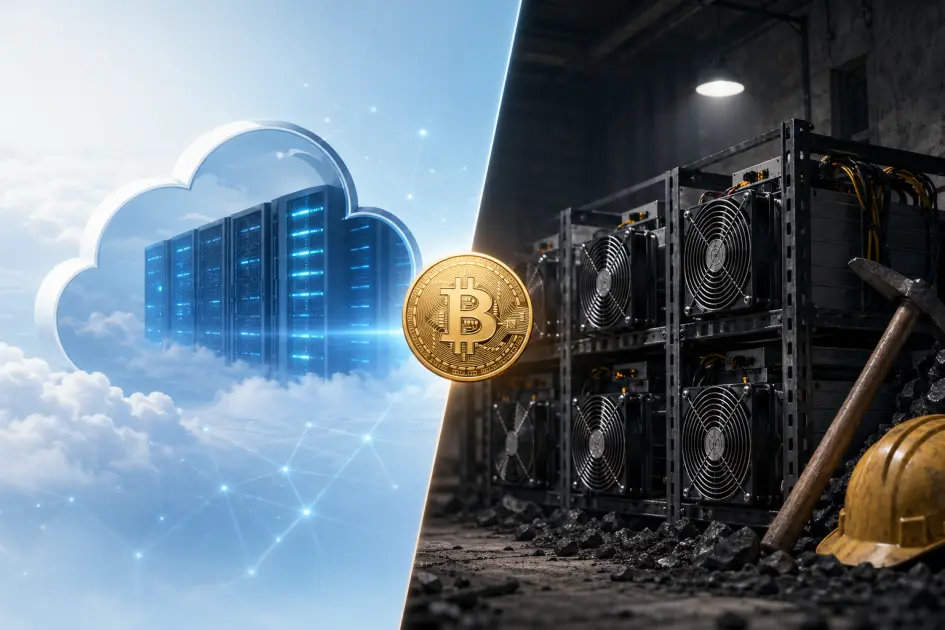
Cloud mining wins if you pay more than ~$0.08/kWh for power, live in an apartment, or simply want BTC exposure without a buzzing 75 dB appliance in the next room. Traditional (home) mining wins if you have sub-$0.06/kWh electricity, a dedicated ventilated space, and you enjoy tuning firmware. Everything below is the honest math and four reader-shaped scenarios to help you pick without regretting it a month later.

The Real Difference in One Paragraph
Traditional mining means you buy the ASIC, plug it into your own power, and deal with every consequence — heat, noise, failed fans, firmware updates, electric-bill shock, resale value when the machine becomes obsolete. Cloud mining means you rent a slice of somebody else's fleet on a monthly contract; they carry the hardware and power risk, you carry the BTC price and network-difficulty risk. Both earn real Bitcoin. The question is whether your life — budget, apartment walls, electricity meter, technical appetite — is better matched to owning the box or renting the hashrate.
Side-by-Side Comparison — 10 Factors That Actually Matter
These are the numbers that decide the argument. The "Home mining" column assumes one new Antminer S21 (200 TH/s, 3,500 W, ~$3,200–4,500 retail depending on retailer in April 2026). The "Cloud mining" column uses NoxHash's published Standard Miner ($50/month, 150 TH/s, 1-month term) as the reference point.
| Factor | Home mining (1× Antminer S21) | Cloud mining (NoxHash Standard) |
|---|---|---|
| Upfront cost | $3,200–4,500 for the unit + PSU | $50/month, no hardware purchase |
| Electricity cost | ~2,520 kWh/month × local rate (see electricity table below) | Included — NoxHash pays $0.035/kWh industrial in Kazakhstan |
| Noise & heat | ~75 dB (vacuum-cleaner level), ~12,000 BTU/h of heat | None in your home — machine sits in a remote data center |
| Hardware failure risk | 100% yours — fans, hashboards, PSUs eventually die | Operator replaces within 4–8 hours, no cost to you |
| Setup time | 1–3 weeks (order, ship, wire, configure) | Minutes after USDT deposit confirms |
| Obsolescence risk | You own a depreciating asset — resale drops 40–60% in 18 months | Operator upgrades the fleet; you just renew to the newer tier |
| Control & tuning | Full — firmware, pool, overclock, underclock | Limited — term length, plan tier, when to renew |
| Technical knowledge | Networking, PSU wiring, firmware flashing, basic thermals | Send USDT, click a plan, paste a BTC address |
| Break-even / ROI timeline | 12–24+ months, highly dependent on local power cost | Month-by-month — you can stop renewing at any term boundary |
| Exit cost | Sell used ASIC (slow, taxable) or keep running at a loss | Let contract lapse; withdraw remaining BTC (1.5% fee) |
The electricity row above does most of the heavy lifting. To make it concrete, here's what 2,520 kWh/month (one S21 running 24/7) costs at typical residential rates in April 2026:
| Region | Typical residential $/kWh | Monthly power cost (1× S21) | vs NoxHash $0.035/kWh ($88/mo) |
|---|---|---|---|
| NoxHash data center (Kazakhstan industrial) | $0.035 | ~$88 | Baseline |
| Russia (residential average) | ~$0.05 | ~$126 | +43% |
| Vietnam (residential tier 3–4) | ~$0.10–0.12 | ~$252–302 | +186–243% |
| United States (national avg, Apr 2026) | ~$0.18 | ~$455 | +417% |
| EU average (residential, 2026) | ~$0.27 | ~$680 | +673% |
Residential averages are drawn from public sources including GlobalPetrolPrices.com household electricity data and 2026 EU consumer electricity reporting. A home miner pays these directly; a cloud miner inherits the data-center rate whether the Kazakhstan grid costs $0.03 or a Berlin apartment costs $0.40.
Skip the shipping week — plug into the data center you just read about
If the table made cloud mining look like the easier fit for your situation, you can verify it with NoxHash's free Basic Miner trial — no USDT, no card, just 48 hours on the same Kazakhstan fleet the comparison references.

Which Path Fits You? Four Reader Personas
Numbers are only useful once they're attached to a life. Find yourself in the closest of the four profiles below — the recommendation is based on the comparison you just read, not on which product pays us. Two lean cloud, one leans firmly home, one is a genuine toss-up.
Mai — the apartment dweller in Vietnam
Lives in a 40 m² Hanoi apartment. Electricity tier 3–4 runs ~$0.10–0.12/kWh and the building shares thin walls. A single S21 would cost ~$252–302/month just in power, plus a neighbor complaint by week one. Starting with a NoxHash Basic Miner at $20/month gets her real BTC exposure without a fan-scream lullaby or a landlord eviction letter.
Verdict: cloud mining wins decisively.
Dan — the Texas homeowner with solar
Owns a 200 m² house, a detached insulated garage, and a 12 kW rooftop solar array. His effective marginal power cost during daylight is close to zero, and nights are under $0.05/kWh on his ERCOT plan. He can host an S21 in the garage without anyone hearing it, absorb a failed fan himself, and the rig's heat is actually useful in winter. Home mining here beats cloud on pure cost-per-TH.
Verdict: home mining wins — this is one of the real cases where it does.
Elena — the retiree wanting passive BTC exposure
Age 62, owns her home, no interest in firmware or SSH sessions. She wants a small BTC position that accrues on its own so she doesn't have to learn trading. A $4,500 appliance she can't troubleshoot when it fails is a non-starter. A NoxHash Standard or Pro Miner on a 6–12 month term (5–15% discount) gives her a fire-and-check-monthly product. Self-custody of the BTC once it hits the 0.00001 BTC withdrawal minimum keeps control in her hands.
Verdict: cloud mining wins on simplicity and maintenance burden.
Sam — the hobbyist tinkerer
Already has a lab, loves flashing BraiinsOS, runs his own node, and the noise of a 75 dB fan bothers him less than the thought of giving up control. Pure cost math may favor cloud — but cost math isn't why he's mining. The hands-on learning is the whole point. Some mix is often optimal here: a small home rig for the craft, plus a modest cloud plan as a sanity-check benchmark against his own setup.
Verdict: lean home for the love of tuning; add cloud if he wants scale without more noise.
When Home Mining Actually Wins — The Honest Cases
Plenty of cloud-mining articles dismiss home mining as a bad deal in every scenario. That's not true. There are specific, falsifiable situations where running your own rig beats any rental on pure economics — and you should know them before committing to either camp.
Sub-$0.06/kWh electricity
Hydro regions in Washington, Québec, parts of Iceland and Paraguay, solar households during daylight, or industrial time-of-use tariffs in rural areas. Below roughly $0.06/kWh, a modern ASIC can generate more BTC per dollar spent than a cloud rental.
Dedicated, ventilated space
A detached garage, a basement with exhaust ducting, a barn, a farm shed — anywhere the 75 dB roar and 12,000 BTU/h of waste heat don't ruin your living room or a sleeping partner's week.
Heat as a feature, not a bug
Cold-climate homes that are already heating in winter effectively get the ASIC's thermal output for free — you were going to burn that energy anyway. This flips the equation and can make home mining net-positive even at $0.10/kWh.
You genuinely enjoy the craft
Tuning firmware, running your own Bitcoin node, joining a solo-mining lottery pool — these are legitimate reasons that have nothing to do with USD yield. If the hobby itself is the point, cloud removes the fun.
If two or more of the four boxes above describe you, buy the ASIC. You'll get a better deal per TH/s than any cloud contract, and you'll probably enjoy the process.
When Cloud Mining Wins
The mirror-image cases are just as specific. Cloud mining earns its keep when hosting hardware at home would be impractical, unprofitable, or just miserable — and where the operator's scale advantages matter more than your ability to tune a hashboard.
Residential power above ~$0.08/kWh
Most urban US, EU, UK, Vietnam tier 3–4, Japan, Korea. Above that threshold NoxHash's industrial $0.035/kWh contract in Kazakhstan structurally out-earns a home rig by 2–5× on electricity alone.
No room for an industrial appliance
Apartments, co-living spaces, small condos, anywhere with shared walls or an HOA. An S21's sound profile is roughly "vacuum cleaner on continuously for the entire contract" — which is not a thing most households will accept.
Under $500 to deploy
A new S21 runs $3,200–4,500 before PSU and shipping. A NoxHash Basic rental is $20/month. If your testable budget is sub-$500, cloud is the only way to touch modern hashrate at all.
You don't want to learn ASIC maintenance
If "SSH into the miner and check the hashboard temps" sounds like a chore you're actively trying to avoid, offloading that to a data-center team paid to do it — with hardware replacement in 4–8 hours — is worth the operator margin.
Notice the pattern: home mining wins on economics when you have cheap power and space; cloud mining wins on access, friction, and scale. Neither is universally better — they solve different problems.
If the table and personas point you to cloud — test before you spend
You've now got a framework: power cost, space, budget, technical appetite. If three of the four push you toward cloud, NoxHash's 2-day Basic Miner trial lets you confirm the infrastructure is real before committing a cent — same fleet, same $0.035/kWh Kazakhstan data center the whole article references.
Frequently Asked Questions
At what electricity price does home mining stop making sense?
Roughly $0.08/kWh is the rule-of-thumb tipping point in April 2026 conditions with a ~17.5 J/TH ASIC. Below that, home mining is typically cheaper per TH/s than cloud. Above it, a cloud operator on $0.035/kWh industrial power structurally wins on electricity alone — before counting your time and hardware risk.
How much does a new Antminer S21 actually cost in 2026?
New S21 200 TH/s units run about $3,200–4,500 depending on retailer and region in April 2026. The S21+ and S21 Pro carry a premium to roughly $4,200–5,200. Second-hand units show up on resale markets for less, but verify hashboard health before buying used — dead boards are the single most common failure mode.
Is cloud mining profitable given current network difficulty?
As of April 2026, global hashrate sits above 1 ZH/s with difficulty around 135 T per the CoinWarz difficulty chart. Reputable fixed-rental platforms still produce BTC value above the monthly fee in flat-to-rising BTC markets. In sharp drawdowns, USD yield can briefly turn negative. Size accordingly.
Can I do both — a small home rig and a cloud plan?
Yes, and for hobbyists it's often the optimal setup. A modest home rig lets you learn firmware, pools, and thermals hands-on. A small cloud plan adds scale without more noise in your home and serves as a benchmark against your own setup. Treat it as "craft plus commodity," not as a pick-one-camp decision.
What's the real ROI timeline on a home ASIC in 2026?
For a new S21 at $4,000, running on $0.05/kWh, the payback is typically 14–20 months at current difficulty — heavily dependent on BTC price trajectory. At $0.10/kWh the timeline stretches past 30 months and can turn into a net loss during drawdowns. At $0.18/kWh residential, most single-unit home miners never break even at all.
What if I change my mind after starting a cloud contract?
Cloud contracts finish at their term boundary and then simply don't renew if you choose. On NoxHash, accrued BTC can be withdrawn to your own Bitcoin address anytime above 0.00001 BTC (1.5% fee). Compare that to a home rig, where exiting means selling a depreciating used ASIC — cloud is easier to walk away from cleanly.
Educational content — not financial advice
This guide is for education. The hardware prices, electricity rates, network statistics and earnings ranges reflect conditions in April 2026 and will change. Both home and cloud mining carry real risks: BTC price volatility, network difficulty growth, hardware failure, operator counterparty risk, and regulatory changes in your jurisdiction. Past results do not guarantee future performance. Only commit funds you can afford to lose, and consult a qualified tax and legal professional before scaling up any mining operation.