Cloud Mining vs Staking — Passive Income Strategies Compared
Cloud mining vs staking in 2026: compare ETH, SOL and ADA yields against BTC hashrate rentals, lock-ups, slashing risk, tax and when each strategy wins.
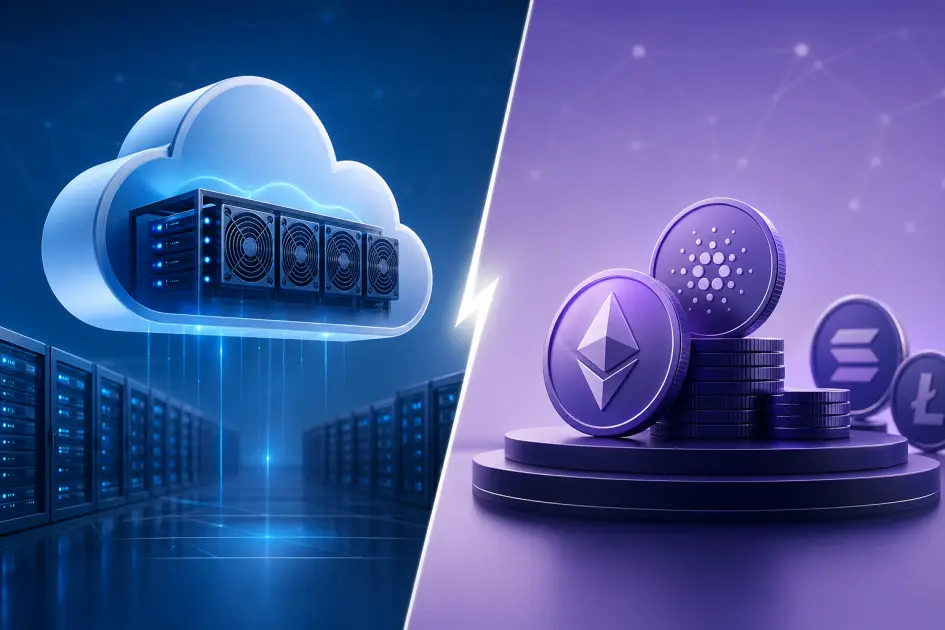
Staking locks capital in a proof-of-stake coin to earn more of that same coin; cloud mining rents Bitcoin hashrate with a fixed USD fee and pays out in BTC. Both are passive income in crypto, but they charge very different prices — in capital type, in lock-up, in what happens when the market turns. As of April 2026, ETH staking pays roughly 3–4% APY, SOL around 6%, while cloud mining targets 115–125% of rental in BTC value. Here is how to pick.

Two Models, Two Very Different Trades
Staking and cloud mining both get filed under "crypto passive income," but the underlying mechanics are almost mirror images. Understanding each one on its own terms is the only way to compare them honestly — headline APY numbers alone will mislead you every time.
Staking means you buy a proof-of-stake coin (ETH, SOL, ADA, etc.), lock it with a validator, and earn newly issued coins of the same type. Your capital is the coin. Cloud mining means you pay a fixed USD fee to rent Bitcoin hashrate from a data center, and that hashrate accrues BTC to your wallet. Your capital is the rental fee in USD, and you never need to already own BTC to start.
Staking — Lock the coin, earn the coin
You already hold (or buy) the target PoS coin. You lock it with a validator for weeks, months, or indefinitely. Rewards arrive in the same coin — so a rising coin price lifts your yield in USD, and a falling price drags it down, even if the staking APY looks identical on paper.
Typical lock-ups in 2026: ETH unbonding roughly 7–21 days, SOL 2–3 days, ADA epoch-based (essentially a few days).
Cloud mining — Pay USD, receive BTC
You do not need to own BTC beforehand. You pay a flat monthly USD fee (USDT on NoxHash) to rent hashrate from an operator's ASIC fleet, and BTC accrues to your wallet continuously while the contract runs. Your exposure flips: you are long BTC price and long hashrate-output, short a fixed USD rental.
Lock-up: the rental term itself (1, 3, 6, 12, or 24 months on NoxHash, with 0–20% discounts for longer commitments). BTC earned is withdrawable immediately at the 1.5% fee.
The key mental flip: staking concentrates you in one altcoin; cloud mining converts stable USD into BTC exposure over time. Neither is inherently better — they are tools sized for different goals. A long-term ETH or SOL bull wants more of that coin. Someone who wants to dollar-cost into BTC with a yield kicker wants the mining side of the trade.
Typical Returns — April 2026 Snapshot
Headline APYs move weekly, so treat the following as a snapshot of conditions in April 2026, not a forecast. Staking yields below are drawn from Staking Rewards public data. The NoxHash column restates the published operator-side target of 115–125% of rental — an illustrative band, not a guarantee.
| Strategy | Approx. yield (Apr 2026) | Paid in | Capital type |
|---|---|---|---|
| ETH staking (solo / liquid) | ~3.2–4.2% APY | ETH | ETH you already own |
| SOL staking | ~5.9–6.5% APY (nominal) | SOL | SOL you already own |
| ADA staking | ~3.0% APY | ADA | ADA you already own |
| NoxHash cloud mining | Target ~115–125% of rental (illustrative) | BTC | USDT rental fee |
One nuance the table hides: SOL's nominal 6% APY is partially inflation. With SOL issuance near 5–6% annually, the real (inflation-adjusted) SOL yield can be close to flat — you gain tokens, but each token represents a smaller share of total supply. ETH, by contrast, has had periods of net-zero or negative issuance thanks to EIP-1559 burn, so a 3.2% ETH staking yield is closer to a "real" yield. Always check the dilution picture, not just the APY banner.
Risk Profiles — What Each Strategy Is Actually Exposed To
APY on its own says nothing about downside. Each strategy carries a different menu of risks, and sizing a position without knowing them is how people end up surprised. The table below strips it down.
| Risk | Staking (ETH/SOL/ADA) | BTC cloud mining |
|---|---|---|
| Underlying coin price | Full exposure — capital and yield both in the same coin | Only the output (BTC) is exposed; your rental is already paid in USD |
| Slashing | Real — validator misbehavior can cut your stake (ETH up to 1 ETH or more) | None — no validator, no slashing surface |
| Smart contract | Yes on liquid staking (Lido, Rocket Pool, Jito) — audits reduce, not eliminate | None — no contracts in the path |
| Unbonding / lock-up | 7–21 days for ETH, 2–3 days for SOL, epoch for ADA | Rental term (1–24 months); BTC earned withdrawable anytime |
| Network / protocol | Consensus bugs, hard forks, governance risk | Network difficulty spikes reduce BTC per TH/s |
| Counterparty | Custodial staking provider if not solo | Cloud mining operator (diligence-able) |
| Opportunity cost | Capital cannot be redeployed during unbonding | USD fee is spent — not recoverable if you exit early |
The short version: staking stacks slashing, smart contract risk (if liquid), and full coin-price exposure on top of network risk. Cloud mining trades those for counterparty risk and BTC price risk, while removing slashing and smart contract surface entirely. Neither is risk-free — but the risks are different shapes, and some shapes are easier for a given person to evaluate than others.
See the mining side of the trade before you commit
You've now seen how staking's risk menu compares to a BTC hashrate rental. The fastest way to stress-test the mining column is the NoxHash 2-day Basic Miner trial — 50 TH/s running on a real Kazakhstan ASIC fleet, no deposit. Watch actual pool shares and BTC accrual before you move a single USDT.

Lock-Up, Liquidity, and Tax Treatment
Beyond headline yield, three operational details quietly decide which strategy fits your life: how long you are locked in, how fast you can exit, and how your local tax authority sees the rewards. Skip these and you can pick the "higher APY" and still end up worse off.
Lock-up. ETH staking requires a validator queue to activate and an unbonding period of roughly 7–21 days to withdraw, depending on queue congestion. SOL deactivates stake at the epoch boundary (about 2–3 days). ADA is the most flexible — your stake is delegated, never locked, and rewards arrive each epoch. Cloud mining has no per-coin unbonding; the lock-up is the rental term you chose, and BTC earned during that term is withdrawable on demand at the 1.5% fee.
Liquidity. Liquid staking tokens (stETH, jitoSOL) give you a tradeable receipt that can be used as collateral in DeFi — attractive, but they add a smart contract layer and can trade at a discount to the underlying in stressed markets. Cloud mining has no liquid receipt, but there is also nothing to trade at a discount — BTC paid out is real BTC in your wallet, spendable like any other BTC.
Tax treatment. This is jurisdiction-specific and changes often, but the common pattern across many countries in 2026 is: staking rewards are treated as ordinary income at receipt, then capital gain/loss on later disposal. Mining rewards often follow the same two-step pattern. The practical wrinkle is that staking pays in a volatile coin, so the "income value at receipt" can diverge wildly from the USD you eventually realize — creating awkward tax bills in bear markets. Always verify with a qualified professional in your country.
When Staking Wins — and When Cloud Mining Wins
There is no global winner. The right answer depends on what you already hold, how you see the next 6–12 months, and which risks you can tolerate.
Staking wins when...
- You already own the PoS coin and plan to hold it anyway — staking is free optionality.
- You have a high-conviction multi-year thesis on ETH, SOL, or ADA.
- You want exposure to a specific ecosystem (DeFi on Ethereum, high-throughput on Solana).
- You can accept the unbonding window and slashing risk without losing sleep.
Cloud mining wins when...
- You want to convert stable USD into BTC over time with a yield kicker.
- You do not already own a PoS bag and do not want to buy one just to farm it.
- You want to avoid smart contract and slashing surface entirely.
- BTC is flat or trending up — the fixed USD rental is easier to profit through in strong BTC tapes.
A practical observation from users who run both: staking tends to behave like a conviction multiplier — it amplifies whatever view you already hold on a specific altcoin. Cloud mining behaves more like a structured BTC accumulation plan — you are paying USD every month and receiving BTC, independent of whether you have an altcoin thesis at all. Those are complementary roles, not substitutes.
Running Both — Portfolio Diversification
The most honest finding from comparing staking and cloud mining: they are not really competitors. They solve different problems, hedge different risks, and combine surprisingly well in a single portfolio. A simple allocation many NoxHash users describe looks something like this:
Core — Spot BTC
The anchor allocation. Self-custody where possible. No yield, no counterparty — just pure exposure to the asset with the deepest liquidity in crypto.
Satellite — PoS stake
A smaller allocation in ETH or SOL you believe in, staked natively or through a long-audited liquid staking protocol. Yield is modest; the real reason is ecosystem exposure.
Income — BTC cloud mining
A monthly USD outlay that converts into steady BTC accrual. Functions as a structured DCA into BTC with a yield kicker. No altcoin dependence, no slashing surface.
The elegant part is that each slice hedges a weakness of the others. Spot BTC has no yield, mining provides that. Staking concentrates you in one altcoin, mining keeps you squarely on BTC. Mining has counterparty risk, self-custodied spot BTC does not. Built together, they cover more ground than any single strategy alone.
Add a BTC income slice alongside your existing stake
You've mapped staking's strengths and seen where cloud mining fits as the income slice of a diversified crypto portfolio. NoxHash plans start at $20/month for Basic (50 TH/s) and scale to Enterprise, all with 5–20% discounts on 3–24 month terms. Start with the free 2-day trial to see real BTC accrual before you allocate.
Frequently Asked Questions
Does cloud mining pay a higher yield than ETH or SOL staking?
They are not directly comparable. Staking's 3–6% APY is measured against your coin position; cloud mining's 115–125% target is measured against your rental fee. Both can win or lose depending on coin-price moves, BTC trends, and network conditions. Compare the full risk profile, not just the headline number.
Can I do both — stake ETH and rent cloud mining?
Yes, and many users do. They occupy different roles: staking concentrates you in one PoS coin, cloud mining steadily converts USD into BTC. Together with spot BTC they form a core-satellite-income structure where each slice hedges a weakness in the others. Size each according to your own risk tolerance.
What is slashing, and can it happen in cloud mining?
Slashing is a PoS penalty that burns part of a validator's stake for misbehavior — double-signing or prolonged downtime. It can affect stakers, including delegators in some cases. Bitcoin uses proof-of-work, so cloud mining has no slashing surface at all. That is one of mining's cleanest structural advantages over staking.
How long is my capital locked in each strategy?
ETH unbonding takes roughly 7–21 days depending on validator queue congestion. SOL deactivates at the epoch boundary (about 2–3 days). ADA delegation has no lock. Cloud mining locks the rental fee for the term you chose (1–24 months); BTC earned during that term is withdrawable on demand at the 1.5% withdrawal fee.
Is SOL's 6% APY real or mostly inflation?
SOL's nominal staking yield is around 6% in April 2026, but annual issuance is close to 5–6%, so a large part of the headline number is inflation rather than real yield. Your token count grows, but each token represents a smaller share of total supply. Check real yield, not just nominal APY.
Do I need to already own BTC to start cloud mining?
No. Staking requires you to already hold (or buy) the target PoS coin. Cloud mining on NoxHash only requires USDT for the rental fee — the BTC arrives as your rental runs. That is a structural difference: mining converts USD to BTC over time, while staking concentrates you further in a coin you already hold.
Illustrative numbers — not financial advice
Every yield figure in this article — ETH ~3.2%, SOL ~6%, ADA ~3%, and NoxHash's 115–125% target range — reflects April 2026 conditions and is illustrative only. Staking APYs move with network participation and consensus parameters; cloud mining returns move with BTC price, network difficulty, and mempool fees. All strategies discussed carry market, counterparty, regulatory, and tax risks that vary by jurisdiction. Slashing, smart contract exploits, validator downtime, BTC drawdowns, and difficulty spikes can all turn a projected gain into a realized loss. Past performance does not predict future results. Only commit funds you can afford to lose, verify local legal and tax treatment with a qualified professional, and do not size any single strategy as a make-or-break position.