Cloud Mining vs DeFi Yield Farming — Risk and Return Compared
Cloud mining vs DeFi yield farming compared head-to-head: where yield comes from, real risks, fee friction, and when each model wins in 2026.

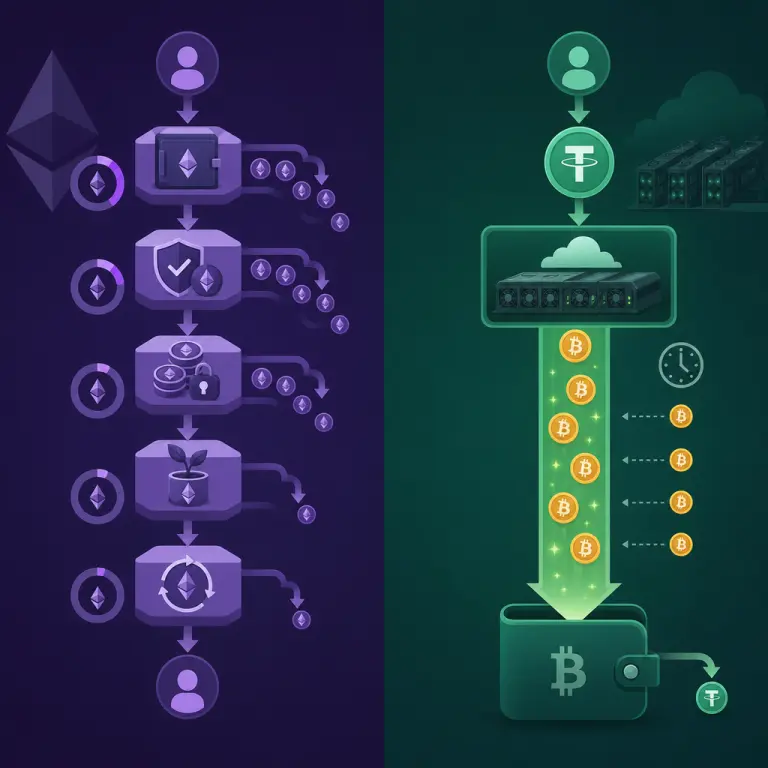
Cloud mining and DeFi yield farming are two very different ways to generate crypto yield — one rents hashrate for predictable BTC accrual, the other supplies liquidity or stablecoins to on-chain protocols for fees plus token rewards. Quoted DeFi APYs of 5–50% often compress to 5–15% realized after impermanent loss, gas, and token decay, while cloud mining targets a steadier 115–125% of rental in BTC. The risks are different, not smaller.

The Two Yield Models, Defined Precisely
Before comparing anything, fix the definitions. These two models sit in completely different parts of the crypto stack, so using "yield" as a single word to describe both is the first mistake most articles make.
Cloud mining is the rental of Bitcoin hashrate from a data center operator. You pay a fixed USD-denominated fee — usually in USDT — and the operator points the rented hashrate at a Bitcoin mining pool. The pool pays out BTC roughly every minute, proportional to your share of the global hashrate. No smart contracts sit in the path between your payment and your output.
DeFi yield farming is the deployment of crypto assets into on-chain smart contracts — liquidity pools on DEXs like Uniswap or Curve, lending markets on Aave, or structured vaults on platforms like Pendle. Your "yield" is a mix of trading fees, lending interest, and often a governance or reward token whose own price can swing wildly. Everything runs on-chain, self-custodial, and transparent — until the day a contract breaks.
Cloud mining — fixed cost, variable BTC output
Rent TH/s for a fixed monthly USD fee. BTC accrues proportionally to your hashrate. Single-asset exposure (BTC), operator-custodied until withdrawal. Target range ~115–125% of rental in typical months.
DeFi yield farming — APY quoted, IL priced later
Supply liquidity to a DEX pool or stablecoin vault. Earn swap fees, lending interest, and often a reward token. Self-custodial via smart contract. Quoted APY often 3–50%, realized 5–15% after IL, gas, and token decay.
Where Does the Yield Actually Come From?
Both models return a number each month. But the source of that number is different, and source matters because it tells you which macro force can take it away.
| Yield component | Cloud mining (BTC hashrate) | DeFi yield farming |
|---|---|---|
| Primary source | Block reward + mempool fees | Swap fees + lending interest |
| Secondary source | None (pure BTC) | Reward/governance tokens (often the majority of headline APY) |
| Denomination | BTC (priced against fixed USD cost) | Mixed (stables + paired asset + reward token) |
| What erodes it | Difficulty rising, BTC price falling | TVL inflows, reward token inflation, IL, exploits |
| Quoted vs realized gap | Small (target range is operator-published) | Often large (headline 30% becomes realized 8–12%) |
| Compounding model | Manual reinvestment (more TH/s) | Auto-compound common but costs gas each harvest |
The honest asymmetry: cloud mining yield sinks or swims on two macro variables — BTC price and network difficulty — that every participant can read the same way. DeFi yield depends on per-protocol incentive programs that are deliberately front-loaded: emit aggressively to attract TVL, then taper as the farm matures. Late entrants inherit a different product from the one the banner advertised.
Risk Matrix — Comparing Apples to Apples
Both models carry real, material risks. The difference is in the type of risk, and in how an individual investor can actually assess it. Below is a line-by-line comparison of every meaningful risk category for each model.
| Risk factor | DeFi yield farming | BTC cloud mining |
|---|---|---|
| Smart contract exploit | High — even audited contracts break; bridges and restaking stacks especially exposed | None — no contracts in the payment path |
| Rug-pull / anon team abandonment | Material on newer farms with unknown teams | Operator counterparty risk — diligence-able |
| Impermanent loss | Material on volatile-asset LPs (ETH/USDC, SOL/USDT) | None — single-asset output (BTC) |
| Custody model | Self-custody via smart contract (non-custodial) | Operator-custodied until BTC withdrawal |
| Asset price risk | Stables + paired asset + reward token (multi-factor) | BTC only — single factor, easy to hedge or size |
| Protocol contagion | High — one upstream exploit can drain dependent vaults (LRT, restaking) | Low — isolated infrastructure, no composability surface |
| Regulatory risk | Evolving — DEX/DAO legal status still contested in many jurisdictions | Mining is regulated but established in multiple jurisdictions (Kazakhstan, US, Canada) |
| Network / infrastructure risk | L1 congestion, oracle failures, bridge halts | Data center uptime — NoxHash targets 99.9%, 4–8h hardware replacement SLA |
April 2026 has been a brutal demonstration of what the top row in that table actually looks like in practice. Total DeFi TVL fell from roughly $99.5B to $86.3B in 48 hours after a $292M Kelp DAO bridge exploit triggered cascading withdrawals through Aave's rsETH collateral, per DefiLlama TVL data. Recorded DeFi losses in 2026 have already topped $750M across 47 incidents, and the rekt.news exploit archive shows that bridge and restaking stacks — not base-layer AMMs — produced the largest single-day drawdowns. Mining, for all its BTC-price exposure, has nothing structurally analogous to a bridge exploit.
See hashrate-based yield in practice, zero smart contract exposure
You've seen the risk matrix. The fastest way to test the mining side of the comparison is NoxHash's 2-day Basic Miner trial — 50 TH/s pointed at a live Bitcoin pool in a Kazakhstan data center. No USDT, no wallet connection, no contract signature. Watch real pool shares accrue before comparing net returns.
Fee Friction — The Silent Killer on Small Wallets
A yield comparison that ignores fees is a yield comparison that lies. The two models handle friction very differently, and for wallets under roughly $5,000, the gap is wide enough to flip the apparent winner on its head.
DeFi fee stack. Each on-chain interaction costs gas. On Ethereum mainnet, a typical farming lifecycle is: approve token (~$5–10), deposit into vault (~$10–20), periodic harvest of rewards (~$10–15 each), compound or migrate on APY changes (~$15–30 each), exit (~$10–20). A single month of active farming across three protocols can burn $80–150 in gas alone. L2s cut this roughly 90%, but bridging to and from an L2 has its own fee plus the bridge risk discussed above.
Cloud mining fee stack. One USDT deposit (BEP-20 gas ~$0.05–0.30, TRC-20 ~$1–2), the monthly rental fee paid from your on-platform balance, and a 1.5% withdrawal fee on BTC you move off the platform. That's it. No per-harvest friction, no compounding tax, no migration cost when you change plans.
| Fee event | DeFi yield farming (ETH L1) | Cloud mining (NoxHash) |
|---|---|---|
| Initial deposit | $15–30 (approve + stake) | $0.05–2 (USDT on-chain fee) |
| Reward claim / harvest | $10–15 per claim | None — BTC accrues automatically |
| Compound / restake | $15–30 per event | None — rent more TH/s if desired |
| Exit / withdrawal | $10–20 gas + any pool exit fee | 1.5% of BTC withdrawn |
| Typical monthly friction | $80–150 across 3 protocols | ~1.5% of realized BTC at withdrawal |
For a $500 wallet chasing 20% APY across three Ethereum mainnet farms, fee friction alone can exceed the headline yield. L2s and alt-L1s help, but they add a fresh layer of bridge and settlement risk. Cloud mining's single-event fee structure is structurally cheaper on small capital — which is exactly the opposite of the usual assumption that DeFi is "the cheap option" for small investors.
When DeFi Yield Farming Wins — and When Cloud Mining Wins
Neither model is universally better. Both have legitimate use cases, and the right choice depends entirely on what you're optimizing for. This is the honest version of the "which is better" question.
DeFi wins when…
You want self-custody, you can read smart contract audits and tokenomics, your capital is large enough ($10k+) to absorb gas friction, you want flexibility to rotate positions weekly, or you actively want stablecoin yield rather than BTC exposure.
Cloud mining wins when…
You want BTC accumulation as the endpoint, you can't or won't audit Solidity, your capital is modest ($50–$5k), you prefer a single macro variable (BTC + difficulty) over dozens of protocol-specific ones, or you specifically want infrastructure exposure rather than DeFi surface area.
DeFi loses when…
You chase triple-digit APYs on six-week-old farms. You provide liquidity to a volatile pair in a trending market. You hold the reward token past its emission taper. You operate out of a wallet too small for the gas footprint. All of those are self-inflicted.
Cloud mining loses when…
You start a long rental during a clear BTC downtrend. You treat BTC exposure as risk-free. You over-size a single operator without diligence. You ignore halving timing. Infrastructure advantage cannot overcome a 40% BTC drawdown in the month you sign a 12-month contract.
A fair summary: DeFi yield farming is the better fit for crypto-native operators with capital, time, and risk-tolerance for protocol-specific assessments. Cloud mining is the better fit for BTC-accumulation-focused users who want infrastructure exposure with a single readable macro variable. The overlap where both make sense is narrower than either camp usually admits.
The Hybrid Portfolio — Using Both Deliberately
In practice, most thoughtful crypto portfolios include some of each, sized by conviction rather than by FOMO. Here is a conservative skeleton that separates the two models by the risk they are designed to capture — not a recommendation, but a structure you can adapt.
Core BTC exposure — spot + cloud mining
Spot BTC for directional beta, cloud mining (e.g. a Standard or Pro Miner on a 6-month term) for yield-on-top. One macro variable to track, self-custody on the spot side, infrastructure custody on the mining side until withdrawal.
Conservative DeFi yield — battle-tested protocols only
Aave stablecoin lending at modest single-digit rates, or a long-audited vault you understand. Nothing under 18 months old, no anonymous teams, no triple-digit banner APYs. This sleeve captures self-custodial on-chain yield without the exploit surface of new farms.
Stable reserve — cash or stablecoins, off-platform
A rainy-day allocation held either as fiat or self-custodied stablecoins, not locked into any yield protocol. This is what lets you ride a BTC drawdown without being forced to unwind the core allocation to cover rent or life.
Speculative sleeve — capped, honest, separate
If you want exposure to high-APY DeFi farms or early-stage protocols, size it as a small speculative sleeve — capped at a percentage you can fully lose without affecting the rest. Do not let the speculative sleeve masquerade as "yield."
The guiding principle: each sleeve captures one type of risk, priced honestly. Cloud mining captures infrastructure + BTC beta. Conservative DeFi captures on-chain stablecoin yield with bounded contract risk. The stable reserve captures optionality. The speculative sleeve captures asymmetric upside while isolating downside. Mixing them inside a single position is how portfolios end up with hidden correlation.
Use cloud mining for the BTC sleeve — not the whole portfolio
If the hybrid skeleton makes sense to you, the next step is to size just the cloud mining slice. The NoxHash 2-day Basic Miner trial is the cleanest way to watch real hashrate and pool shares before deciding on a $20, $50, $100, or $250 monthly plan. No USDT required to start.
Frequently Asked Questions
Is cloud mining actually lower risk than DeFi yield farming?
It carries different risk, not strictly lower. Cloud mining removes smart contract exploits and impermanent loss but adds BTC price, difficulty, and operator counterparty risk. DeFi removes counterparty custody risk but adds smart contract, bridge, and reward-token risks. Match the risk type to what you can actually assess.
Why is realized DeFi APY often so much lower than quoted?
Headline APY usually prices reward tokens at today's market value and ignores impermanent loss and gas. Once emissions dilute the token, TVL compresses the yield, and gas eats the harvests, a quoted 30% commonly realizes at 8–12%. The spreadsheet version is always smaller than the banner.
Do I keep self-custody of my BTC with cloud mining?
Not while the BTC is accruing on the platform — it is operator-custodied until you withdraw to your own wallet. NoxHash supports Segwit, P2PKH, and P2SH BTC addresses with a 1.5% withdrawal fee. Self-custody begins the moment the withdrawal confirms on chain. DeFi is self-custodial throughout, assuming the contract holds.
How much DeFi has been lost to exploits in 2026?
Over $750 million across 47 incidents in the first four months of 2026, with bridge and restaking exploits producing the largest single-day losses. The April Kelp DAO bridge incident alone drained $292 million and triggered roughly $13 billion of TVL outflow across dependent protocols within 48 hours.
Should small wallets choose DeFi or cloud mining?
For wallets under roughly $5,000, Ethereum mainnet DeFi gas friction often exceeds realized yield. Cloud mining's single-event fee structure — one deposit, one 1.5% withdrawal — is structurally cheaper on small capital. L2 DeFi can close the gap but introduces bridge and settlement risk that a smaller investor may not be equipped to assess.
Can I run both models at once?
Yes, and most serious portfolios do. A common structure is cloud mining for the BTC-accumulation sleeve, conservative DeFi lending for self-custodial stablecoin yield, spot BTC for directional exposure, and a cash reserve for optionality. The key is sizing each sleeve by the specific risk it captures, not by headline APY.
Is DeFi "dead" after the recent exploits?
No. Lending, stablecoin rails, and base-layer AMMs have durable use cases. What is clearly broken is the reflex to chase triple-digit APYs on new, composability-heavy stacks. Separating battle-tested DeFi from emission-chasing speculation is the lesson — not abandoning the sector outright.
Comparative framework — not financial advice
Every figure in this article — DeFi TVL levels, APY ranges, exploit totals, cloud mining target bands — reflects April 2026 network and market conditions and is illustrative. Both DeFi yield farming and cloud mining carry material market, counterparty, regulatory, and tax risks that vary by jurisdiction and change continuously. The 115–125% target range is an operator-side conservative figure, not a guaranteed return. Smart contract audits reduce but do not eliminate exploit risk. Past performance does not predict future results. Only commit funds you can afford to lose, verify local legal and tax treatment with a qualified professional, and do not size any single platform or protocol as a make-or-break position.