Cloud Mining vs Other Crypto Passive Strategies — Honest Comparison
An honest comparison of Bitcoin cloud mining against DeFi yield farming, staking, and savings accounts — risk profiles, return sources, and real trade-offs.
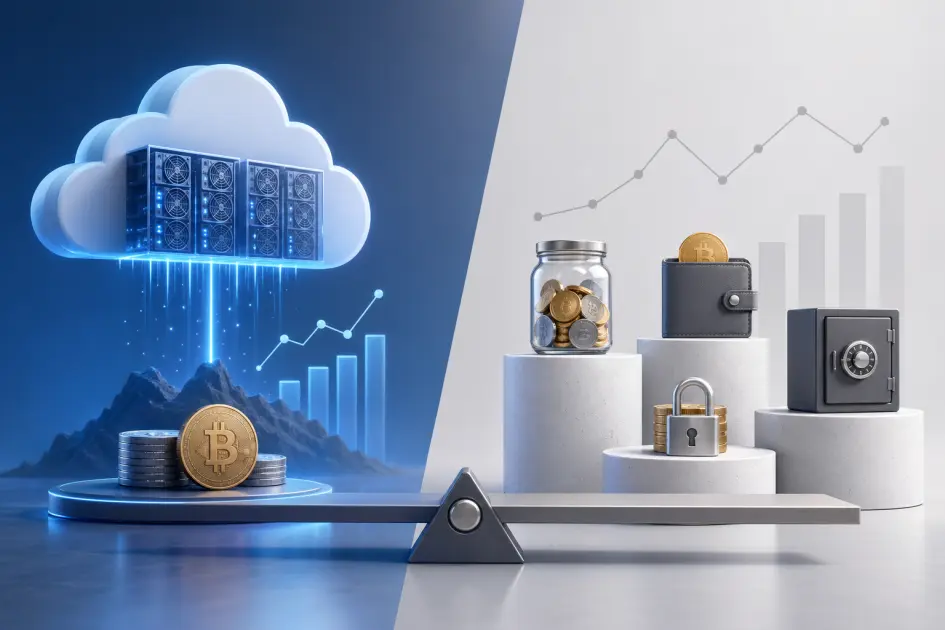
For two years I chased 20–60% APY across DeFi yield farms. Then rug-pulls, impermanent loss, and APY decay ate most of the edge. In early 2026 I moved roughly a third of that capital into Bitcoin cloud mining — trading higher theoretical yield for lower variance, smart contract risk for pure BTC price exposure. Here's the honest math.

The APY Honeymoon (And Why It Didn't Last)
When I started yield farming in 2023, the numbers looked magical. A new stablecoin farm advertising 48% APY. A newly launched L2 offering 62% for ETH-USDC liquidity. A cross-chain bridge paying me in its own token at three-digit rates. Compounded weekly, it felt like I'd solved money.
The problem was that the headline APY was almost never what I actually earned. Token emissions dumped. Pool weights shifted. TVL flooded in and yields compressed within weeks. And every now and then, a protocol I'd trusted simply broke — drained, exploited, or quietly abandoned by an anonymous team.
Smart contract risk
One reentrancy bug or oracle manipulation and the pool is empty before you wake up. Audits help; they do not eliminate the risk.
APY decay
The 60% APY I saw on day one was often 12% by day 30 as TVL grew and token emissions diluted. Early birds eat; latecomers hold the bag.
Impermanent loss
Providing ETH-USDC liquidity in a trending market cost me more in divergence loss than the farm paid in rewards. The APY number hid it; the withdrawal screen didn't.
On top of all that, gas fees. Every harvest, every compound, every migration: another $12–40 off the top on mainnet. For a small wallet chasing yield across five protocols, the friction alone can wipe out a full month of "gains." A look through the history at rekt.news exploit archive made it clear I wasn't the only one discovering this the hard way — the cumulative DeFi loss tally from hacks and rugs is now deep into the tens of billions.
What Cloud Mining Actually Trades — The Risk Swap
Cloud mining is a very different animal. You pay a fixed USD fee (in my case, USDT via BEP-20) to rent hashrate from a data center. That hashrate points at a Bitcoin pool and accrues BTC to your wallet roughly every minute. No smart contracts in the path. No liquidity pool. No governance token to dump on you.
What you do trade is real: you now carry straight BTC price risk, plus network difficulty risk, plus counterparty risk on the operator. The question for me wasn't "is mining risk-free?" — nothing in crypto is. The question was "are the risks I'm taking now better matched to the risks I can actually understand and tolerate?"
| Risk factor | DeFi yield farming | BTC cloud mining |
|---|---|---|
| Smart contract exploit | High — any audit can miss a bug | None — no contracts in the path |
| Rug-pull / team vanishing | Real (especially anon teams) | Operator counterparty risk (diligence-able) |
| Impermanent loss | Yes — LP pair diverges | None — single asset (BTC) |
| Yield stability | Decays fast as TVL grows | Predictable monthly cost, BTC-denominated output |
| Fees eating small wallets | Gas $12–40 per harvest on mainnet | One deposit fee ($0.05–2 on BEP-20/TRC-20) |
| Price exposure | Multi-token pair + reward token | BTC only (directly linked to cost in USD) |
| Operator jurisdiction | Often unknown / offshore DAO | Regulated data center in Kazakhstan |
The headline trade is simple: I gave up higher theoretical APY in exchange for lower variance and zero smart contract surface area. NoxHash's data center runs ASIC miners on industrial-grade power at roughly $0.035/kWh in Kazakhstan, with a cold climate handling most of the cooling — infrastructure I could never replicate on a yield farm spreadsheet.
My Decision Timeline — From Farm to Fleet
I didn't flip the switch overnight. The reallocation played out across roughly four months, and I kept notes. Here's how the sequence actually went:
Month 1 — Audit my actual DeFi returns
I exported every position's realized PnL and subtracted gas. My "48% APY" stablecoin farm came out at 11.2% net after token dumps and claim costs. The ETH-USDC LP? Net negative once I priced in impermanent loss against simply holding ETH. That was the honest baseline.
Month 2 — Test with the free trial
Before committing capital I activated NoxHash's 2-day Basic Miner trial (50 TH/s, no deposit). I watched the CGMiner terminal through the "View Desktop" feature — real hashrate, real pool shares. Trial earnings don't credit your wallet, but the machine is genuine. That mattered more than a glossy homepage.
Month 3 — Small Standard Miner to pressure-test payouts
I rented one Standard Miner ($50/month, 150 TH/s) for a single month — no commitment discount, deliberately. I wanted to confirm: BTC accrual really does arrive each minute, the withdrawal flow works, and the 1.5% withdrawal fee matches the documentation. It did.
Month 4 — Scale and lock a longer term
Satisfied with the first payout cycle, I moved about a third of my DeFi stack — specifically the riskiest, newest-protocol positions — into two Pro Miners on a 6-month term for the 10% discount ($90/month each). The BTC that accrues now sits in one place with one variable to watch (BTC price) instead of seven.
What I kept in DeFi
Aave lending at modest rates. A small stablecoin yield position on a battle-tested protocol. Nothing under 18 months old, nothing with anonymous teams, nothing paying triple digits. DeFi still has real use cases — I just stopped treating it like a yield buffet.
Start where I started — with the trial, not the deposit
My first move wasn't sending USDT. It was watching a real Basic Miner run for 48 hours and checking the CGMiner output. You can do exactly the same before committing a cent.
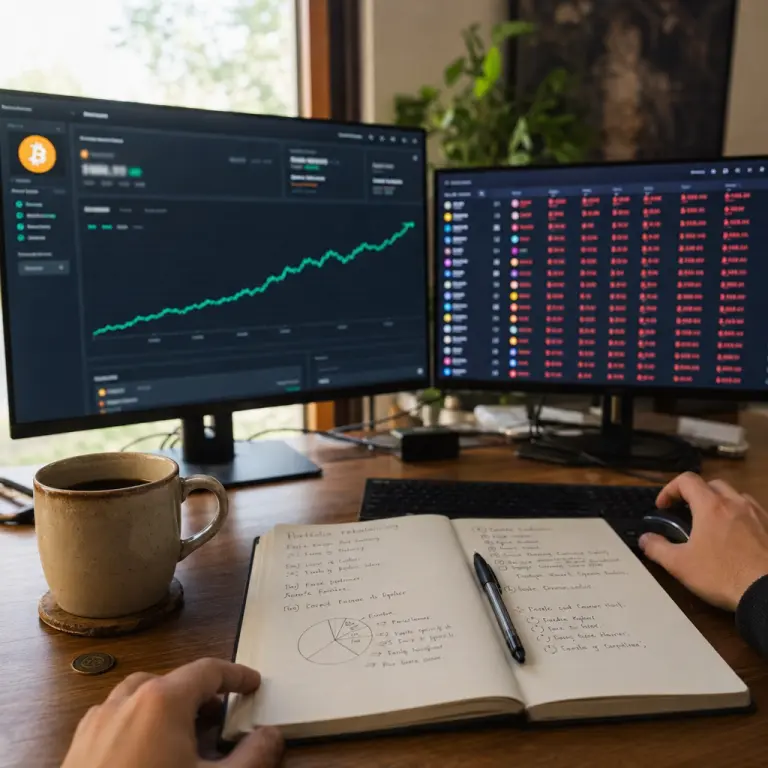
Four Lessons I Wish I'd Had Before Reallocating
These aren't universal truths — they're the things I'd tell a friend who was two years into DeFi and burning out from constantly checking Discord for exploit alerts. Take what applies, leave what doesn't.
Net APY, not headline APY
Subtract gas, reward-token dumps, and impermanent loss. A 45% banner often becomes 8–12% real. Mining's fixed cost/variable BTC output is uglier on a banner but cleaner on a spreadsheet.
Pick risks you can actually assess
I cannot meaningfully audit a 3,000-line Solidity contract. I can read BTC price charts and difficulty trends. Pick risks your toolkit matches, not ones that sound exciting.
BTC price risk is still risk
Mining is cheaper USD-denominated exposure to BTC with yield on top, but it is not delta-neutral. If BTC drops 40%, your monthly USD fee stays flat and your BTC output revalues lower. Size accordingly.
Diversify, don't switch camps
I moved about a third. The rest is split between spot BTC, a small ETH stake, conservative DeFi lending, and cash reserves. Abandoning a category entirely is usually a worse trade than rebalancing within it.
Frequently Asked Questions
Is cloud mining really lower risk than DeFi yield farming?
It's different risk, not necessarily lower. Cloud mining removes smart contract exploits and impermanent loss, but adds BTC price risk, network difficulty risk, and operator counterparty risk. For me, those risks are easier to understand and tolerate than Solidity audit uncertainty. Your answer may differ.
Why BTC cloud mining instead of just buying BTC spot?
Buying spot BTC is simpler and I kept some allocation there. Mining adds a yield component — your rented hashrate accrues BTC continuously — in exchange for operator and difficulty risk. If BTC price is flat or rising, mining can beat pure spot; if BTC crashes, mining loses faster. Neither is strictly better.
How much of my portfolio did I reallocate?
Roughly a third of my DeFi stack — specifically the positions I was least able to assess honestly. I kept conservative DeFi lending, spot BTC, a small ETH stake, and a cash reserve. Complete category switches are usually worse than partial rotations, and no single platform should be a make-or-break bet.
What happens to my mining returns if BTC price drops?
Your monthly USD rental fee stays fixed, but the USD value of accrued BTC falls with the price. In a deep drawdown the USD yield may not cover the rental cost for that period. This is why I wouldn't recommend starting a long rental during an obvious BTC downtrend — timing still matters, even in cloud mining.
Did I completely give up on DeFi?
No. I still lend on Aave and hold a conservative stablecoin yield position on a long-audited protocol. DeFi has real, durable use cases — lending, stablecoin rails, on-chain settlement. I stopped chasing triple-digit APYs on six-week-old farms. That's the part I wanted gone.
Can I try cloud mining before committing real money?
Yes. NoxHash offers a 2-day free Basic Miner trial (50 TH/s, one per account) — no deposit, no card. You see real hashrate and pool shares in the CGMiner terminal. Trial earnings don't credit to your wallet, but it's the fastest way to confirm the infrastructure is real before you rent anything.
Not financial advice — personal allocation story
This article describes one person's reallocation decisions and the reasoning behind them. It is not investment advice. Swapping DeFi smart contract risk for BTC price risk is a trade-off, not a risk removal — Bitcoin's price, mining difficulty, and global regulation can all move against you. Past results do not guarantee future performance. Only commit funds you can afford to lose, weigh your own tax and legal situation with a qualified professional, and avoid sizing any single platform as a make-or-break position.