Cloud Mining vs Buying Bitcoin — Which Is Smarter for Accumulating BTC?
Cloud mining or spot buying BTC — which path accumulates more Bitcoin on $1,200? Honest 3-scenario math, plus tax, custody, and counterparty trade-offs.

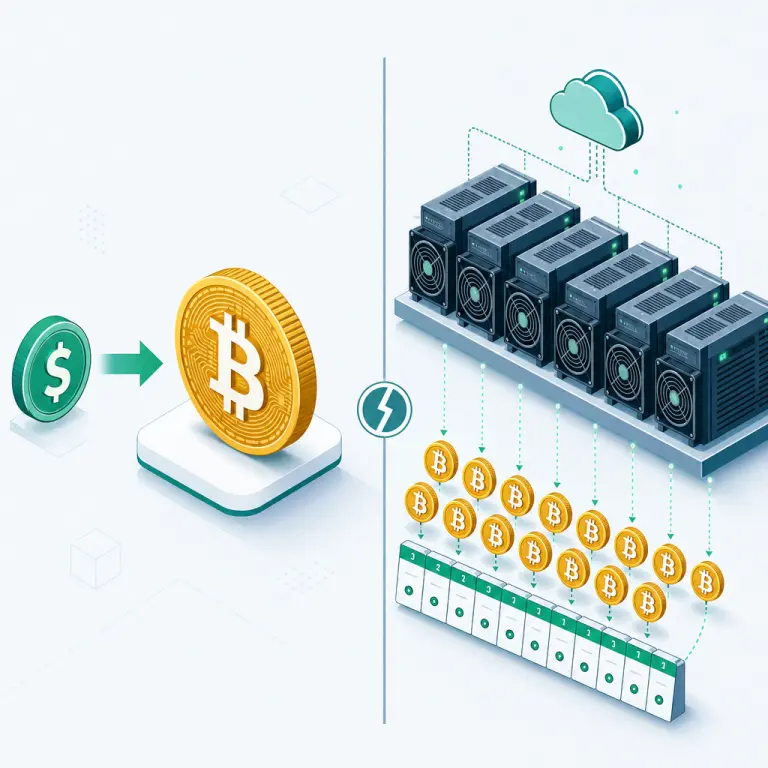
Both paths end in Bitcoin, but they get there with very different properties. Spot buying is a lump sum — you own the BTC on day one, with no ongoing cost and pure price exposure. Cloud mining is a fixed-USD drip over the contract term, with a yield on top but also monthly fees that keep billing in a bear. This article runs the math on $1,200 across three BTC price paths so you can see which fits your risk appetite.
The Core Difference — Two Ways to End Up Holding BTC
If your only goal is to finish the year with more Bitcoin in your wallet, both paths can get you there. The difference is how and what you are exposed to along the way. Spot buying compresses the entire decision into one click; cloud mining spreads it across months of rental fees and BTC payouts. Those two shapes behave very differently when the chart moves against you.
Spot buying — lump sum, immediate exposure
One transaction on an exchange or on-chain. You own the BTC on day one, no ongoing cost, no fee stream, no counterparty drip. Your USD PnL is a straight function of BTC price from that entry.
Cloud mining — DCA-style drip, yield on top
Monthly USD fee in, BTC accrual out — every minute, for the contract term. You accumulate BTC across many prices instead of one. In return you carry an ongoing fee, BTC price risk, and operator counterparty risk.
As of April 23, 2026, BTC trades around $78,000 per the CoinGecko BTC/USD page, and mining hashprice sits near $33 per PH/s/day per the Hashrate Index hashprice chart. Those are the two anchor numbers powering every calculation in this article.
Three Scenarios on $1,200 — Flat, +50%, -40%
Here is the comparison. Starting capital is $1,200 in both lanes. Path A buys BTC immediately at $78,000. Path B funds twelve monthly payments on a NoxHash Pro Miner (350 TH/s at $100/month) and sweeps the mined BTC to a self-custody wallet at the end. For mining output we assume roughly $115/month net BTC value at a flat-to-mild hashprice — which is consistent with the platform's conservative 115–125% of rental target and the current ~$33/PH/s/day environment.
Each row ends with two numbers: final BTC balance and USD PnL versus the original $1,200. All figures are illustrative — real results depend on BTC price path, network difficulty, and mempool fees during the year.
| Scenario | Path A — Spot BTC buy | Path B — Cloud mining (12 × $100) |
|---|---|---|
| BTC flat ($78k → $78k) | 0.01538 BTC · PnL $0 | ~0.01770 BTC · PnL +$180 |
| BTC up 50% ($78k → $117k) | 0.01538 BTC · PnL +$600 | ~0.01415 BTC · PnL +$455 |
| BTC down 40% ($78k → $46.8k) | 0.01538 BTC · PnL -$480 | ~0.01305 BTC · PnL -$590 |
A few honest notes on what the table actually shows. In the flat scenario, cloud mining wins on both BTC count and USD — the yield adds sats while price does nothing. In the +50% scenario, spot wins on both USD and BTC count, because your $1,200 went to work on day one at $78k and each mining month's $100 kept buying fewer sats as price climbed. In the -40% scenario, spot hurts less in both BTC and dollars — the bag sits there; cloud mining hurts more, because you kept paying $100/month while hashprice collapsed alongside BTC.
The pattern is not "cloud is better in bulls" — it's the opposite: cloud mining shines in flat markets, and hurts worse than spot in deep bears. In rising markets, spot tends to pull ahead because the full lump sum compounds from day one. That is not an opinion — it is what the arithmetic says when a fixed USD fee meets a variable-price BTC output.
The DCA Argument — Why Some Accumulators Prefer the Drip
There is a reason dollar-cost averaging shows up in almost every Bitcoin playbook. Most people cannot reliably pick the local bottom, and the psychological cost of buying a lump sum right before a 30% drawdown is real — many investors freeze, revenge-trade, or capitulate. Cloud mining is structurally closer to a DCA: you pay a fixed USD fee, and the fleet produces BTC at whatever price is on the tape that minute.
In a choppy or slowly rising year, that averaging is genuinely useful. Your twelve monthly payouts land at twelve different BTC prices — some higher than today, some lower — and the blended cost basis is smoother than a single entry. It also forces a discipline most humans lack: you cannot panic-sell accruals you never decided to buy in the first place.
The catch is that a traditional DCA (buying spot BTC every month with $100) has no operating cost. Cloud mining is a DCA with an expense stream attached, justified only if the fleet's yield beats the cost of simply buying BTC on the same schedule. When hashprice is healthy and BTC is stable or rising, it does. When hashprice craters or BTC falls hard, a plain DCA usually beats it.
See what the mining drip actually looks like before committing $1,200
The scenario table uses a 12-month Pro Miner contract. Before funding twelve months, you can run the free 2-day Basic Miner trial and watch hashrate, BTC accrual, and the dashboard behave in real time against live prices. No deposit, no card.

Tax, Custody, and Counterparty — The Non-PnL Risks
The arithmetic is only half the comparison. The two paths also differ on three less-visible fronts that can dominate your experience if something goes wrong. None of these are reasons to avoid either approach, but skipping them is how accumulators end up surprised.
Tax treatment
Spot BTC is typically treated as a capital asset in most jurisdictions — you realize a gain or loss only when you sell, and the cost basis is your purchase price. Cloud mining payouts, by contrast, are often treated as ordinary income at the USD value when received, with a second capital-gains event if you later sell that BTC at a different price. That means a mining setup can generate taxable events every single day even if you never touch the wallet. Verify the exact treatment in your country with a qualified tax professional — this article is not tax advice.
Custody
A spot buy you move to self-custody lives on your own keys — full sovereignty, full responsibility for seed backups. Cloud-mined BTC sits on the operator's platform until you withdraw; for the 12 monthly accruals in our scenario, you would typically sweep once per month or once per quarter to an external Bitcoin address. NoxHash withdrawals cost 1.5% and support bc1, 1, and 3-type addresses. The custody window — between when BTC is credited and when you withdraw — is where operator risk lives.
Counterparty
Spot buying still has counterparty risk at the exchange layer, briefly, until you move to self-custody. Cloud mining carries ongoing operator risk for the whole contract term: the fleet must keep running, the payouts must keep landing, and withdrawals must keep clearing. That is why transparent infrastructure matters — NoxHash operates an identifiable Kazakhstan data center on an industrial $0.035/kWh contract with an Antminer S21 fleet at 12–17.5 J/TH, which is verifiable against the Cambridge Bitcoin Electricity Consumption Index benchmarks for the region. Known infrastructure is not the same as zero risk, but it is materially different from an anonymous contract site.
The Hybrid Strategy — Why Not Both?
The scenario table treats Path A and Path B as a binary choice, but in practice almost no serious BTC accumulator runs one path to the exclusion of the other. The honest answer is usually a blend — because the two paths hedge each other in the exact scenarios each one dislikes.
Core position in spot BTC
Most of your stack sits on self-custody keys with no ongoing cost. It moves dollar-for-dollar with the market and is untouchable by operator or platform risk.
Satellite allocation to cloud mining
A smaller budget funds 1–3 months of a Basic or Standard Miner. It behaves like a DCA overlay — adding BTC even in flat markets, with exposure limited to what you are willing to pay in fees.
A typical hybrid split on $1,200 might put $900 into spot BTC and use the remaining $300 for three months of a Standard Miner ($50/month × 3, plus a small buffer). That combination captures most of the price upside if BTC rips, gains a modest BTC drip in flat markets, and caps your mining fee exposure at $150 if things turn ugly. No magic — just a less binary way to size the two approaches.
Decision Framework — Matching Path to Profile
There is no universally correct answer. The right path depends on how you feel about ongoing costs, how confident you are in your BTC price view, and how actively you want to think about this. Four honest profiles:
You want simplicity
Buy spot, self-custody, forget about it. No fees, no operator, no tax reporting every month. This is the lowest-maintenance path if your thesis is long-term BTC appreciation and nothing else.
You want yield on top of BTC
You are comfortable paying a monthly fee to get a yield, and you expect flat-to-rising price conditions. Cloud mining with a 6–12 month contract captures the term discount and the drip.
You cannot time entries
If picking a single entry stresses you out, a cloud mining contract or a plain spot DCA both smooth the decision. Mining adds a yield overlay; plain DCA has no fees. Pick based on whether you trust the operator layer.
You expect a deep bear
Neither path is comfortable, but spot hurts less because the fee meter is off. If you genuinely expect a 40%+ drawdown, sit in USDT or go short-duration rentals only — never lock a 12-month contract into a visible downtrend.
Notice that none of the four profiles calls one path objectively "smarter." That is the honest read: both are valid, and the right one depends on which shape of exposure you actually prefer to hold.
If the yield profile fits you, test a live miner first
You've matched your profile against four quadrants. If "yield on top of BTC" or "cannot time entries" fit, a 2-day Basic Miner trial lets you watch real hashrate and BTC accrual in a Kazakhstan data center with no deposit — before you commit anything like $1,200.
Frequently Asked Questions
Which accumulates more BTC — cloud mining or spot buying?
It depends on the price path. In flat or modestly rising markets, cloud mining tends to accumulate more BTC because the yield compounds. In a deep bear, fixed monthly fees erode both BTC count and USD value faster than simply holding a spot bag. Neither path is universally better.
Is cloud mining just a complicated way to DCA into Bitcoin?
Structurally it behaves like a DCA with an operator-provided yield. The yield is justified if net mining output beats the cost of simply buying BTC each month. When hashprice is healthy, it often does; when hashprice craters, a plain spot DCA usually wins.
What happens to a cloud mining contract if BTC crashes mid-contract?
BTC payouts keep accruing, but the USD value of each payout drops with the market while your fee stays fixed. The BTC accumulates; the dollar PnL retroactively weakens. That is why locking long terms into a visible downtrend is generally worse than short-duration rentals or waiting.
Do the two paths have different tax treatment?
In many jurisdictions, yes. Spot buys are typically capital assets taxed on sale. Mining payouts are often ordinary income at receipt, with a second capital-gains event on later sale. That can create many more taxable events per year. Confirm your local treatment with a qualified tax professional.
Can I run both paths at the same time?
Yes — a hybrid allocation is common. A typical split puts the majority into spot BTC on self-custody as a core position and uses a smaller budget for short-term cloud mining contracts as a satellite yield overlay. This caps fee exposure while still capturing some mining-side upside.
If I only have $1,200 once, should I buy or mine?
If your conviction is long-term BTC and you hate ongoing management, buy spot and self-custody. If you want time-smoothed accumulation with a yield and expect flat-to-rising conditions, a 6–12 month mining contract can outperform. Testing with the free trial first avoids committing the full budget blind.
Illustrative scenarios — not financial or tax advice
The $1,200 comparison, scenario table, hashprice assumption, and BTC price anchor reflect April 2026 market conditions and are illustrative only. Real cloud mining output depends on BTC price, network difficulty, mempool fees, and contract parameters that change continuously. Neither spot buying nor cloud mining is a risk-free path to BTC accumulation — both carry market risk, and cloud mining adds operator counterparty risk and jurisdiction-specific tax complexity. Past performance does not predict future results. Only commit capital you can afford to lose, verify local legal and tax treatment with a qualified professional, and do not treat this article as a recommendation to pursue either path.