Cloud Mining ROI — How to Calculate Break-Even and Expected Returns
Learn the exact ROI and break-even formulas for cloud mining. Plug in your own rental cost, hashrate, hashprice, and BTC price to model outcomes.

Cloud mining ROI is the percentage gain (or loss) you realize after subtracting rental cost and withdrawal fees from the USD value of mined BTC. Break-even is the BTC price at which those two numbers cancel out. Learn the formula once, know the four inputs, and you can stop trusting marketing screenshots — you can model any plan, any term, any market on the back of a napkin.
Why ROI and Break-Even Matter More Than "Expected Profit"
Most cloud mining landing pages quote a single headline number — "earn up to X% per month". That figure tells you almost nothing because it does not expose the assumptions baked in. ROI and break-even are honest numbers: they force you to name your inputs, accept that each one can move, and decide if the plan still works when they do.
Think of ROI as the backward-looking score you calculate at the end of a term to judge whether the rental paid off. Break-even is the forward-looking trigger — the BTC price below which the same rental will not cover its own cost. Together they replace hope with arithmetic. A renter who knows both can walk past any guaranteed-return pitch without flinching.
This article is a calculator walkthrough, not a scenario catalogue. If you want worked bear, flat, and bull outcomes on a Standard Miner, the sibling article Cloud Mining Profitability Examples covers that ground. Here, the goal is to put the formula in your hands so you can plug in any plan, any hashprice, any BTC price and get an answer you trust.
The Four Inputs You Need Before You Touch the Formula
Every ROI calculation on every cloud mining platform reduces to the same four numbers. Gather them first, write them down, and the rest is arithmetic. Guessing one of them is how renters end up disappointed six months in.
Rental cost (USD)
Monthly plan price multiplied by term length, minus any term discount. On NoxHash: 5% off at 3 months, 10% at 6, 15% at 12, 20% at 24.
Rented hashrate (TH/s)
The contracted terahashes per second. NoxHash tiers: Basic 50, Standard 150, Pro 350, Enterprise 1,000 TH/s. This is a fixed spec for the whole term.
Hashprice (USD/TH/day)
The daily USD value of one TH/s, combining block reward, network difficulty, fees, and BTC price into a single number. Read it fresh before every calculation.
Withdrawal fee (%)
The haircut when you move BTC off-platform. On NoxHash it is a flat 1.5% on withdrawal amount — small, but compounding it into the model is the difference between honest and optimistic math.
As of April 2026, hashprice trades around $33 per PH/s/day — roughly $0.033 per TH/s/day — according to the Hashrate Index Bitcoin Hashprice Index. For the worked example below we use a slightly higher planning figure of $0.04/TH/day; any ROI you compute is only as good as the hashprice input, so always pull the live number before you commit to a term.
The ROI Formula in Plain English
Here is the whole equation. One line. Everything else in this article is a walk through what each term means and where the numbers come from.
ROI =
(BTC mined × BTC price − Rental cost − Withdrawal fee) ÷ Rental cost
Read it out loud once. Revenue minus costs, divided by what you paid. If the answer is 0.25, your ROI is 25% — you got back your rental plus a quarter on top. If it is negative, the rental lost money. If it is 3.0, you tripled (plus change) what you put in.
To actually plug numbers in, you need each term spelled out:
- BTC mined = (Rented TH/s × Term days × Hashprice per TH/day) ÷ BTC price. In practice it is simpler to compute USD gross directly — see step 2 of the walkthrough.
- BTC price = the spot price you convert to USD at, ideally the average across the term.
- Rental cost = Monthly price × (1 − term discount) × number of months.
- Withdrawal fee = 1.5% of the gross BTC USD value, applied when you move BTC off-platform.
Notice what is not in the formula: electricity, hardware depreciation, cooling, data center rent. Those are costs NoxHash absorbs because the rental price already bakes them in. That is the core shift from home mining — you swap variable operating exposure for a fixed USD rental and inherit market risk instead.
The Break-Even BTC Price Formula
Break-even answers a different question: how low can BTC drop before my rental stops covering itself? It is the single most useful number when deciding term length, because a 12-month contract at a high break-even is fragile, while one at a low break-even can ride out a drawdown.
Break-even BTC price =
Rental cost ÷ BTC earned during term
In words: break-even is the BTC price at which the BTC you mined is worth exactly what you paid in rental. Above that price, the contract is net-positive. Below it, you are paying more in USD than you are receiving in BTC value. The lower your break-even, the more BTC-price downside your rental can absorb before turning red.
Two practical notes. First, the formula above uses gross BTC before the 1.5% withdrawal fee — to be strict, multiply the denominator by 0.985 to bake the fee in. Second, break-even shifts every time hashprice moves, because "BTC earned during term" depends on hashprice. Re-run it monthly during long terms rather than assuming the day-one number holds.
Worked Example — Pro Miner, 6-Month Term (Illustrative)
Let's run the whole calculator end to end with concrete numbers. Every figure below is illustrative and anchored to April 2026 conditions plus user-chosen assumptions; the point is not the exact answer, it is the process you can repeat with your own inputs.
Pick plan and compute rental cost
Pro Miner at $100/month, 350 TH/s, 6-month term carrying a 10% discount. Rental cost = $100 × 0.90 × 6 = $540.
Estimate USD gross from hashprice
Gross = TH/s × term days × hashprice per TH/day. Using $0.04/TH/day as the planning figure: 350 × 180 × $0.04 = $2,520 in USD-equivalent BTC. This is before any fees.
Convert to BTC at current price (optional check)
Hashprice already bakes BTC price into the USD output, so you rarely need to convert. If you do — e.g. for break-even — at a $70,000 BTC price, $2,520 ÷ $70,000 ≈ 0.036 BTC accrued over 180 days.
Subtract the 1.5% withdrawal fee
Withdrawal haircut = $2,520 × 0.015 = $37.80. Net USD-equivalent after fee = $2,520 − $37.80 = ~$2,482.
Compute ROI and break-even
ROI = ($2,482 − $540) ÷ $540 ≈ 3.60, i.e. ~360% over the 6-month term. Break-even BTC price = $540 ÷ 0.036 BTC ≈ $15,000 — BTC would have to collapse below $15k for the rental to stop covering itself at this hashprice.
Two honest caveats before anyone quotes that 360% in a thread. First, the entire number hinges on hashprice staying near $0.04/TH/day for the full 180 days — the April 2026 live figure is closer to $0.033, which would compress the result meaningfully. Second, the break-even of ~$15k is only as real as the BTC accrual; if difficulty jumps 20% during the term, you earn fewer BTC and break-even rises. Treat this as the shape of the answer, not the answer itself.
Run the same five steps on a live account
You've just walked the full calculator on a Pro Miner. The same five-step process applies to Basic, Standard, and Enterprise — only the hashrate and rental line change. Start the 2-day free trial with 50 TH/s, watch real accrual, then plug the observed daily payout back into step 2 and verify the formula on your own data.
Sensitivity Table — Stress-Test Your ROI
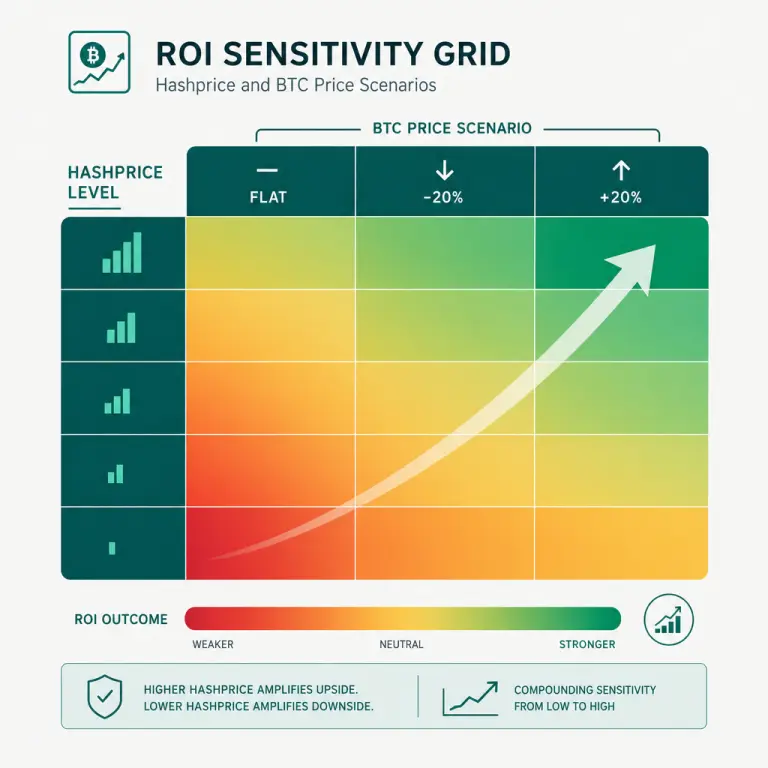
A single ROI number is fragile. A sensitivity table is durable. By flexing the two most volatile inputs — hashprice and BTC price — across a realistic band, you learn where your contract is resilient and where it breaks. The grid below uses the same Pro Miner, 6-month, $540 rental cost example. All numbers are illustrative.
| Hashprice (USD/TH/day) | BTC −20% | BTC flat | BTC +20% |
|---|---|---|---|
| $0.025 (weak) | ~133% ROI | ~188% ROI | ~244% ROI |
| $0.035 (mid-low) | ~226% ROI | ~303% ROI | ~381% ROI |
| $0.045 (mid-high) | ~319% ROI | ~418% ROI | ~518% ROI |
| $0.055 (strong) | ~412% ROI | ~534% ROI | ~655% ROI |
Read the table honestly. The "BTC −20%" column is not a one-off bad day — it is the average BTC price across the full 180-day term being 20% lower than your entry assumption. The weak-hashprice row is what happens if global hashrate grows ~15% while block reward stays fixed. Even in the worst cell (weak hashprice, BTC drawdown) the illustrative ROI stays positive, which reflects that the April 2026 $0.04 planning figure is already above the cost floor of the $540 rental for Pro tier; your own cell might land negative if you used a smaller plan, a shorter term, or a higher-priced operator.
One thing the grid hides: all four columns assume you withdraw at term end. If you withdraw monthly and BTC trends down during the term, your effective exit price is a time-weighted average, not the worst day. That usually helps you, but it makes back-of-envelope ROI slightly optimistic compared to realized PnL.
Common ROI Mistakes — The Four Errors We See Most
Every honest operator has watched renters compute ROI the wrong way. Four mistakes show up over and over. Knowing them is cheaper than making them.
Mistake 1: Ignoring the withdrawal fee. A 1.5% haircut looks small, but on a $2,520 gross it is $37.80 — nearly one month of a Basic Miner rental. Model it into the formula from the start, not as an afterthought at withdrawal time.
Mistake 2: Using a single static hashprice for the whole term. Hashprice moved from ~$28 in February 2026 to ~$33 in April 2026 — a 15–18% swing in two months. Multiplying your day-one hashprice across 180 days is how renters "discover" their ROI was overstated. Stress-test with a sensitivity table like the one above.
Mistake 3: Assuming BTC price stays where it was when you signed. Your rental is USD-denominated and your output is BTC. If BTC drops 30% across the term, your USD-equivalent gross drops 30% even if hashprice and difficulty are flat. ROI calculated against the entry BTC price is a projection, not a result.
Mistake 4: Confusing percentage-per-month with annual ROI. A "125% of rental per month" target is not a 125% annual ROI — it means BTC value returned equals 1.25× rental each month, which annualizes very differently. Always name the time frame attached to any percentage you see.
Pitfalls — How ROI Gets Weaponized in Marketing
ROI is an honest concept, but it is easy to misuse. Platforms that quote guaranteed fixed returns are almost always doing one of the three things below. Spotting them is self-defense.
"Guaranteed 2% daily ROI"
Real mining yield floats with hashprice. A fixed daily ROI promise is either paying old renters from new deposits (Ponzi) or quietly capping withdrawals when the market turns. Legitimate platforms publish a target range, not a guarantee.
ROI quoted without hashprice
Any ROI calculator that will not show you the hashprice assumption behind the output is hiding its most volatile input. Demand to see the planning hashprice — and reject figures that bake in $0.08+/TH/day numbers that have not been seen since 2022.
Annualized ROI on a short-term projection
Some platforms compute 30-day ROI and then annualize it by multiplying by 12. That is only honest if the underlying conditions hold for a full year — which they won't. Annualize only when you have evidence, not arithmetic convenience.
ROI without a break-even line
A projection that shows upside but never names the BTC price at which the contract flips negative is incomplete. Always compute break-even alongside ROI. A rental with 300% ROI at spot but a break-even 40% below spot is sturdy; one with 300% ROI but break-even 10% below spot is not.
You now own the math — test it on a transparent operator
You have the ROI formula, the break-even line, the sensitivity grid, and a list of four pitfalls to avoid. The best place to stress-test all of that is on an operator that publishes its specs — NoxHash shows per-tier hashrate, 1.5% withdrawal fee, term discounts, and real Kazakhstan infrastructure costs in plain view.
Frequently Asked Questions
What is a good ROI for cloud mining in 2026?
There is no universal number — ROI depends on hashprice, BTC price, term length, and operator cost structure. A realistic planning band for a mid-tier term at April 2026 hashprice lands in the low-to-mid hundreds of percent, but treat any figure as illustrative, not a promise. Break-even matters more than headline ROI.
Where do I find the current hashprice?
The Hashrate Index Bitcoin Hashprice Index publishes a live USD/PH/s/day figure updated daily. Divide by 1,000 to convert to USD/TH/s/day. Read it the same week you sign a term and re-read it mid-term to update your projection — it is the most volatile input in the whole formula.
How does term length affect ROI?
Longer terms lower the monthly rental line via discounts (5–20% on NoxHash) and give more days for BTC to accrue — but they also expose you to more market variance. A 12-month term at a high break-even is fragile; the same term at a low break-even is resilient. Compute both before locking.
Why does break-even matter more than peak ROI?
Peak ROI is a best-case projection; break-even is a stress test. Two contracts can show identical upside but very different downside. The one with a lower break-even BTC price can survive a deeper drawdown without turning red — that resilience is what you are actually buying when you pick a plan and term.
Does the 1.5% withdrawal fee really matter in the ROI math?
On large grosses, yes. 1.5% of a $2,520 earnings figure is $37.80 — close to two months of the Basic Miner rental. It will not flip a healthy ROI negative, but leaving it out is the difference between a projection and a realistic estimate. Bake it in from step one, not at withdrawal time.
Can I recalculate ROI mid-term if conditions change?
You should. Every month, plug the latest hashprice and BTC price into the formula using your remaining term days. If break-even has drifted dangerously close to spot, you know to not compound the position. Mid-term recalculation is the difference between a renter with a plan and a renter with a hope.
Why do some platforms advertise ROI numbers that look too good?
Usually they bake in an unrealistic hashprice, omit fees, annualize a best-month result, or simply guarantee returns that real mining cannot produce. If a platform cannot show you the hashprice input behind its projection and its break-even BTC price, treat the headline figure as marketing rather than math.
Illustrative numbers — not financial advice, not a profit guarantee
Every ROI figure, break-even value, and sensitivity cell in this article is illustrative and anchored to April 2026 network conditions. Hashprice, BTC price, network difficulty, and mempool fee pressure move continuously and can move hard against you. The worked-example ROI and sensitivity grid assume a planning hashprice of $0.04/TH/day; the live April 2026 figure is closer to $0.033, which would compress outcomes. Past performance does not predict future results. Cloud mining carries market, counterparty, regulatory, and tax risks that depend on your jurisdiction. Only commit funds you can afford to lose, verify local legal and tax treatment with a qualified professional, and do not size any single contract as a make-or-break position.