Cloud Mining Profitability — How It Works and Realistic Examples
How cloud mining profitability really works in 2026: the four variables, the formula, and three worked bear/flat/bull scenarios with honest numbers.

Cloud mining profitability is the gap between what you pay each month to rent hashrate and the USD value of the Bitcoin that hashrate produces. Three variables move the number: your rented TH/s, the global network difficulty, and the live BTC price. Everything else — rental discounts, withdrawal fees, halving — is a fourth modifier layered on top. Understand those four and you can stop guessing.

The Four Variables That Move Your Profit
Before a single dollar changes hands, it helps to know what you are actually buying. Every cloud mining contract — no matter how it is marketed — resolves to the same four inputs. The first three are outside your control. The fourth is where you can actually save money.
Rented hashrate (TH/s)
The only lever you pick. A Standard plan at 150 TH/s earns three times a Basic plan at 50 TH/s — assuming everything else stays equal, which it rarely does.
Network difficulty
The quiet killer. When global hashrate climbs, every TH/s on the planet — including yours — earns proportionally less BTC. Difficulty re-adjusts every 2,016 blocks.
BTC price
The headline number. Since your cost is USD-denominated and your output is BTC, a 40% BTC drawdown turns the same mined sats into 40% fewer dollars — without changing a single network variable.
Fees and term length
Rental price, withdrawal fee (1.5% on NoxHash), and term discount (5–20% for 3–24 months). The only part of the formula you can negotiate down.
As of April 2026, global network hashrate sits at roughly 1.004 ZH/s with difficulty at ~135.6 T and a block reward of 3.125 BTC, according to the CoinWarz Bitcoin hashrate and difficulty chart. Hashprice — the daily USD value of one PH/s of hashrate — recently traded in a $30–$45 per PH/s/day band per the Hashrate Index hashprice chart. Those are the numbers you should plug into any ROI estimate this quarter.
The Profitability Formula in Plain English
Strip away the branding and every cloud mining contract collapses into one equation. Write it once, understand what each term represents, and you can evaluate any offer you see anywhere on the internet in under a minute.
Monthly net PnL (USD) =
(Rented TH/s × Hashprice per TH/day × 30)
− Rental fee − Withdrawal fee (1.5%)
Hashprice per TH/day is already the shortcut that combines difficulty, block reward, transaction fees, and BTC price into a single number. Multiply by your rented TH/s and by 30 days, you get gross monthly revenue in USD. Subtract the fixed rental fee and the withdrawal haircut when you move BTC off-platform, and what is left is your net.
A worked example with a Standard Miner (150 TH/s at $50/month) at a mid-range hashprice of $40/PH/s/day:
- Daily gross: 150 TH/s ÷ 1,000 × $40 = $6.00/day
- Monthly gross: $6.00 × 30 = $180.00
- Rental fee: −$50.00
- Withdrawal fee (1.5% of gross): −$2.70
- Net monthly PnL: ~$127 USD-equivalent in BTC (illustrative)
This is where NoxHash's "target range of ~115–125% of rental" comes from — a typical month at a flat-to-rising hashprice lands near the middle of that band. It is a target, not a promise. Bear markets push it below, bull phases push it above.
Three Realistic Scenarios — Bear, Flat, and Bull
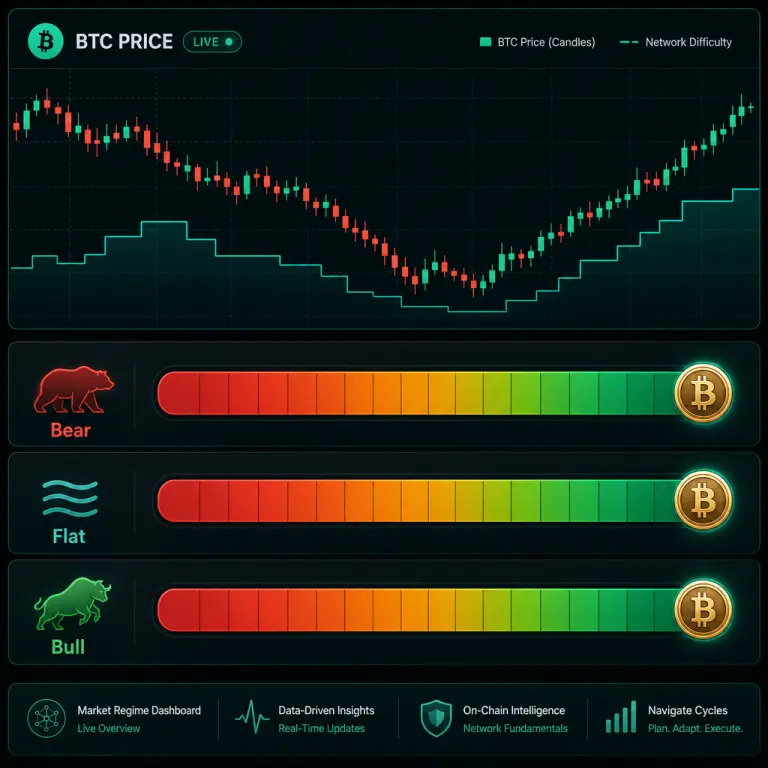
The same Standard Miner plan behaves very differently depending on where BTC is in its cycle. The table below shows three scenarios using public 2026 hashprice data as the anchor: a bear case near the Q1 2026 post-halving low, a flat case around current mid-range conditions, and a bull case where hashprice trends toward $55/PH/s/day. All numbers are illustrative and assume a single Standard Miner ($50/month, 150 TH/s, 1-month term, no discount).
| Line item | Bear (BTC weak) | Flat (mid-2026) | Bull (BTC strong) |
|---|---|---|---|
| Hashprice (USD/PH/s/day) | ~$30 | ~$40 | ~$55 |
| Daily gross (150 TH/s) | ~$4.50 | ~$6.00 | ~$8.25 |
| Monthly gross (30 days) | ~$135 | ~$180 | ~$247 |
| Rental fee | −$50 | −$50 | −$50 |
| Withdrawal fee (1.5%) | −$2.03 | −$2.70 | −$3.71 |
| Net monthly PnL (illustrative) | ~$83 | ~$127 | ~$193 |
| Return on rental | ~166% | ~254% | ~386% |
A few honest caveats. First, the hashprice numbers are moving targets — they change daily with BTC price, difficulty, and mempool fee pressure. Second, the "return on rental" row looks eye-catching but ignores one thing: you received BTC, not USD. If BTC drops another 20% before you withdraw, the USD math changes retroactively. Third, NoxHash's published target range of 115–125% of rental is a conservative operator-side figure that bakes in a much harsher assumption than mid-2026 hashprice suggests — it is designed to hold up even in a weak month, not to capture an upside like the bull column.
Plug your own numbers into the same formula
You've seen three scenarios on a Standard Miner. The exact same formula applies to Basic ($20, 50 TH/s), Pro ($100, 350 TH/s), and Enterprise ($250, 1,000 TH/s) — with the 6/12/24-month term discounts reducing the rental line. Start a free trial to watch real BTC accrual before you commit a single USDT.
What Actually Kills Your Profit — The Honest List
Three forces can quietly erode a contract that looked great on day one. None of them are secret. They just do not make it into the headline banner on most cloud mining landing pages.
Bitcoin price drawdowns. This is the one everyone notices too late. When BTC drops 40% across a 3-month rental, the BTC you mined during those months is worth 40% fewer dollars retroactively. Your rental fee kept being billed at 100%. This is why starting a 12-month contract the day after a local BTC top is a worse idea than the spreadsheet suggests.
Network difficulty spikes. In 2024–2025 the global hashrate climbed roughly 20–25% post-halving as operators rushed efficient fleets online. Every upward difficulty adjustment cuts the BTC your TH/s produces — even if BTC price is flat. The same $50 Standard Miner earning 0.002 BTC this month might earn 0.0017 BTC three months later if global hashrate jumps another 15%.
The halving overhang. The next halving is estimated for ~2028, when the block reward drops from 3.125 BTC to 1.5625 BTC. Any contract running across that date sees the block-reward portion of hashprice cut roughly in half overnight. Transaction fees partly compensate, and BTC price has historically appreciated post-halving — but neither effect is guaranteed.
The "do not start in a bear market" rule. Cloud mining is not a way to short BTC cheaply. Your monthly fee is fixed in USD, so when BTC is visibly trending down, you are paying full price for a product whose output keeps losing dollar value. A flat or rising BTC tape is materially easier to profit through than a weak one.
When NoxHash's Infrastructure Cost Advantage Matters
Hashprice is a market-wide number — it does not care which operator you rent from. Where the operator does matter is the cost structure behind the rental fee. NoxHash's fleet is stationed in Kazakhstan on a $0.035/kWh industrial power contract, with an Antminer S21 fleet running at roughly 17.5 J/TH for Standard tier and as low as 12 J/TH on hydro-cooled flagship units. That is 40–60% cheaper power than most Tier-1 mining regions, per infrastructure cost benchmarks from the Cambridge Bitcoin Electricity Consumption Index.
| Cost factor | Home miner (high-cost grid) | NoxHash (Kazakhstan) |
|---|---|---|
| Electricity rate | $0.12–0.20/kWh | $0.035/kWh industrial |
| Fleet efficiency | Whatever unit you own (often 21–30 J/TH) | 12–17.5 J/TH (S21 series) |
| Cooling cost | HVAC + dedicated space | Natural-air cooling (winter -30°C) |
| Downtime risk | Your problem | 4–8h replacement SLA, 24/7 techs |
The honest nuance: infrastructure cost is the floor, not the ceiling. Cheap power and efficient hardware let NoxHash stay solvent — and keep passing real BTC through to renters — at hashprices where higher-cost operators already shut down machines. That is genuine protection in a weak market. It does not make your contract immune to a BTC price crash, because the output is still BTC and the crash still happens on the chart regardless of how cheap the kWh is.
Decision Framework — When to Rent, When to Wait
Stripped to its essentials, the rent-or-wait question comes down to three signals you can check in ten minutes. If all three lean green, renting through a long term with a meaningful discount is historically the better move. If two or more lean red, a shorter term — or sitting it out — tends to outperform.
Good moment — signals align
BTC has stabilized after a drawdown or is trending up, hashprice has recovered off a recent low, and your conviction horizon is 6+ months. Lock a longer term to capture the discount.
Acceptable moment — start small
BTC is chopping sideways, hashprice is in the middle of its range. A 1–3 month Basic or Standard rental lets you observe real payouts before scaling. No heroics.
Caution — don't size up
BTC is in a clear downtrend and hashprice is near multi-month lows. Short-term rentals only. Do not lock a 12-month contract trying to "average in" — that is a losing fee schedule in disguise.
Wait — signals lean red
BTC in deep capitulation, hashprice at post-halving lows, your conviction horizon is short. Hold USDT, run the free trial to learn the dashboard, rent when the tape turns.
None of those four quadrants requires a TA guru. "Is BTC in a clear downtrend right now?" is the kind of question most thoughtful people can answer honestly if they are not cherry-picking their timeframe. The discipline is acting on the honest answer — especially the "wait" quadrant, which every marketing page on earth will discourage.
Apply the framework on a live miner, not a spreadsheet
You now have the formula, the three scenarios, and a four-quadrant rent-or-wait filter. The fastest way to stress-test it is NoxHash's 2-day Basic Miner trial — 50 TH/s running in a real Kazakhstan data center, no deposit required. Watch the hashrate and compare against the numbers in this article.
Frequently Asked Questions
Is cloud mining really profitable in 2026?
It can be, and in April 2026 a Standard Miner at mid-range hashprice lands near the NoxHash target range of ~115–125% of rental. But profitability is not fixed — a 40% BTC drawdown or a sharp difficulty spike can flip a contract negative in USD terms. Treat every projection as illustrative, not a promise.
What happens to my contract in a bear market?
Your BTC keeps accruing, but the USD value of that BTC drops with the market. The monthly rental fee does not adjust. Many miners continue to accumulate BTC during drawdowns and evaluate results on a multi-month stacking basis instead of a strict month-by-month USD PnL — but a deep, prolonged bear can still put you underwater in dollars.
Can I lose money with cloud mining?
Yes. In USD terms, if BTC falls sharply during your rental or network difficulty spikes significantly, the value of mined BTC may not cover the rental fee. Operator counterparty risk is also real — which is why using a transparent platform and starting with a short term or free trial matters before scaling up.
How is the 115–125% target range calculated?
It is an operator-side conservative target expressing BTC value returned as a percentage of rental paid in a typical month. At mid-2026 hashprice the realized number tends to land higher, but NoxHash publishes the conservative band so the figure still holds up during weak months. It is a target, not a guarantee.
How do 1, 3, 6, and 12-month returns typically compare?
Longer terms carry more market variance but also compound the 5–20% rental discount. A 1-month contract locks in a single-month hashprice; a 12-month contract averages a year of hashprice movement against a 15% lower monthly cost. Longer terms tend to outperform in trending or rising markets and underperform if you started them at a cycle top.
Does NoxHash's cheap electricity mean my contract is safe?
It means the operator's cost floor is low, which helps keep the fleet online in weak markets where higher-cost miners shut down. It does not remove BTC price risk — your output is still BTC, and if BTC falls, the USD value of your output falls too, regardless of how cheap the underlying power contract is.
Should I start now or wait for a better moment?
Check the three signals — BTC trend, hashprice level, and your conviction horizon. If BTC is stable or rising and your horizon is 6+ months, a longer discounted term historically performs well. If BTC is in a clear downtrend or hashprice is near cycle lows, run the free trial and wait — short rentals only until the tape stabilizes.
Illustrative numbers — not financial advice, not a profit guarantee
Every figure in this article — hashprice bands, scenario tables, target ranges, break-even math — is illustrative and reflects April 2026 network conditions. Bitcoin price, network difficulty, mempool fee pressure, and platform parameters change continuously and can move hard against you. The 115–125% "target range" is an operator-side conservative target, not a guaranteed return. Past performance does not predict future results. Cloud mining carries market, counterparty, regulatory, and tax risks that depend on your jurisdiction. Only commit funds you can afford to lose, verify local legal and tax treatment with a qualified professional, and do not size any single contract as a make-or-break position.