How to Choose the Best Cloud Mining Platform in 2026
A 12-point buyer's checklist for cloud mining in 2026: transparency, terms, safety, red flags to avoid, and a test-drive protocol before scaling up.
To choose the best cloud mining platform in 2026, evaluate three things before sending a single dollar: transparency (disclosed data center, named hardware), terms (flat monthly fees, BTC-denominated payouts, reasonable withdrawal minimum), and safety (2FA, KYC posture, withdrawal track record). Walk away from any operator promising a fixed daily percentage, hiding its location, or refusing small test withdrawals. The checklist below turns due diligence into a five-minute exercise.
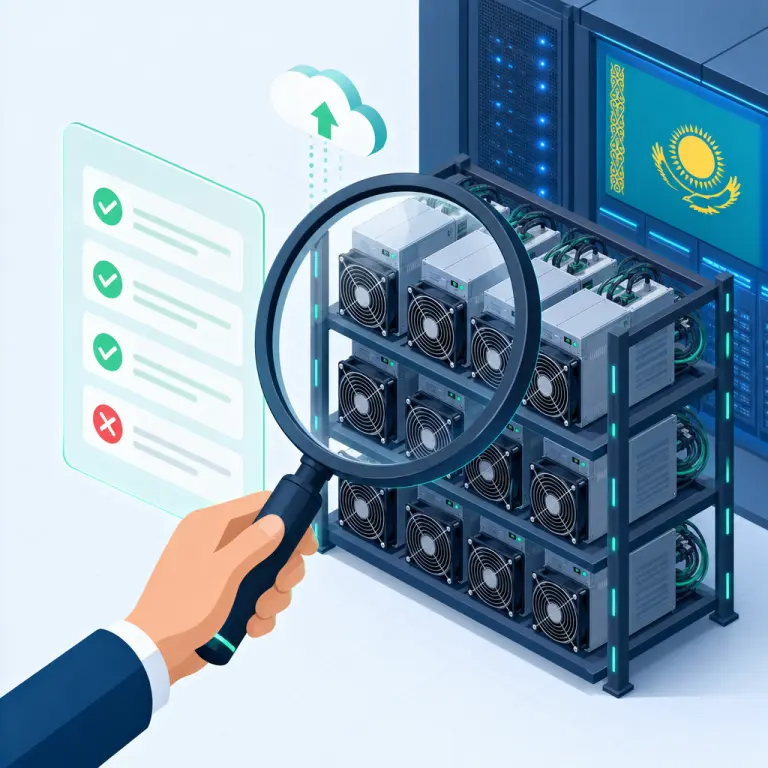
The Three Pillars of a Trustworthy Cloud Mining Platform
Every cloud mining evaluation collapses into three buckets. Each bucket has roughly four questions. Answering all twelve honestly takes about five minutes on any platform's site — and it will tell you more than a week of reading forum threads.
If a site answers every pillar clearly, you've found a candidate worth trialling. If even one pillar is hand-waved — "proprietary infrastructure", "next-gen machines", "industry-leading uptime" — keep looking.
Transparency
Can you name the country, the power source, and the exact ASIC model powering your rental? A real operator can. A paper operation answers in adjectives.
Terms
Flat USD fee, BTC-denominated payouts, a small minimum withdrawal, and a transparent withdrawal fee. Anything pegged to a fixed daily yield is a product, not a mining rental.
Safety
Two-factor authentication, email verification, recovery codes, a track record of honoured withdrawals, and balanced risk disclosures. Custodied BTC requires the same security posture as an exchange.
The 12-Point Cloud Mining Checklist
Print this. Open the platform you're evaluating in a second tab. Tick each box only if you can find the answer on the site — not if a salesperson promises it in a chat window.
Data center country & power source
Does the site name a country and region? The major hubs in 2026 are Kazakhstan, the U.S. (Texas, Georgia), Paraguay, and parts of Canada. NoxHash discloses Kazakhstan operations on industrial $0.03–0.04/kWh power. "Tier-1 global infrastructure" is not an answer.
Named hardware models
Look for actual ASIC model numbers — Antminer S21, S21 Pro, S21 XP Hyd, WhatsMiner M60S, M66S. NoxHash's fleet runs at 12–18.5 J/TH. If a platform only says "proprietary" or "next-gen", there is very likely no hardware behind it.
Live hashrate dashboard
After you rent, can you watch your TH/s tick in real time, ideally with a CGMiner terminal view? NoxHash exposes a "View Desktop" feature for each rented machine. Numbers that only update once a day are a stall tactic.
Mining pool & payout model
Reputable operators connect to public pools and use FPPS (Full Pay Per Share), which smooths payouts regardless of whether the pool finds a block that day. NoxHash uses FPPS. Payouts from an unnamed "internal algorithm" are a warning sign.
Flat USD fee, BTC-denominated payouts
The right pricing shape is: you pay a fixed monthly USD rental, the operator credits you BTC as the fleet mines. NoxHash plans run $20, $50, $100, and $250/month. Fees pegged to a daily percentage of deposit are financial products, not mining rentals.
Transparent term pricing & discounts
Longer terms should carry stated discounts — NoxHash publishes 5% at 3 months, 10% at 6, 15% at 12, 20% at 24. You should be able to price a 12-month rental without contacting support. Hidden maintenance fees that quietly scale with BTC price are a common trap.
Small withdrawal minimum & reasonable fee
The minimum should let you cash out within days, not months. NoxHash allows withdrawals from 0.00001 BTC with a 1.5% fee. Platforms that require 0.005–0.01 BTC minimums are effectively trapping small users for months before their first withdrawal attempt.
Self-custody withdrawal addresses
Can you withdraw to your own Bitcoin address — Segwit (bc1...), P2PKH (1...), or P2SH (3...)? NoxHash supports all three. Platforms that only let you "reinvest" or withdraw to an internal wallet are not giving you BTC at all.
Real two-factor authentication
TOTP via Google Authenticator or Authy, plus 8 recovery codes. NoxHash implements both and enforces email verification. Any platform that protects a custody-holding account with email + password only is leaving the vault door open.
No-deposit free trial
A real infrastructure operator can spare a small slice of hashrate for a trial — NoxHash gives a 2-day Basic Miner (50 TH/s) with no deposit required. No trial at all, or a trial that requires a $50 "activation fee", is a sign that the marketing leads the product.
Balanced risk disclosures
Does the site acknowledge BTC price risk, network difficulty risk, and halving impact? The industry has a long history of Ponzi-style schemes masquerading as mining — a platform that talks only about upside and never mentions the downside is advertising, not informing.
Responsive support & withdrawal SLA
Contact support before depositing — a polite pre-sale question tests response time and tone. Check community reports of withdrawal delays. A legit operator honours withdrawals within hours to a couple of days; scam platforms invent "verification" excuses the moment you try to cash out.
For grounding on current network conditions, cross-check the platform's earnings claims against public references like the CoinWarz Bitcoin difficulty chart and the Cambridge Bitcoin Electricity Consumption Index. If a platform's projected yield implausibly ignores both, that's your answer.
Red Flags: Four Patterns to Walk Away From
These four archetypes account for the overwhelming majority of cloud mining scams reported over the past decade. If a platform fits any of them, the checklist above stops mattering — there is nothing to due-diligence.
The "1.5% per day" platform
Any fixed daily return is structurally impossible in real mining — BTC output tracks difficulty and price, both of which move. Guaranteed daily percentages almost always describe a Ponzi, not a data center.
The no-address platform
No country named, no data center region disclosed, no legal entity filed anywhere. Even without a street address, a legitimate operator names the country and power source. "Global infrastructure" is a marketing phrase, not a location.
The no-hardware platform
Vague mentions of "proprietary ASICs" with no model names, no efficiency numbers, no J/TH. Real fleets cite Bitmain and MicroBT models because those are the only two manufacturers that matter. Stock photos of generic servers do not count.
The "you can't withdraw yet" platform
Huge minimum withdrawals (0.01+ BTC), new verification hoops appearing the moment you try to cash out, or a first withdrawal that stalls for weeks. Test withdrawals are the single fastest scam filter — if your tiny one fails, do not top up.
Run the 12-point checklist on NoxHash yourself
The fastest way to use a checklist is to apply it. NoxHash publicly discloses every item: Kazakhstan data center on $0.03–0.04/kWh industrial power, Antminer S21 and WhatsMiner M60/M66 fleet at 12–18.5 J/TH, FPPS pool payouts, 0.00001 BTC withdrawal minimum, 1.5% fee, TOTP 2FA, and a free 2-day trial. Open the account and tick the boxes.
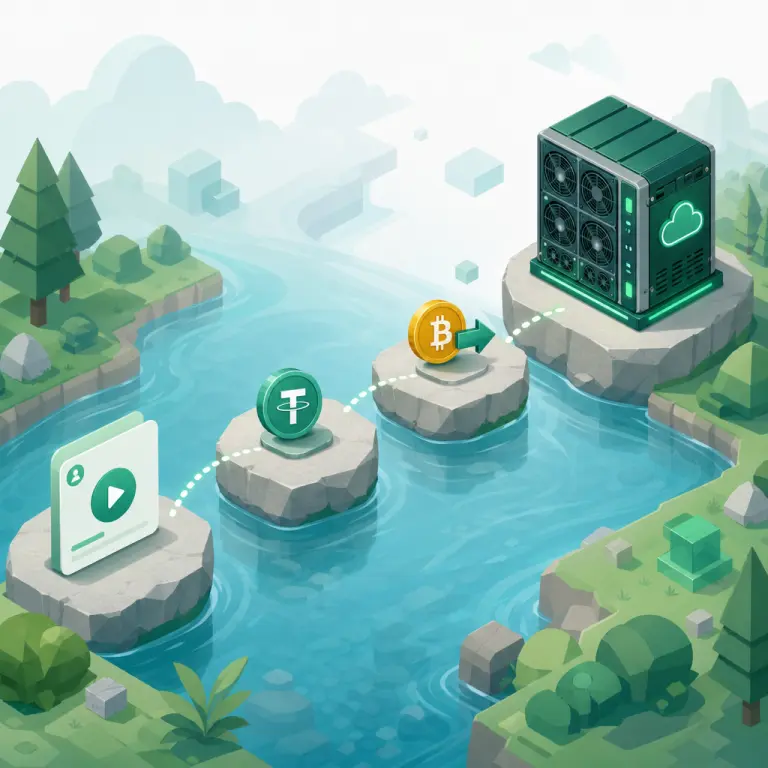
The Test-Drive Protocol: Four Steps Before You Scale
Even if a platform passes the 12-point checklist on paper, your money should not. Run the operator through four practical tests, in order. Stop at the first failure — do not talk yourself past it.
Claim the free trial
Register, enable 2FA, and activate the no-deposit trial. On NoxHash, that's a 2-day Basic Miner at 50 TH/s. Watch the hashrate tick on the dashboard. Does the CGMiner terminal show real output? Good signs at this stage: infrastructure is visible, latency looks plausible, UX is not fighting you.
Make a tiny first deposit
Once the trial convinces you the system is real, deposit the smallest rental unit — on NoxHash, a Basic Miner at $20 plus a small buffer (so ~$25 USDT on TRC-20 or BEP-20). This amount is survivable if everything goes sideways. Check that USDT lands within the quoted window (typically 10–30 minutes).
Run the small test withdrawal
After a few days of accrual, withdraw a tiny amount to your own Bitcoin wallet. On NoxHash, the minimum is 0.00001 BTC with a 1.5% fee. The only question that matters: did the BTC actually hit your wallet? If yes, you have empirical proof — not marketing proof — that the platform honours withdrawals.
Scale gradually, re-test on every upgrade
Only after a successful first withdrawal should you consider a Standard, Pro, or longer-term contract. When you scale, keep withdrawing small amounts periodically — do not park the whole balance on the platform. Self-custody remains the safest final step no matter how long you've been on an operator.
Platform Archetypes in 2026 — and How They Score
Instead of naming specific competitors, it helps to classify the cloud mining landscape into four recognisable archetypes. When you open a new site, ask which one it resembles — the classification alone tells you most of what you need to know.
| Archetype | How it presents | Checklist verdict |
|---|---|---|
| The infrastructure operator | Names country, hardware, pool, electricity rate. Publishes term pricing openly. | Passes 10–12 of 12 points |
| The hashrate marketplace | Matches buyers and miners; you rent from third parties. Transparent but variable. | Passes 7–10; needs extra scrutiny on counterparties |
| The yield app in mining clothing | Fixed daily returns, vague on hardware, recruit-your-friends marketing on top. | Fails on terms — treat as a financial product, not mining |
| The ghost platform | No location, no hardware, no team, slick landing page only. | Fails immediately — do not deposit |
In practice, the first two archetypes are where you want to shop. The infrastructure operator wins on simplicity — one counterparty, transparent terms, predictable BTC accrual. NoxHash fits this profile: named Kazakhstan facility, Antminer S21 and WhatsMiner M60/M66 fleet at 12–18.5 J/TH, published term discounts up to 20%, and a withdrawal floor low enough to test with pocket change.
Put the test-drive protocol into practice
You've seen the 12-point checklist, the red flags, and the four-step test drive. NoxHash is built for exactly this process: register, run the 2-day free trial on a 50 TH/s Basic Miner, then decide whether to deposit. Every step above maps to a button in the dashboard.
Frequently Asked Questions
What is the single most important criterion when choosing a cloud mining platform?
The ability to withdraw a small amount of real BTC to a wallet you control. Everything else — data center claims, hardware photos, uptime banners — is marketing until you have the empirical proof that your BTC leaves the platform and settles on chain. Test early, test small.
Are platforms that advertise a fixed daily return ever legitimate?
No, not as a pure mining rental. Real BTC output varies with network difficulty and price — both of which move daily. A guaranteed fixed percentage describes a financial product funded by new deposits, which is the structural definition of a Ponzi scheme. Treat it as such.
How small should a test deposit and test withdrawal be?
Small enough that losing the amount would not change your week. For most readers that's roughly $20–$25 — enough to cover the smallest available plan (for example NoxHash's Basic Miner at $20) with a small USDT buffer. Your first withdrawal can be the platform's minimum, 0.00001 BTC on NoxHash.
Does a missing street address automatically mean scam?
Not automatically — many operators keep physical security by avoiding exact coordinates. What is unacceptable is refusing to name the country, region, power source, or electricity rate. NoxHash, for example, openly discloses Kazakhstan operations on $0.03–0.04/kWh industrial power without publishing the exact coordinates.
How long should a term contract be for a first-time user?
Start with one month even if longer terms carry discounts — you are buying optionality, not yield. After one successful rental cycle and a test withdrawal, moving to a 6 or 12-month discounted term (NoxHash offers 10% and 15% off respectively) becomes a reasoned decision rather than a leap of faith.
Is 2FA really necessary for a cloud mining account?
Yes. Any account that holds BTC until you withdraw is functionally a custodial wallet. TOTP-based two-factor authentication via Google Authenticator or Authy, plus recovery codes, is the baseline. A platform that does not offer this is not taking its own security posture seriously.
What withdrawal fee is considered reasonable in 2026?
A flat percentage in the 1–2% range is normal and covers the on-chain Bitcoin network fee plus operational overhead — NoxHash charges 1.5%. Fees above 3%, or opaque "network fees" that change per withdrawal, are a sign the platform is padding margins on the way out.
Educational content — not financial advice
This checklist is for education and due diligence support. Platform parameters, network statistics, and withdrawal terms described here reflect conditions in April 2026 and can change. Cloud mining yields depend on BTC price, network difficulty, operator reliability, and your tax jurisdiction — all outside your direct control. Past results do not guarantee future performance. Only commit funds you can afford to lose, and verify local legal and tax treatment with a qualified professional before scaling any allocation.