Bitcoin vs Litecoin Mining — Profitability, Difficulty & Long-Term Value
Bitcoin (SHA-256) vs Litecoin (Scrypt) mining head-to-head — algorithm, hardware (S21 vs L7), halving schedules, and realistic 2026 profitability compared.
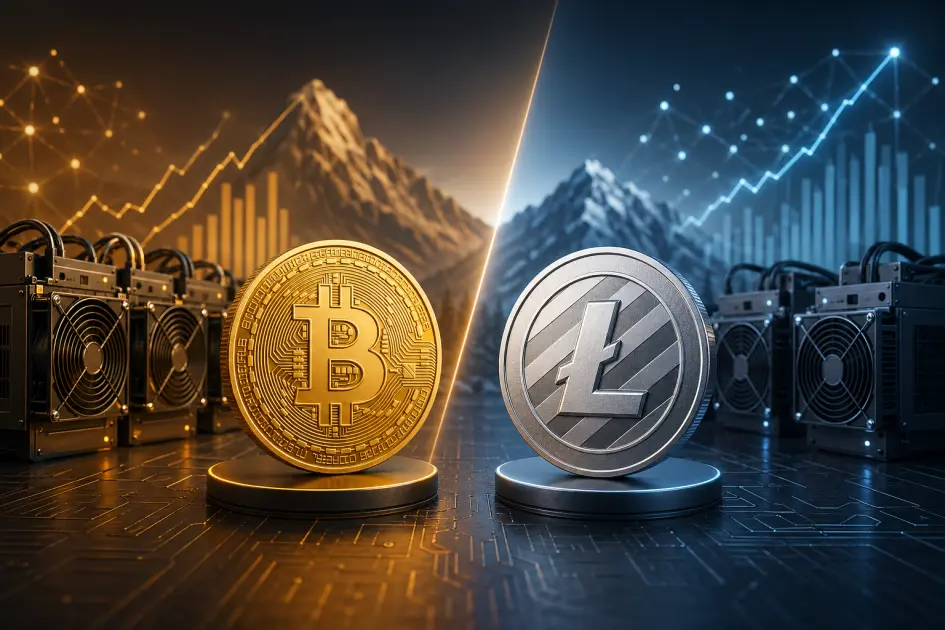
Bitcoin and Litecoin are cousins, not competitors — but their mining economics diverge sharply. Bitcoin uses SHA-256 on Antminer S21 class hardware; Litecoin uses Scrypt on the Antminer L7. Block times differ (10 min vs 2.5 min), halving schedules differ, and market caps differ by more than two orders of magnitude. In April 2026, one S21 grosses roughly $240/month mining BTC; one L7 grosses $100–160/month mining LTC (plus a DOGE merge-mining bonus). This guide compares them side by side.

Why Compare Bitcoin and Litecoin Specifically
Of the thousands of altcoins, Litecoin has the strongest claim to being Bitcoin-like. Charlie Lee, a former Google engineer, forked Bitcoin's codebase in October 2011 and pitched Litecoin as "silver to Bitcoin's gold." The design choices read like a deliberate counterweight: keep the Proof-of-Work security model, keep the fixed-cap deflationary issuance, but tune the parameters for faster, lighter transactions.
That's why a head-to-head makes sense. Almost every other "Bitcoin alternative" comparison pits BTC against a fundamentally different system — Proof-of-Stake Ethereum, memecoin Dogecoin, or privacy coin Monero. Litecoin is the only major PoW altcoin that shares Bitcoin's DNA at the protocol level but diverges on the things that matter most to a miner: the hashing algorithm, the block cadence, and the halving schedule. If you're weighing alt-PoW mining against straight Bitcoin, this is the comparison that actually decides the question.
SHA-256 vs Scrypt — Two Different Hash Functions
The headline difference is the algorithm. Bitcoin uses SHA-256, a cryptographic hash function designed by the NSA and published in 2001. It's purely computational — a good implementation is fast if you can throw enough arithmetic logic units at it, which is exactly what a SHA-256 ASIC does.
Litecoin uses Scrypt, a memory-hard hash function designed by Colin Percival in 2009. The original goal was to be ASIC-resistant by forcing each hash to read and write a large block of RAM, which GPUs and CPUs could do but custom chips supposedly couldn't. In practice, dedicated Scrypt ASICs arrived in 2014 and ended GPU profitability on LTC within a year — the "ASIC resistance" held for roughly three years before hardware engineers solved the memory bottleneck.
SHA-256 — compute-heavy
Pure arithmetic workload. Modern Bitcoin ASICs push 200–500 TH/s at 12–17.5 J/TH. Chip area is dominated by hashing cores, not memory.
Scrypt — memory-hard
Each hash reads and writes a working set of RAM. Chip area spends silicon on memory, so hashrates are measured in GH/s and MH/s — not TH/s.
Block cadence — 4x faster
Bitcoin targets a block every 10 minutes; Litecoin targets one every 2.5 minutes. Four times more blocks per day means four times more reward events — spread over a smaller coin supply.
Hardware — S21 for BTC, L7 for LTC
Because the algorithms are incompatible, the hardware is incompatible. You cannot plug an Antminer S21 into the Litecoin network, and you cannot point an Antminer L7 at Bitcoin. They are different machines running different circuits for different math.
| Spec | Antminer S21 (BTC) | Antminer L7 (LTC + DOGE) |
|---|---|---|
| Algorithm | SHA-256 | Scrypt |
| Hashrate | 200 TH/s | 9.5 GH/s |
| Power draw | 3,500 W | ~3,425 W |
| Efficiency | 17.5 J/TH | 0.36 J/MH |
| Retail price (2026) | ~$4,500–6,000 | ~$2,800–4,500 (used market) |
| Merge-mine secondary coin | No | Yes — DOGE via AuxPoW |
The L7's one real advantage is merge mining. Since 2014, Dogecoin has accepted Litecoin miners' proof-of-work through a mechanism called AuxPoW — the same hash that validates an LTC block can also validate a DOGE block if the miner opts in. L7 operators get paid in both LTC and DOGE from the same electricity bill, with no extra hardware. This is a genuine structural bonus that Bitcoin miners don't have, and it's covered in more depth in our dedicated merge-mining article.

Halving Schedules and Supply Caps
Both coins inherit Bitcoin's original scarcity model: a fixed supply cap with a block reward that halves on a schedule. The numbers are tuned differently.
| Parameter | Bitcoin | Litecoin |
|---|---|---|
| Halving interval | Every 210,000 blocks (~4 years) | Every 840,000 blocks (~4 years) |
| Current block reward | 3.125 BTC (since April 2024) | 6.25 LTC (since August 2023) |
| Next halving | ~2028 (to 1.5625 BTC) | ~2027 (to 3.125 LTC) |
| Max supply cap | 21,000,000 BTC | 84,000,000 LTC |
| Ratio | 1x (baseline) | 4x supply, 4x faster blocks, 2x reward |
Notice the symmetry: Litecoin's supply cap is exactly 4x Bitcoin's, its blocks come 4x faster, and its current reward is 2x Bitcoin's. Roughly speaking, Litecoin issues 8 times more coins per day by unit count (576 blocks × 6.25 LTC ≈ 3,600 LTC daily vs 144 × 3.125 ≈ 450 BTC). That's why each LTC trades for a tiny fraction of one BTC — the supply schedule is built into the price.
Profitability Math — April 2026 Snapshot
Profitability for both coins is a product of hashprice (network revenue per unit of hashrate) and your machine's hashrate, minus electricity. Here's how the two compare in April 2026, using rough retail-grade electricity at $0.08/kWh and industrial mining electricity at $0.04/kWh.
| Metric | S21 (BTC) | L7 (LTC + DOGE) |
|---|---|---|
| Gross revenue/month | ~$240 | ~$100–160 (LTC + DOGE) |
| Power consumed/month | ~2,520 kWh | ~2,470 kWh |
| Electricity at $0.04/kWh | ~$101 — net ~$139 | ~$99 — net ~$1–61 |
| Electricity at $0.08/kWh | ~$202 — net ~$38 | ~$198 — often net negative |
| Sensitivity to coin price | Moderate — deep liquidity | High — thinner order book |
Bitcoin wins on absolute dollars per machine in the current regime. The S21 grosses around 50–80% more than the L7 per month and is far less sensitive to a 20% swing in coin price because Bitcoin's order book is orders of magnitude deeper. In certain market windows — typically when LTC rallies harder than BTC or when DOGE has a viral month — the L7 can briefly win on dollars per watt, but these windows are narrow and unpredictable. Figures here are order-of-magnitude estimates; current numbers move with network difficulty, coin price, and transaction fees. Check Hashrate Index for live BTC hashprice before committing capital.
Skip the S21-vs-L7 hardware decision entirely
Those ~$240/month S21 figures assume someone else has already bought the machine, racked it, and pays $0.035/kWh. That someone is NoxHash — rent a slice of our SHA-256 fleet and start earning BTC today, no Scrypt sidestep required.
Long-Term Value — Liquidity, Adoption, and HODL Risk
Short-term profitability is only half the story. The other half is what happens to your mined coin after it lands in your wallet. Most miners don't sell every block; a large fraction hold for months or years, which means the coin's long-term trajectory matters as much as today's hashprice.
On that axis, Bitcoin dominates. As of 2026, Bitcoin makes up more than 99% of the total market cap among all Proof-of-Work coins, with Litecoin a distant second at a small single-digit percent of Bitcoin's capitalization (current market caps: see CoinGecko's BTC and LTC pages). Bitcoin also has something Litecoin doesn't: institutional adoption. The spot Bitcoin ETFs approved by the SEC in January 2024 now hold hundreds of billions of dollars in custody; Litecoin has no equivalent vehicle.
Bitcoin — deeper moat
Institutional ETFs, deepest order book, largest mining network by orders of magnitude. If you're a HODL-and-accumulate miner, BTC is the default pick.
Litecoin — trader's window
Thinner liquidity cuts both ways. LTC rallies can be sharper than BTC moves, giving the L7 occasional short-term yield windows — but also sharper drawdowns.
Why NoxHash Mines Bitcoin Only
Every machine at our Kazakhstan facility is SHA-256 hardware: Antminer S21, S21 Pro, S21 XP Hyd, and WhatsMiner M60/M66. Zero L7s. This is a deliberate choice, not an oversight.
Adding Scrypt mining would mean running a parallel operation — separate hardware from Bitmain, separate pool connections, separate payout accounting, separate spare parts inventory, separate firmware upgrade cycle. The economics only work at scale, and that scale would have to be carved out of the capital that's currently funding the next generation of SHA-256 efficiency gains. We'd rather run one thing well.
Users who want Litecoin exposure have a simple workaround: mine BTC with us, then convert any portion of your monthly payout to LTC on any major exchange. You get the S21's stronger dollars-per-watt, the deeper BTC market for liquidity, and whatever LTC allocation you want on top — without carrying L7 depreciation risk yourself.
Frequently Asked Questions
Can one machine mine both Bitcoin and Litecoin?
No. Bitcoin uses SHA-256 and Litecoin uses Scrypt — two fundamentally different algorithms requiring different ASIC circuits. An Antminer S21 can only mine SHA-256 coins; an Antminer L7 can only mine Scrypt coins. To mine both, you need two separate machines with two separate power budgets.
What's the Litecoin–Dogecoin merge mining bonus worth?
In April 2026, DOGE merge mining typically adds 20–40% on top of pure LTC revenue for an Antminer L7, with no additional electricity cost because the same hash validates both chains. The bonus scales with DOGE price, which is notoriously volatile — it can briefly double or halve during meme-driven market cycles.
Is Litecoin still profitable to mine in 2026?
Only with cheap electricity and modern hardware. At $0.04/kWh on an Antminer L7, LTC mining is typically marginally profitable with the DOGE merge-mining bonus doing most of the work. At retail $0.10+/kWh, the L7 often loses money mining LTC — unless LTC or DOGE is in a strong rally.
Why doesn't NoxHash offer Litecoin mining plans?
Our entire fleet is SHA-256 hardware for Bitcoin. Adding Scrypt would require a separate capital outlay for L7 units, a separate operations pipeline, and a separate payout system. We prefer depth over breadth — one fleet, one coin, one clean reliability story. Users wanting LTC exposure can convert BTC payouts on any exchange.
Is the Antminer L7 still the best Scrypt ASIC?
As of April 2026, yes — the Antminer L7 at 9.5 GH/s and 0.36 J/MH remains the efficiency leader for Scrypt. Bitmain has not released a direct successor, and competing models from Goldshell and Elphapex trail on joules per megahash. The L7 is older silicon than the S21, which reflects how quiet Scrypt hardware R&D has become compared to SHA-256.
Which coin is better for long-term holders — BTC or LTC?
Bitcoin has deeper liquidity, institutional adoption through spot ETFs since 2024, and roughly 99% of Proof-of-Work market cap. Litecoin is a second-tier asset by adoption metrics. For buy-and-hold miners, BTC is the default; LTC makes more sense for active traders who want volatility and can time entries and exits.
Get the stronger chain — keep your options open
Mine BTC with our S21 fleet at $0.035/kWh and industrial-grade uptime. Want a Litecoin slice later? Convert any portion of your monthly BTC payout on any exchange — no L7 to buy, no Scrypt rig to babysit.
Not financial advice
The profitability figures, prices, and market-cap data in this article are approximate as of April 2026 and will change as network difficulty, coin prices, and transaction fees move. Crypto mining carries market, regulatory, and technical risk. Past performance does not guarantee future results. Do your own research and only commit capital you can afford to lose.