What Are Bitcoin Transaction Fees and How Are They Determined?
Learn how Bitcoin transaction fees work in 2026 — sats/vB, mempool dynamics, fee tiers, and why miners care. Clear explainer with real data.
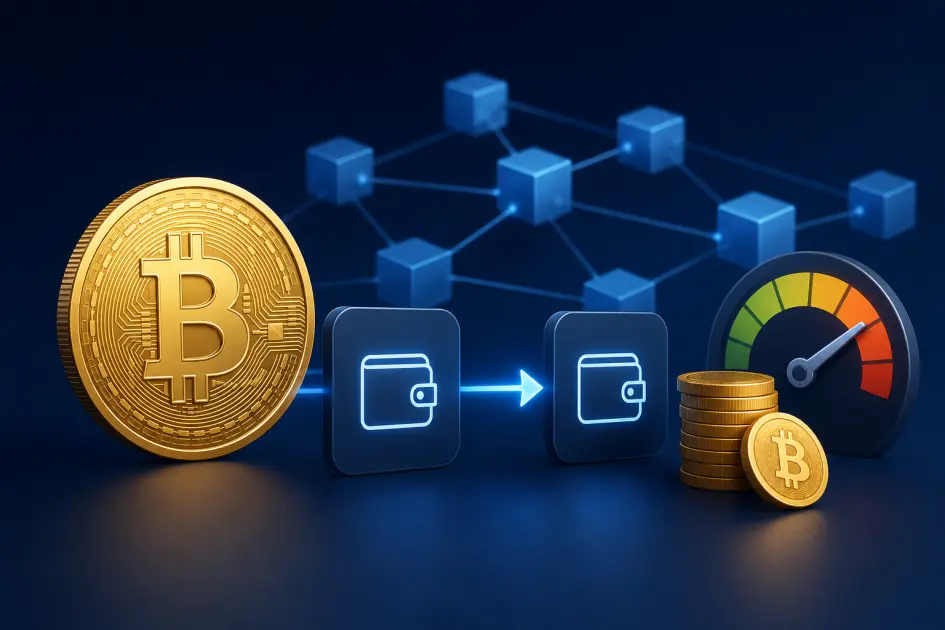
A Bitcoin transaction fee is the amount a sender pays to have their transaction included in a block — quoted in sats/vB (satoshis per virtual byte) and decided by an open fee market, not a fixed table. Miners pack each block with the highest-fee transactions from the mempool first, so what you pay depends on how crowded the queue is at the moment you broadcast. Slow day? A few cents. Congested day? Several dollars.
What a Bitcoin Transaction Fee Actually Is
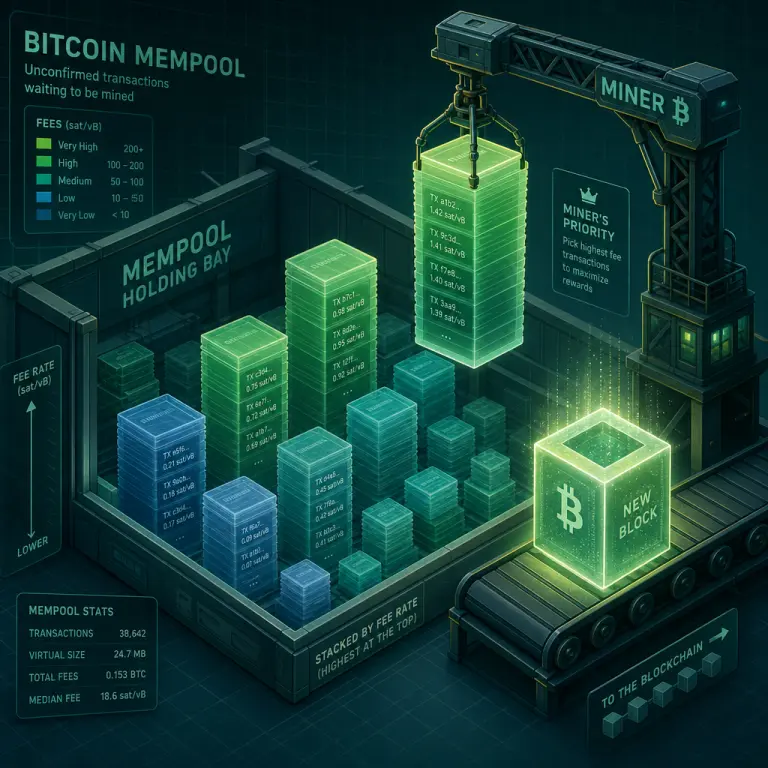
Every Bitcoin transaction consumes block space — a finite resource capped at roughly 4 million weight units per block, or about one new block every ten minutes on average. The fee is what you pay to be one of the lucky transactions that fits into the next block.
Under the hood, a transaction is a bundle of inputs (the coins you are spending), outputs (the addresses you are sending to), and signatures that prove you own those inputs. Add them together and you get a transaction weight measured in virtual bytes (vB). Multiply that weight by a fee rate and you get the total fee.
The formula is deliberately simple: fee = fee_rate (sats/vB) × tx_weight (vB). A typical Segwit send is around 140 vB, so a fee rate of 10 sats/vB produces a ~1,400-sat fee. At a $70,000 BTC price that's about $0.98. At 100 sats/vB during congestion that same send costs ~$9.80. The transaction is identical; the auction is different.
How the Fee Is Chosen — Three Moving Parts
Three quantities drive every fee on the network. Understanding each of them is the difference between overpaying by 10x and sending for the cheapest viable rate.
Fee rate (sats/vB)
The price you bid per virtual byte of block space. Higher rate = earlier confirmation. This is the only number you actually choose when you hit "send".
Transaction weight (vB)
How much block space the transaction takes. More inputs means more signatures means more bytes. Consolidating many UTXOs is structurally more expensive than a simple two-input send.
Mempool state
The global queue of unconfirmed transactions. When the backlog is deep, you must outbid what's already waiting — which is why the same transaction can cost cents one week and dollars the next.
The mempool is where the auction runs. Each node keeps its own copy, but they converge quickly. Miners scan the mempool, sort by fee rate (not total fee), and fill the next block top-down until the 4-million-weight-unit limit is hit. Everything else waits for the next block — or gets evicted if something higher-paying arrives.
Typical Fee Ranges in 2026 — What You'll Actually Pay
There is no single "Bitcoin fee." There is a distribution that shifts with demand. Below are representative tiers you'll see on fee trackers like mempool.space's block fee-rate chart across the congestion levels the network cycles through. Numbers reflect conditions observed in April 2026.
| Mempool state | Economic (next day) | Standard (~30 min) | Priority (next block) |
|---|---|---|---|
| Quiet — empty mempool | 1 sat/vB | 1–2 sats/vB | 2–3 sats/vB |
| Normal — blocks near full | 3–5 sats/vB | 8–15 sats/vB | 15–25 sats/vB |
| Busy — backlog growing | 20–40 sats/vB | 50–80 sats/vB | 80–150 sats/vB |
| Peak — major congestion event | 100+ sats/vB | 200+ sats/vB | 300–500+ sats/vB |
For most of April 2026 the median fee sat at around 1 sat/vB, with blocks near 94% capacity but the backlog not growing faster than it cleared. That's the quiet end of the distribution. Contrast that with the Ordinals inscription boom of 2023 or the Runes launch of mid-2024, when priority rates briefly exceeded 500 sats/vB — and a simple send could cost $30–$50. These spikes are the exception, but they do recur whenever new on-chain use cases flood the mempool.
Stack BTC while someone else watches the mempool
Cloud mining accrues BTC continuously — so you can hold off on the network fee until the mempool quiets down. NoxHash pays out every minute, and a 2-day Basic Miner trial lets you see it live with no deposit.
Why Fees Matter for Miners — Today and in 2140
A Bitcoin miner who finds a block earns two things: the fixed block subsidy (currently 3.125 BTC after the April 2024 halving) and the sum of all transaction fees inside that block. The subsidy gets cut in half every 210,000 blocks — roughly every four years — and will eventually stop.
In April 2026, fees typically make up somewhere between 1% and 5% of total block reward. A quiet day can push that under 1%; a congested day can push it above 20%. But the long-run trend is clear: the subsidy keeps halving and fees become a larger share of the pie every four years.
| Era | Block subsidy | Fees' share of miner revenue |
|---|---|---|
| 2013–2016 | 25 BTC | < 1% typical |
| 2020–2024 | 6.25 BTC | 1–8% typical, up to 20%+ at peak |
| 2024–2028 (current) | 3.125 BTC | 1–5% typical in 2026 |
| Post-2140 (projected) | 0 BTC | ~100% of revenue |
For an industrial operator running Antminer S21 and WhatsMiner M66S units — the kind of fleet NoxHash runs in Kazakhstan on $0.035/kWh power — this is a structural consideration, not a future one. Fee spikes during congestion events can swing a block's total reward 20% higher, and every halving shifts the long-term revenue mix a little further toward transaction fees.
What Cloud Mining Users Should Know About Network Fees
If you're renting hashrate on a platform like NoxHash, the block-level economics above happen at the operator level — you don't bid fees to get your share. Where fees do touch your wallet is the moment you move BTC off the platform into self-custody.
On NoxHash, a withdrawal carries a fixed 1.5% platform fee on the amount withdrawn. On top of that sits the Bitcoin network fee required to confirm the on-chain transaction at the time of broadcast. The platform fee is predictable; the network fee is market-driven and can vary 50x between a quiet week and a peak congestion event.
Batch your withdrawals
Withdrawing 0.01 BTC once is far cheaper in network-fee terms than withdrawing 0.001 BTC ten times. The on-chain weight is nearly identical, but you pay ten times the fixed network cost.
Watch the mempool before you request
Open mempool.space or Blockchain.info before clicking withdraw. If the "next block" rate sits at 2 sats/vB, you're at a cheap moment. If it's above 100, hold off a day or two unless you need the BTC immediately.
Use Segwit addresses when you can
Segwit (bc1…) and native P2WPKH addresses occupy fewer virtual bytes than legacy 1… addresses. Same send, lower weight, lower fee. NoxHash supports Segwit, P2PKH, and P2SH — pick Segwit if your wallet generates one.
Weekends and low-hour windows
On-chain demand is not uniform. Late US evenings and weekends often see the mempool drain. If your withdrawal is not time-sensitive, waiting a few hours can turn a $5 network fee into a $0.20 one.
Let the hashrate run while you watch the mempool
NoxHash credits BTC every minute and lets you withdraw from 0.00001 BTC whenever network fees make sense for your size. Open an account and check the dashboard — no deposit required for the 2-day trial.
Frequently Asked Questions
What does sats/vB actually mean?
Sats/vB means satoshis per virtual byte — the price you bid per unit of block space. A sat is 0.00000001 BTC, and a virtual byte is a unit of transaction weight. Miners rank every mempool transaction by this number and fill the next block from the top down.
Why can a $5 send cost the same as a $5,000 send?
Fees are priced by block-space usage, not by the BTC value you send. A simple send of any amount occupies roughly the same virtual bytes, so the on-chain fee is the same in sats. This is why Bitcoin is cheap for large transfers and relatively expensive for tiny ones.
Can I send a Bitcoin transaction with zero fee?
Technically yes, but most nodes won't relay a zero-fee transaction and no rational miner will include one when paying alternatives exist. The practical floor is about 1 sat/vB — the default minrelayfee most nodes enforce. Below that your transaction likely never reaches a miner.
My transaction is stuck. What happened?
Your fee rate was below the current mempool minimum. The transaction is sitting in queue waiting for blocks to clear. Options: wait for the mempool to drain, use Replace-By-Fee to rebroadcast at a higher rate, or use Child-Pays-For-Parent by spending the unconfirmed output at a higher fee.
Do Bitcoin miners earn only the block subsidy?
No — miners earn the subsidy plus all transaction fees in the block they mine. Fees are roughly 1–5% of revenue today, but grow with every halving. After the last subsidy around the year 2140, transaction fees will be 100% of miner income — which is why fee market health matters for long-term network security.
How do I check the current Bitcoin fee rate?
Visit mempool.space or blockchain.info and look at the next-block, 30-minute, and next-day fee tiers. Most wallets pull the same data automatically and offer Economic, Standard, and Priority presets. If you're not in a rush, Economic is almost always a smart default.
Educational content — not financial advice
This article is for educational purposes only and does not constitute financial, legal, or tax advice. Bitcoin transaction-fee levels, mempool dynamics, and miner revenue figures reflect observed conditions in April 2026 and will change. Cloud mining and any crypto activity carry market, regulatory, and technical risks — only commit funds you can afford to lose, and consult a qualified professional for decisions specific to your situation.