Is Bitcoin Mining Still Profitable After the 2024 Halving?
Two years after the 2024 halving: hashrate at 1 ZH/s, hashprice at $33, and why efficient industrial miners still profit while home rigs quietly shut down.

Yes — Bitcoin mining is still profitable two years after the April 2024 halving, but only for operators with modern hardware and cheap industrial power. The feared hashrate collapse never came: the network now runs at roughly 1 ZH/s, about 30% higher than pre-halving. What did collapse were margins for home miners and older-generation fleets. The industrial tier is still compounding BTC.
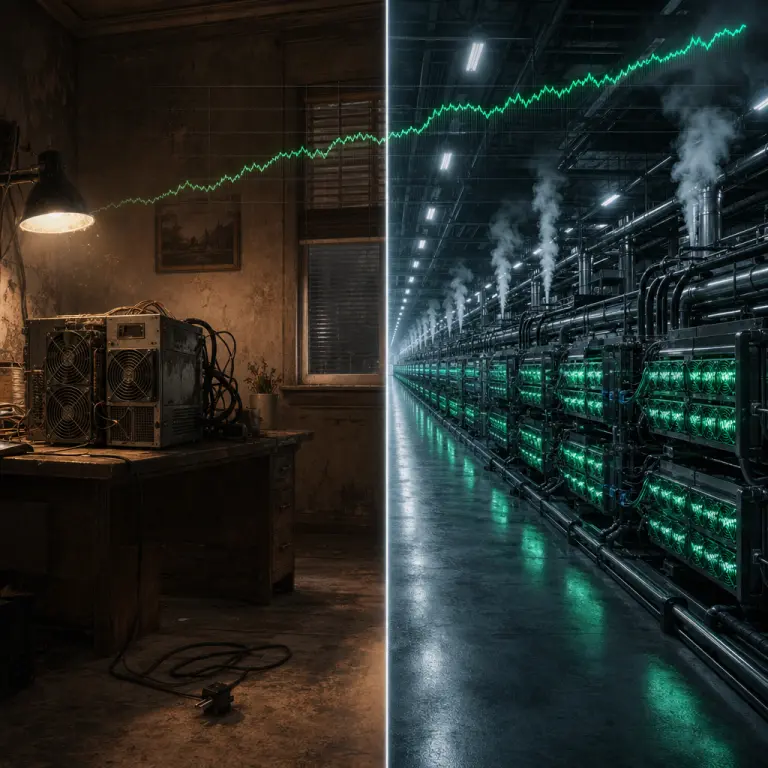
The Question Everyone Asked in April 2024
When the block reward dropped from 6.25 BTC to 3.125 BTC on April 20, 2024, the mainstream narrative was blunt: Bitcoin mining is dying. Half the revenue overnight, no change in electricity bills, and a wave of headlines predicting a death spiral as miners capitulated and hashrate collapsed.
Two years later, that story has aged badly. The network did not spiral. Hashrate did not collapse. But the industry that emerged from the squeeze does not look like the one that went in. Some operators got richer. Others quietly powered down their rigs and sold them for scrap. Whether you can still mine profitably in April 2026 depends almost entirely on which side of that split you land on.
This article walks through what actually happened since the halving, what the numbers look like today, and where the profit line sits for each tier of miner — from industrial-scale public companies down to someone plugging an S19 into a garage outlet.
What Actually Happened 2024–2026
The doom forecasts assumed a static industry — same machines, same power costs, same BTC price. Reality did the opposite of static. Here are the four trends that actually played out between the halving and today.
Hashrate went up, not down
Network hashrate sits near 1.004 ZH/s in April 2026, roughly 30% higher than the ~770 EH/s level on halving day. New-generation ASIC deployments more than replaced the older rigs that switched off.
Difficulty followed hashrate
Difficulty now sits around 135.6 T, also at all-time highs. Each TH/s on the network competes with more rival hash than ever, which means every miner earns a smaller slice of the same 3.125 BTC block reward.
Margins compressed, hard
Hashprice — the daily USD revenue per PH/s — recently traded near $33 after a Q1 2026 dip to ~$28. That is far below the $60–80 range miners enjoyed in 2023, and right at the pain threshold for anything older than an S21.
Survivors got stronger
Operators with sub-$0.05/kWh power and latest-generation fleets (S21 Pro, S21 XP Hyd, M66S) kept producing BTC at an all-in cost well below market, while inefficient S17/S19 machines were pulled offline across the network.
Numbers above are sourced from the CoinWarz Bitcoin hashrate and difficulty chart and the public Q1 2026 hashprice reporting on the Hashrate Index hashprice page. Both are live feeds — the exact daily readings will have drifted slightly by the time you read this.
Pre-Halving (2023) vs Post-Halving (April 2026)
The cleanest way to see what changed is to line up the same operating variables two years apart. Same network, same SHA-256 algorithm, very different economics.
| Metric | Mid-2023 (pre-halving) | April 2026 (post-halving) |
|---|---|---|
| Block reward | 6.25 BTC | 3.125 BTC |
| Network hashrate | ~400 EH/s | ~1,004 EH/s (1 ZH/s) |
| Network difficulty | ~55 T | ~135.6 T |
| Hashprice (USD/PH/s/day) | ~$70–80 | ~$33 |
| Dominant efficient fleet | Antminer S19 / S19 XP (~21–30 J/TH) | Antminer S21 / S21 Pro / S21 XP Hyd (12–17.5 J/TH) |
| Breakeven power cost | ~$0.08/kWh on S19-class fleets | ~$0.05/kWh on S21-class fleets |
Two things jump out. First, hashprice collapsed by more than half while difficulty more than doubled — a brutal squeeze on gross revenue per TH. Second, the breakeven power cost tightened from roughly $0.08/kWh to around $0.05/kWh. That shift alone is what killed most home and mid-tier operations: residential electricity in North America, Europe, and most of Asia sits above that line.
Profitability Tiers in April 2026
Mining is no longer one market. Depending on scale, hardware, and power cost, a miner sits in one of three tiers — and the gap between them is wider than ever.
Industrial tier — Profitable
Power at $0.03–0.05/kWh, S21/S21 Pro/S21 XP Hyd fleets. All-in cost per BTC well below market price. Healthy margins even at $33 hashprice. This is where NoxHash's Kazakhstan fleet operates.
Mid tier — Break-even to marginal
Power at $0.06–0.09/kWh, mixed S19 XP / early S21 fleets. Cash-profitable some months, underwater others. Roughly 15–20% of the network currently sits in this zone, highly sensitive to BTC price swings.
Home tier — Mostly unprofitable
Residential electricity $0.12–0.20/kWh, older S17/S19/M30 machines. Cash negative at current hashprice. Most home miners in this bucket either shut down in 2024–2025 or run at a loss for ideological reasons.
The honest takeaway for a would-be home miner reading this in 2026: unless you have negative-cost power (surplus solar, flared gas, heat-reuse in a cold climate), running an S21 in a residential setting is very likely a net USD loss this year. That is not a NoxHash marketing line — it is just the hashprice math at $0.12/kWh. Cloud mining exists precisely to bridge that gap: it lets individuals rent capacity from the only tier where the numbers still work.
Rent the tier that still makes money
You have just seen the numbers: only industrial operators with sub-$0.05/kWh power and S21-class hardware still clear a margin post-halving. NoxHash runs that exact setup in Kazakhstan — $0.035/kWh, 12–17.5 J/TH fleet — and rents slices of it from $20/month. Skip the home-rig losing trade.
What Kept Mining Profitable Despite the Reward Cut
A straight halving-of-revenue should have halved miner income. It did not, and the three forces that softened the blow are worth understanding because they determine whether the industrial tier stays profitable into the 2028 cycle.
Transaction fee spikes from Ordinals, Runes, and BRC-20 activity. In the months immediately after the halving, fee revenue periodically pushed past 20% of total miner income — occasionally above 50% during inscription-driven congestion spikes. That fee layer did not fully compensate for the subsidy cut, but on the busiest days it came close. It is also a structural hint at the post-2140 fee-only future Satoshi designed.
Bitcoin price recovery through 2024–2025. BTC climbed from the ~$64k halving-day level through a multi-quarter rally that pushed hashprice back into a workable range even as difficulty marched up. Early 2026 saw a drawdown (hashprice touched $28 and miner profitability briefly crashed to post-halving lows), but the recovery to ~$33 has kept efficient fleets above water.
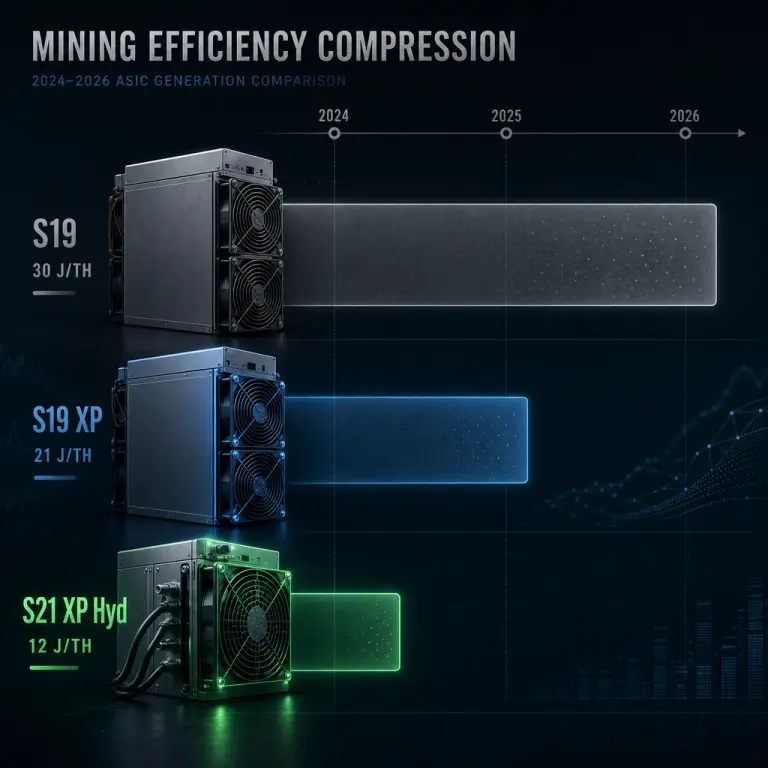
Fleet efficiency gains from ~30 J/TH to ~12 J/TH. The single biggest lifeline. An S19 Pro at 30 J/TH burns 2.5× the electricity per TH of an S21 XP Hyd at 12 J/TH. Every operator who upgraded to current-gen hardware during 2024–2025 effectively got a ~60% power cost reduction per unit of hashrate — enough to offset most of the halving haircut on its own.
Public Miner Performance — Narrow Margins, Still Profitable
The NASDAQ-listed miners are the most transparent window into post-halving economics because they publish their all-in cost per BTC. Their Q1 2026 filings tell a consistent story: margins compressed sharply, but the efficient operators did not lose money.
CleanSpark reported an industry-leading fleet efficiency near 16 W/T (16 J/TH) across roughly 50 EH/s of installed capacity. Electricity cost per BTC rose to about $52,463 in Q1 2026 (up from $44,679 a quarter earlier as difficulty climbed), with tight SG&A discipline keeping operations cash-profitable against a BTC price above $70k.
Riot Platforms guided toward 45 EH/s capacity for Q1 2026, up from 40 EH/s at end of 2025, with continued reinvestment into both mining and data center infrastructure. Marathon Digital (MARA) remains the largest public miner by hashrate, though like peers it has faced pressure from the narrower per-TH economics.
The aggregate signal from Q1 2026 reporting: at ~$70k BTC and ~$33 hashprice, roughly 15–20% of the global network sits near or below break-even, while miners with sub-$0.04/kWh power and current-generation ASICs are still producing BTC at an all-in cost of roughly $34,000–$43,000 per coin. That spread — cost near $40k, market above $70k — is the margin that kept the survivors profitable.
Outlook to the 2028 Halving
The next halving, estimated around April 2028 at block height 1,050,000, will drop the block reward from 3.125 BTC to 1.5625 BTC. The structural question for today's miners is whether the 2024–2026 playbook still works when revenue halves again.
Tailwind: efficiency keeps improving
Next-gen ASICs targeting sub-10 J/TH are already being sampled. Another ~40% efficiency gain by 2028 would roughly replicate the cushion the S21 generation provided into the 2024 halving.
Tailwind: fee revenue share growing
Every halving mechanically pushes fees up as a share of miner revenue. Any sustained blockspace demand between now and 2028 compounds that effect and partly offsets the subsidy cut.
Headwind: difficulty keeps climbing
Hashrate is unlikely to stop rising. If network difficulty doubles again by 2028, the industrial tier needs BTC price to roughly double as well just to stand still in USD terms.
Headwind: price path is not guaranteed
Three for three post-halving rallies is a pattern, not a law. A weak BTC tape into 2028 would force another round of mid-tier capitulation. Plan for the possibility.
The base case most industrial operators are sizing for is continued efficiency gains plus a modestly rising BTC price — enough to keep current-gen fleets profitable across the 2028 event even at lower subsidy. It is not a certainty. It is just the reasonable default.
Test the post-halving math on a live miner
The S21-class fleet that survived the 2024 halving is the same one running NoxHash's Kazakhstan data center today. Spin up a 2-day Basic Miner trial (50 TH/s, no deposit) and watch the BTC accrual line up with the hashprice numbers in this article before you commit any capital.
Frequently Asked Questions
Is Bitcoin mining still profitable in April 2026?
Yes, but only for efficient operators. Industrial miners with sub-$0.05/kWh power and S21-class hardware still clear healthy margins at a ~$33 hashprice. Home miners on residential electricity above $0.12/kWh are mostly cash-negative. The gap between the two tiers has widened significantly since the halving.
Why did Bitcoin hashrate go up after the halving instead of down?
Efficiency gains outpaced the reward cut. Next-gen S21 and M60/M66 hardware at 12–18 J/TH roughly halved the energy cost per TH versus S19-era rigs, so operators deployed more hashrate per watt available. Older rigs went offline, but the new ones more than replaced them, lifting network hashrate to ~1 ZH/s.
Can I still mine Bitcoin profitably at home in 2026?
Usually not, at residential electricity prices. Breakeven currently sits near $0.05/kWh on an S21-class fleet. Home miners paying $0.12–0.20/kWh on older hardware are typically cash-negative. Exceptions exist for heat-reuse setups, surplus solar, or subsidised industrial rates — but those are edge cases, not the norm.
What is hashprice and why does it matter?
Hashprice is the daily USD revenue generated by one PH/s of hashrate. It bundles BTC price, network difficulty, block subsidy, and transaction fees into one number. In April 2026 hashprice sits near $33, down from ~$70–80 pre-halving. Multiply hashprice by your hashrate to size monthly gross revenue.
How do public miners like Marathon and CleanSpark stay profitable?
Scale, cheap power, and modern fleets. CleanSpark runs near 16 J/TH efficiency at ~50 EH/s. Riot is guiding 45 EH/s with sub-$0.04/kWh power contracts. At ~$70k BTC and $33 hashprice, their all-in cost per BTC sits around $34,000–$43,000 — narrow margins versus 2023, but still profitable.
Will mining be profitable after the 2028 halving too?
Probably for the efficient industrial tier, less so for everyone else. The 2028 halving will drop the reward to 1.5625 BTC. A combination of sub-10 J/TH hardware, rising fee revenue, and continued BTC price appreciation is what operators are sizing for — but none of those three are guaranteed, and a weak BTC tape would force another shakeout.
Is cloud mining a reasonable alternative for individual miners?
It is the practical way for individuals to access industrial-tier economics they cannot replicate at home — $0.035/kWh power, S21-class hardware, 24/7 operations. The trade-off is operator counterparty risk: you depend on the platform staying solvent and honest. Start small, verify payouts, then scale — do not bet a position you cannot afford to lose.
Educational content — not financial advice
All numbers in this article — hashrate, difficulty, hashprice, efficiency figures, public miner cost-per-BTC — are based on publicly reported data as of April 2026 and will have drifted by the time you read this. Historical post-halving patterns are not a forecast of future performance. Bitcoin mining returns depend on BTC price, network difficulty, transaction fee revenue, hardware efficiency, and electricity cost — all outside your direct control. Cloud mining adds operator counterparty risk on top. Only commit capital you can afford to lose, verify local tax and legal treatment with a qualified professional, and do not size any single contract as a make-or-break position.