Bitcoin Mining Glossary — 50+ Terms Every Miner Must Know
A plain-English Bitcoin mining glossary with 50+ terms — hashrate, ASIC, FPPS, halving, stratum and more — grouped into eight quick-lookup categories.

Bitcoin mining has its own vocabulary — and skipping it is how new miners lose money. This glossary defines 50+ terms you will run into on pool dashboards, ASIC spec sheets, halving threads, and cloud mining contracts, grouped into eight quick-lookup categories. Every definition is one or two plain-English sentences, with units and concrete examples where it matters.
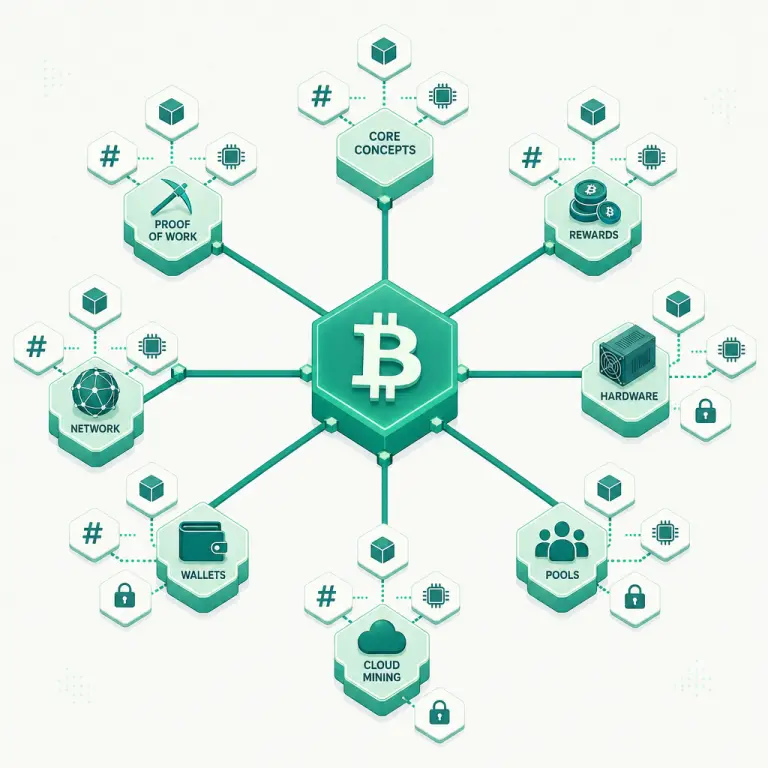
How to Use This Glossary
Scan the eight category headings below to jump to the area you are confused about. Every term follows the same pattern — a bold name, a one-to-two-sentence definition, and a concrete unit or example — so you can skim fast without losing meaning. Where a term depends on another (e.g. difficulty leaning on hashrate), the linked concept is bolded so you can cross-reference.
1. Core Concepts
The foundation. If a term farther down the glossary feels hazy, the cause is almost always a shaky grasp of one of these six.
Bitcoin (BTC)
Bitcoin is a decentralized digital currency secured by proof-of-work mining, launched in January 2009 by the pseudonymous Satoshi Nakamoto. Ticker symbol: BTC. Maximum supply: 21 million coins.
Blockchain
A blockchain is a chronological, append-only ledger of transactions grouped into blocks that each reference the previous block's hash. Bitcoin's chain has been continuously extended since block 0 in 2009.
Block
A block is a batch of validated Bitcoin transactions plus a header, produced roughly every 10 minutes. Bitcoin blocks have a ~1 MB base size (up to ~4 MB weight with SegWit).
Node
A node is any computer running Bitcoin software that stores and relays the blockchain. Full nodes independently verify every rule; miners are a subset of nodes that also produce blocks.
Transaction
A transaction is a signed instruction that moves BTC from one or more inputs to one or more outputs. Each transaction has a unique ID (txid) and pays a fee to the miner who includes it.
Mempool
The mempool is the waiting room of unconfirmed transactions held in each node's memory. Miners pick from the mempool — typically highest-fee first — when assembling the next candidate block.
Satoshi (sat)
A satoshi is the smallest unit of Bitcoin, equal to 0.00000001 BTC (1/100,000,000). Mining rewards and cloud mining payouts are often measured in sats at the per-minute level.
Confirmation
A confirmation is a block mined on top of the one containing your transaction. Most services treat 1–3 confirmations as safe for small amounts and 6 as final for large amounts.
2. Proof-of-Work Terms
The cryptographic machinery that turns electricity into consensus. Every number on a pool dashboard eventually traces back to one of these seven terms.
Hash
A hash is a fixed-length digital fingerprint produced by a one-way cryptographic function. Bitcoin hashes are 256 bits long (64 hex characters) and cannot be reversed to recover the input.
Hashrate
Hashrate is the speed at which a miner attempts hashes, measured in hashes per second. A modern ASIC does ~200 trillion hashes/second (200 TH/s); the global network exceeds 1 ZH/s.
SHA-256
SHA-256 is the cryptographic hash function Bitcoin uses for its proof-of-work. Miners apply it twice to each candidate block header — the same algorithm also secures Bitcoin Cash and Bitcoin SV.
Nonce
A nonce is the 32-bit field in a block header that miners increment while hashing. Each new nonce value produces a new hash; the goal is to find one below the current target.
Target
The target is the 256-bit number that a valid block hash must be below. A lower target means fewer acceptable hashes, which directly raises network difficulty.
Difficulty
Difficulty is a dimensionless number expressing how hard it is to find a valid block, relative to the easiest target. Bitcoin difficulty in April 2026 sits around 135 T — roughly 20× its 2021 level.
Proof-of-Work (PoW)
Proof-of-work is the consensus rule requiring miners to spend real energy to produce valid blocks. It is what makes rewriting Bitcoin history economically prohibitive.
Difficulty Adjustment
Difficulty adjustment is the automatic recalibration of the target every 2,016 blocks (~two weeks). The goal is to keep average block time at ~10 minutes regardless of how much hashrate joins or leaves.
3. Rewards & Economics
Where hashing translates into money. These terms govern how many sats land in your account each day.
Block Reward
The block reward is the total BTC a miner earns for a valid block — currently 3.125 BTC subsidy plus any transaction fees from the block's transactions.
Coinbase (Transaction)
A coinbase transaction is the first transaction in every block, which creates new BTC and pays the miner. Not to be confused with the US exchange of the same name.
Halving
The halving is the scheduled 50% cut to the block subsidy every 210,000 blocks (~4 years). April 2024's halving dropped it from 6.25 to 3.125 BTC; the next is expected around 2028.
Transaction Fee
A transaction fee is the BTC users pay to have their transaction included in a block, usually quoted in satoshis per virtual byte (sat/vB). Fees go entirely to the miner.
Hashprice
Hashprice is the revenue a miner earns per unit of hashrate per day, quoted in USD per TH/s per day. In April 2026 it sits around $0.04–0.06/TH/day — the single most useful metric for estimating returns.
ROI (Return on Investment)
ROI is the percentage gain (or loss) on mining capital over a given period. For cloud mining, it is typically measured as BTC value mined ÷ monthly rental fee.
4. Hardware & Units
Spec sheets, wattage stickers, and pool dashboards are flooded with these acronyms. Know them and the rest stops looking like alphabet soup.
ASIC
An ASIC is an Application-Specific Integrated Circuit — a chip engineered to do one job. A Bitcoin ASIC is 10,000–100,000× more efficient than a GPU at SHA-256 hashing.
GPU
A GPU is a graphics processing unit, historically used for mining before ASICs. GPUs are no longer competitive for Bitcoin but still mine altcoins with ASIC-resistant algorithms.
TH/s, PH/s, EH/s, ZH/s
These are hashrate units: 1 TH/s = 10¹² h/s, 1 PH/s = 10¹⁵, 1 EH/s = 10¹⁸, 1 ZH/s = 10²¹. A single ASIC does 200 TH/s; Bitcoin's network exceeds 1 ZH/s.
J/TH (Efficiency)
J/TH is joules of energy per terahash — the headline efficiency number. Lower is better: 2021's S19 Pro ran at 30 J/TH, while 2025's S21 XP Hyd reaches 12 J/TH.
W (Watts) & kWh
A watt is one joule per second — power draw. A kilowatt-hour (kWh) is 1,000 W used for one hour, the unit your electricity bill is measured in. An S21 at 3,500 W uses ~2,520 kWh/month.
Antminer
Antminer is Bitmain's flagship line of Bitcoin ASICs. The S21 series (S21, S21 Pro, S21 XP Hyd) is the current generation, delivering 200–473 TH/s at 12–17.5 J/TH.
WhatsMiner
WhatsMiner is MicroBT's Bitcoin ASIC line, Bitmain's main rival. The M60S and M66S deliver 186–298 TH/s at 17–18.5 J/TH — popular for diversifying fleet supply.
Hydro-Cooled Miner
A hydro-cooled miner is an ASIC that uses liquid coolant instead of air to remove heat. It packs more hashrate into less space — e.g. the S21 XP Hyd at 473 TH/s in a single 5.7 kW unit.
5. Mining Operations & Pools
How individual miners actually earn BTC in practice. Nearly every modern miner routes through a pool; the acronyms below explain how the pool splits the pie.
Solo Mining
Solo mining is attempting to find a full block yourself, keeping 100% of the reward if you succeed. At current difficulty, a single S21 expects to find a block roughly once every 300+ years.
Mining Pool
A mining pool is a coordinator that combines hashrate from many miners, splits block rewards proportionally, and smooths each member's income. Pool fees are typically 1–2%.
Share
A share is a proof that a miner is actually hashing — a hash that meets the pool's easier share-target (but usually not the full network target). Shares measure each miner's contribution.
Stratum
Stratum is the TCP-based protocol miners use to receive jobs from and submit shares to a pool. Stratum V2 (emerging) gives miners more control over block templates than V1.
PPS (Pay Per Share)
PPS is a payout model where the pool pays a fixed rate for every valid share, even if the pool finds no block. Predictable income for the miner; the pool eats the variance and charges a higher fee.
PPLNS
PPLNS is Pay Per Last N Shares — rewards only get paid when the pool finds a block, distributed across the last N shares. Higher variance for the miner but typically cheaper pool fees.
FPPS
FPPS is Full Pay Per Share — PPS plus the pool's estimated share of transaction fees. This is the dominant model for large pools today because it gives miners steady income including fee revenue.
Orphan / Stale Block
An orphan block is a valid block that loses the race because another miner's block propagates first and gets built upon. The orphan's reward is forfeited, which is why fast pool connectivity matters.
Try these terms on a live miner
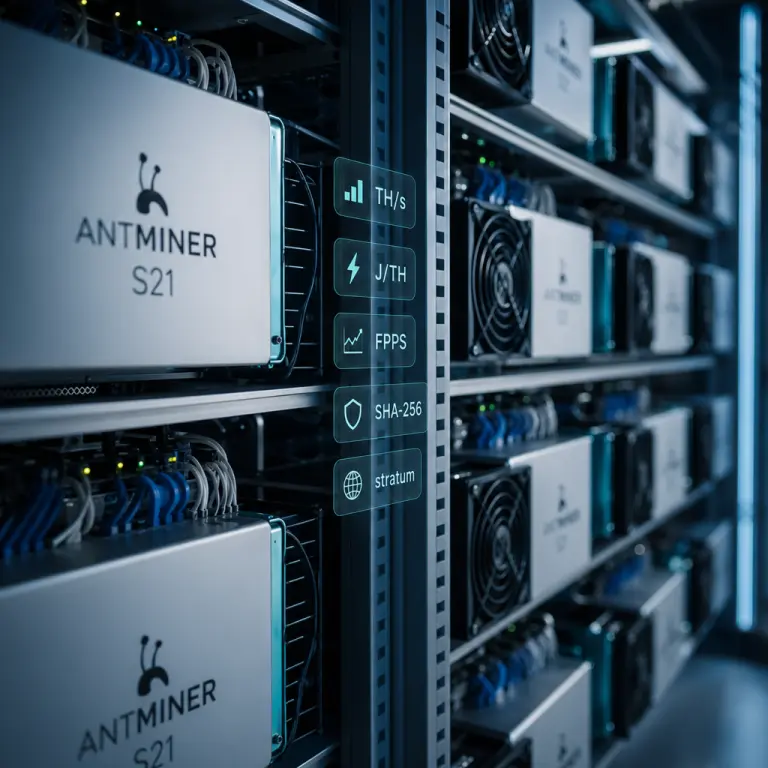
Reading definitions is half the work. A 2-day NoxHash free trial puts 50 TH/s on an Antminer S21 into an FPPS pool and streams the CGMiner terminal to your browser — so you can watch shares, hashrate, and BTC accrual with your own eyes, no deposit required.
6. Cloud Mining Terms
The vocabulary specific to renting hashrate instead of owning hardware. These six clarify what you are actually buying when you sign a cloud mining contract.
Cloud Mining
Cloud mining is a service where an operator runs ASICs in a data center and rents hashrate to users on a contract. You pay a fixed fee in USD and receive the BTC earned by your rented share.
Hashrate Rental
Hashrate rental is the underlying mechanic of cloud mining — you rent TH/s for a fixed term. On NoxHash, tiers range from Basic (50 TH/s) to Enterprise (1,000 TH/s).
Cloud Mining Contract
A cloud mining contract is the agreement defining your rented hashrate, term length (1 / 3 / 6 / 12 / 24 months), monthly fee, and payout rules. Longer terms usually carry 5–20% discounts.
Data Center
A data center is the industrial facility housing ASIC miners, power distribution, cooling, and networking. NoxHash operates in Kazakhstan at ~$0.035/kWh with natural-air cooling.
Uptime
Uptime is the percentage of time a miner is online and hashing, typically quoted as a 99.9% target by reputable operators. Every hour of downtime is lost BTC.
Mining Farm
A mining farm is a large-scale deployment of ASIC miners in one facility, usually megawatt-scale. The terms "mining farm" and "mining data center" are often used interchangeably.
Hosted Mining
Hosted mining is a close cousin of cloud mining where you own the ASIC but pay a facility to power, cool, and connect it. Cloud mining removes the purchase; hosted mining does not.
7. Wallet & Security
Mining without wallet hygiene is the most expensive mistake in crypto. These terms cover how you custody and withdraw the BTC you earn.
Wallet
A wallet is software or hardware that stores the private keys controlling your BTC. Wallets do not technically hold coins — the coins live on the blockchain; the wallet holds the right to move them.
Bitcoin Address
A Bitcoin address is a destination identifier like bc1q… or 1A1z… derived from a public key. Anyone with an address can send BTC to it, but only the matching private key can spend it.
Seed Phrase
A seed phrase is a 12- or 24-word backup that regenerates every private key in a wallet. Anyone who reads those words controls the wallet — never photograph, email, or type it into a website.
Cold Wallet
A cold wallet is a wallet whose private keys have never touched an internet-connected device. Recommended for any BTC amount you would regret losing — typically the bar is above ~$1,000.
Hardware Wallet
A hardware wallet is a small dedicated device (Ledger, Trezor, Coldcard) that signs transactions without exposing the keys. It is the most common practical form of cold storage.
SegWit
SegWit (Segregated Witness) is the 2017 Bitcoin upgrade that restructures transactions to save block space and fix malleability. SegWit addresses start with bc1 and generally pay lower fees.
2FA
2FA is two-factor authentication — a time-based code (TOTP) from an app like Google Authenticator required in addition to your password. Non-negotiable on any account holding BTC.
Self-Custody
Self-custody is the practice of holding your own private keys rather than leaving BTC on an exchange or platform. "Not your keys, not your coins" is the industry aphorism.
8. Network & Miscellaneous
The remaining terms you will meet in research articles, halving threads, and block explorers.
Block Time
Block time is the average duration between consecutive Bitcoin blocks, targeted at 10 minutes by the difficulty-adjustment algorithm. Actual block times vary widely — anywhere from seconds to over an hour.
Block Height
Block height is the sequential number of a block in the chain, starting at the genesis block (height 0). In April 2026 Bitcoin sits around block 890,000+.
Network Difficulty
Network difficulty is the current difficulty value for the whole Bitcoin network, rising and falling with global hashrate. It sets the bar every miner — solo, pooled, or cloud — must cross.
Genesis Block
The genesis block is block 0, mined by Satoshi Nakamoto on 3 January 2009. Its coinbase contains the famous headline "Chancellor on brink of second bailout for banks."
Merkle Root
A Merkle root is a single hash summarizing every transaction in a block, stored in the block header. It lets lightweight clients verify a transaction's inclusion without the full block.
Fork (Soft & Hard)
A fork is a change to Bitcoin's consensus rules. Soft forks tighten rules and remain backward-compatible (e.g. SegWit, Taproot); hard forks change them incompatibly and split the chain.
51% Attack
A 51% attack is a theoretical attack where one entity controls a majority of network hashrate and rewrites recent blocks. Attacking Bitcoin at its current scale would cost billions in hardware and energy.
Block Explorer
A block explorer is a website (e.g. Blockchain.com, mempool.space) that lets you look up any block, transaction, or address in real time. Essential for verifying your own withdrawals.
For deeper data on live network metrics — current hashrate, difficulty, and the precise halving countdown — the public CoinWarz Bitcoin difficulty chart is a reliable open source used throughout this glossary.
The 10 Most Important Terms for Beginners
If you only memorize ten, make it these. The first four are the most common trip-ups in beginner forums; the six that follow round out the mental model.
Hashrate
Your share of the mining lottery tickets. More TH/s = more expected BTC, all else equal.
Difficulty
The bar your hashrate has to clear. When it rises, your TH/s earns less BTC.
J/TH
Energy per unit of work. Lower = cheaper to run. The core number on any spec sheet.
2FA
The single best habit for keeping mined BTC. Enable it on every account, always.
The remaining six you should internalize: block reward (where your BTC comes from), halving (the four-year reward cliff), FPPS (how most modern pools pay), SegWit (lower fees, faster withdrawals), seed phrase (do not lose it, do not share it), and hashprice (the single number that captures daily mining revenue).
Put the ten key terms into practice
Hashrate, difficulty, J/TH, FPPS, block reward — all appear in real time on NoxHash's dashboard the moment a miner is assigned to your account. Claim the free 2-day Basic Miner and treat this glossary as the field manual.
Frequently Asked Questions
Which mining terms matter most for a beginner?
Start with hashrate, difficulty, J/TH, block reward, halving, FPPS, SegWit, seed phrase, hashprice, and 2FA. These ten cover roughly 90% of the vocabulary you will meet on pool dashboards, cloud mining contracts, and ASIC spec sheets during your first year of mining.
What is the difference between PPS, PPLNS, and FPPS?
PPS pays a fixed rate per share regardless of luck; PPLNS pays only when the pool actually finds a block, distributed across recent shares; FPPS is PPS plus a share of transaction fees. FPPS is the dominant modern model because it gives miners the steadiest combined income.
Why is J/TH more important than raw hashrate on a spec sheet?
Hashrate tells you potential revenue; J/TH tells you the cost to produce it. A 200 TH/s miner at 17.5 J/TH beats a 200 TH/s miner at 30 J/TH on every electricity bill. When BTC price dips, the efficient miner stays profitable while the inefficient one shuts off.
Where can I go deeper than this glossary?
Bitcoin.org hosts the original whitepaper — nine pages that still answer most first-principles questions. For live network data use CoinWarz or mempool.space. For energy and sustainability context, the Cambridge CBECI index provides independent analysis without vendor marketing.
Do cloud mining users need to know all these terms?
Not all, but the core ten plus the cloud mining category are essential. You will not configure stratum yourself, but you should understand what hashrate, uptime, and the payout model mean so you can evaluate a contract and verify your dashboard matches what the operator promised.
Educational content — definitions only
This glossary is a reference document, not investment advice. Network statistics (hashrate, difficulty, block reward) reflect conditions in April 2026 and will change. Always verify current values on a live block explorer before making decisions, and consult a qualified professional for any financial or tax questions.