What Is Bitcoin Mining Difficulty Adjustment? How It Works Every 2,016 Blocks
How the Bitcoin mining difficulty adjustment recalibrates the network every 2,016 blocks to keep block times near 10 minutes, with April 2026 examples.

The Bitcoin mining difficulty adjustment is a protocol rule that recalibrates network difficulty every 2,016 blocks — roughly every two weeks — so the average time between new blocks stays near 10 minutes. If miners produced the last 2,016 blocks too quickly, difficulty rises on the next cycle; if they took too long, it falls. The mechanism is automatic, trustless, and capped at a ±4× swing per adjustment.
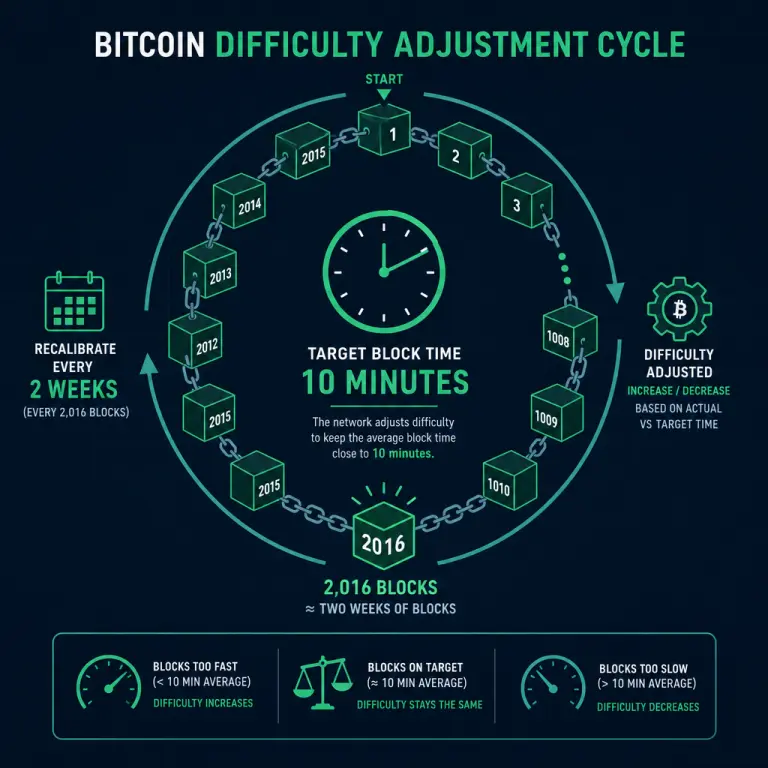
The 2,016-Block Rule — Where the Number Comes From
Bitcoin's protocol schedules a difficulty recalculation at a very specific cadence: once every 2,016 blocks. That number is not arbitrary. At the network's target block time of 10 minutes, 2,016 blocks equal exactly 20,160 minutes, or 14 days. Satoshi picked a two-week window as a balance — long enough to smooth out short-term noise from hashrate spikes, short enough to react before the network drifts far from its 10-minute target.
At each 2,016-block boundary — called a retarget — every full node on the planet independently runs the same calculation on the same block headers and arrives at the same new difficulty. No vote, no committee, no human intervention. If you've heard Bitcoiners call the protocol "self-regulating," the difficulty adjustment is the canonical example of what they mean.
2,016 blocks
The retarget window. At 10 minutes per block, that's 20,160 target minutes — exactly 14 days if the network runs on schedule.
10-minute target
Average block interval the network aims for. Individual blocks vary, but the 2,016-block average trends back toward this line.
±4× hard cap
Any single adjustment is clamped between 0.25× and 4× the previous difficulty — protection against catastrophic hashrate swings.
The Formula in Plain English
The math behind the retarget is one of the cleanest pieces of engineering in the Bitcoin codebase. Reduced to plain English:
new_difficulty = old_difficulty × (2,016 × 10 min) / actual_time_for_last_2,016_blocks
The ratio inside the parentheses is the expected time — 20,160 minutes. Divide that by the actual time the last cycle took, and you get a correction factor. If the correction factor is greater than 1, difficulty rises. If it's less than 1, difficulty falls. The protocol then applies that factor to the old difficulty to produce the new one.
Two concrete numbers make it click. Suppose hashrate spikes and the last 2,016 blocks arrive in 12 days instead of 14. The correction factor is 14/12 = 1.17, so difficulty rises by about +17%. Now suppose miners go offline and the next 2,016 blocks take 16 days. The factor is 14/16 = 0.875, and difficulty falls by about -12.5%. That's it. There is no hidden variable, no discretionary policy — just arithmetic, ratified by tens of thousands of independent nodes.
A Worked Example — Walking Through One Full Cycle
To see the full retarget cycle end-to-end, follow a single 2,016-block epoch from the moment it opens to the moment the new difficulty locks in.
Block 0 of the epoch — clock starts
A retarget just occurred. Every node records the timestamp of this block as the start of the new 2,016-block counting window. The current difficulty level applies unchanged for the next two weeks of blocks.
Blocks 1 through 2,015 — mining proceeds
Miners keep hashing at the current difficulty. Each block's timestamp is recorded in its header. Some blocks come in at 7 minutes, some at 14 — noise is normal. What matters is the aggregate.
Block 2,016 — measure the elapsed time
Nodes subtract the timestamp of block 0 from block 2,016 to get the actual time the epoch took. Say the result is 13 days, 8 hours, 14 minutes — that's the denominator in the retarget formula.
Apply the formula and clamp
Divide 14 days by 13.34 days to get 1.049, a ~4.9% increase. If the ratio had exceeded 4 or dropped below 0.25, the protocol would clamp it. With this modest number, no clamp needed.
New difficulty locks in — repeat
The next block (block 2,017 of the old epoch, or block 0 of the new epoch) is mined at the new difficulty. Every node accepts it only if its hash meets the new target. The clock resets and the next 2,016-block cycle begins.
See the next retarget affect a real miner
The formula is one thing — watching it change the BTC output of a rented rig is another. NoxHash's 2-day Basic Miner trial lets you observe the live CGMiner terminal as blocks arrive, with no deposit required.
Notable Difficulty Adjustments in Bitcoin's History
Most retargets are boring — single-digit percentage changes that reflect normal hashrate drift. A handful over Bitcoin's history have been dramatic, and each tells a story about what was happening in the real world of miners, regulators, and electricity grids. Data below is drawn from public on-chain records compiled by the CoinWarz difficulty chart.
| Date | Change | What caused it |
|---|---|---|
| July 2021 | -27.94% | Largest drop ever — China's mining ban forced roughly half of global hashrate offline almost overnight. |
| August 2023 | -7.50% | Texas heat wave — ERCOT grid operator requested miners curtail to stabilize power demand. |
| April 2024 | +3.41% | Pre-halving hashrate surge as miners raced to mine the final 6.25 BTC reward blocks. |
| April 17, 2026 | -2.43% | Most recent — difficulty eased from 138.96 T to 135.59 T; hashprice rose 13.65% on the relief. |
| May 1, 2026 (est.) | ~+ small | Estimated next retarget — average block interval running ~9 min 35 sec, pointing to a modest uptick. |
The April 17, 2026 retarget is a textbook example of the formula in action: hashrate had drifted just slightly above the 10-minute target, so difficulty nudged down by 2.43% to 135.59 trillion. Miners felt it immediately — hashprice, the USD revenue per TH/s per day, jumped 13.65%. Two weeks later, the next cycle will reassess.
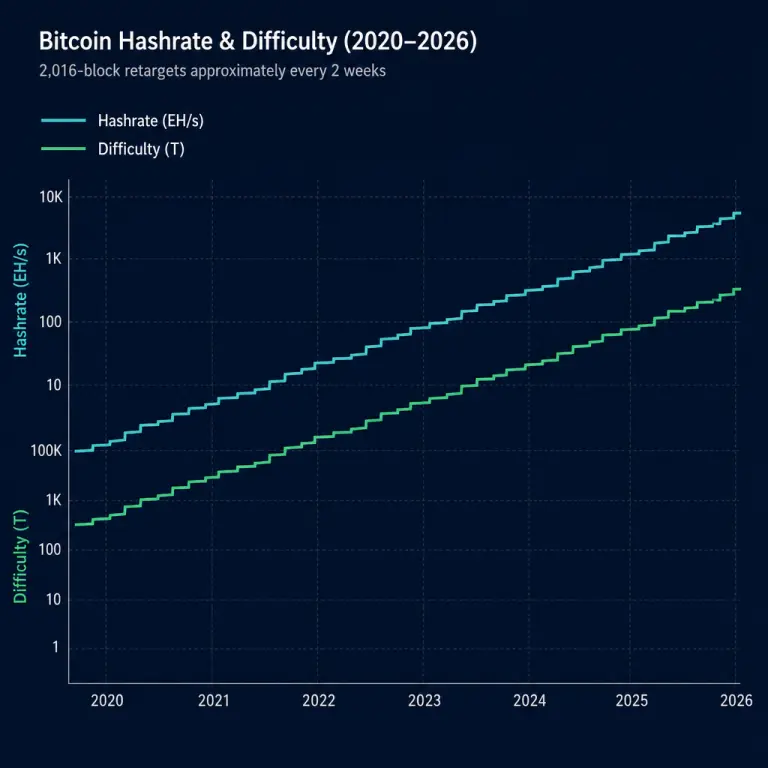
What Difficulty Adjustments Mean for Cloud Mining Users
If you rent hashrate — on NoxHash or anywhere else — difficulty adjustments are the most important variable you don't directly control. Your rental fee is fixed in USD, but the BTC you earn per TH/s shifts in small steps every two weeks. Understanding the direction of travel helps you size rentals sensibly.
Difficulty drops help you
When a retarget lowers difficulty — like the -2.43% move in April 2026 — your rented TH/s earns slightly more BTC per day for the next two weeks. Everything else equal, your monthly BTC stack grows faster.
Difficulty rises reduce output
When new machines come online or BTC price rises enough to pull miners back in, difficulty climbs. The same rented TH/s then earns marginally less BTC — a headwind worth modeling if you plan a 12-month rental.
Think in multi-cycle windows
Single retargets rarely move the needle more than a few percent. But stacked over six or twelve adjustments, difficulty can climb 15–30% — which is why honest ROI estimates assume a gradual uptrend, not a static number.
Price and difficulty are linked
Higher BTC prices attract more miners, which pushes difficulty up. The two variables chase each other — which is why miner economists watch the hashprice (revenue per TH/s) rather than either one in isolation.
Why the ±4× Cap Exists — A Safety Valve, Not a Suggestion
Read any Bitcoin Core documentation and you'll find this line buried in the retarget logic: the new difficulty cannot be more than 4× or less than 0.25× the previous value. On most retargets the cap is irrelevant — real adjustments land between -15% and +15%. But the cap matters in one specific scenario, and Bitcoin's designers built it in on purpose.
The cap is a safety valve against a catastrophic hashrate shock. Imagine a scenario where 99% of global hashrate goes offline simultaneously — a coordinated government action, a continent-wide blackout, a miner exodus. Without a cap, the formula would divide by an enormous denominator and propose a difficulty drop of 90% or more. That would make the next 2,016 blocks almost trivially easy to mine, and a bad actor who quietly kept hashrate online could reorganize the chain cheaply.
By clamping the adjustment at a factor of 4 in either direction, Bitcoin limits how fast an attacker could exploit a hashrate vacuum. Even after the July 2021 China ban — the single largest hashrate exodus in Bitcoin's history — the actual drop was only 27.94%, nowhere near the cap. The cap exists precisely because Satoshi couldn't rule out worse. Engineering for the tail risk is what makes the protocol durable.
Turn the retarget cycle into rented hashrate
You now understand how the 2,016-block retarget shapes every miner's BTC output. On NoxHash, plans start from $20/month for 50 TH/s — a low-cost way to feel the cycle in real BTC instead of in spreadsheets.
Frequently Asked Questions
How often does Bitcoin difficulty adjust?
Every 2,016 blocks — roughly every two weeks if blocks hit the 10-minute target exactly. When network hashrate is above trend, blocks arrive faster and the cycle finishes in under 14 days. When hashrate drops, the cycle can stretch past two weeks before the retarget triggers.
What was the April 2026 difficulty adjustment?
On April 17, 2026, Bitcoin difficulty fell 2.43% from 138.96 T to 135.59 T — a small relief move after a short period of elevated hashrate. Hashprice rose 13.65% alongside the drop. The next estimated retarget is May 1, 2026, with blocks currently averaging 9 min 35 sec.
Can the difficulty adjustment go down?
Yes. If the last 2,016 blocks took longer than 14 days — because hashrate dropped — difficulty falls on the next retarget. The largest historical drop was -27.94% in July 2021, following China's mining ban. The protocol caps any single drop at 0.25× the previous level.
Why is the target block time 10 minutes?
Satoshi chose 10 minutes to balance two goals: short enough that transactions confirm at usable speed, long enough that new blocks propagate globally before the next one is found. A shorter target would raise orphan rates; a longer one would degrade user experience without meaningful security gains.
Does the difficulty adjustment affect my cloud mining earnings?
Yes, directly. Your rented TH/s earns a proportional share of the block reward; as difficulty rises, that share shrinks. A +5% retarget reduces BTC output per TH/s by roughly 5% over the next two weeks. Over a 12-month rental, cumulative difficulty drift is the single largest non-price variable.
What is the maximum possible difficulty change in one cycle?
The protocol clamps any single retarget at 4× up or 0.25× down. In practice, no real-world event has come close — the record drop is roughly -28% and the record rise is under +30%. The cap is a tail-risk safeguard against catastrophic hashrate shocks, not a routine constraint.
Educational content — not financial advice
This article explains Bitcoin's difficulty adjustment mechanism for educational purposes. Difficulty values, hashrate figures, and next-adjustment estimates reflect conditions on April 17, 2026 and will change by the next retarget. Mining returns depend on BTC price, network difficulty, operator reliability, and local tax treatment — all outside your direct control. Past performance does not guarantee future results. Commit only funds you can afford to lose, and consult a qualified professional for tax or investment guidance.