Bitcoin Halving Explained: What It Means for Cloud Mining Returns
How the 2024 Bitcoin halving cut block rewards to 3.125 BTC, what it means for cloud mining earnings, and why fleet efficiency now decides who stays profitable.

The Bitcoin halving is a protocol event that cuts the block reward paid to miners by 50% every ~210,000 blocks — roughly every four years. The April 2024 halving dropped rewards from 6.25 BTC to 3.125 BTC, instantly halving the BTC earned per terahash. For cloud mining users, it reshapes every return calculation.
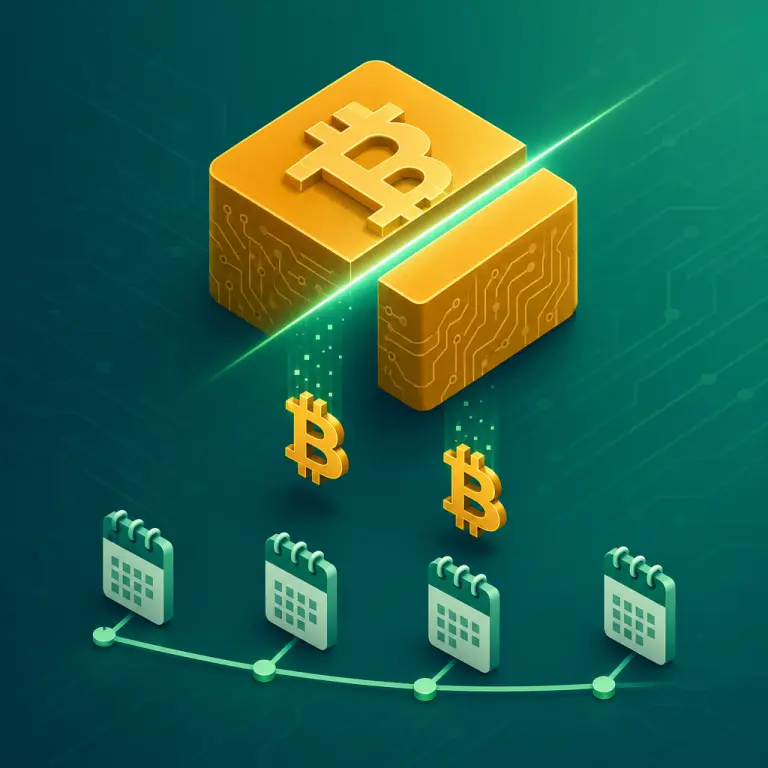
What the Bitcoin Halving Actually Is
Bitcoin's source code hard-codes a rule: every 210,000 blocks — about four years at 10-minute block times — the reward paid to the miner who seals a block is cut in half. Think of it as Bitcoin paying its mining workforce 50% less for the same job, on a schedule Satoshi wrote in 2009. It's the mechanism that enforces Bitcoin's 21 million supply cap.
The cut is automatic, global, and non-negotiable. No committee votes on it. The instant block 840,000 was mined on April 19, 2024, every miner on Earth started earning exactly half the BTC they earned the block before. You can read the rule directly in the original Bitcoin whitepaper, which sketched the fixed-supply schedule.
Every ~4 years
Triggers every 210,000 blocks. With a ~10-minute target block time, that lands roughly every four calendar years.
Reward halves, exactly
50 → 25 → 12.5 → 6.25 → 3.125 BTC per block. No curve, no gradient — a single instantaneous cut.
Hard cap guaranteed
The halving schedule ensures total Bitcoin supply asymptotically approaches — but never exceeds — 21 million coins.
A useful analogy: imagine a gold mine where every four years the vein yields half as much per pickaxe swing. Miners with outdated tools go bankrupt. Miners with efficient, modern tools keep going — often at higher revenue if the gold price rises to compensate. That's the halving, applied to Bitcoin.
Every Bitcoin Halving in History
Four halvings have happened so far. Each one triggered a wave of inefficient miners shutting down, followed — historically — by a BTC price rally 12 to 18 months later. Past performance is not a guarantee of future results, but the pattern matters because it's what keeps modern mining operations profitable through the reward cut.
| Halving | Date | Block reward | What followed (historical, not predictive) |
|---|---|---|---|
| 1st | Nov 2012 | 50 → 25 BTC | Extended bull run into late 2013 |
| 2nd | Jul 2016 | 25 → 12.5 BTC | Rally peaked ~17 months later in Dec 2017 |
| 3rd | May 2020 | 12.5 → 6.25 BTC | Rally peaked ~18 months later in Nov 2021 |
| 4th (most recent) | Apr 2024 | 6.25 → 3.125 BTC | We're currently in this cycle |
| 5th (projected) | ~2028 | 3.125 → 1.5625 BTC | Fee revenue becomes a larger share of miner income |
One detail most guides skip: the halving doesn't just cut the block subsidy. It raises the relative weight of transaction fees in miner revenue. Post-2024, on busy days when the mempool is congested, fees can contribute 10–30% of total block rewards — and in the 2028 cycle that share will grow further as the subsidy shrinks again.
How the Halving Hits Cloud Mining Returns
Here's the math that matters to you as a cloud mining user. Your rented hashrate produces a fixed number of shares per day. Those shares earn BTC proportional to the block reward. When the reward halves, each TH/s earns half as much BTC — instantly, on halving day.
BTC per TH/s falls 50%
If 1 TH/s earned 0.00002 BTC/day pre-halving, after the event it earns roughly 0.00001 BTC/day at the same network difficulty. The drop is mechanical — it happens whether BTC price moves or not.
Inefficient miners capitulate
Older hardware (S19-class, ~30 J/TH) can no longer cover its electricity bill. Those rigs get unplugged, which reduces global hashrate, which triggers a downward difficulty adjustment every 2,016 blocks — partially restoring BTC-per-TH for the machines that survive.
USD returns hinge on BTC price
Your rental cost is priced in USD, but your earnings accrue in BTC. If BTC price doubles in the 12–18 months after halving, USD returns can still grow despite the BTC cut. If price stays flat or falls, USD returns drop proportionally.
Fleet efficiency becomes decisive
After a halving, the operator running 12 J/TH machines on $0.035/kWh power keeps mining profitably. The operator running 30 J/TH machines on home electricity shuts down. This is why our fleet selection matters more post-halving than it did before.
Worked example: 1 TH/s before and after the 2024 halving
To make the math concrete, here's a simplified BTC-earnings comparison for a single TH/s of rented hashrate. Network difficulty is held constant to isolate the halving effect; real-world numbers shift with difficulty and BTC price.
| Metric (illustrative) | Pre-halving (early 2024) | Post-halving (today) |
|---|---|---|
| Block reward | 6.25 BTC | 3.125 BTC |
| BTC earned per TH/s per day | ~0.00002 BTC | ~0.00001 BTC |
| USD value at flat BTC price | 100% baseline | ~50% of baseline |
| USD value if BTC price doubles | 100% baseline | ~100% of baseline |
| USD value if BTC price triples | 100% baseline | ~150% of baseline |
Numbers are illustrative and depend on network difficulty, pool fees, BTC price, and transaction fee conditions at the time of mining. Actual earnings will differ.
See how a post-halving fleet actually earns
The math above lands differently depending on the hardware running behind it. Activate a free 2-day Basic Miner trial (50 TH/s) and watch the current 3.125-BTC-era numbers stream into your dashboard — no deposit, no commitment.
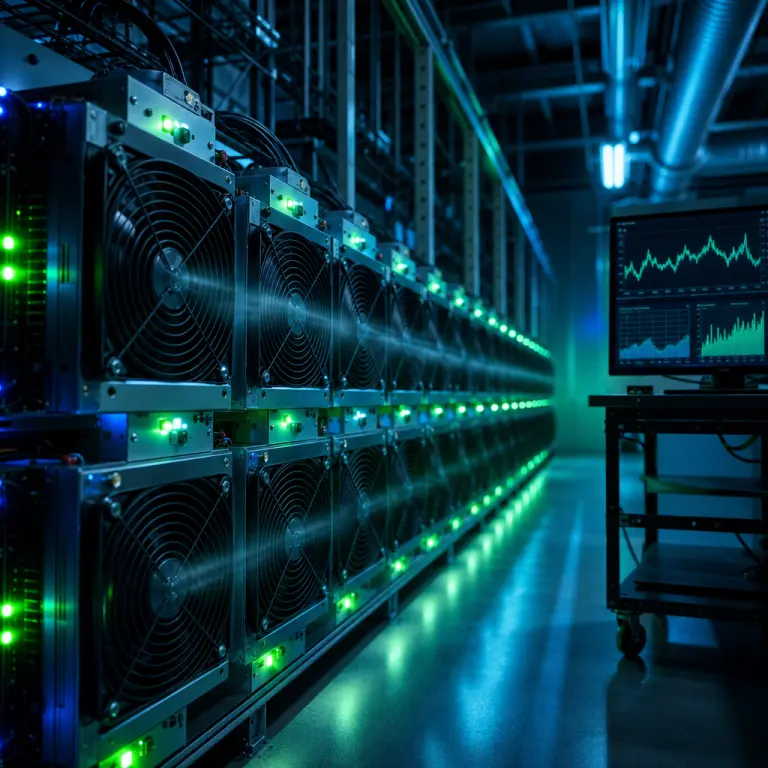
Why Efficient Operators Survive — and How NoxHash Stays Competitive
Every halving is, in practice, a forced upgrade cycle. Old hardware becomes uneconomic the moment the reward halves, and only operators who already run efficient machines on cheap power make it to the other side. Three factors decide who survives:
Hardware efficiency (J/TH)
Our fleet runs 12–18.5 J/TH machines — Antminer S21 XP Hyd, S21 Pro, S21, and WhatsMiner M66S/M60S. That's roughly twice as efficient as the 2021-era S19 Pro (~30 J/TH) that a lot of home and cloud operators still have deployed.
Industrial electricity
Our Kazakhstan data center pays roughly $0.035/kWh on an industrial contract. A home miner paying $0.12–0.20/kWh sees their per-TH electricity bill 3–5× higher — often decisive after the block reward halves.
Continuous fleet refresh
We replace hardware when a new generation offers >15% efficiency gains. That policy is what keeps the fleet average below 18.5 J/TH today, and it's why rentals priced at pre-halving levels still make sense for us to operate.
Natural cooling climate
Kazakhstan winters average −15 °C to −30 °C, and the summer mean stays in the single digits. We use ambient-air cooling with industrial fans instead of HVAC — the cooling-cost share that would otherwise eat into post-halving margins essentially disappears.
The takeaway isn't that cloud mining "beats" the halving — nothing beats a protocol rule. The takeaway is that shared industrial infrastructure absorbs the shock better than a home setup, because the fixed costs that matter most after a halving (power price, cooling, hardware generation) are all pre-optimized.
Frequently Asked Questions
When is the next Bitcoin halving?
The 5th halving is projected for early 2028, when block height reaches 1,050,000. The exact date drifts because block times vary slightly from the 10-minute target. At that point, rewards drop from 3.125 BTC to 1.5625 BTC per block.
Does the halving automatically make BTC price go up?
No. The halving reduces the rate of new BTC supply, which is bullish in theory, but price depends on demand, macro conditions, regulation, and sentiment. Previous halvings were followed by rallies 12–18 months later, but that's correlation across a small sample — not a guarantee of future cycles.
Did my rented hashrate earn less BTC after April 2024?
Yes — mechanically. BTC per TH/s halved on halving day. But difficulty adjustments, transaction fees, and BTC price movement have partially offset the cut in USD terms. Your dashboard's daily earnings line shows the real-world result, not the theoretical one.
What happens to Bitcoin miners when the subsidy reaches zero?
The final sat of block subsidy is projected to be mined around the year 2140. Long before that, miner revenue is expected to come primarily from transaction fees. Each halving between now and then grows the fee share relative to the subsidy share — the transition is gradual, not sudden.
Is it worth starting cloud mining in the middle of a halving cycle?
It depends on current BTC price, network difficulty, and your time horizon. Starting when BTC is low can be risky because rental costs are fixed in USD while earnings are in BTC. The free 2-day trial lets you see live numbers before committing. Don't invest more than you're prepared to lose.
Do transaction fees really matter after a halving?
Yes, and more each cycle. Pre-2024 halving, fees were typically 1–5% of block rewards. Post-2024, on congested days they've regularly hit 10–30%. By the 2028 halving, fees are expected to be a permanent, material share of miner revenue rather than an occasional bonus.
Not financial advice — market speculation warning
This article is educational content about a protocol event and its historical effects. It is not investment advice, a price prediction, or a guarantee of future returns. The "12–18 month post-halving rally" pattern comes from only three past cycles — a very small statistical sample, and past performance does not predict future results. Bitcoin price can fall as well as rise; cloud mining earnings depend on BTC price, network difficulty, transaction fees, and operating conditions — all of which can change quickly and are outside your control. Rental costs are denominated in USD while earnings are in BTC, so a sustained BTC price decline can push returns below rental cost. Only commit funds you can afford to lose, consult a licensed financial or tax advisor for your jurisdiction, and verify local cryptocurrency regulations before investing.