The Ultimate Guide to Bitcoin Cloud Mining Contracts
Understand Bitcoin cloud mining contracts before you buy: contract types, term-length discounts, FPPS payouts, halving clauses, and a worked $50 example.

A Bitcoin cloud mining contract is a fixed-term rental agreement in which you pay a defined USD fee — usually monthly — to lease a slice of a data center's hashrate, and the BTC that slice mines is credited to your account. Before you sign one, you need to know what's included, what isn't, how payouts are calculated, and how term length changes your risk profile. This guide is the full walkthrough.

What's Actually In a Cloud Mining Contract
Before you can judge whether a contract is priced fairly, you need to see it as three separate pieces: what you're paying for, what's silently bundled in, and what the operator keeps doing behind the scenes. The fee is just the price tag — the real product is the bundle underneath.
Reputable operators disclose each component up front. Vague copy along the lines of "buy hashpower, earn BTC" with no breakdown is a sign the contract is either rudimentary or deliberately opaque. Here are the three components to look for.
The hashrate you rent
A defined amount of SHA-256 hashing power measured in TH/s — for example a NoxHash Standard Miner at 150 TH/s. This is the number that determines your share of the pool's BTC rewards.
The operational bundle
Industrial electricity (~$0.035/kWh on NoxHash), cooling, 24/7 technicians, hardware replacement within 4–8 hours, and pool fees (typically 1–2% on FPPS). All baked into the sticker price.
The payout mechanics
How often BTC credits your balance, which pool reward model is used (FPPS, PPS+, PPLNS), and the minimum withdrawal threshold — on NoxHash, 0.00001 BTC with a 1.5% withdrawal fee.
The one item that is never in a legitimate contract is a guaranteed USD return. Mining revenue depends on BTC price and network difficulty, both of which move daily. Any contract promising a fixed daily percentage in dollars is — mathematically speaking — selling something other than mining.
The Three Contract Types You'll See in 2026
The cloud mining industry broadly offers three contract structures. Each solves a different problem, and the one that's "best" depends on whether you want price predictability, flexibility, or upside exposure to the pool's luck. The table below is the quick comparison.
| Fixed hashrate rental | Allocation / marketplace | "Lifetime" contracts |
|---|---|---|
| You rent a fixed amount of TH/s for a defined term (e.g. 150 TH/s for 6 months). NoxHash and most transparent operators use this model. | You bid on hashpower priced per TH/s/day on a marketplace, reselling idle capacity from third parties. Suits traders, not beginners. | One-time fee for "unlimited" duration. Historically associated with Ponzi structures because no operator can guarantee hardware economics forever. |
| Price predictable, output variable with BTC price / difficulty. | Price volatile (marketplace), output also variable. | Often wound down quietly via "maintenance fees" that eat returns to zero. |
| Best for: accumulators who want a monthly bill they can plan around. | Best for: active traders arbitraging hashprice vs BTC price. | Best for: almost nobody — treat with extreme skepticism. |
Fixed hashrate rental is the dominant model in 2026 for one simple reason: it maps the product to how most users actually think about cloud mining — as a subscription that produces BTC. According to Hashrate Index's analysis of pool reward evolution, fixed-structure contracts have grown meaningfully post-halving as operators seek revenue stability and users seek predictable costs.
Term Length — The Discount vs Flexibility Trade-off
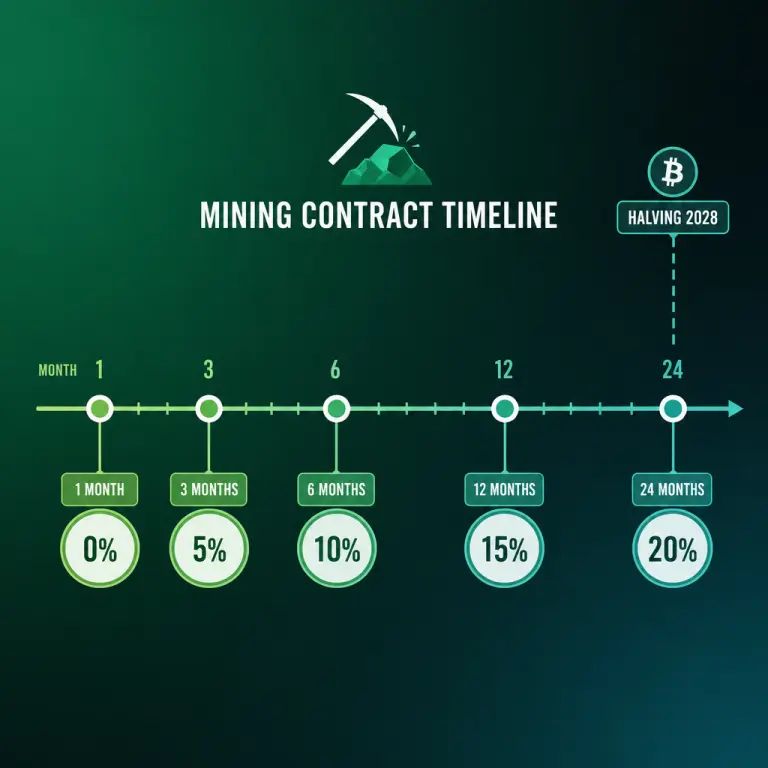
Almost every fixed-hashrate platform offers tiered discounts for longer commitments. NoxHash is a clean illustration: the same machine gets cheaper on a per-month basis the longer you commit, ranging from 0% discount at 1 month to 20% off at 24 months. The trade-off is locking in capital against BTC, difficulty, and halving risk.
| Term | Discount | Standard Miner effective $/month | Key break-even consideration |
|---|---|---|---|
| 1 month | 0% | $50.00 | Pure exposure to this month's BTC price and difficulty. Maximum flexibility. |
| 3 months | 5% | $47.50 | Smooths one quarter of difficulty drift. Good first upgrade from monthly. |
| 6 months | 10% | $45.00 | Popular sweet spot. Spans typical BTC volatility cycle without halving exposure. |
| 12 months | 15% | $42.50 | Bets on a BTC-up year. One difficulty up-cycle fully inside the term. |
| 24 months | 20% | $40.00 | Crosses the April 2028 halving — block reward drops from 3.125 to 1.5625 BTC mid-term. |
The deeper the discount, the more "BTC up, difficulty behaved" you need to hold on faith. A 6-month term is, in our experience across the NoxHash user base, the most common first choice — long enough to smooth a single difficulty adjustment cycle, short enough to avoid the 2028 halving lock-in entirely.
See the five term lengths priced against a real machine
You've just seen the discount ladder in theory — the NoxHash pricing page shows it applied to Basic, Standard, Pro and Enterprise tiers in real time. Pick a term, see the effective monthly cost, and only commit once the math matches the framework you just read.
Worked Example — What $50/Month Actually Looks Like
Abstract frameworks only get you so far. The quickest way to internalize a cloud mining contract is to follow one full order through the system. Let's use a NoxHash Standard Miner (150 TH/s, $50/month sticker) on a 6-month term — the most common new-user configuration — under April 2026 network conditions.
| Line item | Value (illustrative) |
|---|---|
| Plan | Standard Miner — 150 TH/s |
| Term | 6 months (10% discount) |
| Monthly cost | $45 ($50 × 0.90) |
| Total 6-month commitment | $270 |
| Target BTC output / month (illustrative) | ~115–125% of rental in BTC value |
| Payout cadence | Credited every minute, FPPS pool |
| Deposit fee (USDT on BEP-20) | ~$0.05–0.30 one-off |
| Withdrawal fee on mined BTC | 1.5% of each withdrawal |
The pattern over six months is simple: you pay $45 in USD, the system credits your BTC wallet in real time, and each month you face one decision — withdraw what you've accrued to self-custody or let it compound in the platform wallet. Your USD outgo is locked; your BTC income drifts with price and difficulty. If BTC climbs during the term, the same mined BTC is worth more dollars; if it slides, the reverse.
For live network context, as of April 2026 global hashrate sits above 1 ZH/s and difficulty hovers around 135 T — roughly 20× higher than five years ago, per public data from the CoinWarz Bitcoin difficulty chart. Every ROI estimate you read should be timestamped against a specific difficulty, or treated as stale.
The Fine Print Worth Actually Reading
Most contract disputes come down to a clause the buyer skimmed. These are the five clauses that most often matter, ordered by how early in the contract life-cycle they bite. Check each one before you sign — especially on a 12 or 24-month term.
Withdrawal fee and minimum
What percentage does the platform take on each withdrawal, and what's the minimum BTC you must accumulate before you can move funds out? NoxHash charges 1.5% with a 0.00001 BTC floor; watch out for platforms that quietly gate withdrawals until you hit an unrealistic threshold.
Bitcoin network fee
Separate from the platform's withdrawal percentage, there's the on-chain Bitcoin fee paid to miners for broadcasting the transaction. During mempool congestion this can spike. Withdrawing less often, in larger chunks, amortizes this cost efficiently.
Halving clause
Does the contract explicitly address what happens at halving? The next Bitcoin halving is expected in April 2028 — block reward drops from 3.125 BTC to 1.5625 BTC overnight. Reputable operators keep your hashrate unchanged; output simply follows the halved network reward. Any contract promising unchanged BTC yield through a halving is impossible.
Hardware swap clause
If your assigned ASIC breaks, does the operator guarantee replacement and within what window? NoxHash's SLA is 4–8 hours with equivalent-spec hardware. If a platform's terms are silent on this, you may be quietly exposed to downtime with no offset.
Early termination & renewal
Can you exit a 12-month contract if market conditions change? Most fixed-term rentals are non-refundable by design — the operator locked in your electricity at industrial rates and cannot re-sell that capacity mid-term. Check whether renewal is automatic or opt-in; surprise auto-renewals on 12-month terms have burned plenty of users.
Choosing Your First Contract — A Decision Framework
Beginners over-optimize pricing and under-think term. The four questions below, answered honestly, usually point to the right first contract without needing a spreadsheet. Work through them in order.
1. How long am I willing to be wrong?
If you can stomach 6 months of a BTC drawdown without panicking and unwinding, a 6-month term is the default. If not, start with 1 or 3 months and renew manually.
2. What's my realistic monthly budget?
Size to the tier whose sticker price you could lose fully without stress. $20 Basic is perfectly sensible for a first contract — scaling up later is cheaper than unwinding a misjudged Enterprise commit.
3. Am I buying a USD yield or stacking sats?
If you want USD income, cloud mining is a poor fit — returns fluctuate with BTC. If you want to accumulate BTC over years, a longer term with a discount rewards the conviction.
4. Does my term cross the 2028 halving?
Any 24-month contract starting mid-2026 onward will span the April 2028 halving. Block reward halves; your BTC output drops accordingly. If that scares you, stay at 12 months or shorter until post-halving pricing shakes out.
A sane default for a first-time buyer: Basic or Standard tier, 3 or 6 months, no auto-renew. That gives you a real data point to make a better decision next time — at the cost of a single dinner out, not a retirement account.
Run the four questions — then try a real contract risk-free
The framework above lands most first-timers on a small, short-term contract. Before you even sign that, NoxHash's 2-day Basic Miner trial lets you watch a real ASIC run with no deposit. That's the lowest-stakes way to validate everything you just read.
Frequently Asked Questions
Is a Bitcoin cloud mining contract the same as buying Bitcoin?
No. A contract buys you future BTC production — hashrate that accrues coins gradually — not a one-shot spot purchase. If BTC price moons immediately after you sign, spot buyers win. If BTC grinds sideways or trends up over months, mining adds a yield component on top of the eventual appreciation.
What happens to my contract when Bitcoin halves in 2028?
Your rented hashrate stays the same, but the block reward drops from 3.125 BTC to 1.5625 BTC — so the BTC you accrue per day falls roughly in half on fundamentals alone. Historically BTC price has risen in the 12–18 months after halvings, offsetting the cut over time, but that pattern is not guaranteed.
Can I terminate a 12-month contract early?
On most fixed-term rentals including NoxHash, no — the discounted price is the reason the term is locked. Operators commit electricity and rack space against your contract. If you're unsure about a 12-month commitment, start with 3 or 6 months and renew, rather than chasing the steeper discount.
How is my BTC payout calculated?
Most reputable operators point your hashrate at an FPPS (Full Pay-Per-Share) pool. FPPS pays a fixed amount per valid share based on expected block reward plus transaction fees, smoothing out the pool's luck. Your share of that payout scales linearly with the TH/s you rent versus the pool total.
Are "lifetime" cloud mining contracts legitimate?
Treat them with strong skepticism. No operator can guarantee indefinite hardware economics — ASICs age, electricity contracts expire, halvings cut revenue. Historical "lifetime" schemes were usually wound down via escalating maintenance fees. Fixed-term contracts with clear endpoints are the honest structure.
Is electricity really included in the monthly fee?
On all-inclusive platforms like NoxHash, yes — power, cooling, pool fees and technician coverage are all baked in. Some older-style operators separate an "electricity maintenance fee" that's billed in BTC against your mined output; read the terms carefully, because a deceptively low sticker can become expensive once the side fee eats accrual.
What's the difference between FPPS, PPS+ and PPLNS?
FPPS pays a fixed amount per share including an expected transaction-fee share — most predictable. PPS+ is similar but credits transaction fees actually collected, so it's slightly more variable. PPLNS pays only on found blocks weighted by recent shares, highest variance. Cloud miners almost always prefer FPPS for its smoothed output.
Educational content — not financial advice
This guide is educational. Network statistics, pricing tiers and example calculations reflect April 2026 conditions and will change. Cloud mining returns depend on BTC price, network difficulty, halving cadence, operator reliability and your local tax treatment — all outside your direct control. Past results do not guarantee future performance. Only commit funds you can afford to lose, verify local legal and tax rules with a qualified professional before scaling up, and avoid treating any single contract as a make-or-break position.