Bitcoin Address Formats — Segwit, P2PKH & P2SH
Which Bitcoin address formats does NoxHash support for BTC payouts? Compare Segwit, P2PKH, and P2SH on fees, wallet support, and prefix.
NoxHash pays BTC withdrawals to three Bitcoin address formats: Segwit v0 (bc1q…), P2PKH or legacy (1…), and P2SH (3…). You can tell which one your wallet gave you from the very first character. Segwit is the cheapest to spend on-chain, P2PKH has the widest compatibility, and P2SH sits in the middle — typical for multi-sig setups.

What a Bitcoin Address Really Is
A Bitcoin address is a string of letters and numbers that tells the network where to send BTC. Under the hood, it's a hash of a public key wrapped in an encoding that includes a checksum — so a single typo almost always fails validation rather than silently sending coins into the void.
Over Bitcoin's lifetime, three mainstream address encodings have become standard. Each one represents a different technical tradeoff between on-chain fee cost, wallet compatibility, and age of the format. NoxHash's withdrawal form accepts all three, so you can pay out to whatever your wallet supports.
Segwit (bech32)
Starts with bc1q. Introduced in 2017 via BIP-173. Lowest on-chain fees, all-lowercase, strongest error detection.
P2PKH (legacy)
Starts with 1. The original Bitcoin address format from 2009. Works in every wallet ever made — but pays the highest on-chain fees.
P2SH (nested)
Starts with 3. Standardised via BIP-16 in 2012. Common for multi-sig and "wrapped Segwit" — middle-ground fees.
Spot the Format in One Second — Read the First Character
You don't need a parser or a tool to tell the three formats apart. Every Bitcoin address begins with a distinctive prefix that's unique to its encoding. Glance at the first character and you know what you're looking at.
→ Segwit (bech32)
Full prefix is bc1q. All lowercase, 42 characters long. Example shape: bc1q…
→ P2PKH (legacy)
Mixed case (Base58Check), 26–34 characters long. Example shape: 1A1zP1…
→ P2SH
Also Base58Check, 34 characters. Often used for multi-sig or wrapped Segwit. Example shape: 3J98t1…
A quick analogy: the first character is the postcode on your envelope. b tells the network "this is a modern Segwit envelope"; 1 says "this is the 2009 original"; 3 signals "a wrapped or multi-sig arrangement". The Bitcoin network can route all three, but the "postage" — the on-chain network fee a spender pays — differs between them.
Segwit vs P2PKH vs P2SH — Side-by-Side Comparison
Here is how the three formats stack up against the things that actually matter when choosing which address to paste into the NoxHash withdrawal form: prefix, typical length, on-chain fee behaviour, and wallet support.
| Attribute | Segwit (bech32) | P2PKH (legacy) | P2SH |
|---|---|---|---|
| Prefix | bc1q… |
1… |
3… |
| Typical length | 42 characters | 26–34 characters | 34 characters |
| Encoding | Bech32 (all lowercase) | Base58Check (mixed case) | Base58Check (mixed case) |
| Introduced | 2017 (BIP-173) | 2009 (original) | 2012 (BIP-16) |
| On-chain spend fee | Lowest | Highest | Medium |
| Wallet support | All modern wallets & exchanges | Universal — works everywhere | Wide — including multi-sig |
| Typical use case | Default for everyday BTC | Old wallets, maximum compatibility | Multi-sig & wrapped Segwit |
| NoxHash support | Yes | Yes | Yes |
Why does Segwit cost less in fees? Bitcoin network fees are priced by transaction weight, not by the amount of BTC sent. Segwit inputs weigh less than legacy inputs, so a spender pays fewer satoshis per byte when the funds sit at a bc1 address. For a definitive explanation of the encoding, see the BIP-173 specification on the Bitcoin wiki — it's the standards document that introduced bech32.
What about Taproot (bc1p…)?
Taproot is the newer Segwit v1 format introduced in 2021 — it starts with bc1p instead of bc1q. NoxHash's current withdrawal pipeline supports Segwit v0 (bc1q…), not Taproot. If your wallet only gives you a bc1p address, switch the receive-address type to Segwit v0, pick a different account, or use a 1 or 3 address instead.
Ready to point an address at your NoxHash wallet?
You've seen how Segwit, P2PKH, and P2SH compare — all three are accepted on NoxHash. Create your account, rent a miner, and paste the bc1q, 1, or 3 address your wallet gives you into the withdrawal form.
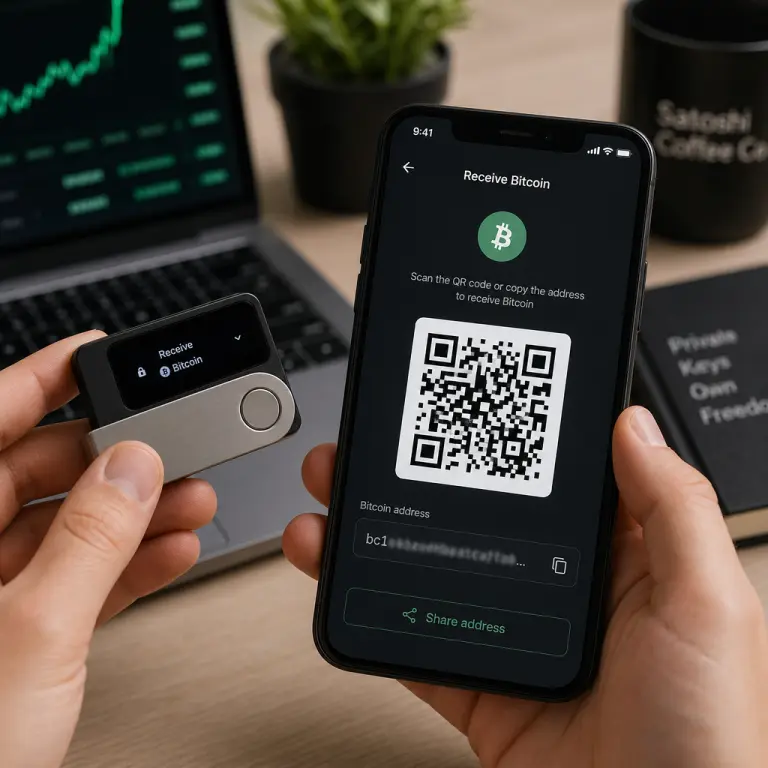
Which Wallet Gives You Which Address?
Different wallets default to different formats. Here's a practical overview of what you'll typically see when you open a Bitcoin receive screen, grouped by device type. The goal is not to pick the "best" wallet — it's to know which prefix your wallet is handing you.
Hardware wallets
Ledger, Trezor, and Coldcard let you pick the account type when you set up the device. Choose Native Segwit (bc1) for the cheapest fees. Most also offer a separate Taproot (bc1p) account — avoid that for NoxHash withdrawals.
Mobile wallets
BlueWallet, Muun, and Phoenix default to Segwit (bc1q). Older self-custody apps may still hand you a 3 (wrapped-Segwit) address — it works on NoxHash, just costs slightly more to spend later.
Desktop wallets
Electrum and Sparrow let you pick the address type per account (Legacy / Segwit / Taproot). Create a Native Segwit account and every receive address will start with bc1q.
Exchange receive addresses
Most centralised exchanges issue bc1q addresses by default, but some still hand out 3 for legacy account types. Always double-check the prefix before you submit the withdrawal.
Do's and Don'ts When Pasting an Address
The NoxHash form validates formats on the fly, but a valid string can still be the wrong address. A 30-second habit around copy-paste is what separates a smooth withdrawal from an irreversible mistake.
- Always copy the address from your wallet — never retype by hand.
- Verify the first 4 and last 4 characters match on both screens before submit.
- Prefer Segwit (
bc1q) when your wallet offers a choice. - On hardware wallets, confirm the receive address on the device screen, not only on your computer.
- Don't paste a Litecoin (
L…) or Ethereum (0x…) address. - Don't use a Taproot (
bc1p) address — switch to a Segwit v0 account first. - Don't trust an address from a chat, email, or ad link — malware swaps clipboard contents.
- Don't send to an exchange deposit address without double-checking it still accepts BTC mainnet deposits.
Frequently Asked Questions
Which Bitcoin address format does NoxHash recommend?
Segwit v0 (bc1q…) is the recommended default. It produces the cheapest on-chain spending fees and is supported by every modern wallet and exchange. P2PKH (1…) and P2SH (3…) also work, but cost more the moment you spend the received BTC.
Does NoxHash support Taproot (bc1p) addresses?
The current NoxHash withdrawal pipeline supports Segwit v0 (bc1q), P2PKH, and P2SH. Taproot (Segwit v1, bc1p) is not accepted. If your wallet hands you a bc1p address, switch to a Segwit v0 account or use a 1 or 3 address instead.
Why does Segwit produce lower fees than legacy addresses?
Bitcoin network fees are priced by transaction weight, not by BTC amount. Segwit moves witness data into a separately discounted area, so spending from a bc1q address weighs less — roughly 30–40% less than a legacy 1 address, depending on input count and script complexity.
Can I send BTC from a Segwit address to a legacy address?
Yes. All three formats are fully interoperable on the Bitcoin network — a Segwit input can pay a legacy output and vice versa. The format only affects the fee and encoding of the sending input, not whether the transaction is valid. NoxHash broadcasts to whichever format you provide.
My wallet gives me a "3" address — is that safe to use?
Yes. A 3 prefix means P2SH, which often wraps Segwit under the hood. It is fully supported on NoxHash and by essentially every exchange and wallet. Fees sit between Segwit and legacy — if your wallet also offers a bc1q option, the Segwit version will be slightly cheaper.
What happens if I paste an invalid address?
The NoxHash withdrawal form validates prefix and checksum before you can submit. A wrong character produces an inline error and the request cannot be sent. This catches most typos, but it cannot detect a valid address belonging to the wrong person — always copy-paste and verify the first and last characters.
Not financial advice
This guide covers Bitcoin address formats only. Bitcoin transactions are irreversible — a BTC withdrawal sent to the wrong address cannot be recalled by NoxHash, your wallet, or the Bitcoin network. Always verify the first and last characters of the destination address before submitting, and prefer copy-paste over manual entry. Tax treatment of crypto earnings varies by country; consult a local tax advisor if you are unsure how withdrawals apply to you.