Air Cooling vs Hydro-Cooled ASICs — How Modern Mining Hardware Stays Cool
How air cooling and closed-loop hydro cooling work in Bitcoin ASICs, the efficiency gap they create, and why operators like NoxHash run both in parallel.
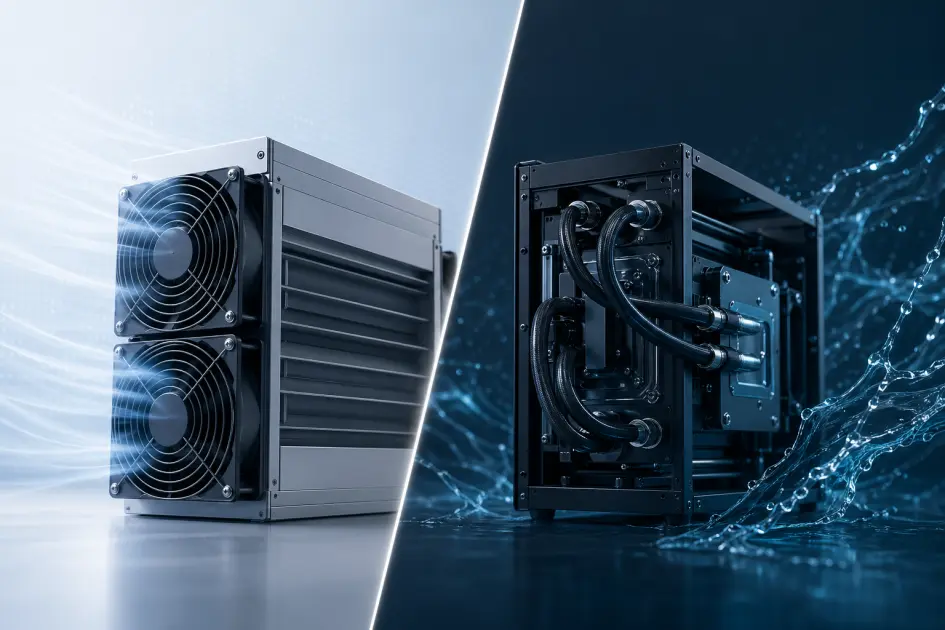
Air cooling and hydro cooling are the two thermal paradigms modern Bitcoin ASICs use to keep silicon below its throttle point. Air-cooled units push ambient air across heatsinks with high-CFM fans; hydro-cooled units circulate a water-glycol loop through cold plates bolted to the hashboards. The cooling method directly decides how densely chips can be packed and how low a J/TH rating the unit can sustain.

Why cooling decides ASIC efficiency
An ASIC's headline spec — the number printed on the spec sheet as "15 J/TH" or "12 J/TH" — is not a property of the chip alone. It is the efficiency the chip achieves when kept at its design temperature. Push the die past roughly 75–85°C and the firmware starts throttling clock speed to protect the silicon, which drops hashrate while the wall draw barely moves. Effective efficiency gets worse even though the sticker on the box never changes.
Sustained performance requires sustained thermal removal. Every joule of electrical input becomes roughly one joule of heat, so a 3,500 W miner is also a 3,500 W space heater. That heat has to leave the box fast enough to hold the chip in its operating window — not just on a cool morning, but during a 40°C summer afternoon after weeks of continuous load.
Cooling also sets the ceiling on chip density. Packing more hashboards into the same chassis, or squeezing more chips onto each board, is only viable if you can extract the extra heat. That is why the highest-hashrate, lowest-J/TH units on the market are almost always liquid-cooled: the thermal budget is what unlocks the density, not a different silicon process.
How air cooling works
Air cooling is the familiar paradigm. Each hashboard sits between aluminum heatsinks bonded to the ASIC chips with thermal paste or pads. At one end of the chassis, a bank of high-static-pressure axial fans pulls cool air through the board stack; at the other end, an equal-sized bank of fans pushes the heated air out. A typical S21-class air-cooled unit moves somewhere between 1,500 and 3,000 CFM of air continuously.
The heat leaves the unit as warm exhaust, usually 40–50°C depending on intake temperature and load. At facility scale, rows of these units feed into a hot aisle that is vented or mechanically exhausted outside. The external fan walls you see on every large mining warehouse — including ours in Kazakhstan — exist to move that hot air out fast enough to keep intake temperatures low.
Mechanically simple
No pumps, no plumbing, no coolant refills. A failed fan is a 15-minute swap.
Field-serviceable
Everything you touch on a dead unit is a screw, a connector, or a fan. Parts are cheap and interchangeable.
Loud and thermally limited
~75 dB at the unit and a hard ceiling on chip density once airflow saturates.
Air cooling is honest engineering: the physics are obvious, the failure modes are visible, and a technician with a screwdriver can fix almost anything in the field. The trade-off is that air is a mediocre coolant. Its specific heat capacity is roughly 4,000 times lower than water by volume, so to absorb the same heat you need a lot more mass flow, which means louder fans, higher static pressure, and eventually a density wall you cannot push past without melting something.
How hydro cooling works
Hydro-cooled ASICs replace the heatsink-and-fan stack with cold plates bolted directly onto the hashboards. A closed loop of water-glycol coolant — typically around 30–50% glycol to prevent freezing and inhibit corrosion — is pumped through those plates, absorbs heat from the chips, and carries it out of the unit through insulated quick-connect lines. The hot coolant then runs to an external radiator, dry cooler, or chiller plant where the heat is rejected to ambient air, after which the cooled liquid returns to the miners. The miner itself runs nearly silent because there are no internal fans pushing high-CFM airflow — just the coolant loop.
Hydro cooling is not the same as immersion cooling. Immersion dunks the entire hashboard assembly into a tank of dielectric fluid (single-phase mineral oil or two-phase fluorocarbon). Hydro keeps the coolant inside sealed plates and pipes; the electronics stay dry. The two solve the same problem but are different products, with different capex, different service profiles, and different failure modes.
Denser packing
Higher chip density per board and higher hashrate per U of rack space become feasible.
Lower chip temps = better J/TH
Cooler silicon leaks less current; firmware can run higher clocks without throttling. 12 J/TH vs 17.5 J/TH on the same ASIC generation.
Infrastructure-heavy
Requires a chiller or dry-cooler plant, manifolds, coolant, and leak detection. Unit-level service is harder.
Noise does not disappear — it just moves. Inside a hydro-cooled hall, you can hold a normal conversation next to a rack pulling tens of kilowatts. The fans and compressors that would have been inside each miner are now concentrated in the external cooling plant, where they can be sited further from occupied space and optimized as one system instead of hundreds of small ones.
Efficiency and density — side by side
The cleanest comparison uses units from the same generation so the silicon is the variable held constant. The air-cooled S21 Pro and the hydro-cooled S21 XP Hyd both descend from Bitmain's current-generation SHA-256 ASIC. The delta below is almost entirely attributable to how heat is removed.
| Criteria | Air — S21 Pro | Hydro — S21 XP Hyd |
|---|---|---|
| Hashrate per unit | 234 TH/s | 473 TH/s (+102%) |
| Efficiency | 15.0 J/TH | 12.0 J/TH (~20% better) |
| Power draw | 3,510 W | 5,676 W |
| Noise at rack | ~75 dB | ~50 dB (quieter) |
| External infrastructure | Fan wall / hot aisle only | Chiller or dry cooler + plumbing |
| Service per unit | Pull, swap, slot back in | Purge loop, disconnect, reseat |
| Home feasibility | Possible with a vented room | Effectively no |
The 20% efficiency gap is not marketing — it is the same BTC mined for 20% less electricity. Over the life of a unit, that compounds into a meaningfully different break-even curve when hash price drops. The density number is even more striking: a single hydro chassis outputs more than twice the hashrate of its air-cooled sibling, which changes how much rack space, cabling, and floor area you need for a given facility size.
Rent air-cooled or hydro-cooled hashrate from $20/month
You do not have to pick a side. Our mid-tier plans run on air-cooled S21 Pro / M66S racks; our Enterprise tier uses hydro-cooled S21 XP Hyd and S21 Hyd units. Same dashboard, same payouts, two different thermal stacks behind the scenes.

Why NoxHash runs both paradigms in parallel
We do not treat air vs hydro as a religion. Our fleet mixes Antminer S21 Pro, WhatsMiner M60S, and M66S on the air side with Antminer S21 XP Hyd and S21 Hyd on the hydro side. The mid-tier rental plans map to the air-cooled fleet; the Enterprise plan sits on the hydro racks. There are three reasons to run them side by side instead of standardizing on one.
Kazakhstan's climate is a gift to both. Winter ambient temperatures sit between -15°C and -30°C for months at a time. Air-cooled units get essentially free cold intake through the season — the outside air is already far below the chip's safe operating temperature, so the internal fans barely have to work. Hydro units benefit too: the chiller plant can run in a much lower-load regime, sometimes bypassing the refrigeration cycle entirely and using the dry cooler alone. Both thermal architectures land in a sweet spot at the same latitude.
Diversification protects uptime. A hydro-cooled hall has a single point of failure that a fan-cooled hall does not: the chiller plant. If a pump fails or a coolant line develops a leak, a large block of units may have to come offline until it is isolated and repaired. Meanwhile the air-cooled racks keep running on independent exhaust infrastructure. The inverse is also true — if an exhaust fan bank fails, that section of the hot aisle heats up, but hydro units on a different loop are unaffected. Two thermal paradigms means two independent failure domains.
Supply and generation timing. Bitmain and MicroBT do not release air and hydro variants of a new generation at the same price or the same cadence. Sometimes the air-cooled version ships six months before the hydro one, or vice versa. Running a mixed fleet means we can adopt whichever variant makes sense first for a given capacity expansion, rather than waiting for a specific SKU to become available.
Can you run hydro at home? Almost certainly not
Air-cooled ASICs occasionally fit a determined home setup. A garage or dedicated shed with a proper ventilation path, a 240 V circuit, and earplugs for the operator is enough to run one or two S21-class units. It is not pleasant, but it is possible. The unit ships with everything it needs to function.
Hydro is a different category. A hydro unit on its own does nothing — it is half a system. You also need a chiller or dry cooler sized for the miner's thermal load (5–6 kW each), insulated coolant lines, a manifold, coolant fluid, leak detection, and somewhere to put the external plant that is not occupied space. The external cooling equipment is noisy on its own, so the "quiet unit" selling point evaporates the moment you locate the plant in a residential setting. The plumbing is also not retrofittable: an air-cooled S21 Pro cannot be converted into a hydro unit by bolting on cold plates. The hashboards and chassis are physically different products.
This is a structural reason cloud rental exists. Hydro efficiency — the 12 J/TH tier — is only economically reachable inside a facility that amortizes a shared chiller plant across hundreds of units. An individual miner cannot access that efficiency at any reasonable price point. Renting hashrate from an operator that runs both paradigms is the only way for a small-scale participant to touch hydro-class J/TH at all.
What this means for you as a renter
Efficiency matters most when hash price is low
A 12 J/TH unit breaks even at a lower BTC price than a 17.5 J/TH one. The gap is invisible during bull runs and very visible during bear markets.
Hashrate density changes rental math
Our Enterprise tier delivers 1,000 TH/s because hydro units make that density physically possible. The same capacity on air cooling needs four times the rack footprint.
Serviceability favors air at small scale
If you ever buy hardware directly, air-cooled is almost always the right answer for single-unit ownership. Hydro only pays off at facility scale.
Cold climates boost both
Facility latitude is a quiet competitive factor. Every degree of lower intake air means lower chip temperature and higher sustained hashrate, regardless of thermal architecture.
Frequently asked questions
Is hydro cooling worth the extra complexity?
At facility scale, yes. The roughly 20% efficiency improvement and 2x density gain per chassis usually repay the chiller plant capex and the added service burden. At single-unit scale the answer flips — the external plumbing and infrastructure overhead is not worth it for one or two miners.
Is hydro cooling the same as immersion cooling?
No. Hydro runs a water-glycol coolant through sealed cold plates bolted to the hashboards; the electronics stay dry. Immersion submerges entire boards in a dielectric fluid. They solve the same thermal problem but are physically different products with different capex, service, and failure profiles.
How often does the coolant need servicing?
A closed water-glycol loop is typically checked annually for pH, glycol concentration, and corrosion inhibitor levels, with a partial or full flush every few years depending on manufacturer guidance. Particulate filters on the plant side are swapped on a scheduled basis alongside routine pump and pressure inspections.
Does air cooling just "waste" all the exhaust heat?
At most facilities today, yes — the warm air is vented outside. Heat recovery is technically easier with hydro, where a 60–70°C coolant loop can tie into building heating or district heating, but commercial deployments at scale are still uncommon. It is an active area of development for both paradigms.
Can I retrofit an air-cooled miner into a hydro unit?
No. Air and hydro variants are separate SKUs with different hashboard designs, chassis layouts, and power delivery. Third-party cold-plate retrofit kits exist for some models, but they void warranties and rarely reach the efficiency of a factory-built hydro unit. Buy the right variant for your cooling infrastructure upfront.
Which one does NoxHash use — air or hydro?
Both. Our Basic, Standard, and Pro plans map to air-cooled S21 Pro, M60S, and M66S racks. The Enterprise plan runs on hydro-cooled S21 XP Hyd and S21 Hyd. Same dashboard and payout logic on either side — the user never has to pick a cooling paradigm manually.
Touch hydro-class efficiency without buying the infrastructure
Renting hashrate is the practical way for individual miners to reach the 12 J/TH tier — the chiller plant, plumbing, and coolant are already part of the NoxHash facility. Pick a plan, we handle the thermal stack.
Further reading: Bitmain product pages publish full spec sheets for the air and hydro variants of each S21 generation, and the Cambridge Bitcoin Electricity Consumption Index publishes network-wide efficiency estimates that reflect how fleet cooling choices shape total energy draw.
Informational content, not financial advice
Hardware specifications and J/TH figures cited above reflect manufacturer-published values as of 2026 and may change as firmware revisions ship. Bitcoin mining returns depend on BTC price, network difficulty, transaction fees, and electricity cost — all of which are volatile. Nothing here is a forecast or a guarantee of profit. Research your own setup carefully before committing capital.