AI Data Centers vs Mining Farms: The 2026 Energy Race
Who wins the megawatts in 2026 — AI hyperscalers or Bitcoin miners? A look at the power squeeze, miner pivots, and where cheap-energy mining still holds.
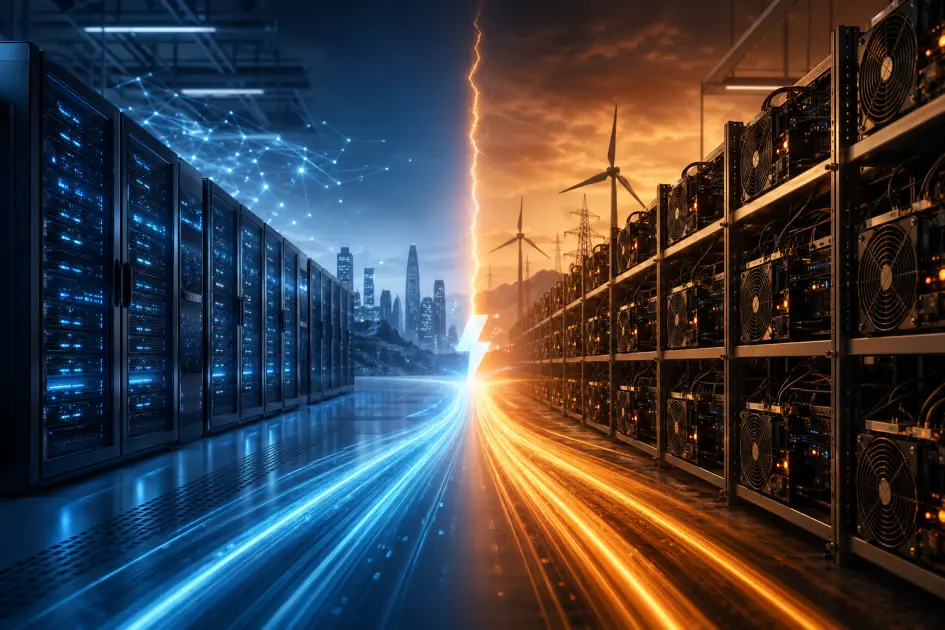
In 2026, a new question is shaping every megawatt decision in the industry: who gets the power — Bitcoin miners or AI data centers? Hyperscalers are writing billion-dollar checks for grid capacity that used to flow to SHA-256 farms. This piece looks at the numbers behind that shift, where miners still win, and what it means for cloud mining users.
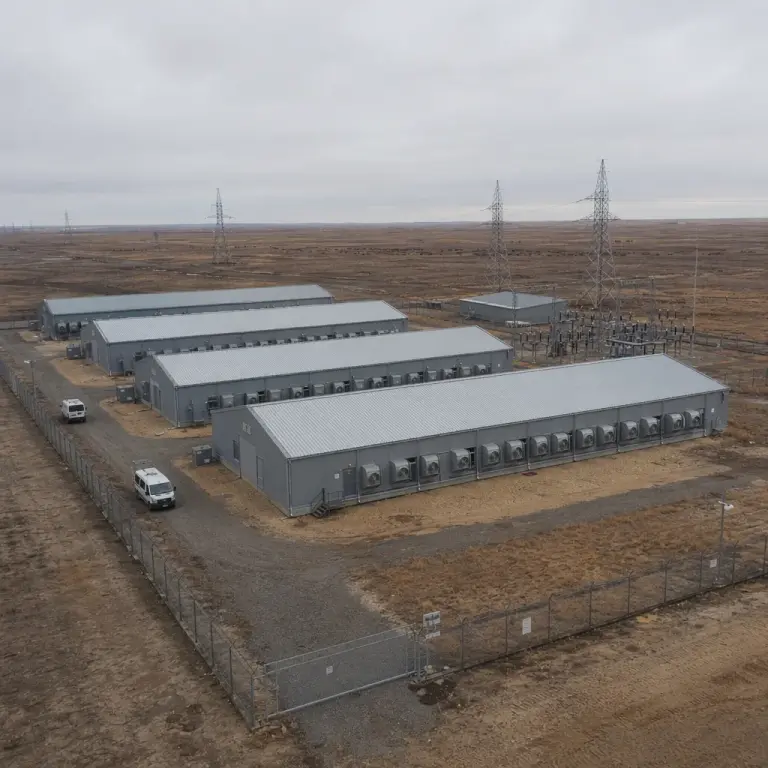
The Energy Math Behind the Squeeze
Data center electricity use doubled over the past few years, and the trajectory only steepens. The International Energy Agency's 2026 outlook projects global data center consumption reaching around 945 TWh by 2030 — roughly 3% of worldwide electricity — with AI-optimised facilities more than quadrupling their share of that total. The United States and China account for nearly 80% of the growth.
Bitcoin's energy footprint, by contrast, has plateaued. Global hashrate sits near 800–900 EH/s as of early 2026, and per-TH efficiency keeps improving (new ASICs run at 12–18.5 J/TH, roughly half the draw of 2021-era rigs). Miners are running more work per kilowatt each year. AI workloads are the opposite — bigger models, denser racks, more watts per rack every quarter.
That gap is the heart of the squeeze. Two industries bid for the same substation, but only one is doubling its appetite. In 2026, miners are negotiating against buyers with deeper pockets and a louder demand curve.
Why AI Wins Most Bidding Wars
When a utility or landowner weighs two offers — a Bitcoin miner at one price and a hyperscaler at another — the hyperscaler usually wins. It isn't sentiment; it's economics. AI tenants can simply pay more per kilowatt-hour and still print positive margin, because the revenue each megawatt generates is an order of magnitude higher.
Higher revenue per kilowatt
AI infrastructure costs roughly $8–15 million per megawatt to build vs. $700k–$1M for Bitcoin mining, but the revenue per megawatt is structurally higher and more stable — AI tenants can absorb $0.08–0.15/kWh and still profit.
10–12 year contracts
AI colocation deals run a decade or more. Core Scientific's expanded agreement with CoreWeave was structured at roughly $10.2 billion over 12 years. Miners historically offer month-to-month or annual commitments — utilities prefer the long lock-in.
Flat, predictable load
AI inference and training draw steady 24/7 baseload, easy for grid planners to dispatch. Bitcoin farms are also 24/7, but miners have spent years marketing themselves as flexible — a story that now cuts both ways when utilities prefer certainty.
None of this is secret. Hyperscalers — Meta, Google, Microsoft, Amazon, and the Nvidia-backed cloud layer above them — are locking in future power aggressively so competitors cannot. JPMorgan analysts have flagged a narrowing window for miners to secure AI infrastructure deals; the hyperscalers know it and are paying to accelerate.
Where Bitcoin Miners Still Win
The story is not one-sided. AI's appetite is real, but so are its constraints: hyperscalers want very specific kinds of sites, and a lot of mining infrastructure does not fit that mold. The mismatch is where the remaining miner-only territory lives.
| Site characteristic | AI hyperscaler needs | Bitcoin miner needs |
|---|---|---|
| Site size | Multi-hundred-MW campuses, gigawatt roadmap | 5–100 MW halls, modular growth |
| Latency to user markets | Close to Tier-1 fiber / population centers | Irrelevant — miners ping a pool, not an end user |
| Load behaviour | Inflexible baseload, no curtailment tolerance | Interruptible — miners shut off during grid stress and get paid |
| Water for cooling | Large volumes for liquid cooling | Air-cooled or hydro-cooled in cold climates |
| Jurisdiction bar | Stable rule-of-law, sovereign-data rules | Any jurisdiction that tolerates mining and sells cheap kWh |
Translation: hyperscalers want big, urban-adjacent, Tier-1 sites. Miners can use small, remote, interruptible parcels that hyperscalers will never touch. That's the opening — and it's why the industry map is fragmenting, not collapsing.
The Miner-to-AI Conversion Trend
For public miners sitting on grid-connected US sites, the math is almost irresistible. Over $70 billion in cumulative AI and HPC contracts have been announced across the listed mining sector, and analysts estimate listed miners could derive up to 70% of their revenue from AI by the end of 2026, up from roughly 30% today. A few anchor stories define the trend:
Core Scientific and CoreWeave
A 12-year, ~$10.2 billion AI colocation contract where Core Scientific builds the facility and CoreWeave runs the GPUs. A proposed $9 billion all-stock merger was voted down by Core Scientific shareholders in early 2026, but the underlying hosting relationship — and AI-driven revenue mix — continues. AI colocation already accounts for roughly 39% of Core Scientific's revenue.
TeraWulf, FluidStack and Google
TeraWulf pivoted from Bitcoin toward HPC hosting with a roughly $3.7 billion, 10-year FluidStack lease; Google backstopped the deal and took an initial ~8% equity stake that expanded to ~14% with a later 160 MW option. Total contracted HPC revenue in the $12+ billion range, funded by multi-billion debt raises.
Riot, HIVE, and the second wave
Activist investors have publicly pressed Riot Platforms to accelerate its own data-center pivot. HIVE Digital acquired Canadian data-center land in early 2026 to expand AI capacity. The pattern is consistent: North American miners with good grid interconnects are being repriced as AI-adjacent infrastructure plays.
The twist: these companies are not stopping Bitcoin mining. They are adding AI hosting on sites that originally ran ASICs, often selling some BTC to fund the conversion. Reporting from CoinDesk in March 2026 describes the shift as miners becoming AI companies that still mine Bitcoin on the side.
What This Means for Cloud Mining
For retail users renting hashrate, the question is simpler than the industry headlines suggest: does your cloud provider operate in a region where Bitcoin mining still has the lowest marginal cost of power? If yes, the AI boom is mostly neutral. If no, the provider is in a bidding war it cannot win long-term.
Winners: frontier-market operators
Platforms hosted in Kazakhstan, Paraguay, parts of Ethiopia, Oman, and similar markets where hyperscalers do not currently build. Power stays cheap, mining margins stay defensible, and users benefit from rental prices that do not need to absorb a bidding-war premium.
Pressure: marginal North American operators
Providers with grid contracts in Texas, Virginia, and other hyperscaler target regions face rising power-procurement costs as utilities route capacity to AI. Some will convert to AI hosting themselves; the rest face margin compression that cloud-mining customers will eventually feel.
Neutral: Bitcoin itself
If US miners convert to AI, their hashrate relocates to cheaper regions rather than vanishing. Total network hashrate may plateau or rotate geographically, but the difficulty-adjustment mechanism self-balances — this is a redistribution story, not a shrinkage story.
Watch: long-term rental pricing
Over the next 2–3 years, expect cloud mining price bands to widen. Frontier-market operators hold their rates; North American operators drift upward or reposition as AI hosts. Users should ask where the hashrate actually sits before committing to long-term contracts.
Where NoxHash Sits on This Map
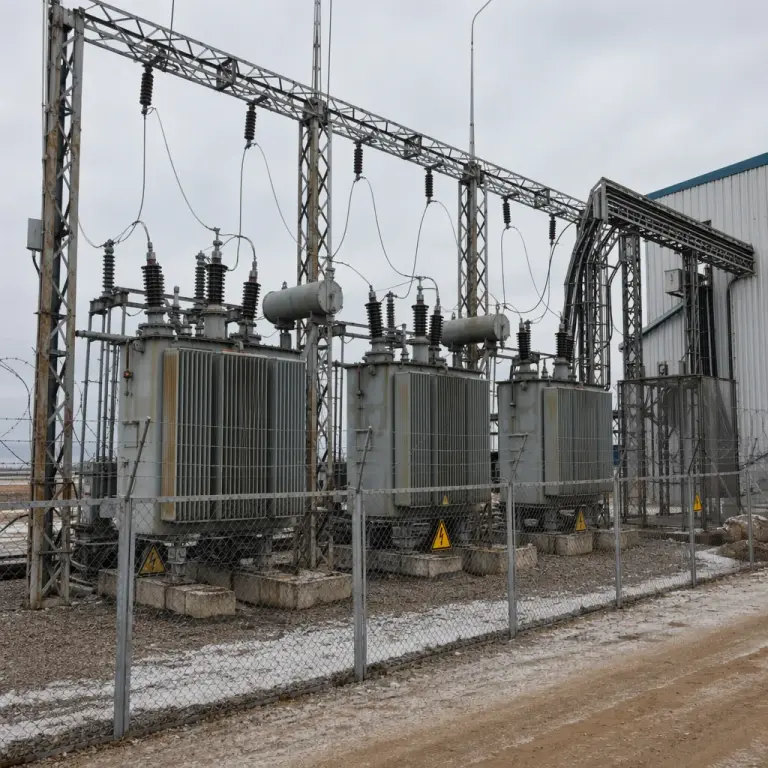
NoxHash's Kazakh site is, for now, exactly the kind of location AI hyperscalers do not target. The grid is industrial and low-cost (~$0.035/kWh), the climate supplies free winter cooling, and the jurisdiction's data-sovereignty profile is not where major US or European AI firms plan their next frontier training clusters. That is not a coincidence — it is why mining concentrated there after the 2021 China exit.
Concretely, that means our cost stack in 2026 looks roughly the same as it did in 2024: industrial power contract, S21-series and WhatsMiner fleet at 12–18.5 J/TH, 24/7 technicians, and rental prices that do not have to pass through hyperscaler bidding premiums. Users renting hashrate here are insulated from the specific dynamic that pushed North American peers toward AI colocation.
The honest caveat: nothing about this is permanent. If AI demand saturates Tier-1 regions and investors start hunting frontier capacity, that competitive picture can change. We watch it. For now, Kazakhstan is still a miner's market, and the economics of our rentals reflect that.
See what mining in a region AI hasn't touched looks like
You just read why frontier-market operators are the ones whose margins hold up in 2026. NoxHash is one of them. Open a free account, activate the 2-day Basic Miner trial, and look at the live hashrate from the Kazakh floor before committing to anything.

Frequently Asked Questions
Will AI data centers push Bitcoin miners out entirely?
No. AI is outbidding miners for specific urban, high-density sites, but global Bitcoin hashrate is still near record highs as of early 2026. What is shifting is geography — mining concentrates in cheaper frontier markets (Kazakhstan, Paraguay, Ethiopia, Oman) while AI takes the gigawatt Tier-1 campuses miners used to chase.
Can cheap power survive the AI boom?
In regions hyperscalers are not developing, yes — for now. Kazakhstan's industrial tariffs around $0.035/kWh are not under AI pressure because major AI firms are not sourcing training capacity there. In Texas or Virginia, cheap mining power is disappearing fast as utilities route new capacity to hyperscalers.
Will NoxHash convert to AI hosting?
No plans to. The economic pressure that pushes US miners toward AI colocation — losing bidding wars for local power — does not apply in Kazakhstan, where demand from AI is marginal. Our site is designed for Bitcoin mining at industrial scale, and that is what we run.
Is electricity getting more expensive everywhere?
Not uniformly. The IEA projects data center electricity demand roughly doubling by 2030, with most of the pressure concentrated in the US, China, and parts of Europe. Central Asia, South America, and parts of Africa still have surplus generation relative to data center demand, which keeps industrial tariffs stable.
Should I still rent hashrate in an AI-dominated power market?
The question to ask is not about AI — it is about where the hashrate physically runs. A cloud provider in a frontier market with long-term industrial power contracts has a very different cost stack from one renting space on a grid AI is actively bidding up. Verify the geography before committing to multi-month plans.
Does the AI boom change Bitcoin's overall energy picture?
Yes, indirectly. As AI captures more Tier-1 grid capacity, new Bitcoin capacity increasingly lands on stranded, renewable, or under-utilised generation in remote regions. Over time this likely pushes the network's energy mix toward lower-cost and, in many cases, lower-carbon sources — a side effect of the competition rather than a plan.
Not financial advice
This article is an industry analysis, not investment advice. Figures cited (contract sizes, revenue mixes, IEA projections) are as of early 2026 and will shift. Cloud mining earnings depend on Bitcoin price, network difficulty, and market conditions outside any operator's control. Past performance does not guarantee future results — only commit funds you can afford to lose, and consult a local tax advisor about crypto income in your jurisdiction.