6 Red Flags of a Cloud Mining Scam — How to Stay Safe
Guaranteed daily returns, no hardware photos, gift-card payments — 6 red flags of a cloud mining scam and what a legitimate operator looks like instead.
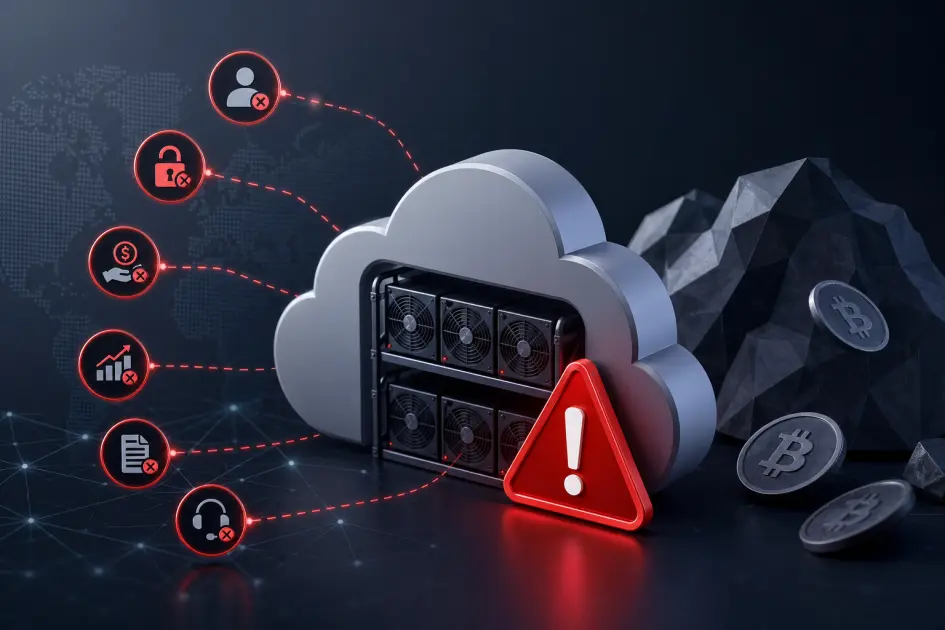
A cloud mining scam almost always shows one of six concrete red flags before it collects your money: guaranteed daily returns, no verifiable hardware, an anonymous team, a pyramid-style recruit-to-earn tree, gift-card-only payments, or a withdrawal page that locks you out until you "upgrade". A legitimate operator reverses every one of them — published electricity rate, named facility, public withdrawal fee, stablecoin rails.

Why Cloud Mining Is a Favourite Scam Category
Cloud mining sits at the intersection of three things scammers love: a technical topic most newcomers can't fully verify, a recurring-payment model, and crypto rails that settle irreversibly. A fake dashboard showing a rising BTC balance is cheap to build, and the scam runs exactly until withdrawals start — then the site quietly adds "verification fees", "tax deposits", or a vanished support inbox. The US Federal Trade Commission warns that investment-platform fraud — where "earnings" only exist on the dashboard — is one of the largest consumer loss categories in crypto.
The six red flags below are structural, not cosmetic. A scam operator cannot fake all of them at once without eventually collapsing; a legitimate operator (NoxHash included) cannot hide them even if they wanted to, because the business model demands the opposite. Use the list before you wire any USDT, not after.
The 6 Red Flags of a Cloud Mining Scam
Guaranteed daily returns — "1.5% / day", "doubles in 30 days"
Real mining income depends on BTC price, network difficulty, and a fixed block reward of 3.125 BTC per block — none of which a platform can control. Any site that "guarantees" 1-2% per day (a ~3,700% APY) is mathematically incompatible with Bitcoin's protocol and is the single most reliable scam signal. A legitimate operator quotes a potential monthly yield, shows the variables, and prints a disclaimer that revenue moves with BTC price and difficulty.
No verifiable hardware or data-center photos
A scam site will either show zero facility images or reuse stock rack photos you can reverse-image-search to an unrelated stock-photo provider. No ASIC model is named, no country is named, no electricity rate is named. Compare with an operator that publishes: "Kazakhstan facility, Antminer S21 / S21 Pro / WhatsMiner M66S, $0.035/kWh industrial contract, 12-18.5 J/TH." Specific, falsifiable claims are what separates a real data center from a landing page.
Anonymous team, no business registration, fake "audit" badges
Check the footer. A scam will show invented "team" avatars (run a reverse image search — often stolen LinkedIn photos), a fabricated company number, and PNG badges claiming audits by firms that either don't exist or never audited the site. Legitimate operators list a real registered entity you can look up in a public company registry, a physical address for the holding company, and either no audit badge at all or a linked PDF report you can open.
An MLM-style recruit-to-earn pyramid, not a mining product
If the sales pitch is mostly "earn X% from your recruits' recruits' recruits" across 5, 7, or 10 tiers, the product isn't mining — it's a recruitment pyramid dressed as a mining product. Pyramid math requires exponential new deposits to pay the existing base, and collapses the month it doesn't. A legitimate platform's revenue comes from rental fees against real hashrate output; any referral programme it runs is single-tier and small relative to the core product.
Strange withdrawal conditions — "upgrade", "tax deposit", "verification fee"
The classic scam-closing move: the dashboard shows a balance of $4,800 in earnings, then the first withdrawal prompts a message demanding a 15% "tax clearance" paid in fresh USDT, or an "account upgrade" to unlock withdrawals above a trivial threshold. These conditions do not exist on any legitimate platform. A real operator publishes one withdrawal fee openly (for NoxHash it's 1.5% of the amount, minimum 0.00001 BTC) and never charges a deposit to release your own balance.
Gift cards, Cash App, or Western Union — no standard crypto rails
When a "crypto mining" platform asks you to fund the account with Apple gift cards, Amazon gift cards, Cash App transfers, or Western Union, it is not a crypto business — it is an irreversible-payment funnel designed so charge-backs are impossible. Legitimate cloud mining accepts standard crypto rails: USDT on TRC-20 or BEP-20, BTC, or a regulated fiat on-ramp. If the only payment path is non-refundable retail scrip, close the tab.
Side-by-Side — Scam Pattern vs Legitimate Operator
The six red flags collapse into one table when you hold them against how a real mining operator publishes its business. The right column uses NoxHash as a concrete example, but the rules generalise: any operator you compare should score the right column on every row, not just some of them.
| Check | Scam pattern | Legitimate operator (NoxHash as example) |
|---|---|---|
| Return promise | "1.5% / day guaranteed" | Potential monthly yield with market-risk disclaimer |
| Hardware transparency | Stock photos, no ASIC model | Antminer S21 series + WhatsMiner M60/M66, 12-18.5 J/TH named |
| Facility disclosure | No country, no electricity rate | Kazakhstan, $0.035/kWh industrial contract published |
| Commission structure | 5-10 tier MLM pyramid | Core revenue from rentals, not recruitment |
| Withdrawal policy | Locked until "upgrade" or "tax deposit" | 1.5% fee, 0.00001 BTC minimum, published openly |
| Funding rails | Gift cards, Cash App, Western Union | USDT TRC-20 / BEP-20, standard crypto rails |
| Uptime / monitoring | No page, unverifiable | 99.9% uptime target, 24/7 technician team, live dashboard |
| Trial before payment | Deposit required to "activate" | 2-day Basic Miner trial, no deposit required |
Guidance from the US Federal Trade Commission on cryptocurrency scams reinforces the same set of rules: any platform demanding payment in gift cards, promising guaranteed returns, or blocking withdrawals without a legitimate reason should be treated as a scam and reported.
Run the table against NoxHash before you run it against anyone else
Every right-column claim in the table above is published on the platform — Kazakhstan facility, named ASIC models, 1.5% withdrawal fee, USDT-only deposits, 2-day trial with no deposit. Register and verify them inside the dashboard before you commit a single cent.
Why Scammers Cannot Fake All Six Signals at Once
Most scams collapse on the economics of the six red flags as a group, not any single one in isolation. Promising "1.5% per day" requires ever-growing new deposits; paying them requires funnelling money through irreversible rails (gift cards, unregistered wallets); avoiding those rails would force the operator to interact with regulated payment processors who run KYB on the receiving entity; passing KYB requires a real legal entity, which conflicts with an anonymous team.
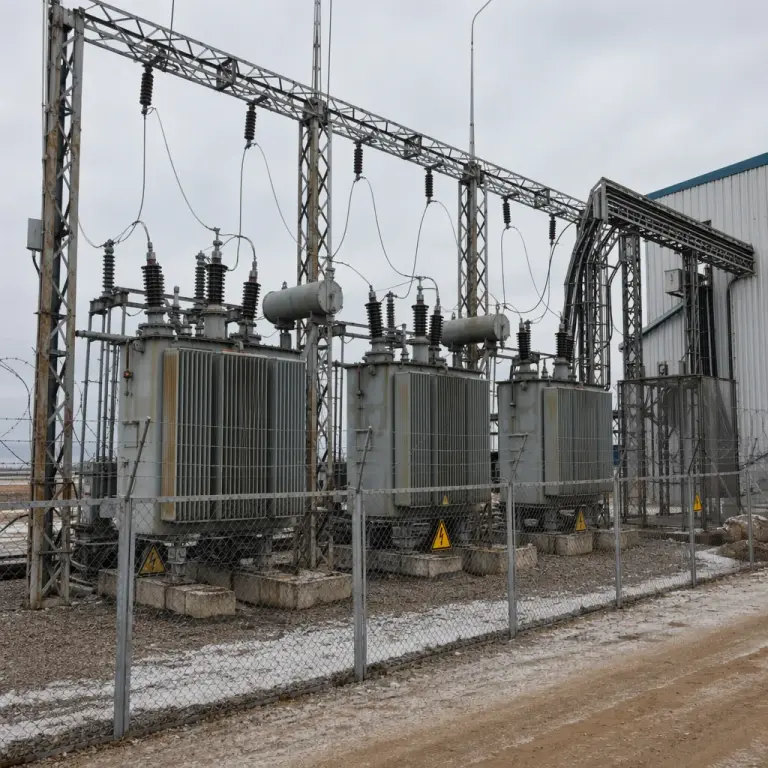
A real mining operator is forced in the opposite direction by the same economics. Running an industrial data center at $0.035/kWh requires a physical site, a named electricity contract, named ASIC fleet, and a registered company to sign all three. Those facts are not optional — they're how the site gets power. This is why the red flags are structural: they are the visible shape of a business that either exists in the real world or doesn't.
What to Do If You Already Suspect a Scam
Stop sending money — even for "verification"
The moment a platform asks for a second payment to "release" the first, you are in the closing phase of the scam. Additional USDT will not unlock the balance; it only feeds the withdrawal-refusal loop. Stop transfers immediately and screenshot every page before the site can be taken offline.
Save the evidence trail
Export your transaction hashes, deposit addresses, dashboard screenshots, chat transcripts, and the email headers of any messages from the operator. A clean evidence pack dramatically increases the usefulness of any later report to an exchange, payment processor, or law-enforcement unit.
Report to a national fraud body
File with your country's consumer-fraud authority — the US FBI Internet Crime Complaint Center (IC3), UK Action Fraud, Europol's EC3 for EU residents, or your local financial-conduct regulator. Include wallet addresses; blockchain analytics can sometimes cluster them with previously-reported scams.
Be sceptical of "recovery services"
A second wave of scams targets recent victims with promises to "recover" lost crypto for an upfront fee. Genuine recovery requires either law enforcement or a regulated blockchain-forensics firm, and neither asks for payment in USDT from an anonymous Telegram account. Assume any unsolicited "recovery" DM is the next scam.
Avoid the four post-scam steps by starting where the six red flags are already clear
The four tips above are the costly plan B — stop, save, report, stay sceptical of "recovery". Plan A is cheaper: pick an operator whose hardware, facility, withdrawal fee, and trial period are already public, so the red-flag checklist passes before you deposit anything.
Frequently Asked Questions
Is any cloud mining legitimate, or is the whole category a scam?
The category is legitimate when the operator runs a real data center and rents hashrate at a margin. The scam variant copies the UI without the facility. Use the six structural red flags — guaranteed returns, no hardware photos, anonymous team, MLM pyramid, withdrawal conditions, gift-card rails — to separate the two, not the industry label itself.
What return level is realistic, so I know when a promise is unrealistic?
A real operator's target revenue sits in single-digit percent per month of the rental price and moves with BTC price and network difficulty. Anything advertised at 1% per day, or a fixed percentage independent of market conditions, is mathematically impossible on a mining product and is the most common single scam tell.
Why do scam dashboards sometimes look more convincing than real ones?
Because a scam dashboard only has to look convincing — it doesn't have to reconcile with a real hashrate feed, pool accounting, or block rewards. That means it can show smooth "daily gains" that no real miner produces. A legitimate dashboard shows messy, market-dependent numbers because it reflects the actual Bitcoin network underneath.
Does the 20% "withdrawal tax" a scam site asks for ever go to a real tax authority?
No. No legitimate tax authority collects tax through the platform as a precondition for a withdrawal. Real tax events happen on your end after funds reach your wallet, and you pay the local authority directly. A "withdrawal tax" paid in USDT to the same platform is always an exit-scam mechanic, not a tax.
Where can I check if a specific cloud mining site has been reported before?
Search the domain in your national fraud database first — US FTC Consumer Sentinel, IC3, UK Action Fraud, Europol reporting. Also search the company name plus "scam" in forums with moderation (not promoter threads). If no reports exist yet, the six red-flag checklist is still the primary filter — new scam brands appear faster than report databases update.
Educational content — not legal or financial advice
This article describes common patterns observed in cloud mining fraud and is published for consumer awareness only. It is not legal advice and does not constitute an accusation against any specific operator. Whether a given platform is legally classified as a scam depends on facts, jurisdiction, and the findings of the relevant regulator or court. If you believe you have been defrauded, report to your national consumer-protection body and seek qualified legal counsel. Crypto investments carry market, regulatory, and technical risk; only commit funds you can afford to lose, and verify local regulations before operating any mining activity in your jurisdiction.