5 Ways to Acquire Bitcoin in 2026 — Ranked by Your Goal
Compare 5 ways to get Bitcoin in 2026: exchange buy, cloud mining, earn rewards, spot ETFs (IBIT/FBTC), and BTC yield. Pick the one for your goal.
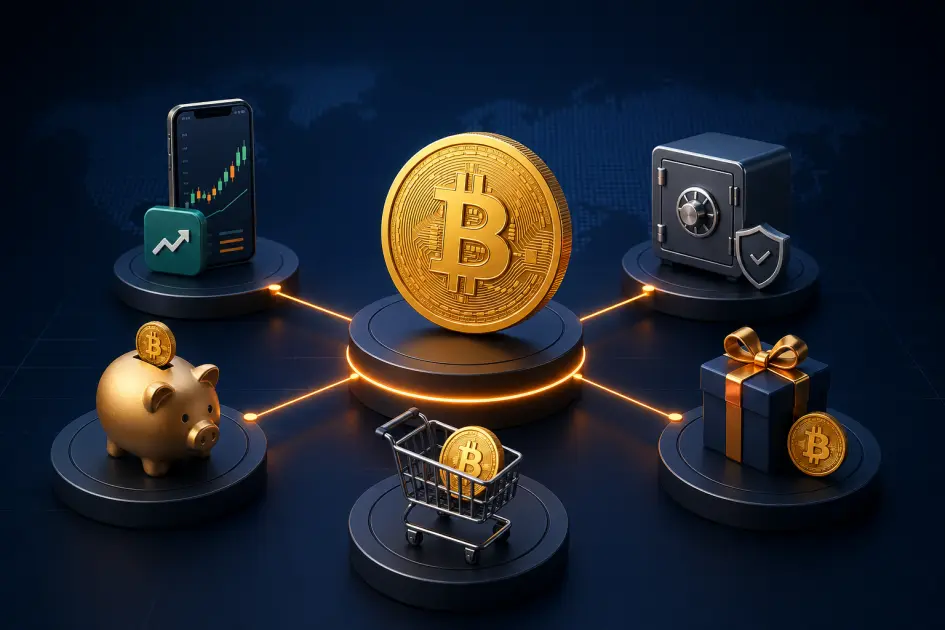
There are five practical ways to acquire Bitcoin in 2026: buy it on an exchange (spot or DCA), rent hashrate through cloud mining, earn it as rewards or cashback, hold it indirectly through spot ETFs like IBIT or FBTC, or generate yield on BTC you already own. Each path has a different cost per BTC, custody model, learning curve, and tax profile — so the "best" one depends entirely on your goal.

Pick your path in 30 seconds — a goal-to-method decision table
Before we compare each method in detail, here's the shortcut. Figure out what you actually want from Bitcoin, and the right method usually follows. Treat this as a map — the sections below unpack each method with cost, custody, learning curve, and tax treatment.
| Your goal | Best method | Why |
|---|---|---|
| "I want BTC in my wallet this hour" | Exchange spot buy | Fastest, lowest friction, you self-custody after withdrawal. |
| "I want to stack sats automatically every week" | DCA (recurring buy) | Smooths price volatility, zero timing stress. |
| "I want BTC trickling in 24/7 without lump-sum buying" | Cloud mining | Daily BTC drip; USD-denominated cost, BTC-denominated income. |
| "I want BTC exposure in my brokerage / retirement account" | Spot ETF (IBIT, FBTC) | Trades like a stock; fits 401(k), IRA, ISA wrappers. |
| "I want free BTC from normal spending" | Earn / cashback apps | Small amounts, zero risk of capital loss — gravy on top. |
| "I already hold BTC and want it to work harder" | Yield / BTC-backed lending | Counterparty risk is real — only for informed holders. |
1. Buy on an exchange — the default path (spot buy or DCA)
Buying Bitcoin on a regulated exchange like Coinbase, Kraken, or Binance is the most direct route — you send fiat, you get BTC, you withdraw to a wallet you control. The two flavors are spot buy (a single purchase, for lump sums) and DCA (recurring buys on a schedule — $50 every Friday, for example).
DCA is the strategy most long-term holders actually use. It averages your entry price across the market's ups and downs and removes the emotional "should I buy the dip or wait?" question. According to Kraken's DCA primer, consistent small purchases mean you automatically buy more BTC when prices drop and less when they rise — smoothing your cost basis over time.
| Profile | Exchange buy / DCA |
|---|---|
| Cost per BTC | Spot price + 0.10%–0.60% fee (Binance ~0.10%, Kraken 0.25%/0.40%, Coinbase up to 0.60%) |
| Custody | Exchange (custodial) until you withdraw to a self-custody wallet |
| Learning curve | Low — sign up, KYC, buy. Add a wallet later. |
| Tax event | None on the buy itself — taxable only when you sell or spend (capital gains in most jurisdictions) |
| Best for | Anyone starting out, and long-term accumulators who want the simplest path |
The trade-off: card-funded recurring buys can cost 1.5%–3.75% in surcharges on top of the spread. If you're serious about DCA, fund via bank transfer and route through the exchange's pro/advanced interface to get exchange-level fees (often 0.10%–0.40%) instead of simple-interface convenience pricing.
2. Cloud mining — rent hashrate, stack BTC every minute
Cloud mining is where you rent computational power from a mining operation and receive the BTC that power earns, minus the rental fee. You don't buy hardware, pay electricity bills, or deal with noise and heat — the data center does all of it.
Unlike buying on an exchange, cloud mining gives you a steady BTC drip rather than a lump sum. The economics are inverted too: your cost is denominated in USD (fixed monthly rental) while your income is denominated in BTC (fluctuating). When BTC goes up, your rental feels cheap; when BTC dips, margins compress. Understanding that inversion is the whole game.

For context, NoxHash runs Antminer S21 and WhatsMiner M60/M66 fleets at a Kazakhstan data center paying $0.03–0.04 per kWh — roughly 3–5× cheaper than residential electricity in most countries. That cost gap is why industrial cloud mining can be viable where home mining often isn't. Plans start at $20/month for 50 TH/s, with discounts up to 20% on 24-month contracts.
| Profile | Cloud mining |
|---|---|
| Cost per BTC | Variable — depends on BTC price, network difficulty, and rental rate. Sensitive to market cycles. |
| Custody | Platform wallet (custodial) until you withdraw to your own BTC address |
| Learning curve | Low — pick a plan, fund in USDT, start mining. Free trials available. |
| Tax event | Mined BTC is typically taxed as ordinary income at fair-market value when received, then capital gains on disposal |
| Best for | Accumulators who prefer BTC flow over lump-sum buying; people who want mining exposure without hardware |
Reality check: cloud mining is not risk-free yield. Your return depends on BTC price, network difficulty (which trended above 110–120 T in 2025 per Blockchain.com difficulty data), and the 3.125 BTC post-halving block reward. Choose a provider with transparent hardware disclosure and verified operations, and don't rent during deep bear markets — the math flips negative fast.
3. Earn Bitcoin — cashback, rewards, and learn-to-earn
This is the free-BTC lane. Apps like Lolli pay you Bitcoin when you shop at 50,000+ stores; Fold offers up to 20% BTC back on retailer gift cards; exchanges like Coinbase and Binance run learn-to-earn quizzes that pay small amounts of crypto for watching educational videos.
The amounts are small — realistically $50–$500 per year for an active user — but the capital risk is zero. You're redirecting rewards that would've been airline miles or store credit into sats instead. Pair this with method 1 (DCA) and method 2 (mining) and you're stacking from three independent streams.
Shopping cashback
Browser extensions + apps (Lolli, Fold) turn 1–20% of your spending into BTC.
Learn-to-earn
Exchanges pay $3–$10 in crypto for watching short lessons and passing quizzes.
BTC-back debit cards
Every swipe returns a small BTC percentage — set-and-forget stacking.
| Profile | Earn / rewards |
|---|---|
| Cost per BTC | Effectively free (you redirect existing spending) |
| Custody | Platform custodial — withdraw frequently to your own wallet |
| Learning curve | Very low — install app, shop normally |
| Tax event | Often treated as rebate (not income) in many jurisdictions; learn-to-earn usually is income — confirm locally |
| Best for | Everyone — this is a complement, not a standalone strategy |
4. Spot Bitcoin ETFs — BTC exposure inside your brokerage account
Since the SEC approved spot Bitcoin ETFs in January 2024, getting BTC exposure through a regular brokerage has become trivial. You don't own the actual Bitcoin — you own shares of a trust that holds BTC on your behalf, and the share price tracks BTC within a small tracking error.
The two dominant products in 2026 are BlackRock's IBIT (iShares Bitcoin Trust, roughly $54–60 billion AUM as of Q1 2026) and Fidelity's FBTC (Wise Origin Bitcoin Fund, about $17.7 billion AUM). Both charge a 0.25% annual expense ratio. For context, CoinGlass ETF flow data tracks daily net inflows across the full basket of spot BTC funds.
| Profile | Spot Bitcoin ETF |
|---|---|
| Cost per BTC | Share price tracks BTC + 0.25% annual expense ratio + brokerage trading fees |
| Custody | Fund custodian (typically Coinbase Custody) — you never touch the BTC |
| Learning curve | Zero if you already use a brokerage — buy like any other ETF ticker |
| Tax event | Standard securities capital gains treatment; eligible for tax-advantaged accounts (IRA, 401(k), ISA) |
| Best for | Traditional investors, retirement accounts, anyone uncomfortable with crypto wallets |
The honest caveat: an ETF share is not Bitcoin. You can't send it on-chain, you can't use it to pay for things, and you inherit the counterparty risk of the fund sponsor and custodian. You're buying price exposure, not self-sovereignty. For a retirement bucket that's the right trade-off. For anyone who cares about "not your keys, not your coins," it isn't.
5. Yield on BTC — lending and BTC-backed products (the hazardous tier)
If you already hold Bitcoin, you can earn yield on it through lending platforms (Ledn, Nexo, and newer regulated entrants), collateralized borrowing (Coinbase's borrow-against-BTC product launched in 2025, Strike's lending offering), or BTCFi protocols on-chain.
This tier earned its reputation the hard way. Celsius, BlockFi, and Voyager collapsed in 2022 and cost retail users billions — Celsius alone had $5 billion in customer losses. The survivors — Ledn processed over $1B in loans in Q1–Q3 2025 — compete on transparency, third-party audits, and published proof-of-reserves. That's the minimum bar today.
| Profile | BTC yield / lending |
|---|---|
| Cost / return | 2–8% APY on deposited BTC; borrowing rates 2.9–9%+ APR against BTC collateral |
| Custody | Platform custodial during the lending term — counterparty risk is the core risk |
| Learning curve | Medium — understand LTV, liquidation mechanics, rehypothecation policy |
| Tax event | Yield = interest income; borrowing against BTC is generally not a taxable event, but liquidations are |
| Best for | Advanced holders with a high tolerance for counterparty risk — not entry-level |
Guardrail: if "not your keys, not your coins" matters to you, this tier is the opposite of that by design. Never deposit BTC you can't afford to lose, never chase the highest advertised APY, and prefer platforms with regulatory licensing in a real jurisdiction plus verifiable reserves.
Master comparison — 5 methods side by side
Here's the full matrix. Read it as a fit-by-goal table, not a ranking: the "best" method depends on whether you value speed, automation, self-custody, tax wrapper, or passive BTC flow.
| Method | Typical cost | Custody | Learning curve | Tax treatment |
|---|---|---|---|---|
| 1. Exchange buy / DCA | 0.10–0.60% fee | Custodial → self-custody | Low | Capital gains on sale |
| 2. Cloud mining | Fixed USD rental; BTC income variable | Platform → self-custody on withdraw | Low | Ordinary income + capital gains |
| 3. Earn / cashback | Effectively free | Platform | Very low | Rebate or income (varies) |
| 4. Spot ETF (IBIT/FBTC) | Spot + 0.25% ER | Fund custodian | Zero (if you use a brokerage) | Securities cap gains; tax-wrapper eligible |
| 5. Yield / lending | 2–8% APY (with counterparty risk) | Platform custodial | Medium | Interest income; borrowing usually not taxable |
Want to try method 2 — cloud mining — before you commit?
You just compared five ways to stack Bitcoin. If the steady BTC drip from cloud mining is the path that fits your goal, you can test drive it on NoxHash with a 2-day Basic Miner free trial — no deposit, no card, just a real feel for how daily BTC flow looks on the dashboard.
How to combine methods — the portfolio approach
Most long-term Bitcoiners don't pick one method — they stack several in parallel. The combinations that show up most often in practice:
The "core + drip" stack
DCA weekly into your main position (method 1) + run a small cloud mining contract in parallel (method 2) so BTC arrives both ways.
The "brokerage + wallet" split
ETF shares (method 4) inside your retirement account for tax-advantaged exposure + actual self-custodied BTC outside it for sovereignty.
The "everything free first" starter
Start with method 3 (cashback + learn-to-earn) to get a few dollars of BTC at zero risk, then graduate to DCA once you're comfortable holding.
The "HODL + yield" advanced play
Keep most BTC in cold storage; put a small, defined slice into method 5 (lending) only after understanding the counterparty risk in full.
Frequently asked questions
What's the cheapest way to acquire Bitcoin in 2026?
For outright purchase, bank-transfer DCA on a pro exchange interface costs about 0.10–0.25% per buy — the lowest friction path. For zero-capital acquisition, cashback and learn-to-earn apps deliver real BTC for free, though amounts are small. Cloud mining sits in the middle — variable cost, steady BTC flow.
Is a spot Bitcoin ETF as good as owning real BTC?
For price exposure, yes — IBIT and FBTC track BTC within a small tracking error. For sovereignty, no — you can't send an ETF share on-chain, pay with it, or hold it outside regulated markets. Use ETFs for retirement wrappers; hold real BTC in a wallet you control for everything else.
Does cloud mining beat just buying Bitcoin?
They're different tools. Buying gives you BTC instantly at a known price. Cloud mining gives you a daily BTC drip with variable economics tied to price and difficulty. Many holders run both in parallel — the drip smooths accumulation, the spot buys build the core position.
Are earn-Bitcoin apps like Lolli and Fold legitimate?
Yes — Lolli has 600,000+ users and pays real BTC via partnerships with 50,000+ retailers; Fold offers up to 20% BTC back on gift cards. Earnings are modest, typically $50–$500 a year for active users. Withdraw to your own wallet frequently rather than leaving balances on the platform.
Is BTC lending safe after the 2022 collapses?
Safer than 2022 — surviving platforms publish proof-of-reserves and submit to third-party audits, and regulated entrants like Coinbase and Ledn operate in licensed jurisdictions. But counterparty risk is still the core risk. Only deposit BTC you can afford to lose and diversify across providers.
Not investment advice
This article is educational information only, not personalized investment, tax, or legal advice. Bitcoin prices are volatile; past performance doesn't guarantee future results. Every method described has its own risk profile — market risk, counterparty risk, custody risk, and regulatory risk among them. Only invest what you can afford to lose, and confirm local tax treatment with a qualified professional before acting. Fee, AUM, and rate figures reference Q1 2026 data and may change.